Re-Share: ‘Politics’ is Not a Dirty Word

As mentioned in a recent update article, this week’s post is an re-share of a previous article that is still tragically relevant.

This piece examines the concept of ‘not talking about politics’. What does it mean for an issue to be political, and when is it OK to talk about these issues?

**************************************

Another day, another tragedy. Presently, it’s the Las Vegas massacre on my mind, or the recent terrorist attack in Edmonton. But depending when you’re reading this, I have sorry little doubt there will be some fresh new event to use for context. Nothing will be different if we use another example, so it doesn’t really matter anyways. Inevitably, you will be told that “this isn’t the time to get political.”

“Let’s not politicize this.”

“Can’t we just have a day to grieve?”

There are a million ways to say it, but it always boils down to the same idea—“Let’s not go using the government to solve problems…that’s not what they’re for.”

It happens after all the most political events. We are told not to get political, not to examine issues and causes. Just be sad.

Pray…if that’s your thing.

Just…don’t try to do anything about it.

They can’t afford real change. They won’t.

But ‘politics’ is not a dirty word, and must not be treated as such if there is ever to be any real progress in this sad world of ours. To turn any political discussion into a taboo subject is to actively waste the opportunity for learning and growth. Further, to claim that political discourse over a tragedy is disrespectful to the victims is not only unhelpful, it’s pigheadedly ignorant.

If we want to prevent tragedy, we must learn from those that occur, and improve our society to prevent future occurrences. That’s what politics is. Anything else—any claim of respect, or timing, or taboo is obstruction of politics. It isn’t kind-hearted, or even well-intentioned. It’s intellectual dishonesty, and in any such instance, you can be damn sure someone is being well paid to convince you that scoffing at the chance to fix things is somehow the moral high ground.

Yes, this is about informed gun control policies.

At least today.

It could also be about systemic racism.

Or police brutality.

Or climate change.

Or money in politics.

Or dozens of other important debates which have been put off for far too long.

These aren’t inappropriate subjects, and they are absolutely the business of politicians and citizens alike. What they are not, is the business of corporations and lobbyists, and yet those are the only ones who seem effective at turning it into their business—specifically, profit.

Shame on them, and shame on anyone who resorts to such hair-brained, nihilistic diversions as ‘let’s not make this political’.

Avoiding civil discourse creates a gap in our understandings, and feeds the ever-widening divide in our nation, and our world. It is uncouth to discuss who you vote for. It’s provocative to talk about the ecosystem during a hurricane. It begins to feel anti-social to make any attempt to discuss our world, when it should be incumbent upon every citizen to do so.

Sadly, when this happens, it usually quickly devolves into attacks like ‘snowflake’, ‘libtard’, ‘hack’, or ‘radical’. This inevitably kills any drive towards honest engagement, and prevents us from truly exploring our values and examining the facts to dream up a better world.

The truth of the matter is that at the end of the day, just about everything is political—especially if it has the potential to affect another living thing without their direct consent. That may seem like a heavy qualification, but there’s an easy litmus test to use for those of you too jaded to do your own research.

Is a great deal of money being spent to convince you something is none of your business?

If so, it’s probably directly affecting to you, your family, and the world you live in.

So, talk about it.

Scream if need be.

If that fails, act.

Make them hear you.

Leave them no choice.

You still have power—never forget that.

-Brad OH Inc.

Re-Share: A Ghost Poem

Under the Green Desk Lamp…

Green DesklampConsidering the season, I thought it only right to re-share this old poem from 3 years ago. I think it’s the only real Halloween poem I’ve done so far, and I remain quite fond of it.

I hope all my readers had a great Halloween–whether they celebrated last weekend, on Thursday, or this weekend. If anyone has good costume pictures, send them my way and maybe we’ll do a feature here on BradOHInc.

**************************

A Ghost Poem:

I’m haunted still by visions past,

By ghostly wails and die long cast.

Porcelain smiles and ochre eyes,

Find me much to my surprise.

Sleeping, thinking, lost in mind,

I’m stalked by those I’ve left behind.

A ghostly whisper comes to me,

As I search for serenity.

There is no rest, no sure reprieve,

From the specters I believe.

A curling grin, a twisted brow,

An implacable stretch from then to now.

I toss and turn upon my bed,

These memories searing through my head.

I rise aloft and cross the floor,

A grinning vision at the door.

A flickering vestige of all I had,

To have and lose and then grow mad.

But ever smiling, turns away,

A promise that nothing untrue may stay.

Alone I stand on the edge of dream,

The perfect start to Halloween.

-Brad OH Inc.

Change, Fear, Truth, and Renewal

Under the Green Desk Lamp…

Green DesklampThe only immutable

Force in the world,

The grinding of time

Is the sense of absurd.

Futility tracing its

Claws down your back,

And leaving its markings

On minds sorely wracked.

Then doubts do set in

And preponderance lost,

So shifting with worry

To escape at all cost.

When realization

Makes fools of us all,

Stand tongue-tied and mute

Never hearing that call.

Not too late does it happen

That sudden release,

Understanding, acceptance,

And finally, peace.

-Brad OH Inc.

Re-Share: I Found God in the Drums of ‘Boléro’

Under the Green Desk Lamp…

Green DesklampTolkien, philosophy, music. This is one of my favourite posts, and it deserves to surface again.

*******************************************************

This article is inspired by the classical piece ‘Boléro’ (Link), by Maurice Ravel (1875-1937) (Link). If you aren’t familiar with that piece, it should be considered required listening for the article to follow. You can find it here (Link).

I listened to this piece recently, and found an unexpected intensity within its plodding rhythm. I hadn’t put the song on for any specific reason, yet early in, I understood the depth of the moment I was having.

It should also be noted, perhaps, that I was at the time firmly entrenched in my (11th?) reading of J.R.R. Tolkien’s ‘The Silmarillion’ (Link), a book to which I ascribe particular inspiration. So you should probably read that, too.

Nonetheless, my revelation started with the first beat of that oh-so-familiar snare-drum. Described as an ‘ostinato’, the pulsing rhythm of this opening drum continues throughout the entire song, remaining constant as everything else is thrown into chaos.

It struck me immediately as terribly spiritual, although it took me a while to articulate exactly why that was.

You see, in ‘The Silmarillion’, the one God, Eru Illúvatar, conceives of creation as music—performed by his angels, the Ainur. The Ainur sing his tune, but among them is the spirit Melkor, who sews discord into the song, and causes turmoil. Some of the Ainur join in Melkor’s discord, while Eru adds new themes to the music to counterbalance Melkor’s efforts.

In the end, when all music stops, Illúvatar offers the Ainur an opportunity to see what they have done, and creates the world and all existence to reflect the reality of his divine tune. Unto the Ainur he says, “Mighty are the Ainur, and mightiest among them is Melkor; but that he may know, and all the Ainur, that I am Ilúvatar, those things that ye have sung, I will show them forth, that ye may see what ye have done. And thou, Melkor, shalt see that no theme may be played that hath not its uttermost source in me, nor can any alter the music in my despite. For he that attempteth this shall prove but mine instrument in the devising of things more wonderful, which he himself hath not imagined.” (Pg. 17)

Since childhood, this story always struck me as one of the most apt and inspiring metaphorical representations of the divine will. And so, as I listened to the ever-increasing notes of ‘Boléro’ rising above and competing with the persistent drum-beat in the background, this was the idea that settled in my mind.

The Silmarillion goes on to tell of the events of Middle-Earth being a representation of the Music of the Ainur, and assures us that although great evil does occur, its power is limited, and in the end all things turn to the greater good. This requires a lot of faith, but it’s something I’ve held onto since first reading it as a young elementary school boy—hoping that it would prove true in our world as it does in this fantastical place.

Throughout the duration of ‘Boléro’, the snare drums maintain their eternal beat in perfect rhythm. Meanwhile, horns and woodwinds, strings and symbols are taken up against the drums. They increase endlessly throughout the song, rising to an incredible cacophony and very nearly drowning out the snare drums which are their source.

At times, the listener can barely hear the drums, but when the music changes, or when there is a brief silence in the din, they are ever to be found beneath the turmoil, just as they were before. Patient, persistent, eternal.

Taking this in, I couldn’t help but feel I heard God in those snare drums. The music rising against it was like the duelling theme of Melkor—want and greed and malice and destruction. These are present still in our world, and will often threaten to overwhelm the senses of those unguarded ears who know not how to find the consistency of Grace beneath.

Much like the confusion of the composition at hand, it’s easy to get lost in this world. These days, perhaps more than ever, the myriad distractions and temptations we meet each day are easily sufficient to overwhelm the senses and deafen us to reason and decency. It takes a concerted effort and a determined will for us to focus on what is right and just, when so much around us seems so dark and hopeless.

But of late, I have seen greater evidence of Grace and beauty in this world than I have long held possible. It’s buried no doubt, often times nearly beyond reach. And all the while the daily racket of industry, and want, and loneliness and grief compete for our ear, turning us away from the true rhythm of the world and focussing us only on ourselves.

But to miss the rhythm is to miss the point entirely.

For no matter how dismal the world can be, there is light to be found, and beneath the din there is the rhythm of Grace for any with the will to listen for it. Immutable and constant, it plods along as it always has, unaffected and undeterred by all the competing noise, and when the racket of distraction dies down, its beauty sounds out all the clearer.

I know it isn’t easy. The clamour of discontent can be deafening, and it is often all too easy to fall into this discord and march along with the madness rather than keep to course. But this is folly, for no matter how distant it may seem, for every evil there is goodness still. Where there is hate, there is also love. Where there is terror, there may also be found mercy. For the loneliness of a consumerist society there remains the comfort of the family home. There is friendship, and loyalty, and faith, and hope, and honour…for every conceivable darkness, there is a light which can still set things right.

The drums of decency pound on, and when the din of darkness rises too high for the ears to readily perceive them, all the more must we focus our hearts and minds to that eternal rhythm, and trust that all will unfold according to that divine beat.

-Brad OH Inc.

Checklists

Under the Green Desk Lamp…

I was talking to a friend of mine recently, and he brought up the idea of checklists. The idea that so many people—probably all of us to some extent—live their lives by a specific set of items to tick off. Each one representing an essential expectation for their life.

Before they’ve even lived it, they’ve got it all mapped out.

  • Find the Job.
  • Meet the partner.
  • Buy the house.
  • Walk the aisle.
  • Have the kids.
  • Take pictures in front of famous landmarks.

It’s slightly different for everyone of course, but we all have some form of checklist. Most likely, this is a good thing, keeping us on track and focussed on the wonderful things we want to do with our lives.

It can take over though. Too tight a fixation on these checklist items can cause you to lose sight of life as it happens. To look ever to the future in our hopes can lead us to miss out on the meaning of the moment.

It’s important to ask yourself what you are willing to sacrifice in the moment for a chance at something else in the future? It’s a tough balance, but I have often found the greatest joys in life have laid not on the path I expected to take, but in the side alleys and dark bars of spontaneity and surprise.

Now, far be it for me to discourage anyone from chasing their dreams. Go for the things you want—hunt them as relentlessly as you see fit, but as you hasten in your pursuit, don’t forget to look around at the things passing by. It may be that they are the things you’ll find you miss.

-Brad OH Inc.

Muse

Under the Green Desk Lamp…

The minutes crawl, meandering mindlessly by,

as the mind mulls on myopic miseries.

Minutiae distracting—malicious in its mediocrity,

as merciless minions of misgivings muddy the waters.

But where the muse, whose music brings meaning?

When weaning from mundanity we writhe,

then written on the walls is the wonder of her witchcraft.

Who mollifies the weary and meddles with our worry.

Myriad memories are woven in her menagerie.

Where many malevolent mental blocks

are withdrawn and mended into that

magical mess of which they were wrought.

The who’s and the where’s and the why’s and the when’s,

writing we wrestle them while we still can.

It’s merely a moment, a miraculous wash

but wading unworried we’ll master the world.

-Brad OH Inc.

Spin Top

Under the Green Desk Lamp…

You can feel it in each day,

As the plans just slide away.

You can feel it in the minute,

Perhaps there’s just more in it.

More to look back on,

To miss where you’ve come from.

You’ve made it nowhere before long,

Into the distance the road goes on.

The axis spinning starts to wobble,

Yet unfinished on you hobble.

More to do, and more to see,

And more to meet, and more to be.

But every year’s a little faster,

Can you hear the laughter of the Master?

-Brad OH Inc.

The Bushido of Bogney, Part III

Under the Green Desk Lamp…

Bushido: (武士道) literally meaning “the way of the warrior”, is a Japanese word for the way of the samurai life, loosely analogous to the concept of chivalry in Europe. (Source)

Bogney: A tiny dog, wise for his years.

Today, we once again combine the old and the new for a fresh new perspective on life through the eyes of our classy canine friend. This is the daily living of a small dog. This is the extrapolated wisdom of the ages…This is the Bushido of Bogney.

-Click Here for Part I-

-Click Here for Part II-

The face of an animal may speak volumes to one who can read it.

As I prepare to leave for another day of work, I look upon the tiny dog I will leave behind. There is a sadness on his face, and it confuses me at first.

I am going to work—but he gets to stay home. Should I not be the sad one? He never has to work, he gets all that he wants provided for him. How can he be sad?

Bogney yawned and stretched. I saw the age in his face.

A thought occurred to me then.

If one human year is 7 dog years, one day must be the equivalent of a dog week.

If so, how similar it is to our own.

Bogney’s day begins with a walk, some play, and food. It is a relaxing joy, much like a Sunday.

This is followed however by a long stretch of time alone. He cannot do what he wants, eat what he likes, see who he wants to see, or go where he wants to go.

He sits, I assume, patiently waiting for this boring stretch of time to end. This is not unlike the work week.

Finally, I return to him, and he resumes with fun and play and food and happiness. This is much like a Saturday.

Suddenly, I understood how similar are the lives of dog and master.

I looked at Bogney anew.

What a somber realization, I thought.

His wise brown eyes agreed.

-Brad OH Inc.

What Should a Government Be?

All too often, political conversations of any sort—whether by public, or by politicians themselves—sink quickly into the mires of partisan politics. Teams of left and right, red and blue, create straw effigies of the other’s values, and burn them upon the altars of their own smug self-righteousness.

This is a matter of hopeless grandstanding—and seldom serves to advance the policies of either side. Elections are won and lost on insults and rumours, and the greater good of the people is abandoned to the wayside of this sickening side-show.

There is a good exercise which can help people of either viewpoint learn more about not only their opponents, but themselves. Setting aside personal emotions and group identities, one may challenge themselves instead to describe only what they believe a government’s role should be. What should it provide, protect, or prohibit—and on what grounds? What is its purpose?

Try to do this without reference to actual individuals, and certainly not to specific parties. Discuss only ideas of the primary functions that must be served.

It is important not to hang yourself on lofty words with little meaning. Freedom, peace, liberty—such words hold high aspirations, but speak little to practical realities. What do they truly mean to you, and how are they to be upheld?

We discussed these concepts in one article, ‘Greed and the Village’, using a simple tribal village as a model for the type of considerations that must be pondered.

We also discussed the fears around giving power to government in the article ‘On the Fear of Big Government’, where we established the wild and barbaric reality of a world with no authority.

Is it a government’s role to protect businesses, or people? Which people, and from what? Are there exclusions to this protection? What happens when the rights of one violates the rights of others? What about when the growth of a company enriches its members but casts many others into poverty?

Is this a natural and enviable result of a free market, or an economic violence which must be redressed?

These are the questions, and the approach to engagement, which can lead people of wildly different persuasions to not only challenge their own beliefs and grow in the process, but also to find the common ground with those who they long considered their rival.

There are very few people on either side of the spectrum who truly want the young to suffer, or women to be scared, or people to live in hateful captivity. By accusing those who think differently of such intentions, we vilify them and close off all possibility of informed debate. Only by remaining open, and seeking sincerely to find the underlying values for ourselves and our opponents, can we hope to find answers which can unite and help people, rather than serving only to reinforce the wild and destructive division that serves only the powerful.

What do you think?

-Brad OH Inc.

How to be a Decent Human

Under the Green Desk Lamp…

I’m not a great person.

Sometimes I’m not even good, exactly.

I’d like to think I’m alright.

At the very least, I certainly try to be decent.

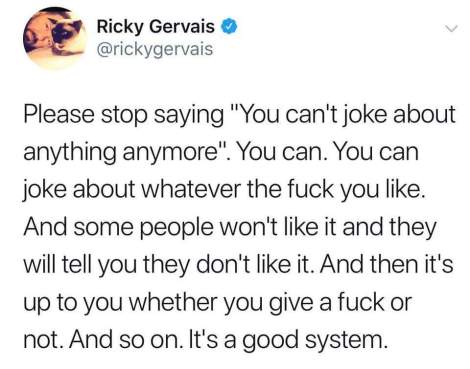
It’s not such a complicated thing really. I read a quote from comedian Ricky Gervais recently. He was commenting on the idea that people felt like they couldn’t joke anymore, and how that really wasn’t the case. The full quote is below.

fb_img_1546643404716

The crux of this really comes down to how a person reacts to a contrary opinion. Yes, you can tell a joke, but if it ends up hurting someone else that hears it, the question becomes not ‘was the joke funny’, but rather, ‘do you give a shit’?

Caring about other people is, after all, one of the chief qualifiers of decency.

If you tell a joke (or any other sort of comment or action) that gets a negative reaction, you don’t have to defend the joke, or your values, or lament the days where we could say anything we wanted and expect others to choke back their pain in defense of your ‘humour’.

People might be hurt. They may be upset or offended. And you, despite the joke being yours—and assuming it was not meant to hurt—can hear that pain.

It may come as a surprise that you can even ask questions. Not to challenge or undermine their feelings, but to better understand their experience to the extent they are comfortable sharing it.

In the end, you may both be able to learn something, transforming a painful encounter into an opportunity for mutual growth.

It’s not always easy, and no one likes being called out or corrected. It can be uncomfortable, even confusing at times to realize that something you’ve said or done has been deemed inappropriate by another.

What do you say? What do you do?

Well, one simple trick is to start with an apology. You don’t have to fully understand the nuance of differing opinions—it can be enough to understand that another is hurting, and that you are sorry for that. People sometimes need their pain acknowledged, and your obstinate focus on the hilarity of your joke should never undermine that need.

After that, there may be room for discussion, learning and growth. It’s important to remember of course, that the learning just may include the fact that the joke simply wasn’t funny, and that you should not repeat it.

That can be enough.

It’s not that you can’t discuss things anymore—it’s just that the discussion needs to have two sides. You’re not being told not to be yourself—unless you’re an asshole—and certainly, you can still feel free to joke around. Just realize that sometimes, there will be people who will point out the flaws of that joke. From there, it’s up to you to improve the approach, content, or delivery… or risk proving that the real joke is you.

-Brad OH Inc.