Outrage Marketing

Last week, we talked about the insidious practice known as ‘Clickbait’. While Clickbait is a loathsome gimmick used to draw simple people to even more simple ends—namely ad-revenue—there are other marketing practices which present an even more surreptitious threat.

Specifically, the topic today is the tactic known as ‘Outrage Marketing’.

For those unfamiliar, Outrage Marketing is the nihilistic attempt to create a large-scale controversy in order to get your branding out to a larger audience. This is a far deeper concept than Clickbait, and requires a good-deal more care as we explore the potential pros and cons therein.

In general, Outrage Marketing relies on making some innocuous statement or observation that has nothing to do with the product being sold. It presents a moving—or provocative—tableau, set to complementary music, and usually only the closing logo will identify exactly what is being sold.

The hope here is that the inevitable controversy created will continue to carry the name of the product, thus getting the product into the mouths and minds of far more people than a simple, direct, and informative ad could ever hope to.

For ease of discussion, let us risk taking part in the cycle by looking to a recent example. In order to minimize our role in these questionable practices, no links will be provided—advertising doesn’t come free here at Brad OH Inc.

Earlier this year, Gillette released an ad that challenged toxic masculinity, providing negative examples of male behaviour, then asking whether or not this was really ‘the best a man could get’.

In the interest of full personal disclosure, I loved the content of the ad. Toxic masculinity is a dangerous blight on our society, one which leads men into dangerous patterns of denying any emotion but anger, and which forces countless women to live in fear of the terrible results of such a hideous mindset.

It is a cultural norm which must be challenged at every turn—discussed, broken down, and replaced with a mindset that encourages a full and complete range of emotional intelligence for our boys.

The question that remains is—should an international razor company be the one leading this conversation?

It should be noted that this article is not an attack on any company in particular, but rather an exploration of corporate responsibility, and the limits thereof.

At the end of the day, Gillette is a corporation—which means that their sole purpose is to make money for their shareholders. That’s it—that’s the ingrained structure of any extant corporation, and to expect any other behaviour from them is naïve at best.

On their part, the ad was nothing more than an attempt to increase sales by forcing their name into public discourse—hardly less cynical than a corporation sponsoring a war, or schoolyard fight. They created a commotion, and plastered their logo above it.

Of course, they still sell ‘ladies razors’ at a significantly higher price-point than men’s, despite being identical save for the pink dye. This alone should hint at the fact that their commitment to positive gender relations only goes revenue deep.

It’s all about provocation meeting brand-recognition, and can be dumbed down to little more than corporate sponsored controversy. The fact that they were inarguably on the ‘right’ side of the debate is of little consequence—if the research indicated that the money was on the other side, you can be damn sure they’d flip.

Ultimately however, there is an insidious subtext here which may go unnoticed. It’s hard to say where this starts and ends, but the ability to sell using inflammatory content guaranteed to get a reaction is a smaller part of the general public’s constant demand for controversy and outrage. This ties back in to our last article on Clickbait.

On the whole, we seek entertainment and distraction over consideration and reflection. The result—or perhaps the parallel—to this constant demand for outrage, is its propensity to contribute to the further creation and distribution of the truly outrageous. After all, people will sell whatever the hottest ticket is, and when outrage sells even when utterly unattached to truth, we find ourselves in a precarious position where people no longer bother to question what’s true and what isn’t, but only parrot the most exciting stories that fit within their already established viewpoint.

But don’t take our word for it; take a look at this, you simply won’t believe it!

Click Here.

-Brad OH Inc.

Facts that Only 12% of Readers Will Understand! You Won’t BeLieve #3!

Of course, a claim like that is absolutely ridiculous. It would be impossible to verify to any respectable degree, and is entirely worthless with or without such verification. Still…was it part of the reason you clicked the link today?

Honestly, did you want to prove you weren’t among that miserable 98% of idiots who will never understand what you do?

Did you even bother to check the math above, or did knowing more than 98% just sound better than knowing more than 88% of people?

Did you check that time?

I’ll admit, the entire block of text above has been a heinous waste of time, but read on…you won’t believe what’s next!

These are the sorts of headlines we see every day—whether trawling Facebook, or trying to make it through the coverage on your preferred ‘news’ site.

Clickbait is the simple understanding that people interact with things that engage them—that cause a reaction, rather than things that present an interesting idea, or a challenging but important topic. People as a mass don’t want the best, they want what’s catchy.

Spoiler alert: This works because people are—on the whole—dumb animals, who are simply reacting to stimuli in whatever way comes natural to them.

Do any of these seem familiar to you?

  • You won’t believe…
  • People can’t stop…
  • Find out what people in your neighbourhood are all talking about…
  • The secret they don’t want you to know…
  • They are trying to erase this one secret from the internet…
  • Only 82% will know this…

When you see wild claims like this, rest assured that the underlying promise is nothing more than vapid tripe for cheap clicks. Ultimately, it’s nothing more than a cynical attempt to increase page hits, and hence advertising revenue.

Nonetheless, many people spend the better part of their time online falling into these incessant traps, supporting websites which generate profit, but not content. Of course, since the model works, it continues to be reinforced, which makes such Clickbait ever more prevalent, and real content that much harder to find.

The secret behind this success is triggering a reaction from a title, and more often than not, that reaction is an urge to prove that you, the reader, are better than ‘those statistics’ the title refers to. You know better, you are better, you have something other people don’t, and dammit, you’ll prove it by following the instructions and typing an English word with two O’s!

If you see an article with 5M comments all disproving the grandiose claim of the article, it might be worth considering that you’ve been duped.

So, here’s a bit of advice, from us to you. The next time you read something online that gives you an urge to prove you’re especially smart or special—just save yourself the trouble.

You aren’t.

With our warmest regrets,

-Brad OH Inc.

Tomorrow

Under the Green Desk Lamp…
The world turns around,

Another day,

Of urgent nothings,

Slips away.

And all the things,

You’d always meant,

To have a try at,

Came and went.

Busy getting by,

Keeping life at bay,

With the real treasures,

All on layaway.

The most dangerous lie,

That you’ll ever know,

Is the endless promise,

Of tomorrow.

-Brad OH Inc.

What Should a Government Be?

All too often, political conversations of any sort—whether by public, or by politicians themselves—sink quickly into the mires of partisan politics. Teams of left and right, red and blue, create straw effigies of the other’s values, and burn them upon the altars of their own smug self-righteousness.

This is a matter of hopeless grandstanding—and seldom serves to advance the policies of either side. Elections are won and lost on insults and rumours, and the greater good of the people is abandoned to the wayside of this sickening side-show.

There is a good exercise which can help people of either viewpoint learn more about not only their opponents, but themselves. Setting aside personal emotions and group identities, one may challenge themselves instead to describe only what they believe a government’s role should be. What should it provide, protect, or prohibit—and on what grounds? What is its purpose?

Try to do this without reference to actual individuals, and certainly not to specific parties. Discuss only ideas of the primary functions that must be served.

It is important not to hang yourself on lofty words with little meaning. Freedom, peace, liberty—such words hold high aspirations, but speak little to practical realities. What do they truly mean to you, and how are they to be upheld?

We discussed these concepts in one article, ‘Greed and the Village’, using a simple tribal village as a model for the type of considerations that must be pondered.

We also discussed the fears around giving power to government in the article ‘On the Fear of Big Government’, where we established the wild and barbaric reality of a world with no authority.

Is it a government’s role to protect businesses, or people? Which people, and from what? Are there exclusions to this protection? What happens when the rights of one violates the rights of others? What about when the growth of a company enriches its members but casts many others into poverty?

Is this a natural and enviable result of a free market, or an economic violence which must be redressed?

These are the questions, and the approach to engagement, which can lead people of wildly different persuasions to not only challenge their own beliefs and grow in the process, but also to find the common ground with those who they long considered their rival.

There are very few people on either side of the spectrum who truly want the young to suffer, or women to be scared, or people to live in hateful captivity. By accusing those who think differently of such intentions, we vilify them and close off all possibility of informed debate. Only by remaining open, and seeking sincerely to find the underlying values for ourselves and our opponents, can we hope to find answers which can unite and help people, rather than serving only to reinforce the wild and destructive division that serves only the powerful.

What do you think?

-Brad OH Inc.

How to be a Decent Human

Under the Green Desk Lamp…

I’m not a great person.

Sometimes I’m not even good, exactly.

I’d like to think I’m alright.

At the very least, I certainly try to be decent.

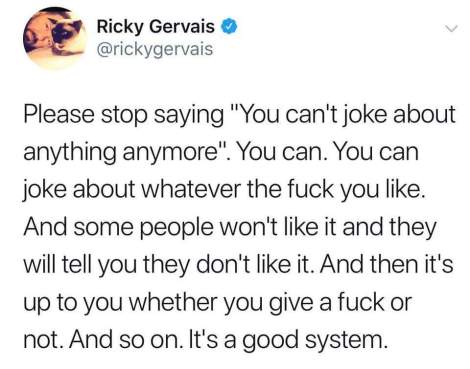
It’s not such a complicated thing really. I read a quote from comedian Ricky Gervais recently. He was commenting on the idea that people felt like they couldn’t joke anymore, and how that really wasn’t the case. The full quote is below.

fb_img_1546643404716

The crux of this really comes down to how a person reacts to a contrary opinion. Yes, you can tell a joke, but if it ends up hurting someone else that hears it, the question becomes not ‘was the joke funny’, but rather, ‘do you give a shit’?

Caring about other people is, after all, one of the chief qualifiers of decency.

If you tell a joke (or any other sort of comment or action) that gets a negative reaction, you don’t have to defend the joke, or your values, or lament the days where we could say anything we wanted and expect others to choke back their pain in defense of your ‘humour’.

People might be hurt. They may be upset or offended. And you, despite the joke being yours—and assuming it was not meant to hurt—can hear that pain.

It may come as a surprise that you can even ask questions. Not to challenge or undermine their feelings, but to better understand their experience to the extent they are comfortable sharing it.

In the end, you may both be able to learn something, transforming a painful encounter into an opportunity for mutual growth.

It’s not always easy, and no one likes being called out or corrected. It can be uncomfortable, even confusing at times to realize that something you’ve said or done has been deemed inappropriate by another.

What do you say? What do you do?

Well, one simple trick is to start with an apology. You don’t have to fully understand the nuance of differing opinions—it can be enough to understand that another is hurting, and that you are sorry for that. People sometimes need their pain acknowledged, and your obstinate focus on the hilarity of your joke should never undermine that need.

After that, there may be room for discussion, learning and growth. It’s important to remember of course, that the learning just may include the fact that the joke simply wasn’t funny, and that you should not repeat it.

That can be enough.

It’s not that you can’t discuss things anymore—it’s just that the discussion needs to have two sides. You’re not being told not to be yourself—unless you’re an asshole—and certainly, you can still feel free to joke around. Just realize that sometimes, there will be people who will point out the flaws of that joke. From there, it’s up to you to improve the approach, content, or delivery… or risk proving that the real joke is you.

-Brad OH Inc.

Why We Write

Under the Green Desk Lamp…

Keyboards are less romantic than a good quill pen. Or a pen at all for that matter. There’s nothing especially enchanting about the click of a modern keyboard. Even those unwieldly old typewriters have them beat in that regard.

Yet for the most part, they are our tool. No longer does a writer sit upon a thick leather chair and dip their quill into fresh ink as heretofore unimagined wonders etch themselves across the clean white page directly from that writer’s imagination.

It’s a lot more head-scratching, start-and-stop bursts of keyboard mashing, and the occasional slide down whatever rabbit hole of google links begins with your subject and ends with your distraction.

The style can be forced, of course, but who has time for that?

The question could be asked, why bother?

In fact, that very question was asked of me quite recently, or something rather like it at least. A good friend and colleague was wondering about whether they should continue to write, struggling to keep their head above the cold flood waters of their present self-loathing and doubt.

Those are a couple of traits which have not abandoned writers into modernity.

It’s tough. It’s frustrating.

Occasionally, it’s infuriating.

If my friend wanted me to talk them into keeping it up though, their bet was off the mark. I did, of course, tell them how much I enjoyed their work—that was true. Beyond that though, all I could do was wish them luck.

Trying to quit?

Yeah…we’ll see.

It may be a good decision to take some time off, but I’ll put it in ink…sorry, ‘.doc format’ right now—you’ll be back. Most likely, you’ll be better for the time off. In some ways at any rate.

It all depends how long it takes.

I don’t expect it will be long.

It doesn’t begin and end at the keyboard, after all. That’s just the easy image. It’s also the questions that pop up in everyone’s mind, and how in yours they turn from questions, to postulations, to weird ideas, to full mythologies. All in a moment, and how you’re left with your fingers twitching for the moment you can type it all out—or screaming into the voice-recorder of your phone in some god-forsaken alley, ignoring the perturbed expressions of the passersby as you struggle to get it all out.

It’s in the way you turn things over in your head—turns of phrase, or conversations past, present, or future—how you play things out, stop and rewind, and do it all again.

Again, and again, until it’s right.

It hurts when it’s not, and it walks beside you all day reminding you of the unloved monstrosity you have created and are now responsible for entirely.

Of course, when you get it right…well, to capture that feeling perfectly would be to find the words we’ve all been looking for all our lives.

Then, there are the times in between those others. The times when we learn, and work. When we see red ink and get a thrill, and ask for more and more not to justify our own decisions, but to hone our art—to sharpen our tools.

These are the times when inspiration does not rain from the sky, and we find ourselves before an empty screen writing about why we write rather than what we’d meant to write.

Never mind all that.

You may stop. You may question if you should. That’s natural, I expect it happens to most of us at some time or another. But if it’s in you, you won’t escape it. And when you feel it again, remember where you left your pe—fuck.

-Brad OH Inc.
Re-Share: EViL

Under the Green Desk Lamp…

This post was originally from March 19th, 2017. It remains sadly relevant however, and we thought it deserved a re-share.


In the great old stories, it’s never hard to spot the source of evil. It may be a winged beast, or a black rider, or a simple, unblazoned ring sitting on a table, just waiting to change the world…

In reality, however, it’s rarely so easy. Evil may take many guises, and come from any direction. Is evil inherent to humanity? Can it ever be prevented?

Education, equal opportunity and the provision of basic needs and human rights is the most obvious answer, for by removing the greatest temptations towards desperate actions, we are most likely to see them decrease. Yet there seems to be an evil in this world which pervades and permeates even the best intentions. It sprouts up no matter what we do. It finds the cracks, or makes them, and it’s dark blossom unfolds often where it is looked for the least.

Traditionally, there are two ends of the polarity in response. One is to be jaded and fearful, rejecting everything different lest it bring evil in with it. This may prevent the terror from without, but it transforms the hearts of people, and creates hatred and evil within.

The other side would be unending faith in the goodness of human kind, sometimes to the open denial of the gathering clouds. This is idealistic, and often this school of thought is quickly met by the bitter reminder that in the end, best intentions cannot ward off evil acts.

We cannot be too careful, or too careless. Vigilance is the price of peace, and those who would deny the presence of evil may soon suffer its harsh truth.

Alas that we do not have a ring to focus on and destroy. Evil is a more insidious thing than that, manifested most often in the sins of pride, greed, and avarice—the strongest motivators of human vice. We cannot see it, nor cast it into the volcano to banish it forever.

Yet the discerning heart can feel it grow. Where will it strike? None can say.

Still, if you pay attention, you can feel the tension in the air, smell the fresh tinders and see the sparks dancing against the black night sky. Old threats and bedtime stories are alive again. Evil grows…now is the time for heroes.

-Brad OH Inc.

The Evocation Series- ‘Comfortably Numb’

Under the Green Desk Lamp…

The following post is part of ‘The Evocation Series’. Click Here for more information about the project, and to learn how to get involved yourself!

Pink Floyd- ‘Comfortably Numb’

Song Link

There is a strange moment sometimes, just between sleeping and waking, when the shadow of forgotten things, forgotten selves, flickers through our mind.

Hello,

Is there anybody in there?

Each passing day, the weight of knowledge grows. Wasn’t that part of the fall, after all? You see a bit more, you accept a bit more. You may settle a bit more, or for a bit less.

Just the basic facts

Can you show me where it hurts?

You learn the shortcuts, how to avoid the worst of it. Abridged and to the point, rather than wandering and wonderful. With each turn around the sun, the goals begin to shift. Avoid the struggle rather than seeking the joys. Solve the problems, rather than inventing the solutions.

I can’t explain, you would not understand

This is not how I am

It remains though, doesn’t it? Some inalienable, indefinable echo within us that calls out to be remembered. Something we once knew which has been long since lost beneath the shuffle and struggle to get by.

Can you stand up?

I do believe it’s working, good

That’ll keep you going through the show

Come on, it’s time to go.

There’s no time for that of course. Not outside of the few seconds before sleep or the first flashes of morning sun, when dreams still live and duty is a distant and shrunken thing. Then it’s gone. Back to the grind, back to routine. The rest is for another time, another life.

When I was a child

I caught a fleeting glimpse

Out of the corner of my eye

I turned to look but it was gone

I cannot put my finger on it now

The child is grown

The dream is gone

I have become comfortably numb.

 Still, we can remember it. We can if we try.

-Brad OH Inc.

Who Are We?

Under the Green Desk Lamp…

One phrase that’s heard with depressing frequency these days is the impotent refrain of “this is not who we are”.

It begs the question—who are we?

That’s a pretty deep question to anyone but an asshole.

Personally, I’m a little bit different around pretty much everyone I know.

I notice their sense of humour, the tones and facial expressions they respond to best, establish nicknames and idioms to go back to in need.

Alone? That’s a wildcard.

Still, I don’t expect that’s what makes someone something.

Is it their actions?

Their stories?

The changes they’ve made?

The happiness they’ve created?

…Who am I?

A soul, lost and confused, trying it’s best to do good for the world. Taking it all in—the good, the bad, the perverse, the fanatical. Working to process it all, to understand it all, to bring it all together, and in the light remind it.

…Who it was in the beginning.

-Brad OH Inc.

‘That’ Guy at the Bar


Under the Green Desk Lamp…

I’d arrived early for my flight, so naturally I found myself at the airport bar having a few last beers before calling it curtains on another fine vacation.

With the thrill of travel still having hold on me, my eyes shot about the room, this way and that, taking in all the different sorts of people gathered. Now, they were no longer the fascinating locals of a strange land, but a mixed assortment of likeminded travellers coming or going to where I would never know.

It was a fairly typical crowd. Young couples with diamonds in their eyes, old men with coals. People exhausted from long treks and people eager to start new ones. And of course, there was ‘that’ guy.

We’ve all seen him before.

Red faced and talkative. Talking too loud, talking too much. Talking too forcefully—too absolutely certain of the value of his long-winded rants, and utterly convinced he was the life of an otherwise non-existent party. He was the kind of idiot you see all the time.

The kind I do my best to avoid. And I certainly tried.

I scrolled through my phone and sipped my beer while waiting on my burger. Still, I’d glance up now and then, taking in the annoyed but patient expressions around him.

He’d already shouted out a young couple sitting on the side of the bar near him. They laughed and waved as they hurried away. I saw his laugh melt into a leer as he watched her take her partner’s hand and leave. Then he fell into blathering to a bunch of young ‘bros’ at the bar, and I figured that would keep him occupied for a while.

My burger arrived, and I thought that was the end of it.

As I finished my meal and got to work on my next beer, I noticed that the young men had been abandoned by their loud-mouthed old counterpart. He was on the other side of the bar now, clawing at some young lady as he bellowed about his life and worth and ‘stories you wouldn’t believe’.

I wondered if she could be his daughter. That would explain the perturbed expression on her face and the patience she showed as he leaned his red face in over-close and tried once more to catch at her arm. How many times had she found him like this?

Or maybe she was just another poor stranger. Perhaps she knew the younger men and was trying to make her way past him to join her companions.

They were staring at their phones now though, and their lack of recognition seemed almost intentional.

She glanced about nervously as he spoke. I felt concerned, but maybe she was just late for a flight and struggling to remain polite.

I caught her eye at one point, and it seemed the look held overlong. Nervously, I glanced away, hoping she didn’t take me for another idiot ready to cast my hand in on the action.

Was he trying to kiss her there, or just leaning in too much under the weight of his drink?

Everyone else stared intently at whatever screen was nearest at hand. But now, I was worried.

He offered to walk her to her gate and she said she would be fine.

He persisted, and she joked that she was a big girl and could handle herself.

She laughed nervously and cast her eyes downward as she tried to step around him. That didn’t work either.

Finally, I felt guilty. I’d waited too long, thought too much.

That’s the point of all this. ‘No’ is a word to be respected. And she’d said it in every way possible while avoiding making too much of a scene.

He was circling around and cornering her near the exit by the time I stood up. I caught her eye again, but spoke this time, loud enough for the bar to hear me above his commotion. “Are you ok there?”

Until that moment, she had held her countenance in a nervous, meek mask of worry and embarrassment. Now, it threatened to break as she leaned desperately around him to answer me, “…no.”

That one did the trick. I turned to him now, giving her my back and clearing a way to the door. He looked up at me with the wry confidence of a man who has been told he was special all his life and finally came to accept it as sacrosanct.

“You need to leave her alone.” Bereft of his banter, I imagine the whole bar heard me. Still, few looked up from their phones. But she took the opening, and darted through the exit.

He held my gaze for a moment in challenge, his ruddy face wrinkling with the supreme disappointment of a toddler being told they couldn’t keep the toy they’d torn from the shelf. Then he shrank back.

“Ok,” he said with a churlish sneer, and slunk off to his seat. He sat back down with the young guys, and soon they were all laughing again.

People kept scrolling on their phones.

I wondered if I was too aggressive, and sat in uncomfortable silence until the bar tender slid over a free beer. “Good man,” he said with a conspiratorial nod.

My vacation was over. She was, presumably, safe. He, I assume, would be unaffected by the encounter.

As I finished up my second beer before moving onto the free one, I reflected on the questions I’d asked myself before acting. The justifications for my potential silence.

Was she his daughter? No.

Was she just a patient stranger? No.

Was she amused by the banter but in a rush to catch a flight? No.

It was clear enough now. It wasn’t about her shyness, or her effort to be polite. Her patience in avoiding a scene didn’t matter, and my reticence to be part of one didn’t either.

She’d said no. At least four times. That was all that mattered, and that should have been the end of it. She should not have had to repeat herself, and if she did the whole bar should have risen loudly to back up her statement and support her choice. But that’s not the world we live in.

It should not have come down to one lone person accepting they would have to be the one to stand up. But I guess that’s where we are these days, and it’s probably well ahead of where we were not so long ago.

I slid the empty cup across the bar and started on the free one. It was cold and smooth.

‘That’ guy at the bar. I thought about the term. It should mean something different. Not the pushy idiot who has no place in the bar to begin with, but rather the ones willing to speak up for those going unheard.

I wondered, if I ever saw the moment to be ‘that’ guy again, would I hesitate?

No.

-Brad OH Inc.