Outrage Marketing

Last week, we talked about the insidious practice known as ‘Clickbait’. While Clickbait is a loathsome gimmick used to draw simple people to even more simple ends—namely ad-revenue—there are other marketing practices which present an even more surreptitious threat.

Specifically, the topic today is the tactic known as ‘Outrage Marketing’.

For those unfamiliar, Outrage Marketing is the nihilistic attempt to create a large-scale controversy in order to get your branding out to a larger audience. This is a far deeper concept than Clickbait, and requires a good-deal more care as we explore the potential pros and cons therein.

In general, Outrage Marketing relies on making some innocuous statement or observation that has nothing to do with the product being sold. It presents a moving—or provocative—tableau, set to complementary music, and usually only the closing logo will identify exactly what is being sold.

The hope here is that the inevitable controversy created will continue to carry the name of the product, thus getting the product into the mouths and minds of far more people than a simple, direct, and informative ad could ever hope to.

For ease of discussion, let us risk taking part in the cycle by looking to a recent example. In order to minimize our role in these questionable practices, no links will be provided—advertising doesn’t come free here at Brad OH Inc.

Earlier this year, Gillette released an ad that challenged toxic masculinity, providing negative examples of male behaviour, then asking whether or not this was really ‘the best a man could get’.

In the interest of full personal disclosure, I loved the content of the ad. Toxic masculinity is a dangerous blight on our society, one which leads men into dangerous patterns of denying any emotion but anger, and which forces countless women to live in fear of the terrible results of such a hideous mindset.

It is a cultural norm which must be challenged at every turn—discussed, broken down, and replaced with a mindset that encourages a full and complete range of emotional intelligence for our boys.

The question that remains is—should an international razor company be the one leading this conversation?

It should be noted that this article is not an attack on any company in particular, but rather an exploration of corporate responsibility, and the limits thereof.

At the end of the day, Gillette is a corporation—which means that their sole purpose is to make money for their shareholders. That’s it—that’s the ingrained structure of any extant corporation, and to expect any other behaviour from them is naïve at best.

On their part, the ad was nothing more than an attempt to increase sales by forcing their name into public discourse—hardly less cynical than a corporation sponsoring a war, or schoolyard fight. They created a commotion, and plastered their logo above it.

Of course, they still sell ‘ladies razors’ at a significantly higher price-point than men’s, despite being identical save for the pink dye. This alone should hint at the fact that their commitment to positive gender relations only goes revenue deep.

It’s all about provocation meeting brand-recognition, and can be dumbed down to little more than corporate sponsored controversy. The fact that they were inarguably on the ‘right’ side of the debate is of little consequence—if the research indicated that the money was on the other side, you can be damn sure they’d flip.

Ultimately however, there is an insidious subtext here which may go unnoticed. It’s hard to say where this starts and ends, but the ability to sell using inflammatory content guaranteed to get a reaction is a smaller part of the general public’s constant demand for controversy and outrage. This ties back in to our last article on Clickbait.

On the whole, we seek entertainment and distraction over consideration and reflection. The result—or perhaps the parallel—to this constant demand for outrage, is its propensity to contribute to the further creation and distribution of the truly outrageous. After all, people will sell whatever the hottest ticket is, and when outrage sells even when utterly unattached to truth, we find ourselves in a precarious position where people no longer bother to question what’s true and what isn’t, but only parrot the most exciting stories that fit within their already established viewpoint.

But don’t take our word for it; take a look at this, you simply won’t believe it!

Click Here.

-Brad OH Inc.

Facts that Only 12% of Readers Will Understand! You Won’t BeLieve #3!

Of course, a claim like that is absolutely ridiculous. It would be impossible to verify to any respectable degree, and is entirely worthless with or without such verification. Still…was it part of the reason you clicked the link today?

Honestly, did you want to prove you weren’t among that miserable 98% of idiots who will never understand what you do?

Did you even bother to check the math above, or did knowing more than 98% just sound better than knowing more than 88% of people?

Did you check that time?

I’ll admit, the entire block of text above has been a heinous waste of time, but read on…you won’t believe what’s next!

These are the sorts of headlines we see every day—whether trawling Facebook, or trying to make it through the coverage on your preferred ‘news’ site.

Clickbait is the simple understanding that people interact with things that engage them—that cause a reaction, rather than things that present an interesting idea, or a challenging but important topic. People as a mass don’t want the best, they want what’s catchy.

Spoiler alert: This works because people are—on the whole—dumb animals, who are simply reacting to stimuli in whatever way comes natural to them.

Do any of these seem familiar to you?

  • You won’t believe…
  • People can’t stop…
  • Find out what people in your neighbourhood are all talking about…
  • The secret they don’t want you to know…
  • They are trying to erase this one secret from the internet…
  • Only 82% will know this…

When you see wild claims like this, rest assured that the underlying promise is nothing more than vapid tripe for cheap clicks. Ultimately, it’s nothing more than a cynical attempt to increase page hits, and hence advertising revenue.

Nonetheless, many people spend the better part of their time online falling into these incessant traps, supporting websites which generate profit, but not content. Of course, since the model works, it continues to be reinforced, which makes such Clickbait ever more prevalent, and real content that much harder to find.

The secret behind this success is triggering a reaction from a title, and more often than not, that reaction is an urge to prove that you, the reader, are better than ‘those statistics’ the title refers to. You know better, you are better, you have something other people don’t, and dammit, you’ll prove it by following the instructions and typing an English word with two O’s!

If you see an article with 5M comments all disproving the grandiose claim of the article, it might be worth considering that you’ve been duped.

So, here’s a bit of advice, from us to you. The next time you read something online that gives you an urge to prove you’re especially smart or special—just save yourself the trouble.

You aren’t.

With our warmest regrets,

-Brad OH Inc.

What Should a Government Be?

All too often, political conversations of any sort—whether by public, or by politicians themselves—sink quickly into the mires of partisan politics. Teams of left and right, red and blue, create straw effigies of the other’s values, and burn them upon the altars of their own smug self-righteousness.

This is a matter of hopeless grandstanding—and seldom serves to advance the policies of either side. Elections are won and lost on insults and rumours, and the greater good of the people is abandoned to the wayside of this sickening side-show.

There is a good exercise which can help people of either viewpoint learn more about not only their opponents, but themselves. Setting aside personal emotions and group identities, one may challenge themselves instead to describe only what they believe a government’s role should be. What should it provide, protect, or prohibit—and on what grounds? What is its purpose?

Try to do this without reference to actual individuals, and certainly not to specific parties. Discuss only ideas of the primary functions that must be served.

It is important not to hang yourself on lofty words with little meaning. Freedom, peace, liberty—such words hold high aspirations, but speak little to practical realities. What do they truly mean to you, and how are they to be upheld?

We discussed these concepts in one article, ‘Greed and the Village’, using a simple tribal village as a model for the type of considerations that must be pondered.

We also discussed the fears around giving power to government in the article ‘On the Fear of Big Government’, where we established the wild and barbaric reality of a world with no authority.

Is it a government’s role to protect businesses, or people? Which people, and from what? Are there exclusions to this protection? What happens when the rights of one violates the rights of others? What about when the growth of a company enriches its members but casts many others into poverty?

Is this a natural and enviable result of a free market, or an economic violence which must be redressed?

These are the questions, and the approach to engagement, which can lead people of wildly different persuasions to not only challenge their own beliefs and grow in the process, but also to find the common ground with those who they long considered their rival.

There are very few people on either side of the spectrum who truly want the young to suffer, or women to be scared, or people to live in hateful captivity. By accusing those who think differently of such intentions, we vilify them and close off all possibility of informed debate. Only by remaining open, and seeking sincerely to find the underlying values for ourselves and our opponents, can we hope to find answers which can unite and help people, rather than serving only to reinforce the wild and destructive division that serves only the powerful.

What do you think?

-Brad OH Inc.

How to be a Decent Human

Under the Green Desk Lamp…

I’m not a great person.

Sometimes I’m not even good, exactly.

I’d like to think I’m alright.

At the very least, I certainly try to be decent.

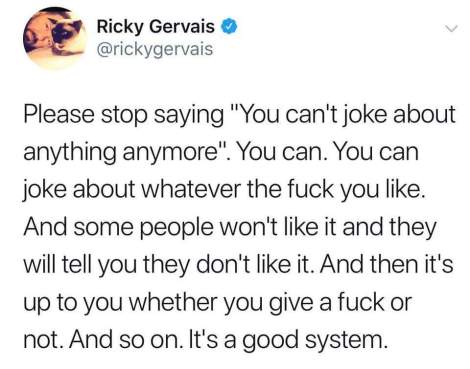
It’s not such a complicated thing really. I read a quote from comedian Ricky Gervais recently. He was commenting on the idea that people felt like they couldn’t joke anymore, and how that really wasn’t the case. The full quote is below.

fb_img_1546643404716

The crux of this really comes down to how a person reacts to a contrary opinion. Yes, you can tell a joke, but if it ends up hurting someone else that hears it, the question becomes not ‘was the joke funny’, but rather, ‘do you give a shit’?

Caring about other people is, after all, one of the chief qualifiers of decency.

If you tell a joke (or any other sort of comment or action) that gets a negative reaction, you don’t have to defend the joke, or your values, or lament the days where we could say anything we wanted and expect others to choke back their pain in defense of your ‘humour’.

People might be hurt. They may be upset or offended. And you, despite the joke being yours—and assuming it was not meant to hurt—can hear that pain.

It may come as a surprise that you can even ask questions. Not to challenge or undermine their feelings, but to better understand their experience to the extent they are comfortable sharing it.

In the end, you may both be able to learn something, transforming a painful encounter into an opportunity for mutual growth.

It’s not always easy, and no one likes being called out or corrected. It can be uncomfortable, even confusing at times to realize that something you’ve said or done has been deemed inappropriate by another.

What do you say? What do you do?

Well, one simple trick is to start with an apology. You don’t have to fully understand the nuance of differing opinions—it can be enough to understand that another is hurting, and that you are sorry for that. People sometimes need their pain acknowledged, and your obstinate focus on the hilarity of your joke should never undermine that need.

After that, there may be room for discussion, learning and growth. It’s important to remember of course, that the learning just may include the fact that the joke simply wasn’t funny, and that you should not repeat it.

That can be enough.

It’s not that you can’t discuss things anymore—it’s just that the discussion needs to have two sides. You’re not being told not to be yourself—unless you’re an asshole—and certainly, you can still feel free to joke around. Just realize that sometimes, there will be people who will point out the flaws of that joke. From there, it’s up to you to improve the approach, content, or delivery… or risk proving that the real joke is you.

-Brad OH Inc.

Re-Share: Why the United States is Not Morally Justified to Limit Immigration

Today, we have an older post for you. Originally posted on July 26th, 2015, this article remains as sadly apt today as it was then. Have things changed at all? For better or worse? Can we still harbour the same hope that was expressed in this article? Can we afford not to?


If there’s one topic permeating public discourse above all others these days, it’s immigration. How to control it, what amnesty programs should be in order, and how it will affect the future of the western world are discussed daily—politicians all sounding off with their own theories, interpretations, and biases.

But the issue is simpler than it’s made out to be. Today, we’re here to discuss why the United States (and the rest of the ‘1st World’ for that matter) has no moral justification to limit immigration whatsoever.

Popular hysteria would find this claim entirely daft no doubt. As Donald Trump elucidated so profoundly in his recent Presidential bid (Link), common perception of immigrants paints a picture of a hoard of locusts come to devastate our pristine and peaceful land. He saw some backlash to be sure (Link), but make no mistake that his sentiments are shared by entirely too large a portion of the population.

So let’s examine the issue a bit more critically.

First off, it must be noted that the North American continent as it is now was built entirely by immigrants. Steel workers, factory workers, road builders and ditch diggers all came from abroad to find the freedom still sought by immigrants today. So there’s an undeniable element of hypocrisy in any claim that immigration is inherently harmful to this or any other nation.

Speaking of past immigration, even if the hotly debated Mexican border were to be shorn open completely, the resulting influx of immigration would be far less destructive to our culture than was our initial immigration to the Native population at the time. But let us not dwell on the past; this is about the present. History continues on by the day, and we must reckon ourselves to the fact that the machinations of the Western World are among the key forces driving the influx of aspiring immigrants around the world. If necessary, their concern for the laws of immigration will be no greater than we once showed.

And justly so. At present, all nations outside of the alleged ‘1st World’ are treated as low-cost production facilities, mining operations, or to put it flatly, as simple, legal sources of modern slave labour. This system produces the vast majority of luxury commodities we benefit from in our daily lives as those doing the building are left to linger in abject poverty.

Once again, Trump makes for a depressingly potent example. While decrying the potential dangers immigrants may bring, he rests high among the contributors to the need for such Freedom-bent exodus. Even as he stands at his pulpit and casts down his vitriol and hatred, he has operations going word wide paying slave-wages to potential immigrants desperate for a chance at something better (Link).

Trump isn’t an isolated example. The ‘Western World’ has a long history of supporting dictators they know will keep this system of indentured servitude in place, while reaping the benefits from the comfort of their own state-side villas.

Ignorance incarnate, this attitude is due for a rude awakening. It’s coming sooner than they think, and these entitled sycophants will shortly learn that you can’t piss in the pool, and then complain when people scramble onto the deck.

Like it or not, we are connected in this world (Link). For every ounce of unearned comfort we see, there are others who suffer a pound. To expect these benefits—at the cost of such despair—and yet expect to close the doors to any who seek only for themselves what we can barely appreciate is the height of arrogance.

If the current luxury we take for granted is to be preserved, it must be made available to all. One way or another (Link) people will find their happiness. If we find ours at the expense of others, we can only expect the same in turn. So let us invest rather in the future of all—for only by building a better world for all its inhabitants can we find justification in enjoying our own spoils.

-Brad OH Inc.

Where the Children Sleep

Under the Green Desk Lamp…

Over here, the children sleep,

In warm and comfy beds,

They dream of games and food and joy,

And peace is in their heads.

Will they see their friends at school?

Will they see a parade?

Will their parents yell today?

Or will their anger fade?

Over there, the children sleep,

On ground filthy and cold,

Will they have the same tomorrow?

Perchance will they be sold?

Will they have friends remaining,

When the bombs somehow bring peace?

Will their parents hold them tight,

or dying will they cease?

Yet we continue on our way,

Dividing here and there,

With more than enough to go around,

And make it ‘us’, everywhere.

Around the world, the children sleep,

The darkening night away,

And do they dream in that deep sleep,

About a better day?


-Brad OH Inc.

Rhapsody

Under the Green Desk Lamp…

Civil discourse these days has become pretty uncommon. You’ll rarely hear a debate that doesn’t soon slip into name calling and paranoid wailing.

It’s both sides.

Everyone is simply too afraid. Afraid of everything, yet somehow afraid of all the wrong things.

That fear is the problem, and it stunts any level of intelligent discourse by wheeling us into knee-jerk reactions and assumptions—making our conclusions for us. When angry and afraid, you go with what you know: Red or Blue.

That’s the thing about political thought however, it never quite fits into a single definition. Try as they may, there is no binary option that can capture the nuance of human belief—of our values.

Values, now there’s a word that’s thrown around a lot in politics, yet never really utilized the way it should be. Values, after all, are what it really comes down to. The truth of it is, I strongly suspect that a measure of fundamental values would show a far less divided picture of humanity than a typical measure of political preferences.

Behind the rhetoric and uproar, there do remain basic rights and wrongs, and obvious decencies which I still believe the vast majority of people can agree upon. These are values which go beyond culture and language.

They are innate to us, and are denied only by the most wretched of deviants, or those desperate souls who by poverty or avarice have found themselves denied entirely of their moral compass.

What would happen then, if people were to put aside their labels and colours—the brand names of political philosophy—and turn away from their hot button issues to discuss instead the basic values they hold dear.

No loose terms like freedom here. Tell me what that really means.

What do you love?

What do you fear?

What do you hate?

Do you realize the last answer is most likely the twisted spawn of some unknowable combination of the former two?

Or that the second closely follows the first?

Really though. If the world at large could manage such civil debate for a while—I mean really keep it going, get deep, and avoid falling back into the ‘yeah but’ type thinking which somehow convinces us that the forces of reality must in the end overwhelm the deepest of truths—what might be the result?

And what would you have to say?

-Brad OH Inc.

Humanity vs. the Corporate Mindset

Of all the unfortunate ills in this world, the Corporate mindset may be the chief. It is this idea which keeps society unbalanced and desperate, which controls our information and divides us against one another. Laws are changed, rules are broken, people are robbed of their potential, and the world at large is injured by this idea that more is better, and that the ability to take more is self-justifying.

It’s often preached about as ‘freedom’, or ‘capitalism’, or even ‘fairness’—all hair-brained explanations for one of the greatest con’s ever. The system supports only itself and those at it’s very top, while actively trying to quash out any popular movement attempting to return to the people some semblance of the power which is theirs by right.

Let’s look briefly at two examples to illustrate this point.

The first is the idea of a universal basic income. The concept here is that if the highest earners paid a higher level of taxes than the pittance they currently do (if they pay at all), then a universal basic income could be provided to each citizen, raising them out of poverty, and allowing them to participate in the economy and society in a meaningful way. This would reduce suffering, and build up communities across the nation, and the world.

To the Corporate mindset, this is the highest of heresies.

They would argue that having successful people pay taxes for less successful people discourages big ideas, and that if the ability to lord unimaginable wealth over the rest of the population wasn’t available, then any incentive to be productive would go with it.

What unimaginable hogwash.

The true reason for such objections is a little more obvious, and far more believable. It’s greed, of course…good old number three.

The truth is that at some point, the motivation of money is no longer about providing for you and yours—Maslow’s hierarchy and such. It ceases to be the calculated pursuit of betterment or provision, and becomes instead the reckless pursuit of an addict. Wealth fast becomes an addiction, and like most addictions, people resort to increasingly terrible extremes to feed it. A Corporation, in essence, is this wealth addiction made manifest. Pursuit of money as a drug in this way breaks the market, the chain of trust, the social contract, and capitalism in general.

Another fine example of the destructive nature of this Corporate mindset can be found in the realm of art and creativity. Corporations have no interest in crating thought-provoking materials or fresh ideas—the very opposite in fact. Their goal is to create easily consumed, content devoid filler. They rehash the same tropes and keep people clapping along to the same tired old ideas. It’s about placation and distraction, never enrichment.

The end result can be seen in the relentless struggle before any true artist—in their need to cut through these quagmires of idiocy to ever have a chance at being heard by the desperate ears of people starving for original content. Examples can be found in free-speech warriors such as Howard Stern or the Insane Clown Posse, who have struggled through great adversity and opposition from the Corporate market, despite having a product which many people desired.

If something’s not in line with a Corporation’s vapid tripe, and especially if it’s not making an obscene amount of money for people who already hold far too much, it has little chance of significant exposure without amassing a devoted underground following in spite of Corporate adversity.

More about the negative impacts of the Corporate mindset on the entertainment industry can be found in our article, ‘The Disgraceful Suicide of ‘Old’ Media’.

In the end, the crux of the issue is that the Corporate mindset influences our society—making us callous and suspicious of one another, rather than supportive and loving. Indeed, it can easily be argued that the Corporate mindset is the very antithesis of the human spirit, and yet it holds us tightly in its sway; controlling our media, our art, our economy, and our very perspectives on life.

What would it take to break free of this influence, and begin to live like the compassionate and caring society we are undoubtedly capable of being? We look forward to hearing your thoughts in the comments below.

-Brad OH Inc.

Playing by the Rules

Under the Green Desk Lamp…

Tennessee Williams once wrote, “I have always depended on the kindness of strangers.”

It’s a terrible approach, and apt to get you killed.

Of course, there’s another thematically similar, yet significantly different expression from an unknown source, “You’ll end up really disappointed if you think people will do for you as you do for them.”

Pretty disparate points of view, to be sure.

Why is this?

It presents a strange conundrum. People, in general, try to be good. This can certainly be disputed, and there’s no doubt there does exist some number of people who are simply, downright rotten. But we can all agree on our strong dislike of those jerks, so let’s not hang ourselves on that point.

As a very broad rule, I believe it can be argued that people tend to try their best to play by the rules. For the most part, we do try. We try to be honest, to do the right thing, and to stick within the general moral boundaries of the society in which we reside.

That brings us to the topic of these so-called ‘rules’, and just where we tend to go wrong. In its simplest form, the problem is that the rules are agreed upon by all, but interpreted by the individual. Each in his or her own heart decides in the moment what is right. Therein lies the issue.

All red tape and political shenanigans aside, it’s not the most difficult task to agree on a simple set of principles behind which almost all of us may stand. The most fundamental values are very similar on every side. No one really wants innocent people to get shot, or children to be hurt, or women to be victimized, or minorities to be afraid. Admittedly, this is a broad generalization, and in this wide world there is no shortage of morally bankrupt imbeciles, but once again, we’re talking about the general population here—not those creeps.

I do believe you’d be hard pressed to find anyone who would object to any of the simple values above, nor to a litany of others we could easily agree on.

The problem then, becomes how we define these ‘rules’ in the moment, and how we react to prevent these things from happening.

When it comes to immediate interpretation, it’s an easy thing to draw exceptions based on personal mindsets, current context, or any other number of feeble yet potent personal justifications. This is wrong in every scenario. It is by drawing these distinctions for our own actions that the entire social contract begins to break down. If we cannot expect decency from our neighbour, even the best of us will falter in our application of decency ourselves.

The other side of the coin, then, is how we react to prevent these universally defined tragedies. This bit is a little more complex, and happens to be where we find the concept of political polarities. More often than not, our reactions or views on prevention are defined not by logic, values, or virtue, but rather by who we surround ourselves with, and what we are told.

Let’s use the simple example of not wanting innocent people to get shot. No matter if you are on the far right or the far left of the political spectrum, the prevention of needless death is a fairly ubiquitous desire. The response is something entirely different.

To use somewhat hyperbolic examples for the purposes of this argument, we will say that the left tends to prefer the elimination of guns, while the right prefers their propagation—arguing that the only defense against a bad guy with a gun is a good guy with a gun. Both are reasonable interpretations on the surface, and both are driven by the shared value of not wanting innocent people to get hurt. That last bit is essential here.

The same—or a very similar—analogy can be made for gender neutral washrooms, minimum wages, and most any other issue being dragged across the fetid political landscape at any given moment.

Is there any solution to this madness? That’s a far more complex question. When it comes to the universal interpretation of rules, I suppose that’s where lawyers come in. If they are up to the job, then the courts can handle those who think they’re an exception.

What about the reactions? Well, as established, this tends to be a matter of what we’ve learned. If we are taught that guns protect, we’ll favour increasing ownership. If we’re taught that guns kill, we’ll tend to favour prohibition, or something in that vein. Neither approach is unreasonable on the surface, but both require a great deal more investigation, testing, and above all—knowledge.

That’s what it all comes down to in the end, as it always does. Education, and access to accurate, replicable data is one of the—if not the absolute—keys to finding a clear and actionable way to fixing the dreadful state of our society.

Sadly, in a world where science and fact are as viciously disputed as all the rest of these issues, we find ourselves in dire straights indeed.

To teach the wrong thing, or anything motivated by a pre-defined political agenda, is propaganda. And, considering where we get the vast majority of our information, this tends to be the case more often than not. Access to legitimate, unbiased information is among the only changes that can set us back on the right course. The final question then, becomes how?

That, unfortunately, is a question above my station. So, I turn it over to you the readers—what do you think? Is education truly the key to solving these problems? Is unbiased education still possible at this point? If not, what other options do we have? Weigh in by posting your comment below!

-Brad OH Inc.

‘Politics’ is Not a Dirty Word

Another day, another tragedy. Presently, it’s the Las Vegas massacre on my mind, or the recent terrorist attack in Edmonton. But depending when you’re reading this, I have sorry little doubt there will be some fresh new event to use for context. Nothing will be different if we use another example, so it doesn’t really matter anyways. Inevitably, you will be told that “this isn’t the time to get political.”

“Let’s not politicize this.”

“Can’t we just have a day to grieve?”

There are a million ways to say it, but it always boils down to the same idea—“Let’s not go using the government to solve problems…that’s not what they’re for.”

It happens after all the most political events. We are told not to get political, not to examine issues and causes. Just be sad.

Pray…if that’s your thing.

Just…don’t try to do anything about it.

They can’t afford real change. They won’t.

But ‘politics’ is not a dirty word, and must not be treated as such if there is ever to be any real progress in this sad world of ours. To turn any political discussion into a taboo subject is to actively waste the opportunity for learning and growth. Further, to claim that political discourse over a tragedy is disrespectful to the victims is not only unhelpful, it’s pigheadedly ignorant.

If we want to prevent tragedy, we must learn from those that occur, and improve our society to prevent future occurrences. That’s what politics is. Anything else—any claim of respect, or timing, or taboo is obstruction of politics. It isn’t kind-hearted, or even well-intentioned. It’s intellectual dishonesty, and in any such instance, you can be damn sure someone is being well paid to convince you that scoffing at the chance to fix things is somehow the moral high ground.

Yes, this is about informed gun control policies.

At least today.

It could also be about systemic racism.

Or police brutality.

Or climate change.

Or money in politics.

Or dozens of other important debates which have been put off for far too long.

These aren’t inappropriate subjects, and they are absolutely the business of politicians and citizens alike. What they are not, is the business of corporations and lobbyists, and yet those are the only ones who seem effective at turning it into their business—specifically, profit.

Shame on them, and shame on anyone who resorts to such hair-brained, nihilistic diversions as ‘let’s not make this political’.

Avoiding civil discourse creates a gap in our understandings, and feeds the ever-widening divide in our nation, and our world. It is uncouth to discuss who you vote for. It’s provocative to talk about the ecosystem during a hurricane. It begins to feel anti-social to make any attempt to discuss our world, when it should be incumbent upon every citizen to do so.

Sadly, when this happens, it usually quickly devolves into attacks like ‘snowflake’, ‘libtard’, ‘hack’, or ‘radical’. This inevitably kills any drive towards honest engagement, and prevents us from truly exploring our values and examining the facts to dream up a better world.

The truth of the matter is that at the end of the day, just about everything is political—especially if it has the potential to affect another living thing without their direct consent. That may seem like a heavy qualification, but there’s an easy litmus test to use for those of you too jaded to do your own research.

Is a great deal of money being spent to convince you something is none of your business?

If so, it’s probably directly affecting to you, your family, and the world you live in.

So, talk about it.

Scream if need be.

If that fails, act.

Make them hear you.

Leave them no choice.

You still have power—never forget that.


-Brad OH Inc.