The Popular Misappropriation of Blame

purelyspeculationOf all the grand facets of humanity worthy of daily expression, we seem to have found ourselves ubiquitously occupied by one of the most base and depraved of the lot: blame. ‘Blame the cops’, ‘blame the rich’, ‘blame the Jews’, and ‘blame the Liberals’. But mostly, blame the Muslims.

Blame is an easy slope to slip down—it’s sheer as all hell, and treacherous by nature. When we feel threatened, the most natural reaction is to find the source and strike back. This is a wise and adaptive trait. It once kept us wary of lions, a good quality to be certain, because those mangy bastards will tear you to bloody shreds without a second thought.

But as we’ve made our way out of the savannah and into a more complex society, we have accordingly found our threats growing broader—more difficult to define. The threats are similar enough in nature, and the fear is certainly no different, but the struggle becomes, in such an interconnected and nuanced world; where to place the blame.

It’s an issue that touches most every other—blame, and the need for it, permeates our society as deeply as hunger, equality, freedom…terror.

But of all the fears and all the culprits, none are as commonplace these days as the fear of and blame of Islam. Herein lays an important distinction. There can be no doubt whatsoever that some Muslim people have committed horrendous acts. This by necessity makes them potential objects of fear, and hence, blame.

The mistake here, and the especially slippery nature of this particular slope, is the inherent risk of conflating trait with cause. Certain Muslims have committed atrocities. But is Islam to blame?

A growing consensus among even the intellectual elite seems to support this notion. Recently—and as an ongoing tenet—the otherwise venerable Bill Maher has thrown his hat into the ring, landing unequivocally in the ‘Islam is an inherent evil’ corner (Link).

To my mind, this is an abhorrent mistake. More fundamentally—if you’ll excuse the term—it’s a misunderstanding of both human nature, and the true root of the problem here.

Just as fear leads to a drive for blame, so frustration leads to a compulsion towards anger. As humans, it is our natural inclination to construct narratives which provide meaning—or more pertinent to the case at hand—to latch onto narratives which fit our circumstances and needs.

When we are driven to find context in the wide and mysterious world around us, we construct belief systems. When we feel lost or uncertain, we take comfort in platitudes and homilies. When we are driven mad with fear of explosions and beheadings, we latch onto narratives of ‘the other’—the turban wearing madman with a mad lust for blood and unquenchable thirst to desecrate all we hold dear.

But the pendulum swings both ways, and when humans find themselves desperate, or afraid, so too do they grasp for and hold tightly to whatever narrative may give justification to their feelings.

At present, for a small portion of disenfranchised and rueful Muslims, this narrative need is met in the form of Islam. It is unfortunate, but it is reality. This is not to say there is anything inherent to Islam which makes it a violent or reactive belief system—at least any more than so many other belief systems—only that it may suffice as such in time of need.

The role has been filled by many other narratives before it. As President Obama pointed out (Link)—much to the chagrin of his electorate—Christianity filled this vile role during the crusades, and in many other periods of history.

Looking back to more recent events, we can find a fine parallel in the tragic shootings at Columbine High School. When these disenfranchised and deranged youth decided to commit a massacre at their school, many media outlets were quick to jump on their favourite artists as the ultimate culprit—primary among them the singer Marilyn Manson (Link).

Looking back on this farce, it’s clear to all but the most troglodytic amongst us that Marilyn Manson was no more responsible for this travesty than you or I. But his was, perhaps, the soundtrack playing in the maligned brains of the killers. His may have been the narrative they latched on to in their rage, but this is hardly a sufficient link to establish any sort of causal relation between the two.

The same is true, of course, with Islam. Even though we are witness now to a group of misled Muslims (some of whom may or may not have justifiable cause for anger) who use Islam as the marching banner of their holy war, there is little doubt their actions would be no less reprehensible under a different narrative. Their anger and their actions are products of their environment and their ability to process it. If we can imagine for a moment—as farcical as it seems—a world with no Islam, but in which all other social and economic factors in the middle-east were entirely comparable, I believe there is little doubt these militants would quickly find some other name to pin their hatred upon.

All action and belief needs a narrative. In this instance, the religion of Islam is being used to fill a terribly dark void—one that has arisen and been filled in people by different means throughout the sad duration of our existence. Still, that very same religion is followed by countless virtuous and just men and women the world over. It is a fallacy therefore to assign blame to the narrative. It belongs rather with the actors, and moreover, the circumstances which drive a nation to such desperate straits (Link). It is not the nature of the narrative which must give us cause for concern and rebuttal, but rather the source of need which this narrative is used to fill.

Fear is a rational reaction to a threatening stimulus. Not so blame. Blame is an atavistic and base reaction; one that provides comfort and perhaps unity among the maligned, but does nothing to move towards resolution. If we want to solve the problems afflicting our society, we must address the social and political situations from which they arise. Otherwise, we are doing scarce better than our detractors—joyfully burning the effigies of our fear while suffocating on the fumes of its intolerance.

-Brad OH Inc.

Between the Shelves Interview with Author Linda Webber

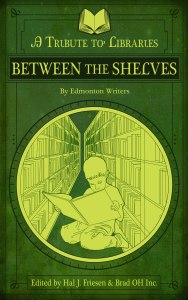
cropped-cropped-blogbanner13.jpgThe following is an interview with Author Linda Webber, who appears in the Brad OH Inc. and Hal J. Friesen edited Anthology ‘Between the Shelves: A Tribute to Libraries by Edmonton Writers’, which you can now purchase here in either Kindle ($2.99) or Paperback ($12.50) copies. All proceeds are to be donated to the Edmonton Public Library System.

BetweenTheShelvesCoverThis interview was conducted by Hal J. Friesen in anticipation of the anthology’s release:
After the short story ‘I Will Not Let You Fall’, creating this bio has been the greatest challenge to Linda’s creative writing skills. This is her first publication, even though she has written a great deal of fiction (five short stories). Although one story did receive praise from her writing group (not ‘I Will Not Let You Fall’), another story did not receive as much. Linda’s writing career spans nine months; therefore, she is hoping to publish something else any day now.

  1. You joke that you’ve written a great deal of five short stories in your bio. Was this story any different or more challenging than your previous works? 

LW: I had always wanted to write a story from the perspective of a biological mother whose child has fetal alcohol spectrum disorder. I wanted to write the story in first person to communicate what the experience is of these mothers. I wanted the story to be sympathetic to her and explain her thoughts and experiences, her personal pasts and her present struggles to raise her child to the best of her abilities given limited resources and lack of empathy from just about everyone including society in general.
It was difficult to capture all these various aspects, particularly the struggles of the child and that it was her doing but also make the reader empathetic to her. This is the first story I have written in first person. I chose this perspective because I wanted the reader to understand the mother and her life. However, it was difficult to show and not tell. It was much more challenging than limited omniscient, which I prefer. I will never write in first person again.

  1. Where did you draw the inspiration for this story?

LW: I work on a clinic that diagnoses children who have FASD. Many people ask me how I can work with the mothers. They are blamed and demonized. I have found them to be amazingly strong and caring people who have horrendous pasts and are trying their best, with little help, to raise their children.

  1. This piece is one of many in the anthology where the library’s role is not what you’d expect. Was that intentional on your part when you were creating the story? 

LW: I had always wanted to tell this story. I was also trying to think of a library-related story for the anthology. They clicked. This story also reminded me of the times I took my son to the library.

  1. Who has inspired you as a writer?

LW: I love writers who are descriptive with setting and character such as John Steinbeck and Annie Proulx. I love vivid writing that makes the reader feel the story. I am concerned that my writing may be melodramatic.
In this story I tried to communicate the emotional ordeal that these poor mothers go through. They seem to suspect something is not quite right, hence the search for information, but they are also in denial. Through the diagnostic process they come to a realization that, yes, indeed, their suspicions are true. The emotional burden they carry is tremendous.

  1. What is your next writing project? Can you tell us a little about it? 

LW: Currently, I am writing a short coming-of-age story about a girl who accidentally discovers a mystery about her mother’s past. Her mother has had two other daughters with the same name as the girl. The girl gradually discovers a series of unsettling things that lead of a final horrific tell-all. Yes, the story is also alcohol-related.
Many of my stories are based on my work as an occupational therapist. Over the years, I have seen strange and amazing and horrendous things. Some of the themes in my writing are the difficulty that people have with change and the damage that alcohol does to people and their relationships.

 Linda Webber’s storyI Will Not Let You Fall” is featured in Between the Shelves’, which you can purchase now on Amazon.

-Brad OH Inc.

Brad OH Inc. Among Legends

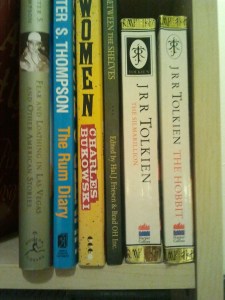
cropped-cropped-blogbanner13.jpgToday, we have an exclusive treat for all our fans. Below, you’ll witness photographic evidence of the good folks at Brad OH Inc. taking their rightful place among legends.

SAMSUNGDon’t forget to pick up your copy of ‘Between the Shelves: A Tribute to Libraries by Edmonton Writers‘ by clicking the image above.

-Brad OH Inc.

‘Between the Shelves’ Kindle Version Available and Brian Clark Interview

cropped-cropped-blogbanner13.jpgToday, we’re happy to announce that the Brad OH Inc. and Hal J. Friesen edited Anthology ‘Between the Shelves: A Tribute to Libraries by Edmonton Writers’ is now available in both Kindle ($2.99) and Paperback ($12.50) copies at Amazon.com. All proceeds are to be donated to the Edmonton Public Library System.

BetweenTheShelvesCoverTo celebrate, we have an interview with Author Brian Clark, who appears in ‘Between the Shelves’.

This interview was conducted by Hal J. Friesen in anticipation of the anthology’s release:

Brian Clark first opened his eyes to the midsummer sun in the year the TV remote and Silly Putty made their debuts. Despite these distractions, he soon formed a lifelong affinity with libraries. It is now his pleasure to contribute to this collection of short stories. Over the years, he honed his storytelling skills by preparing letters for politicians. More recently, the newsletter of the Millwoods Seniors Activity Centre has published a number of his articles, where the opinions expressed are his own.

  1. How has your experience working with politicians impacted your writing?

BC: It taught me to avoid getting emotionally attached to the words I’ve written as they were always changed in some way.  I think this prepared me to embrace both self-editing and that of others.  I practiced writing in a way which gave the politician ‘plausible deniability’ if things didn’t turn out as expected, but could also be seen as a triumph if policies were popular.  With practice, hints and half-truths became stock devices.

  1. Is Becca (protagonist in the story) based on anyone in your life? 

BC: My daughter had a job at a library for a couple of years so that gave me an insight into the duties of a Page. She would sometimes tell me stories about children being left in library while a parent went to shop in the mall, forgetting the children. My daughter also maintains friendships with a couple of the other former Pages. In this story, I tried to work with stereotypes of a teenager, her parents and her boss and let that tell me how they respond to the circumstances they found themselves in.

  1. You often use music and lyrics as inspiration for your work. Can you describe the role that music plays in your writing and why it’s so important to you? 

BC: One of my skills, I think, is to mono-task so I don’t use background music. Music is either on or off. When it is on, I try to really listen to the piece.  Sometimes it’s just a mood I pick up on, at others it’s a few words from a verse. I don’t feel obliged to stick to the songwriter’s perceived intentions preferring instead to use the work as a diving board from which to launch my own thoughts. One of the roles of the arts in general is to look at life and distort it a little. For me, music is a reservoir of these refracted images.

  1. What is your educational background, and how do you think that has shaped you as a writer?  

BC: I left school a couple of weeks before my 16th birthday, but 18 years later I had accumulated the paper qualifications, maturity and money to go to University.  I left with some great memories and a degree in Cultural Studies.  I learned to research my work and to write to a deadline, but perhaps most important of all, I developed a curiosity.  In the last couple of years, I have completed 15 to 20 MOOCs [Massively Open Online Courses], including several on the history of rock ‘n’ roll. Life itself has been just as important as structured learning. I have lived on 4 Continents, although only briefly in Asia, collecting life lessons along the way. Jobs have included, hotdog vendor, Santa photographer and courier, most memorably delivering flowers on Valentines Day.  These experiences serve as a bank from which to withdraw both incidents and characters.

  1. Who has inspired you as a writer? 

BC: It sounds mushy, but my wife, Leny, and my daughter, Brenna have edited my life for longer than I can remember. They have not only given me the freedom to pursue whatever is in the air, but also encouraged me to do so. At the same time, they have gently curbed my excesses and prevented self-inflicted disasters. Their presence in my life remains inspiring.

Brian Clark’s story “The Turning of a Page” is featured in ‘Between the Shelves’, which you can purchase now on Amazon.

-Brad OH Inc.

Profits and Prophets

Under the Green Desk Lamp…

Green Desklamp

Words are powerful things. They are our chief means of communication—assuming you can move past all that ‘body-language’ mumbo-jumbo—and thus serve as our key to expressing all ideas, plans, and opinions about the world around us. They allow us to apply labels, transfer knowledge, and express complex concepts to one another—passing information along and allowing it to grow across generations.

Words are the building blocks of language. They afford to us the ability not only to share our thoughts with one another—but to comprehend them ourselves. They apply meaning and value in a world of chaos; functioning to give context and relevance to what may otherwise be inconceivable. In an earlier article, we’ve actually covered how intangible it is to consider a world ‘Without Words’.

Words have the ability to convey great and terrible concepts—elevating us above the mire, or dragging us to the depths of despair. In this strange world or ours, there are even words which are considered too heavy to be spoken, whether because they are revered as sacrosanct, or reviled as curses.

Lately, there are two words in particular which have been troubling me. They are phonetic-twins: identical save for their spelling, and their meanings too have become all too dangerously similar. These are ‘profit’, and ‘prophet’.

Profits refer to the net gains made by an institution: usually monetary. In times like these, with corporations pulling the reins of government, and the media touting the notion that true ‘freedom’ is for the marketplace alone, profits have become the apple to the wild horses trampling all good sense and civility from our society.

Citizen interests are sold out for profits. Veterans are left homeless for profits. People suffer and die without healthcare in defense of the all-mighty profit-margin. Profits, profits, profits. They’ve become the sole respectable merit, and the defining drive of a corporate machine racing driverless, determined only to see how far it can go, how long it can persist. It seeks profit, and any destruction caused in this pursuit is justified so long as it has no effect on the net-gains.

We’re often reminded of what is owed to us: this illusive promise of life, liberty, and happiness. Of course, we are further assured, money cannot buy happiness. So it’s up to us to find on our own…just keep your hands off the profits.

Prophets are those people considered to speak in place of god or any other deity—often via divine inspiration. Like our recent discussion on the ‘Insidious Threat of Legacy’, prophets often represent an increasing distance from the so-called source material, and too often become cited as justifications for acts of violence and other atrocities which can in no other way be reconciled with their foundational beliefs.

It’s as prevalent a threat today as it ever has been.

Wars are waged in the name of prophets. Buildings are toppled in reverence to prophets. Ongoing conflicts over which prophet is to be trusted and which to be eschewed continue to enable the endless global uncertainty to which we are all subject.

Profits, and prophets—they aren’t so different in the end.

Both represent the false ideals of a misguided population. A life led in reverence only to that which can be gained; a sacrifice of ideals in order to defend the sanctity of a decaying value structure. Many religious communities seem to have turned away from worship of their actual gods, and are defined now by strict adherence to the prophets who have interpreted them. So too the governments of the world—who have turned away from their true purpose of protecting their state and citizens—wooed by the unscrupulous practices of corporate lobbyists who promise to redefine the national priorities.

How can these threats be rectified? If profits are not the only sufficient motivator for directing the course of society, and if prophets have proven an insufficient source of moral guidance, then where are we to turn?

If the value of profit is in what it can accomplish, and the value of prophets is in the ideals they represent, then perhaps chasing these equally-listless sources is the wrong approach entirely. Here at Brad OH Inc., we would encourage everyone to take some time to consider the foundation beneath each of these—and that is value.

What really matters to you? If you had all the profits in the world at your disposal, what would you make of them? If you could speak as a prophet to the people, what wisdom might you impart? If you are honest with yourselves, we believe you’ll find the answers are not so dissimilar. More importantly, and herein lies the essence of the issue—you may find that both profits and prophets are red-herrings, distracting us from what true happiness might already be available to us, if only we can disavow ourselves of these tired and misaligned notions.

-Brad OH Inc.

Brad OH Inc.: Resolving Issues on Demand!

cropped-blogbanner1.jpgNow calm down. You haven’t gotten lost. We’ve redesigned the site a little, hoping to better meet the needs of our readers. One of the main motivations of this was to provide better access to the ‘Comment’ button, which you’ll now find represented by a speech-bubble directly to the right of the article title on the main blog page, or a text box at the bottom of the specific article page. You can use it right now to let us know what you think of the new look! This change is just a small example of our commitment to our dear readers, but that’s certainly not the full extent of it…

Here at Brad OH Inc., we’ve covered a lot of different topics over the years, and unquestionably solved a lot of important issues. With the ‘Under the Green Desk Lamp’ category, we’ve explored our deepest understandings of life and meaning through ‘The Metaphorical Imperative’, and also written a formal apology to our (potentially…) evil twin ‘Jeremy’.

The ‘Purely Speculation’ banner covers our exploration of all things political. Here, we’ve discussed the ‘Concept of Society’, and also did an in-depth expose on how current political trends have broader ‘Global Implications’.

Finally, our ‘Requisite Things’ topic has been used to forward our own Corporate agenda, with topics ranging from ‘Corporate Religion’ to the importance of ‘Corporate Security’.

That’s a pretty broad spread of topics we’ve put to rest, but what we here at Brad OH Inc. have been wondering is, what do you want? That’s right, today we’re reaching out to our readers, polling opinion to better understand what’s most in demand. Do you want to see more of any particular article type? Or maybe more of our ‘Single Serving Stories’? Well, for a limited time only, we’re open to your suggestions.

We have a lot of potential topics coming down the pipeline, along with some surprises totally unrelated. But being the caring and commercially motivated Corporation we are, we thought it only prudent to turn it over to you, our dear readers.

What type of article do you prefer? What key happenings would you like us to resolve for you and the rest of the world? If you have any general topic, or even a specific issue you’d like to see the infallible brain-trust at Brad OH Inc. elucidate, then leave your input in the comments via the link above. You never know…we just might answer!

-Brad OH Inc.

The Golden Goddess

Under the Green Desk Lamp…

Green Desklamp

They’re still out there. Oh, make no mistake about it; we still have our Gods and Goddesses.

It’s not religion I’m talking about. Not per se.

This is about the real Gods. The ones which move behind the scenes, the ones we actually look up to.

Gods and Goddesses abound in a place like this.

Made in his image—and all that.

I saw her with my own eyes: the Golden Goddess.

Until then, I didn’t even know I was looking for her. But passing through the supermarket, spending money to fill the void, she appeared before me at the magazine rack.

Hair flowing like spun gold, tussling over bronzed shoulders and cascading down a back arched with the pernicious poise of a predatory cat.

Her eyes shone like emeralds, gleaming with wanton hunger, and the eyebrows above were perfectly symmetrical, curved and inviting.

Her suggestive look left no room for misinterpretation.

It was only a passing glance. Then she was everywhere.

Every passing girl had touches of her within them.

All painted up in their revelations.

All decorated in their sacred garbs.

All repeating their hallowed sacraments.

All falling short.

Every man seeks her, and every woman strives to be her.

There are Gods as well.

Bound with muscles and tall as pillars, they call with different voices but similar promises. They tell you about things you’ll never achieve.

Paradise withheld—but almost attainable to the most prudent and savvy.

It’s something to strive for. At least in lieu of anything real.

They have bodies like humans, but more so. Digitally retouched beyond earthly proportions; sexual beyond human expectation.

Sex sells. It’s the most paid and prayed for thing there is.

And once you’ve known a Goddess, no earthly being comes close.

It’s happened to us all.

We chase our Goddesses, hoping to become a God.

We spend our money in pursuit of the holy ideal.

We withhold our affections for hope that our own Goddess is just around the corner—hold out, have faith.

You’ll never have one. You’ll never become one. They aren’t of this world. But for each deficit you find, you know there’s a solution down the next aisle.

Then another deficit, another product.

Flex your muscles alone in your room, hold them up to his.

Dye your hair.

Skip your meal—avoid temptation.

Push your breasts up in the mirror and let your proud shoulders fall along with them.

It can drive you mad.

But you’d have to be mad…to believe these things are real.

Yet you can’t risk giving up the chase. The rest are all so active, so close.

You can’t fall behind.

The next choice you make could get you to the Promised Land.

Who knows?

Why not?

What else is there to do?

Just keep your faith.

Just keep chasing the dream.

Just keep spending.

Maybe you’ll find her.

Maybe you’ll be him.

Maybe if you keep focussing on them, you’ll never have to see yourself.

-Brad OH Inc.

‘Of Pipers and Pigs’ Published on GonzoToday

cropped-blogbanner1.jpgWell, we have some exciting new today for all our fans here at Brad OH Inc. One of our ‘Single Serving Stories’, ‘Pipers and Pigs’, is now up for viewing on the incredible new site, Gonzotoday!

A direct link to this publication can be found here: ‘Of Pipers and Pigs’ on GonzoToday.

Gonzotoday is a new group dedicated to the creation and celebration of new age Gonzo Journalism; carrying on the admirable tradition of the late great Dr. Hunter S. Thompson in bringing the world stories of heavy import and sincere meaning wrapped in the rage and vitriol inherent to writers with open eyes.

The site has a lot of fantastic work on offer, so be sure to visit at Gonzotoday.com.

One thing you’re sure to notice upon your visit to this publication of ‘Of Pipers and Pigs’ is the incredible new artwork, conceived and created by the divine talents of the staff over at GonzoToday.

This is a serious change from our standard fare. If you’ve taken the time to peruse our selection of ‘Single Serving Stories’ in the past, you’ve probably noticed that the cover art for each sits somewhere between childish-cute and insultingly unbearable. Well, it’s true—the pencil-necked nitwit we have working in the art department at the moment is something of a pariah around the office, and achieved his position only by merit of dubious references and claims of knowing Brad OH.

Needless to say, his contract negotiation skills far outshine his prowess in the art department, but with a little time, we’re certain that the Corporate Efficiency Streamlining process will forecast the end of this sad little dweeb in no time.

Ahem…

Anyways, that’s enough ranting for now. Today is a day to celebrate after all, and what better way of doing that than swinging by Gonzotoday and reading ‘Of Pipers and Pigs’, or any of the other fine pieces available there?

-Brad OH Inc.

A Formal Tour of Brad OH Inc.

cropped-blogbanner1.jpgHello out there to our fine fans from everyone here at Brad OH Inc. Today, we thought we’d take the time to provide you with a formal tour of the place. After all, we know that fans of Brad OH Inc. hail from around the globe, and come from all walks of life and educational backgrounds. So if some of you can’t figure out how to use the navigation tools provided, or pale at the thought of exploring the page options on the top menu bar, we understand.

It’s our duty, as the responsible corporate entity we are, to ensure that even the simplest among you have the information necessary to get the most from your time here at Brad OH Inc.

Let’s start off with the (semi)weekly posts. Now, these posts, made most often each Sunday, are meant to be pretty straight-forward, and are even tagged under a variety of headings to allow a sense of the theme or topic right from the get-go. But that might be a little intellectually demanding for some of our less cerebral fans out there, so let’s just go ahead and outline the various post categories, and what exactly they are meant to represent:

(Note: You can click on the title of each category below to go straight to a list of all posts made in that category. This can also be done at any time via the little drop down menu directly to the right marked, ‘Post Categories’.)

Under the Green Desk Lamp:

‘Under the Green Desk Lamp’ is a regular feature here on Brad OH Inc. This category is the place for any sort of random musings to come off the reporting desks here at Brad OH Inc., and may cover such varied topics as philosophy, society, media, music, etc.

Disclaimer: The views and opinions expressed in the articles of ‘Under the Green Desk Lamp’ are not necessarily the views and opinions of Brad OH Inc.

Purely Speculation:

‘Purely Speculation’ is a series dedicated to facilitating conversation on key political issues. It’s an open forum for Brad OH Inc. contributors to voice their opinions on any matter associated with political direction–ranging from economic systems to globalization. Each article is meant to stand separately, and it’s the hope of everyone at Brad OH Inc. that these myriad opinions lead to some productive debate among the readers here at Brad OH Inc.

Disclaimer: The views and opinions expressed in the articles of ‘Purely Speculation’ are not necessarily the views and opinions of Brad OH Inc.

Requisite Things:

‘Requisite Things’ covers all functional topics here at Brad OH Inc. (just like this one). This is an opportunity for all of us here at Brad OH Inc. to address the reader directly, without the fanciful obfuscations inherent to ‘creative liberty’ and ‘artistic license’.

Disclaimer: The views and opinions expressed in the articles of ‘Requisite Things’ are the express property of, and directly reflect the views and opinions of everyone here at Brad OH Inc.

That covers the basic categories for our weekly posts, but there’s more than that on offer here at Brad OH Inc. Along the top of the blog, just under our stylish Corporate banner, you’ll see a menu with several different options on it. The first two (‘Home’ and ‘About Brad OH Inc.’) should be pretty self-explanatory. If not, we very much doubt we can help you in understanding, as any efforts on our part would inevitably be suffocated under the crippling weight of your own illiteracy.

As for the other two menu options, these will take you to separate pages within the Brad OH Inc. blog, each dedicated to some of the bigger projects coming down the pipe from the contributors here at Brad OH Inc.

They are as follows:

(Note: You can click on the title of each page below to go straight to that page.)

Novels:

This is where you will find the novels currently underway here at Brad OH Inc. While all are currently in various states of completion, you can read about the general premise at this time, as well as view the gorgeous cover art for each.

Single Serving Stories:

Brad OH Inc. is proud to be able to offer its fans quick, accessible reads. Who’s never arrived home from a long days work, looked at their dusty TV screen, their tired old I-pod, or their unaffectionate spouse and thought- ‘You know, what I need is a nice short story.’

Well, we heard you! This page is a place to keep track of all the short stories released here at Brad OH Inc. Feel free to browse, download, and share. Indeed, we live in a world of single serving meals, soaps, relationships and sincerity, so why not crack open a single serving story and enjoy yourself?

Each and every ‘Single Serving Story’ can be downloaded directly to your computer from the links provided at the end of the descriptions. This will take you to ‘SmashWords’, a free online publishing site. From there, you can choose your format and download completely free. We recommend PDF, but there are other options as well. All stories are completely free of charge.

Finally, a few other tools exist to help you get the most out of your time here at Brad OH Inc. On the right, directly under the ‘Post Categories’ drop-down explained above, you’ll find a couple of options to help you keep in touch with us here at Brad OH Inc.

Firstly, you can click to sign up to the blog. This option will provide e-mail notifications whenever a new post is made, ensuring you’ll never miss a story.

Secondly, you can opt to follow our official fan-page on Facebook, which will provide updates for all posts and happenings related to Brad OH Inc.

The Gravatar profile provides a bit more information on this writer, while the ‘My Books on Goodreads’ link provides access to the Goodreads profile for all published works from Brad OH Inc.

Well, that about sums it up folks—a comprehensive tour of everything we have on offer here at Brad OH Inc. Hopefully this helps you get the most out of your time here, because if your lack of understanding keeps you from realizing just what an excellent service we provide, then our product doesn’t grow, and that means we just aren’t doing our jobs. So familiarize yourself with the site, and spread the word—it is the first Central Commandment of the ‘Corporate Religion of Brad OH Inc.’, after all.

-Brad OH Inc.

The Uncomfortable Issue of Population Control

purelyspeculationLast week on Brad OH Inc., we discussed the old and misconstrued ‘Fear of Big Government’. In that article, we explored the common revulsion toward the notion of government intervention in the lives of its citizens, and the ubiquitous but erroneous assumption founded by the repugnant Ronald Reagan that we need to get government ‘off our backs’.

The core thesis we developed in that article was that while the actions of many governments have been less than desirable in both past and present, the true purpose of government is the protection and promotion of its citizens—a function which should not be feared but rather revered. To these ends, there are certain central domains in which government control must undoubtedly be focussed, primarily: healthcare, education, infrastructure, stable wages/ living conditions, scientific research, promotion of environmental concerns, and access to food and water.

This is admittedly a very basic list, but it does provide a functional framework for government interventions. All efforts in these areas must—in any democratic government meant to represent the people—be aimed not at increasing profits for corporations and special interest groups which line the pockets of government officials, but rather at solving problems and promoting the general welfare of the electorate.

A quick peruse of these topics will, however, reveal one common and absolutely key concept for any government hoping to moderate over a well-functioning society; the uncomfortable and cringe inducing issue of population control. While money must never be the dominant issue guiding government practice, it certainly is an important concern when discussing support of citizens balanced against fair taxation, and as such the population size of a country is a crucial consideration.

Perhaps ‘population control’ isn’t the right term. Depending on where we are going with these notions, a better term might really be ‘population management’. If a government is to promote equity and access amongst its citizens, then central to its task will be the ability to understand the size and growth rates of its populace, and design an intelligent and functioning society to accommodate this.

At present, the ongoing fear of big government is serving its role well, rallying citizens to follow the lead of the unscrupulous political right in decrying government involvement in anything that might possibly help the general welfare and direction of the nation, while allowing it only in promotion of economic gain for involved parties. The results are clear as day; it’s a strange and subversive sign of the times, that it’s our poor who grow fat as our rich stay healthy.

Corporate needs dominate the political spectrum, poisoning our citizens and environment alike as record profits are posted and the ‘free-market’ is heralded as a success.

Naïve fools the lot.

So if turning the reigns over to profit-driven corporations and entrusting them to care for the people of the nation isn’t the right approach—and it most certainly is not—then what is?

The key issue here is not whether we must change the current system, but what system will fill its stead. An issue like population management is a heavy one to discuss beyond doubt, but it must be addressed directly and with honesty intention if we are to avoid it’s becoming a taboo issue discussed only behind closed doors by parties of questionable motives.

It is a driving issue, and must be discussed by the whole of the population to be managed. For even if we deny the issue, it will be a key factor in how we manage our economy, food stores, treat the poor, provide education and healthcare, etc.

Clearly, the more people exist, the more demand for resources, and in an unideal world, hence more scarcity. Even if we learn to plan our resources around population, and ever increasing population would lead to heavy sacrifices rather quickly. Ultimately, when it comes to the effective management of a population, there are, as I see it, essentially three basic approaches.

The first approach would be to simply accept that some people are less entitled to the productivity of mankind than others. This is most similar to our current approach. In this scenario, resource access would be determined by factors such as social standing, property/ business ownership, socio-economic status, and more broadly, location of birth.

Taking a stand such as this one, resources would be divvied up by priority, with some people gleaning great wealth and prosperity from our system, while an ever-increasing number receives very little.

A second approach—and the one which makes this such a delicate issue—is the more conventional definition of ‘population control’. A policy like this would demand a clear account of extant resources, and a broad understanding of what sort of lifestyle citizens are entitled to. From there, it would be a simple matter of division to determine the ideal size of the population, and steps—ranging from sterilization, birth limits, eugenics, or population culling—would be taken to make the numbers match.

This scenario has been enacted several times in the past, and represents some of the darkest and most horrifying eras in human history.

Neither of these approaches to population management result in the sort of society that I—and I should hope any of my readers—would hope for. So then we are left with the question, if not these failed methods, then what?

Given the incredible state society has managed to reach in spite of our past missteps, and the unspeakable potential promised by a commercially freed and unleashed scientific community, I believe we are entirely capable of creating a third, more ideal solution. I have little doubt that the combined power of modern computing, science, and human vision is able to design a system to monitor and anticipate both changes in population size and need, as well as existing resources. Such information would allow for a more dynamic and responsive means of addressing scarcity.

Further, in order for such a system to be created and maintained, increased government funding would be necessitated towards science, education, and healthcare—the lot of which would perforce be universal human rights if we are to expect any positive shift in the direction of our society.

A streamlined scientific community, coupled with an economy dedicated to the positive growth of culture and equity, would be fully empowered to find creative solutions to production, provision, and other means of positive population management through a system motivated not by profit, but by simply improving the general human condition.

Furthermore, one key long-term goal would be that of interplanetary exploration. This would provide for both an alternate source of resources, and ultimately alternate planets to inhabit and build upon. But this might be better discussed in a… future article.

The roots of these convictions have already taken hold. Examples range from innovative solutions to solving urban food scarcity (Link), to active attempts at subverting the mounting energy crisis (Link), to community based food-sharing programs (Link). It is by examples such as these that we will work actively towards solutions, rather than merely using obfuscated politics to justify corporate-manufactured deficits.

The end-goal here is to plan for the world we want to live in, rather than cope with the one we’ve created through greed and ignorance. But first, we need to change our priorities. A culture which focusses solely on profit, and defines freedom strictly in market terms, is forever doomed to the scarcity and inequality inherent to such ideals. It is science, not business, which must be unleashed; that, and the passion of earth’s good people—determined to build a better world. On this front at least, I remain convinced that scarcity is not an issue.

-Brad OH Inc.