A Time for Greatness

purelyspeculationWe closed off last week’s article, ‘The Heights Flags Dare Not Fly’ (Link), with a heavy-heart and an ambiguous question—who now to rise up and fix this mess of a world we find ourselves in? It is—at the very least—a rather serious imposition to place upon even the best of us, yet it’s unlikely to be the wisest or the most experienced who must take up this burden.

The media is unreliable, our politicians are primarily dishonest, and true political agendas are withheld from the public in exchange for reality TV and infomercials—bread and circuses for the less discerning masses. Meanwhile, the environment is failing, ISIS is killing at will, and the political balance of the ‘free-world’ shifts ever towards the uninformed yet brutally reactionary.

One particular trend—the disturbing rise of Donald Drumpf (Link) in the American Primaries—paints us an especially lamentable picture. Specifically, we see for perhaps the first time beyond question that a vast number—if not a majority—of voters are uninformed, uneducated, or simply uncaring enough to let such a malignant presence grow in their midst.

A brief consideration of the current polls must lead us inevitably to one disheartening question about democracy, and ourselves: If this is what people are voting for, is this what we deserve?

The simple answer is, perhaps, yes. But fortunately for the thinking portion of the populace—and evident, as a rule, to them alone—things are seldom that simple. The very systems which are failing us act as reinforcing factors here: and in this instance, a crumbling educational system is the most likely culprit.

Education can improve, but it must be set as a priority, and sadly, the powers gaining their foothold now are unlikely to address this need in any productive way. The very leaders we choose are those keeping us dumb, and the cycle gains momentum. This is precisely why it’s time for great leaders and big ideas.

We must look to ourselves then, if we harbour any hope for reprieve. As we covered in our article ‘On Political Participation’ (Link), political sides and interests don’t matter so much—all that matters is right action. It will be individual integrity which lights our way from these dark times, and the steadfast resolve of those who come after us that will clear the mess we have left behind.

It is most likely to be the children who muster the clairvoyance of thought and the resolution of will to find the answers, and well-suited they are to this task indeed. With the internet constantly at their fingertips and a connected world being all they’ve ever known, the youth of today are far better equipped to understand the Global Scale (Link) than any generation before them.

So in such desperate times, we must not lament for better days. It is in the darkest hour that we must expect the truest grandeur—for great heroes to rise and the will of men to turn again to what is right. Now is no time for anger or cynicism, or to retreat into the comfort of what is familiar. Change is happening as we speak—history is being written. It is incumbent therefore for all people to find their inner decency, and to let it shine out all the brighter to light our way through the shadows of doubt.

It is upon you then—the reader—and the youth among you especially, to consider what sort of world you want. The questions of our day have been asked, and the tumult and turmoil we are experiencing have set the stage for the great actors to come forth. The question then, dear readers, becomes simply: Will you answer that call?

-Brad OH Inc.

The Heights Flags Dare Not Fly

purelyspeculationAside from writing, a significant portion of my week is comprised of driving to and from schools. As a result, I’ve recently made a disturbing observation. It seems to me there is seldom a day which goes by that the school flags are not set at half-mast.

I’ve noticed it far too often to chalk it all up to an observer or expectation-bias, and ever since noting the strange trend, the evidence has only mounted. Truthfully, I can quite accurately make the call as I head out in the morning—I can go through my entire day, and I won’t see a single flag flying at its full height.

For a while, I would try to play recent newsfeeds through my mind, sifting through the long lists of tragedies to try and pinpoint the precise reason why the flags might be lowered. Another bombing in a far off country? A videotaped execution becoming a number one hit on YouTube? Missing indigenous women? A recent school shooting? It’s hard to keep track—and that’s likely one of the most cold-hearted thoughts that’s ever crossed my mind.

Sadly, the fact is there can hardly be a day that goes by when it would be appropriate to fly the flag high. Tragedy is abounding at every turn, and we need never look too far to find some reason to keep the flag at half-mast, and our hearts shrouded in mourning. Indeed, even the briefest purview of recent events will surely be enough to convince any feeling human that to hoist the flags to their full height would be an act of callous audacity.

It made me wonder; has it always been like this? It seems that no matter how far back we look, the world has been mired in a constant string of atrocities and calamity. Are they more common now? Is our instant access to world-wide media making the situation seem more dire than it is, or could we truly be approaching the so-called ‘brink’?

For years uncounted, people have felt that society is falling apart and the world as we know it is coming to an end. Plato famously criticized the youth of his day (~340BC) by lamenting that “The children now love luxury. They have bad manners, contempt for authority; they show disrespect for elders and love chatter in place of exercise.” It remains a familiar feeling to this day. Every generation grows to worry about the future, and fear that the youth set to inherit this fragile little ship of ours will not be up to the task. Doomsday prophecies, threats of revolution or decay, and predictions of cataclysmic environmental disasters have maintained a place beside weather and work as some of the most ubiquitous topics for daily conversation.

But if the flags these days are any indicator, such anxieties don’t seem far off the mark. Our environment grows worse by the day, and those working to save it are embattled from all sides by those who seek only profit. So too with human rights, fights for equality, and pleas for representation. Gun violence runs rampant—challenged for the crown of ubiquity only by poverty and the failing light of hope in the hearts of the needy. Explosions rock the world hourly, cold-blooded death-cults call for our heads, and here in the ‘free-world’ the echoes of long-forgotten jack-booted feet and beer-hall bravado once again eke their way into our political conscience.

Those naïve few who proclaimed that the age of racism and hatred were behind us now hang their heads in shame, and once again the shadow of ignorance spreads across the map of our future. Standing as we are on the brink of such chaos, sky-lining against the half-lowered flags, one can’t help but wonder how close we are to that brink, and what it would take to finally shove us over?

Will it be like the most recent financial crisis? One panicked businessman making a knee-jerk move over night? A chain-reaction of self-serving backroom deals that sell the rest of us down the river? Will it come like daggers in the night, or will it come, as the old adage goes, wrapped in the flag and carrying a cross? Will there be martial law? Riots in the streets? Baffled TV-reporters mumbling through static-filled screens? Smoke and strife, or stony silence?

That I cannot say. It may be all, or more likely none. It may well go unnoticed, as it has for so long already. One small change, then another, all wrapped in the propaganda and misinterpretation so definitive of our times. But none of that concerns me. The road ahead is already laid, and I look not to how its course runs, but rather to who will travel it.

Again, my thoughts turn to Plato, and the defiant children he so sorely lamented. They are still around, and indeed it is them who we should be watching most intently. But perhaps that’s another issue entirely, and one we’ll cover in greater depth next week.

-Brad OH Inc.

A Fool Not Just in April

Under the Green Desk Lamp…

Green Desklamp

There’s a funny thing that happens right around this time of year. On the first of April each year, we observe a weird little day called ‘April Fools’’. This glorious day is a long-time favourite for pranksters and mischief-makers the world over—as jokes are played, tricks enacted, and terrible deceptions perpetrated by one friend upon another all in the righteous pursuit of naming another as a fool.

The possibilities are endless! Saran-wrap over the toilet seat? Check! Sardine Paste in the toothpaste tube? Check! Brutal lies about the health or general well-being of distant loved-ones? Yeah, even that might pass. But recently, one phenomenon has illustrated an especially troublesome habit of humanity—and shown us perhaps that the day of fools is a boon for the few wise people among us.

See, one irresistible opportunity for news pundits and bloggers alike is to post semi-believable yet entirely unreal stories for public consumption on April Fools’ Day. The writer will let the speculation and doubts run roughshod until noon, then coolly—and doubtless with an air of overplayed coyness—reveal the truth: namely, that it was all a ruse.

This all seems harmless enough. The thing is, it’s been going on for a significant enough stretch of time that anyone with half a clue and access to the internet for more than a year knows just what to expect, and rises each April 1st donning the armour of suspicion, and brandishing their sword of rational-inquiry. Each article they see is taken in with a discerning eye. Facts are weighed against probabilities, and anything doubtful is cross-referenced against other articles.

Dates are checked, names researched, local obituaries are pored over for accuracy, and for one day, all sources of information are taken in with a critical eye, hell-bent on sussing out the truth from the trash.

All things considered, it’s a pretty wonderful day!

But then something unfortunate happens. The sun rises on the second of April, the bathroom floors are disinfected, toothpaste tubes replaced, and loved ones are given a brief check-in call with a pre-arranged excuse to hang up after a few minutes small-talk. Then, everything returns to normal. People eat their breakfast, kiss their spouses and children, go to their jobs, and then sit slack-jawed and dumb-founded at the torrents of bullshit flashing across their screens in the name of ‘news’.

‘You won’t believe what…’

‘What happened next will leave you speechless…’

‘Local mom makes $900,000,000 in one hour, when you learn how you’ll…’

‘THIS CHANGES EVERYTHING!!!’

They sit with eyes glazed over as they work their fingers along their mouse, taking it all in, following the currents of their newsfeed like Job waiting on fairer winds. It’s all accepted, all welcome, and none of it is ever second-guessed.

It’s a sorry fact that when not actively warned by our calendars that the news just might not be as accurate as it’s purported to be, people forget the concept entirely. But rational thought is not a novelty to be toyed with once a year, only to be dusted off and returned in mint-condition to its little glass case marked ‘Open April 1st’. Rather, it is a tool to utilize daily, to ward off the perils of misinformation—deliberate or not—and exercise the full potential of our humanity. As rational creatures living in an often irrational world, the onus of critical consideration of news media is on us as consumers. It is a matter of education, of self-protection, and more importantly, of intellectual integrity.

So let us not forget, good people, that there may be but one day a year where we are free to name each other as fools, but that leaves 364 days each year where the names do not fly so readily, and we are left simply with an opportunity to prove the fact for ourselves.

-Brad OH Inc.

A Shameless Plea for Virtue

Under the Green Desk Lamp…

Green Desklamp

I work and hone and search and seek,

To find those things which I would keep,

Within my heart for times ahead,

When I make good the things I’ve said,

I’ve heard the call to love and grace,

But still I train to take my place,

For charm and fun I have my knack,

But my true calling I still lack,

Good Captain help me set my sails,

And teach where my own lessons failed,

To raise with wisdom, strength and heart,

To tend the light that now grows dark,

For what is strength and decency,

When shorn from faith and purity,

For pride and lust and greed and wrath,

All tempt me from my given path,

And when lost deep in the forest,

One path seems as good as the rest,

But still to make it right I know,

There are yet saplings that must grow,

And bring to blossom charity,

And set within me clarity,

That I may hold to what is right,

And cower not at fall of night,

So at the closing of the day,

This one and final thing I pray,

Of vices I have had my fill,

And wait with baited breath until,

Good lady take me by the hand,

And guide me to that Promised Land.

-Brad OH Inc.

On Political Participation

purelyspeculationWhat does it really mean to be politically involved? As the fortunate (if primarily happenstance) citizens of one of the most free and democratic nations on earth, some level of informed political involvement seems like a given. No argument can be made that our hard-fought right to vote is an inalienable extension of our citizenship—and one that should undoubtedly be utilized in a well-considered and informed matter.

Sadly, in a world where so much is secure, people are often far less passionate about what they have. If voting were to be taken away, there would surely be riots in the street, and a full-scale political revolution to follow as people realized the worth of the vote when faced with its absence.

Yet all too often, the simple act of voting feels like a chore. In a world so blessed, it can seem that one choice is as good as another, and there seldom exists any true fear that the rights and freedoms we don’t even know we enjoy might ever be taken away.

And so voting becomes an apathetic duty—inspired all too often by a simple knee-jerk reaction. Vote for your party, or your dad’s party, or the politician with the nicest hair, brightest smile, or genitals which match your own. At any rate, for the vast majority of people, the simple act of dropping their card into the box will suffice to add a patriotic swagger to their step as they exit the polling station and turn their feet towards the nearest fast-food outlet.

But in this time of failing systems and warring factions, it may be that simply casting a ballot every few years is not enough. The political environment these days is a much more confusing and twisted affair than most people are even capable of considering, as we have covered in depth in previous articles such as ‘The Global Scale’ (Link).

Entire political parties are bought and paid for by nefarious and self-serving Corporate interests, and politicians are willing to pull off whatever sort of unthinkable atrocities it takes to keep them in office and pleasing their financial benefactors. It’s a heinous affront to the notion of elected representation, and renders the artful marking of a ballot about as effective a tool of political expression as your common soap-box evangelist’s wailing into the wind.

So the question becomes—what does it take these days to be politically involved? Based on the quagmire of modern politics, voting simply isn’t enough. The sheep has little concern for which wolf eats it in the end, and choosing the flag of the political party which will strip away your rights and sell them to the highest bidder is far from the lofty ambitions of universal-suffrage.

Similarly, loving your country blindly is also quite a stretch from any true means of involvement. It is the sort of affection a child has for a babysitter who gives them late-night candy. Affections can be easily won and are defended passionately, even when everything about the relationship is harmful. Just ask any divorce counsellor.

So voting will not suffice, and patriotism is only turning a blind eye. This is turning out to be a bigger question than we may have anticipated. So, as always, we must do what we always do when met with a difficult question—and that is, dear readers, to ensure that we fully understand the question, and can define the its terms.

True political involvement, for the purposes and intentions of this discussion, must mean to have an active role in defining the state and outlook of your nation (or perhaps more fittingly, your society in general). It means taking an active role in creating the sort of society we want to live in, rather than simply doing what we’re told and keeping our flags clean.

If this is an acceptable definition, then perhaps we can make a bit more headway towards our answer. If we want to actively shape our society, the first step at the very least must be to fully understand how it works. It thus behooves any politically involved adult (and burgeoning adults for that matter) to learn the system. We must understand the relationship between economic and social systems, between campaign donations and party values, and between our own actions and laws. This last, more than any perhaps, may hold the crux of the issue.

All too often, the process of political involvement is sickeningly circular. If you’re too young to have watched it go round a few times, or simply too ignorant, I’ll be happy to break down the basic cycle.

  1. The active political party seems to be serving the interests of only themselves and their benefactors.
  2. A movement is started to create a positive change.
  3. The movement gains traction by outlining the specific changes they would make to fix the system. It sounds great. Some people are upset—but there lingers some small hope that things could actually turn around.
  4. The party is elected, and begin to enact their promises. However, these attempts are met with opposition, and compromises are created.
  5. The finalized results don’t seem to quite work for anyone, and everyone begins to take a different approach to meeting their needs. Most of these approaches involve finding some savvy way to con the system, cheat the neighbour, and benefit—despite those shyster politico types!—off the backs of those around them.
  6. The system changes to meet these unexpected results, while maintaining a close eye on the intentions of their sponsors as the next election cycle draws near.
  7. Finally, the citizens take a serious look around them, and realize that the active political party seems to be serving the interests of only themselves and their benefactors.

No doubt about it, the situation is dire. Still, people in the scenario above have taken active efforts to change things. This may be done through grassroots awareness campaigns, in-depth political discourse (an approach facilitated greatly by our access to the internet), selective consumption (don’t like a product, don’t buy it) and many other means of political involvement which lie somewhat outside the standard ‘mark a ballot and drop it in’ mindset.

Yet despite this, things seem to fall apart. Now…why might this be? To the savvy reader (the majority here, I trust) the answer may be obvious indeed. The missing element in the cycle described above is common decency, or personal accountability. The world may never be entirely perfect for everyone—this is a certainty—but even more certain is the fact that no law, or set of laws, can ever be written so soundly as to create positive change in spite of being enacted on a mass of liars, cheats, and cowards. No growth can happen if the citizenry harbour suspicions of their government, and feel thus justified to act in the same manner.

One of the greatest dints in our system at present are large scale Corporations cheating taxes—taking money out of social systems and leaving the public as a whole far poorer for the benefit of a small and select few.

It’s brutality—a gang of thieves running roughshod over the very fabric of society. Nothing can justify such selfishness and deceit—but it can be fought. For it is lies that breed lies, and fear which begets fear.

This isn’t a new idea by any stretch. In fact, we’ve covered this same notion in our somewhat more humorous article ‘In Defense of the Villain’ (Link). Here, we explained how the assumption that everyone else was out to hurt you (and in this discussion certainly, the government itself is the chief example) creates a sense of diffused responsibility. If you cannot trust your neighbor to be honest after all, there is little sense in being honest yourself.

But decency is not a zero-sum game, and if there is still honesty and courage in the world, then so too is there hope. Simply put, if everyone could show even the most basic commitment to living their own lives with righteousness and integrity, there would scarcely be any need for laws at all.

Now certainly, this is a high-minded, starry-eyed sort of claim. Any hair-brained child could tell you that being good makes good things happen, but what most adults forget is that the wisdom of a child is often the truest.

It has been claimed that for a political movement to succeed, it needs only 3.5% of the population supporting it (Source). If that’s true, it stands to reason that if only a small group of people committed themselves to the precepts of right-action and honesty, the world really could change for the better. Should this fall on one political party or another? Should it fall on a specific religious creed, or cultural identity? No. No, no, no, you damnable fool. It should fall on you alone.

In the end, the truest means of political participation is to be the best person you possibly can—and to call out any lack of decency or integrity with a furious and justified rage. Never forget it: We are better, we are capable of more—and we need to start acting like it.

-Brad OH Inc.

On Laughing Too Much

Under the Green Desk Lamp…

Green Desklamp

I’ve often been accused of laughing too much. It’s a charge I can scarcely deny. No matter what situation I find myself in, laughter tends to be my most ubiquitous means of communication. Sometimes, it may even be my own jokes I’m laughing at, which I’ve been told is especially distasteful. I’ve always argued that it’s just a matter of having good taste in comedy, but I’m not sure that’s really it.

The fact is, laughter is my favourite thing to do with pretty much anyone. To be fair, I may often claim that my favourite activity is drinking with good friends, or more simply enjoying a lively conversation, but the real crux of it is the laughter. Many of my closest friends and I will often exchange very few full words in the course of a long shared laugh. That’s bliss to me, that’s a connection, and I believe that it’s worth celebrating.

Sure, it can be construed as insincere. When the length of a conversation is marked by incessant joking and laughter—or sarcasm, most dreaded of deceptions—there are many who consider this to be a lack of honesty. ‘Why can’t you ever be serious,’ may come the cry from a pleading compatriot who feels that anything honest must be a solemn and stoic exchange.

But what could possibly be more honest than laughter?

You see, when a good joke lands, and your eyes meet to recognize the subtle meanings as they light up with laughter, there is a fulfilling moment of meta-communication similar to emotional intimacies like love. It’s a shortcut to bonding—an innate reliance on subtle body language to confirm even subtler understandings. More often than not, these understandings rely on past experiences and shared double meanings understood only by those involved. It’s a secret—and the laughter which arises from it is the sweetest of payoffs.

It’s communication and connection in its purest form!

Whenever people share a hearty laugh, their eyes open up to show a brief yet transcendent glimpse into the soul. This is a large part of why I always try to find the humour in everything; that, and the fact that life is just funnier that way.

Ultimately, I expect it’s a flaw I will always maintain—if it is a flaw indeed. To the chagrin of many, I will continue to laugh my way through conversations ranging from the frivolous to the solemn. I will hunt down the double meanings, call back to the shared experiences, and twist words in wonderful and weird ways—in constant pursuit of that glorious moment when the lips crack apart and the eyes shine like stars—confirming that some understanding beyond mere words has occurred, and that two minds have been momentarily linked in the thrill of this shared knowledge.

So I confess it, I am not likely to ever ‘grow up’ as so many call it. I will grow old, but if I have it my way, I’ll laugh right to the grave. A morbidly humorous epitaph would be ideal now that I think about it—preferably heavy on alliteration and innuendo.

Some may never understand this odd compulsion, but for that I offer no apologies. For those that find laughter an inherent roadblock to clear communication, I offer my condolences. For myself, I can only pray to someday be 100 years old, sitting in a wheel chair, hopefully next to a little old lady—laughing boisterously to ourselves. They’ll probably call us crazy. But who would I be to argue?

-Brad OH Inc.

What is Democratic Socialism?

purelyspeculationBernie Sanders has been making a lot of headlines lately. With his recent surge of popularity in both the Iowa and New Hampshire Democratic Primaries, Sander’s unique vision for the future of America seems to have struck alight in the tinder of the American youth.

Unique to Sander’s campaign is a fresh dedication to revitalizing the American political and economic structures alike. While other candidates from the DNC and RNC offer the same tired promises and non-committal platitudes that have been reiterated for decades uncounted, Sander’s is addressing issues relevant to the people: poverty, equality, fair electoral changes, equality and justice. Not only doe he hit these hot-button issues, but he does so in a way few other candidates have dared to do in the past—and none so brazenly.

Bernie Sanders is not playing by the rules. Rather, he is attempting to rewrite them. Bernie’s campaign promises a political revolution that will return the American democracy to its rightful owners—the citizenry of the country—from the hands of the wealthy corporations which currently hold it enthralled.

Most disconcertingly however, is that Sander’s promises all of this change under the banner of what he boldly calls ‘Democratic Socialism’ (Link). That’s where the alarms are set off for a great majority of the voting public.

A seemingly oxymoronic term, ‘Democratic Socialism’ inspires both the comfort and equity of our beloved democratic system, while adding a twist of the dreaded red-scare socialism so reviled in the western world. How can these two seemingly opposite systems be reconciled? How can a candidate in a democratic race so brazenly call themselves a socialist and harbour any chance of receiving the favour of voters?

More to the point…just what is ‘Democratic Socialism’?

To understand this question, we must first distinguish between the two faces of government: Political and Economic. As covered in our article ‘Saving the World 101’ (Link), the Political system is meant to address systems of voting and voter representation—essentially it is the process by which elected representatives are meant to conduct the will of the people. In contrast, the Economic system governs the exchange of wealth, property, resources, etc.

The current condition of the government is what could loosely be described as a ‘Democratic Capitalism’. The implication here should be clear enough. There is a Democratic system for politics, and a Capitalist system for economics. With ‘Democratic Socialism’, the political system would remain a Democratic one, while the political system would be shifted towards a more Socialist focus.

As a point of clarification, this primarily differs from the typically more palatable ‘Social-Democracy’ because Democratic Socialism is more actively committed to the systemic transformation of the economy (Link).

This isn’t an entirely new concept in America. In fact, Sanders himself references the laudable FDR as a pioneer Democratic Socialist due to his economic reforms. Nor are socialist institutions a particularly foreign notion, despite the ingrained fear of the word still harboured by many as a relic of the Cold War. Defense spending, highways, public libraries, Police, Fire Departments, postal services, infrastructure, healthcare, farm subsidies, public schools, social security and more are all socialist institutions. True, they do not cart you off to internment camps after taking all you’ve ever earned—but that, despite the rhetoric, isn’t really what socialism is about.

As established in our article ‘On Bernie Sanders and Changing Economic Systems’ (Link), the focus of socialist institutions is the betterment of society. This stands in stark contrast to the focus of capitalism, which—as the name surely implies—is relegated strictly to the creation of capital. This means private wealth.

Social programs use the productivity of society to keep that society going in a way that is accessible and fair to everyone involved. And why not? After all, society is the product of history—and the bounty of society cannot ever be tied solely to its current operators, but rather to the cumulative work of generations of people. For more on this key distinction, see our article ‘On the Concept of Society’ (Link).

Here we can see that the main driving force of Democratic Socialism is a transition in the motives of the economic system. This shift will take it from a self-motivated and arguably rigged system—in which the rich get richer and the poor get squat—to a system which works for the betterment of society as a whole. A socialist economy would actively promote education, access to services, fair minimum wages, and far more. The intended result would be that every member of the citizenry would truly have an equal opportunity to contribute and thrive. By improving wages, education, healthcare and more, no longer would such a large subsection of society be left to the despair of sickness and poverty as the established powers use their political influence to buy votes and change laws to fit their needs alone.

These are the changes to the economic system. A shift from a focus on capital to a focus on society. As for the political system, this would remain largely the same—at least on paper. While the democratic element remains the driving political focus of Democratic Socialism, the economic changes—most specifically the removal of Corporate money from politics—would render the democratic system far more responsive the needs to the citizenry en masse, thus vastly improving the intended function of the political sphere.

This, I believe, offers us a more clear view on what exactly is meant by the occasionally scary-sounding brand of revolution that Sander’s offers. Democratic Socialism is not a surreptitious villain come to rob you of your earnings in the dead of night, but rather a series of reforms protecting your God-given right to participate equally in, and benefit equally from, the society of which you are a part.

To wrap up, let us examine Senator Sander’s own definition of Democratic Socialism:

“So let me define for you, simply and straightforwardly, what democratic socialism means to me,” Sanders told the auditorium full of students, who’d spent hours waiting in the rain to see the presidential hopeful speak. “It means what Franklin Delano Roosevelt said when he fought for guaranteed economic rights for all Americans. And it builds on what Martin Luther King, Jr. said in 1968 when he stated that ‘this country has socialism for the rich, and rugged individualism for the poor.’

“My view of democratic socialism builds on the success of many other countries around the world that have done a far better job than we have in protecting the needs of their working families, their elderly citizens, the children, the sick and the poor. Democratic socialism means that we must reform a political system that is corrupt, that we must create an economy that works for all, not just the very wealthy.” (Source).

Finally, we can see clearly that despite the dread reserved for anything with a Socialist focus, the revolution of Democratic Socialism is one rooted firmly in the interests of the citizens—not corporate interests or the desires of the Super PACS which have for too long held the politics of the nation in thrall. Democratic Socialism is an attempt to return the freedom and privilege of a free society to the people to whom it rightfully belongs.

It is up to those people, if they so choose, to ensure this opportunity for deliverance comes to pass. A word of warning from your friends at Brad OH Inc.*—you may not get another chance at this.

-Brad OH Inc.

*This in no way reflects the official Corporate interests of Brad OH Inc. We happily encourage one and all to sit at home on Election Day and assume the best results will happen without you. Place your faith in the system—and reserve none for yourself.

‘Edgar’s Worst Sunday’ Update #2

cropped-cropped-blogbanner13.jpgNot so very long ago, we let you know that the beta-reads for our upcoming novel, ‘Edgar’s Worst Sunday’, had come to an end, and the revisions had begun! Well, we’re now proud to share that said revisions are wrapping up, and all that now stands between you and picking up a copy at your local retailer is the small task of finding a suitable publisher!

At that time, we celebrated by sharing Chapter One of ‘Edgar’s Worst Sunday’ (Link), so we here at Brad OH Inc. thought it only fitting to share Chapter 2 with you today. We certainly hope you enjoy it!

Edgar's Worst Sunday Official CoverIn life, Edgar Vincent had always maintained one great passion—himself. A semi-successful composer, his rock star lifestyle suited him well, and his narcissistic outlook had always ensured he was a man with few regrets. Callous comments, thoughtless promiscuity, binge drinking, and excess sufficient to shame Caligula were standard Saturday night fare.

Sundays for Edgar had always been a painful haze of sickness and regret.

But when Edgar finds himself in the cloudy planes of the afterlife on one particularly bleak Sunday morning, he must put aside his ever-present hangover and try to figure out how he ever got to this point…and where he’s meant to be going now. But as Edgar traverses the spiritual realm, he comes to find that facing his death is hardly as difficult as facing himself.

However, heaven also presents Edgar with an unending smorgasbord of hedonistic entertainment, so he’s in no particular hurry to change his self-serving ways. After all, considering he’s already dead, what more could he possibly stand to lose?

 Edgar’s Worst Sunday

A Novel by Brad OH Inc.

-Chapter 2: The Local Bar-

[Text Redacted due to Contractual Obligations]

 -Brad OH Inc.

The Fiasco on TuffPuff Mountain

Under the Green Desk Lamp…

Green Desklamp

The peak of the mountain was still a ways off when everything started to sour.

Earlier that day, the world had been filled with all the resplendent promise of nature, and I, along with 2 friends, decided to scale the peak of TuffPuff Mountain, under which we’d been camping for the last few days.

The rock was warm and rough under my hands as I pulled my way inch by inch up the sheer face of a small cranny, my back wedged against the stone behind me as I picked my handholds and made my way along. The air was warm, and the sun on my face sped my way towards the small enclave of light shining above me.

With a final surge, I heaved myself onto the shelf of the mountain, panting and exhausted, yet thrilled with the excitement of my progress. Turning, I stopped to take in the vast distance I had come. Below, I could see my campsite, a tiny dot beside the shimmering green lake, so far below me now.

DSCF2924‘From the Top Down’

Exultation—I’d never been a climber, so this tenuous foray brought a sense of inspiration and pride to me I had been sorely in need of. But the view brought something else as well, and as I watched the great black thunderheads rolling across the valley, I knew immediately that the journey down would be far different than the way up.

There was no hope in climbing down the cliff-face with the rain so close—that would surely mean a terrible plummet and tragic conclusion. Three of us had journeyed up from our campsite, but one had split off just before the cliff-face—unwilling to risk scaling this potential hazard.

He was the smart one.

The plan had been to reach the peak, take in the view, and enjoy a meandering wind back down through the wooded slopes on the further side. Any ideas or detours along the way were to be welcomed with the sort of earnest glee inherent to the free-wheeling voyages of vacationers out in the elements. Now, all that had changed. Where moments ago the potential of the day had been wild and boundless, now we had only one goal: Get off the mountain.

We turned east, hoping to intercept our wiser friend on the trek back to camp…but first we needed to find a safe means of getting down from the heights we’d climbed…back down to the somewhat gentler slopes on the side of the mountain.

I remember the first crack of lightning—loud like nothing I’d ever heard. Like the wrath of God smiting down upon the cold stone all around us.

Then came the rain.

A wall of water and hail, it hit us hard, and head on. A ceaseless tempest moving into us—as if to drive us further up the mountain, away from any hope of safety.

Hurrying along the stony precipice, scouting for potential paths, the storm only increased. With each ear-shattering crack of lightning, the wet hair on my arms rose from the charge in the air.

But with every potential path we spotted, we were met with disappointment alone. Our approach proved each to steep, or too wet. One would be rocky and near vertical, the next slick with snow and ice. And all were hazardous—with new-formed streams rushing down their lengths.

We’d lost sight of our other friend now, and the palpable tension between my companion and I was already reaching a crescendo—the unspoken words between us driving home but two clear ideas: one strike of lightning would kill us up here, and there was no safe way down.

With all hope exhausted, and the storm worsening by the minute, our desperation peaked, and searching about us for deliverance, we were only met with damnation.

Before us stretched a long plain of ice—a sharp slope of about 40 feet that ended in a rocky cliff face…then a long drop.

Beside the ice was a steep incline of rock and mud, and the water washing down it had turned it into a veritable waterfall. All the while, rocks dislodged from above came tumbling past us, threatening an early end to our faint hopes.

He went first—inching and sliding his way down the ice—planted on his ass and clawing to maintain his grip.

Then it was my turn.

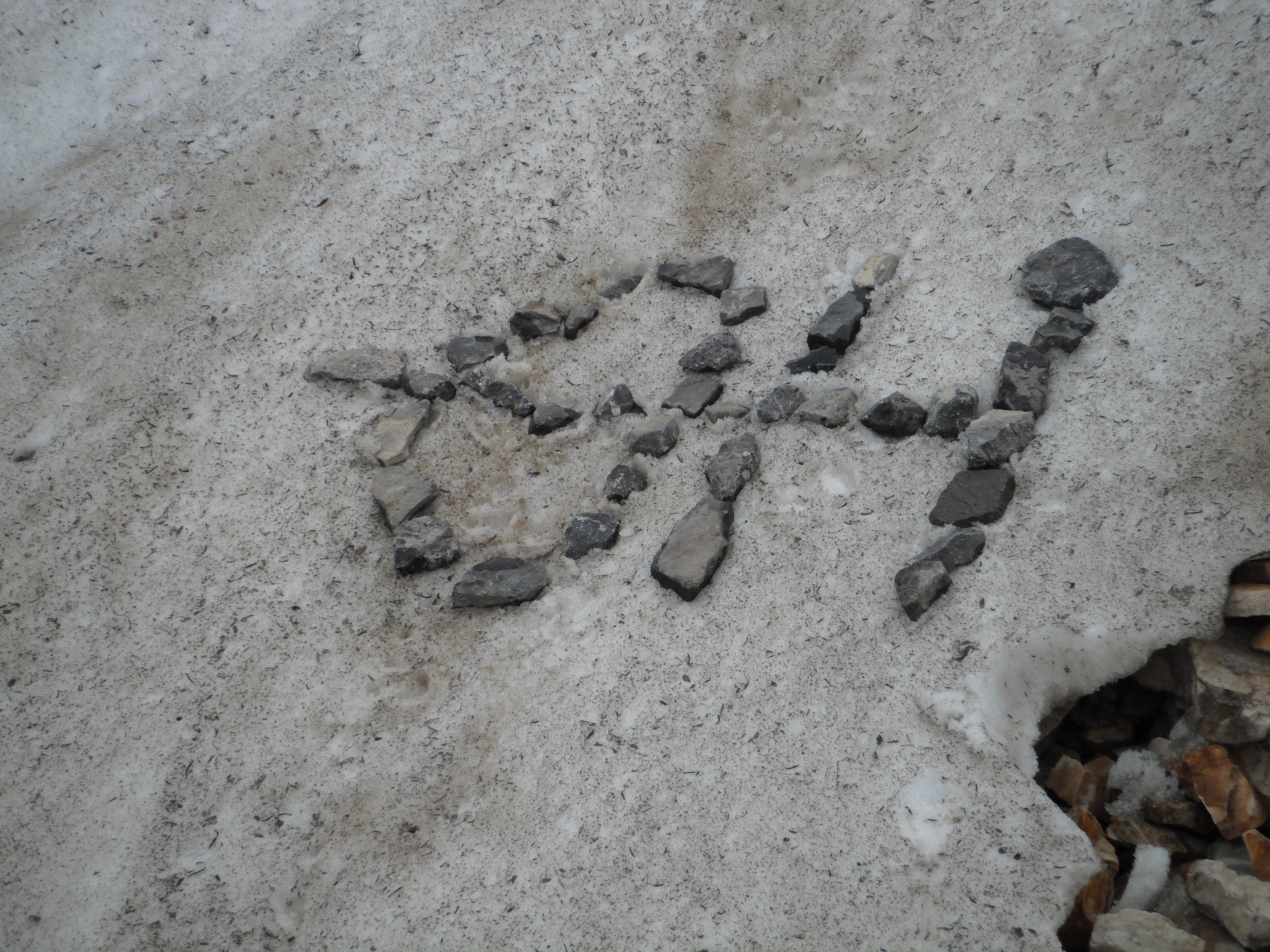
DSCF2918Would this be my Gravemarker?

My instincts raged—the same way they had when I’d went skydiving the summer before. Standing upon the lip of the plane door, looking out into the endless blue, a wordless voice had spoken in my ear, telling me it was a dreadfully bad idea to jump from a perfectly good plane.

The voice was louder now. ‘Sliding down a snowy mountainside in a lightning storm will not end well.’

I had no doubt the voice was right.

But some of my friend’s panic about our imminent lightning-death had spread to me now, despite my earlier sentiments that it would sooner be the decent that brought about our end. Besides that, he was already down past the point of return, and I was loathe to part with another friend in such dreadful circumstances.

And so I went.

It started slowly enough. Clutching my heavy wooden staff in one hand, I inched along. My empty right hand dug into the snow, and I slid bit by bit as the freezing water soaked into my pants.

But I was going faster now. Then faster still. I knew what was happening…my mind processed the math of it faster than it could articulate the threat. Faster and faster. I dug deeper into the ice, tearing my skin and cracking my nails as I slid along.

I could see the rocks below, growing larger with their approach. My friend had nearly reached them.

I was sliding far too fast to stop now. With a final, desperate effort, I clutched my staff in both hands, and slammed the point into the ice, hoping to create an anchor.

The staff broke, twisting my wrist and sending its two halves scattering down the mountain.

Everything after was too fast for conscious thought, yet I remember vividly the bleak sentiment which settled immediately into my conscience. ‘That was my only shot’.

The pull of the staff before it broke had set me spinning, and so I sped down the slope—20 feet, 30 feet, 35…the rocks were close now, and I fully understood what was coming.

Before I hit the rocks, I glimpsed my friend just below me. Colliding with him would surely send us both tumbling over the edge. As a matter of instinct, I jammed my left foot out to brace against the impact.

It hit hard.

Hard like nothing I’ve ever felt.

In the din of the tempest, I couldn’t hear the bones shatter.

Three of them, I later learned. My ankle utterly destroyed.

Despite the effort, I slammed into my friend. Then we were both rolling. Tumbling head over feet, like a child somersaulting down a peaceful summer hill.

End over end I fell, stone and sky blurring together—an all encircling tomb.

The voice was in my head again. ‘So, this is how it ends.’

There were other thoughts too—wordless but present.

A lonely dog.

A mourning family.

A touch of humility, a touch of pride…plenty of regret.

Then peace, and the thrill of adventure, bouncing and rolling down the ice-slick slopes of the mountainside for who knows how many seconds.

…Then curtains. Faster than thought, there was no doubt in my heart that the end was only a blink away. ‘One more rotation, maybe two.’ Then my skull would hit some rock and pour my brains into the torrent of water, down the stone, and finally into the lake—about two kilometers below.

The bruises I discovered later bespoke the force of my fall. But I felt none of that just then. One final thought came to me—‘It’s not a bad death.’

Then a hard thump, and I slid to a stop against a dark brown rock. I saw my friend roll over once more, then back flip over the ledge. ‘Dead,’ I had no doubt.

The ground against my hands was cold and wet as I pushed myself to my feet. I remember what I expected to see—a little black form, bouncing and tumbling down the slope so far from me now. Hopeless.

But there he was—about five feet below, springing to his feet with the frantic energy of a panicked child. “Brad, we’ve got to get out of this lightning!” he screamed. Then, turning, he fled off on his way back towards camp.

It seemed like the only logical choice, so I moved to follow.

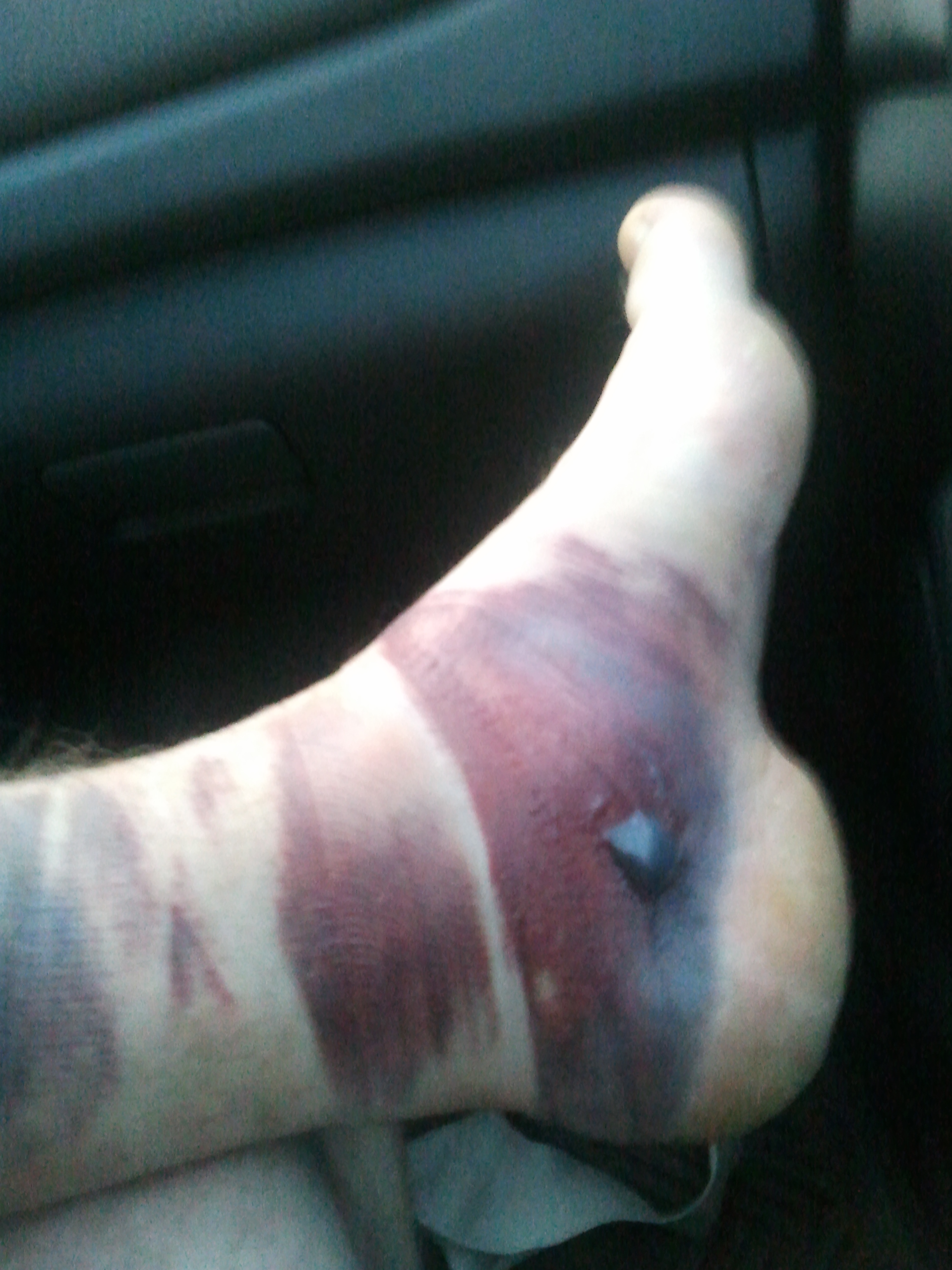
It wasn’t until I hit the ground again that I perceived the state of my foot. Then my head was a cacophony of alarm bells and sirens.

SAMSUNGA Dismal Scene.

I rolled onto my back, pulling my knee to my chest. Touching my ankle, I knew immediately it was far too bad to walk on.

My friend was a speck in the distance now. The storm continued. I was shaking from head to toe—from the cold, from the pain, from the adrenaline.

Freezing to death in the fetal position on a mountainside didn’t promise the same vainglorious ending I’d just missed out on, however.

And so I pushed on.

A few steps here, then I’d fall again. There was no self-conscious muting of my screams. With each step, each fall, I let them come. They were between the mountain and I now, and if I didn’t get back to camp fast, my secret would surely be safe.

I cursed my friend for leaving me.

I bemoaned my ambition for taking me here.

I lamented things I hadn’t done, and regretted things I had.

But just then, there was only one thing to be done.

One step. Then another.

A hundred steps…a thousand.

Much of the journey I spent seated—pulling myself downward with my one good leg. The other slid along by my side.

My pants were shredded now, and I chuckled like a madman at the spectacle I must have been. Bloody, exposed, and broken. A damn fool human who had taken it all too far.

It wasn’t an unfamiliar feeling, and yet something was entirely different about it. Moments ago, I had accepted entirely—deep down in my bones—the fact that I was about to die. Not only that, I’d even felt that it would have been a good death. Guts, glory…all that. But when the dust settled, I found myself broken, battered, and helpless as my ‘friend’ retreated down the mountainside, flatly rejecting my pleas and condemning me to my fate. It was a complete reversal of fortunes. From a blaze of glory to a sad, pathetic, wet little thing sliding down the rocky face of the mountain. I was humbled, and humiliated. And yet, the humiliation was worth it entirely, I knew, to be able to go on with life. It was worth it in spite of—nay, perhaps even because of the suffering it entailed.

This was the crucial lesson I took of those terrible slopes—that to suffer through and persevere when faced with no alternative is no cruel fate, but a blessing rather; a testament of the human spirit and the greatness we are capable of when no easier way is afforded to us. In adversity there is growth, and only through struggle can we achieve our highest potential.

I would go on, I knew, step after step, never again to toil in the mires of apathy or flippancy.

Step after step. Ice and rock passed into trees and valleys. The lake grew bigger. The storm pounded ever on.

But there was no doubt anymore. Not since I found out that movement was possible. I would make it back to camp. I’d get off this cursed mountain if only to strangle that damn snake of a ‘friend’ who’d left me up there to die.

I didn’t in the end.

I may have actually hugged him. It’s hard to say.

When I got to flat ground, I made my way along by grasping pine branches and dragging myself forward. Pain was nothing now. The damage was already done. Survival was all that remained.

I remember stumbling into camp. The first thing I saw was the friend we’d separated from part way up—safe and sound. This was a relief. The entire journey down, he’d been in my thoughts—and I’d often considered the dread I would feel if I’d made it back to camp to find him absent. That would inevitably have meant a trip back up the mountain. Damn the storm, damn my foot. If he was left up there, I’d have to go after him.

We would both have died.

‘Another good death.’

The next thing I saw was the friend who’d left me there. But the anger was gone now.

Before that day, I’d never faced the certainty of my own death. Grudges mattered less now.

In a day, I would be home with my dog. He wouldn’t need to be lonely. My family wouldn’t need to mourn. More than any of that, I’d learned something incredible about my own potential. To look into the eye of doom and persevere is an uplifting experience.

…and that was something I needed to hang onto.

I bound my ankle with a tensor bandage, and curled up in my flooded, freezing tent with a bottle of cheap white rum.

The next day meant a seven kilometer hike down the steep, wooded slopes back to the highway and my car.

But now, I had no doubt that I could handle it.

-Brad OH Inc.
The Corporate Human

cropped-cropped-blogbanner13.jpgA while back, your dear friends here at Brad OH Inc. posted an article called ‘The Constitution is America’s Bible’ (Link), which essentially explained the outdated relationship the United States has with their founding constitution.  While the thesis of that article remains entirely apt, one commentator decided to make a spectacle of himself in the comments section—raving against the progress towards political equality obtained recently by Corporations via the just ruling of ‘Citizens United’ (Link).

For a frame of reference, and to provide insight into just how limited and misled this poor individual (the lowest form of Human) is, we have included the reply here:

DCDear (Link):

“Perhaps we need to give Citizen’s United exactly and completely what they want – to be a person.

They would have to pay taxes like every other person, unlike many corporations who avoid paying taxes. CU could be held in custody for 48 hours without cause, like other citizens. They would be subject to the same laws – for example in states with the death penalty, CU could face the death penalty and the entity would be executed.
I could go on, but lunch is over…and I must save the world – be well.”

Well ‘DCDear’ (if that’s your real name)…ok. Let’s play your little game, shall we? First of all, it is incumbent upon me to point out how highly offensive your chosen vernacular is. ‘Give us what we want’? Liberty is not a gift to be doled out on a whim DC, and certainly not by the likes of you. Being human is the fundamental nature of a Corporation, and to divorce us of that in will or intention is a crime against humanity in its highest form. You should be ashamed of yourself!

Incidentally, if you are ashamed of yourself, some of our Corporate friends have a great line of drugs to remedy just that. Contact us privately for a link.

Now, onto your childish tirade—your first demand is that Corporations pay taxes, ‘just like every other person’. What a demand indeed! Did you know that every single component person in a Corporation pays taxes? That would be like you being taxed for every cell of your body! It’s outrageous to even consider. So clearly, Corporations already pay more taxes than are needed. To ask us to pay more is simply to punish us for our success.

When one of our posted articles gets more likes than the other, we don’t take some of the letters out of it. Instead, we try to produce more content just like it! It’s what the people want! So if more taxes are what you want, then maybe you should follow our example: Become a success, earn more money, and then pay as much as you’d like.

Next, you demand that Corporations (and not their component humans) should be subject to detention and/ or death. Death DC? Really? That seems a tad macabre.

It would behoove you to ask yourself, ‘Do I really want this’? Well, do you DC? Do you want to do without your lauded latte in the morning just because some whales off the coast of who-knows-where died in a perfectly orchestrated oil-spill? No, you don’t.

How about technology? Do you like the keyboard you used to create your hatful vitriol? Well, maybe the Corporations that provide you such blessings should be ‘killed’ just because some kids in the third world are being given an opportunity to work. Honestly DC, it’s the THIRD world. That’s the WORST of all the worlds anyway!

It seems to me that if we allowed our best and brightest humans (Corporations to the last) to be subjected to such primitive law enforcement, it would be you who suffers the most DC. We can only imagine the rant you would come up with when your cell-phone was relegated to a useless mound of plastic because the Power Corporation got in trouble for some measly little fire. And imagine it we would have to, since you would be hard pressed to find a piece of carbon to scratch the tirade on a stone after your computer went out.

So much for that, then.

Ultimately, there’s a crucial thing you have to realize DC. The fact is that yes, Corporations are people whether you like it or not. But they aren’t only people…they’re the best people. By definition, a human can’t be better than a Corporation, and a Corporation can certainly not be less than a single person. We are the builders, the creators, the innovators and the inspirers. More importantly, we are the decision makers. So the next time you feel like flying off the handle over some minor global injustice or trite environmental fiasco, maybe instead of rallying against your betters like an ungrateful putz, you should just pack your things (any not made by a Corporation that is…good luck with that) and move off into some non-Corporate zoned section of nothing to see how well you fare (Hint: Not very well).

Face it DC, without us, the rest of you are nothing. Bald monkeys clamoring about mindlessly—dreaming nothing, achieving nothing. We are Humanity in its fullest form—the culmination of eons of cooperation and growth, focused with laser-like precision upon our own needs. And fear not, for when we invariably meet our needs, rest assured you can count on some trickle of our grace running down to yourselves (Don’t believe in ‘trickle-down’? Go stand under a waterfall. It’s hard to argue with a waterfall, DC). It’s far more than you could ever achieve alone, and you should undoubtedly be thankful for it.

So give us the freedoms we ask, and relinquish your hopes of accountability and equality. There is no equality between Gods and men, nor between the Corporate Human and the mere ‘human’. The more you seek to restrain us, the greater will be our victory—and all your efforts shall come to naught in the glory of our dominance.

Yes DC, we know we’ve been hard on you here, but please understand that we are only trying to help. Humanity needs its Corporate overlords far more than it knows, and if we are unable to pursue our humble ambitions of unlimited wealth and social dominance, then so too will you fail in all your endeavors.

Don’t believe us? We understand, it’s bigger than you could ever process. But next time you consider rebelling against your forbearers, we would advise you to close your laptop, and just take a few deep breaths. While you do that, go ahead and stare into the little glowing apple on the front of your computer, and recall that it was your kind, not ours, that partook of the fruit. So if knowledge is your misery, it is yours alone to wallow in. Frankly, you’d be better off without it. So stop questioning your lot, and be thankful for what you have—as it is to the last morsel the windfall of our own grand design.

-Brad OH Inc.