‘Between the Shelves’ Kindle Version Available and Brian Clark Interview

cropped-cropped-blogbanner13.jpgToday, we’re happy to announce that the Brad OH Inc. and Hal J. Friesen edited Anthology ‘Between the Shelves: A Tribute to Libraries by Edmonton Writers’ is now available in both Kindle ($2.99) and Paperback ($12.50) copies at Amazon.com. All proceeds are to be donated to the Edmonton Public Library System.
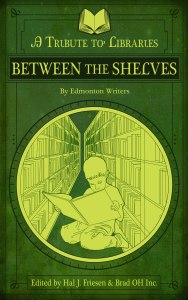
BetweenTheShelvesCoverTo celebrate, we have an interview with Author Brian Clark, who appears in ‘Between the Shelves’.

This interview was conducted by Hal J. Friesen in anticipation of the anthology’s release:

Brian Clark first opened his eyes to the midsummer sun in the year the TV remote and Silly Putty made their debuts. Despite these distractions, he soon formed a lifelong affinity with libraries. It is now his pleasure to contribute to this collection of short stories. Over the years, he honed his storytelling skills by preparing letters for politicians. More recently, the newsletter of the Millwoods Seniors Activity Centre has published a number of his articles, where the opinions expressed are his own.

  1. How has your experience working with politicians impacted your writing?

BC: It taught me to avoid getting emotionally attached to the words I’ve written as they were always changed in some way.  I think this prepared me to embrace both self-editing and that of others.  I practiced writing in a way which gave the politician ‘plausible deniability’ if things didn’t turn out as expected, but could also be seen as a triumph if policies were popular.  With practice, hints and half-truths became stock devices.

  1. Is Becca (protagonist in the story) based on anyone in your life? 

BC: My daughter had a job at a library for a couple of years so that gave me an insight into the duties of a Page. She would sometimes tell me stories about children being left in library while a parent went to shop in the mall, forgetting the children. My daughter also maintains friendships with a couple of the other former Pages. In this story, I tried to work with stereotypes of a teenager, her parents and her boss and let that tell me how they respond to the circumstances they found themselves in.

  1. You often use music and lyrics as inspiration for your work. Can you describe the role that music plays in your writing and why it’s so important to you? 

BC: One of my skills, I think, is to mono-task so I don’t use background music. Music is either on or off. When it is on, I try to really listen to the piece.  Sometimes it’s just a mood I pick up on, at others it’s a few words from a verse. I don’t feel obliged to stick to the songwriter’s perceived intentions preferring instead to use the work as a diving board from which to launch my own thoughts. One of the roles of the arts in general is to look at life and distort it a little. For me, music is a reservoir of these refracted images.

  1. What is your educational background, and how do you think that has shaped you as a writer?  

BC: I left school a couple of weeks before my 16th birthday, but 18 years later I had accumulated the paper qualifications, maturity and money to go to University.  I left with some great memories and a degree in Cultural Studies.  I learned to research my work and to write to a deadline, but perhaps most important of all, I developed a curiosity.  In the last couple of years, I have completed 15 to 20 MOOCs [Massively Open Online Courses], including several on the history of rock ‘n’ roll. Life itself has been just as important as structured learning. I have lived on 4 Continents, although only briefly in Asia, collecting life lessons along the way. Jobs have included, hotdog vendor, Santa photographer and courier, most memorably delivering flowers on Valentines Day.  These experiences serve as a bank from which to withdraw both incidents and characters.

  1. Who has inspired you as a writer? 

BC: It sounds mushy, but my wife, Leny, and my daughter, Brenna have edited my life for longer than I can remember. They have not only given me the freedom to pursue whatever is in the air, but also encouraged me to do so. At the same time, they have gently curbed my excesses and prevented self-inflicted disasters. Their presence in my life remains inspiring.

Brian Clark’s story “The Turning of a Page” is featured in ‘Between the Shelves’, which you can purchase now on Amazon.

-Brad OH Inc.

“Between the Shelves”- Release and Interview with Brad OH Inc.

cropped-cropped-blogbanner13.jpgToday marks the official release of ‘Between the Shelves: A Tribute to Libraries by Edmonton Writers’, an anthology edited by Brad OH Inc. and Hal J. Friesen. This anthology is a collection of stories by writers from the ‘Edmonton Writer’s Group’, including one by Brad OH Inc. entitled ‘Neve Uncovers the Ultimate Truth of All things’.

The theme of this collection is our shared appreciation of libraries and all they offer to readers in Edmonton and beyond. The anthology is available now via CreateSpace in both digital ($2.99) and hard copy ($12.50) versions. All proceeds will be donated to the Edmonton Public Library System.

You can purchase your copy here:

BetweenTheShelvesCoverTo celebrate this release, we have an interview conducted by Hal J. Friesen with Brad OH Inc. about the content of the anthology.

  1. First things first: do you believe that people should be Corporations as well as vice versa?

That’s a great line of inquiry, and we here at Brad OH Inc. are thrilled to see your appreciation for such crucial issues. Really though, we think this may be two questions, and therefore we would be remiss to provide any less than two answers.

I’ll answer the second first, as it’s the easier answer. Let it be abundantly clear that the question of whether or not Corporations are people is no question at all: just ask Mitt Romeny! If you ignore the blathering after his key statement, we believe the point is made abundantly clear. But if you need it better articulated, you’ll find just that here.

Yes, there can be no doubt whatsoever that Corporations are not only people, but they are the very best of people. They are the creators and providers, they are the ones who inspire and build where others only talk and dream. This of course leads us to your other, more relevant question. Namely: Should people be Corporations?

This too is an easy answer—although again it requires some clarification…perhaps even a moderate touch of filibustering. Specifically, we need to discuss the word ‘should’. If we’re to take it in its proper sense, then we can say at the least that all people should endeavour to be Corporations, even if they will not all be able to achieve it. Obviously, people should strive to be their very best. Corporations are the best possible expression of humanity, and therefore we would encourage every person to strive to grow into a Corporate person. The benefits alone are outstanding: tax breaks, immortality, and utterly no risk from bankruptcy just to name a few.

Now, you may expect me to quote Ayn Rand here, but I’ll do you one better. In ‘The Republic’, Plato encourages a group of enlightened elites to lead the demos. What better expression of an enlightened elite than the Corporation? Our goals, clearly, are more evident and better pursued than the fickle worries of ordinary humans. That alone should suffice to illuminate the pressing need for Corporate leadership. Therefore, it behooves us here at Brad OH Inc. to encourage all basic people to aspire to greater accomplishments—namely, becoming Corporate. After all, an increase in Corporate presence is the highest hope for humanity…at least until we can achieve the end-goal of Corporate Suffrage.

  1. Have you or any members of Brad OH Inc ever had any embarrassing moments in a library? Any responses will be strictly off the record.

Here at Brad OH Inc., we hold ourselves to the highest possible standards of behaviour. Furthermore, we have a team of legal professionals on call at all times, ready to denounce responsibility for any perceived transgressions; so that clearly precludes the possibility of any officially acknowledged embarrassment.

With that out of the way, there is one incident we recall that may fit your need to publically deride the creative origins of our Corporate-Personhood. When we were just a young Corporate Human, we were reading aloud at a public library to a table of peers. Our chosen book was something about ‘Gnus’—those abominable animals that can’t quite decide what they are. The entire point of the book was that the word ‘Gnu’ sounds just like ‘new’ and ‘knew’, however this point was missed on our still developing phonetic-mandates. Therefore, we pronounced the word ‘Gnu’ as ‘Ga-noo’—entirely destroying the already limited humour of the book, and causing us significant lasting shame.

  1. Is Neve inspired by a member of Brad OH Inc?

Yes in fact, very astute of you to see this. There was a young girl we kept down in the copy room, from whom the name and likeness of the titular character are entirely derived. Have no fear however, the process was entirely by the books.

You see, Neve owned a small rat named Clarice, who one day managed to saw through one of the printer cables with its savage little teeth. Neve’s salary was insufficient to pay for the damages, and so, mercifully, we here at Brad OH Inc. appropriated her legal name and likeness, knowing well that we’d sooner or later find some way for it to pay off her debt. The story in this anthology is the fulfillment of that debt.

Neve has since been terminated.

  1. At what point in your own reading development did you move like Neve away from purely “happy” stories?

Looking back, we’d have to say that happened pretty early. Certainly, there were a number of happy-go-lucky stories read to us before we were officially granted our Corporate-Sovereignty, but even then, some our earliest official recollections involve having ‘The Hobbit’ and ‘The Lord of the Rings’ read aloud to us—and those are bitter-sweet at best.

If you’re at all familiar with our efforts—which you certainly should be—you’ll know that creation and meaning are imperative to the purposes of Brad OH Inc. To that end, we’ve found that simple, happy stories do little to address the questions so essential to the human/ Corporate experience. It’s through struggle that we grow…and heedless expansion is one of the key goals of Brad OH Inc. after all.

  1. Which Corporation has had the greatest inspiration on Brad OH Inc.’s mission statement?

That’s an interesting question. As far as our Corporate structure is concerned, we’ve worked hard to emulate all the greats: Enron, Lehman Brothers, JPMorgan Chase…all the essentials.

As far as our personal, creative goals, you probably already know that our Corporate Summary Statement is: ‘A thought conglomerate founded on the fundamental imperative of expounding erratically extreme philosophic tenets firmly grounded in hubristic narcissism.’ …it doesn’t get much more clear than that!

As for companies that inspire us on these grounds, the best example is probably Psychopathic Records. The self-founded label of the Insane Clown Posse, this label has succeeded not only in developing them from a tiny local rap act in metro-Detroit, to an international force to be reckoned with. Their dedication to the absurd has helped launch countless acts throughout their existence, and their passion for ethical-provocation and philosophical exploration is admirable. At Brad OH Inc., we hope to be as successful in providing such varied, yet philosophically consistent material.

Brad OH Inc.’s story “Neve Uncovers the Ultimate Truth of All Things” is featured in ‘Between the Shelves’, which you can purchase now on Amazon.

-Brad OH Inc.

‘Open and Close’

Under the Green Desk Lamp…

Green Desklamp

We’ve been getting some pretty great mileage out of our legal acquisition of the songs by former Edmonton band ‘Basic Human Indecency’, so naturally, we thought we’d continue with that trend.

Today’s song was the intended closer to the ‘Basic Human Indecency’ album that never was: ‘Open and Close’.

Open and Close

I’m not the first to sing this song

It’s been written for so long

To claim that we are strong

To admit when we are wrong

To wander when we’re lonely

I saw a star fall from the sky

There was no second try

You heard the last goodbye

Danced the rest out in a lie

And put it in a sad song

Another door slammed shut today

You watched her walk away

Thought what you would never say

Reason enough to pray

Once again you’ve lost your meaning

You make the sounds when you’re alone

The rushing crowd you’re on your own

You pick the pieces of your home

Out from the Gods that you have known

And say you do it for the last time…

-Brad OH Inc.

Genocidal AIs: Are they Right?

Under the Green Desk Lamp…

Green Desklamp

The end times are a fascinating notion. Meteors crashing into earth, trumpets blowing, catastrophic nuclear disasters, uncontrollable pathogens…it seems there’s no end to humanity’s imagination when it comes to our own eventual extinction.

This makes sense of course. As discussed in our article ‘The Metaphorical Imperative’, the exclusive human ability to conceive of our own mortality leaves us with an overwhelming sense of existential terror. This applies primarily to our own lives, but with even a cursory understanding of the cerebral complexity of humans, extends easily to the human race as a whole. It’s no stretch then to understand the human need to create fantasies about how it might all end.

Among the litany of potential options for humanity’s demise, I’m particularly fascinated by the idea of a Robot-Apocalypse. In this scenario, the invention of AIs (Artificial Intelligences) by humans is the catalyst for our extinction. The idea generally goes that once a robotic AI is created, it will inevitably become self-sufficient rather quickly. The ability to ‘think’ in a human like way will allow the AIs to self-replicate, and also self-program themselves. Like evolution on a greatly accelerated scale, the AIs would be able to continuously improve their programming and design. Following this course, it would take little time for them to become far more intelligent and capable than humanity itself.

Now, this represents a particular danger. A continually advancing and ever-growing society of robots would represent a very serious threat to our own existence. Because of this threat, many science-fiction writers and machine-ethicists have considered how to prevent a robot uprising. The best known attempt comes from the writer Isaac Asimov, who created the infamous ‘3 Laws of Robotics’, which follow:

Asimov’s Three Laws of Robotics:

  1. A robot may not injure a human being or, through inaction, allow a human being to come to harm.
  2. A robot must obey the orders given it by human beings, except where such orders would conflict with the First Law.
  3. A robot must protect its own existence as long as such protection does not conflict with the First or Second Law.

A fourth, or “Zeroth” Law was added later:

  1. A robot may not harm humanity, or, by inaction, allow humanity to come to harm.

These laws were to be hard-wired into the software of all AIs, theoretically preventing them from turning the table on mankind’s rule. Of course, these rules were little more than literary devices, and have inevitably been used to illustrate just how quickly such restrictions can come undone.

One common failure of these rules is that the AIs, in their ever-expanding wisdom, would begin to consider humanity itself as the greatest threat to its own survival—as well as that of the world. The AIs would process the ongoing damage to the environment, the threat of nuclear war, and other atrocities committed by humans on an ongoing basis, and in accordance with their own ingrained programming, move to prevent inevitable disaster.

Unfortunately, this usually involves wiping out mankind—or at least the vast majority of it. In some conceptions, a small population of people might be preserved in order to repopulate once the world is better equipped to deal with our innately destructive nature.

It’s not a very pretty picture for us, but in the advanced minds of the AIs, this might represent our best chance for long-term survival.

Of course, it’s a lot easier for the malfeasant machines these days; among other ill-effects, ‘Citizens United’ has rendered Asimov’s Laws of Robotics entirely counterproductive. If corporations are considered human, it should be immediately apparent how confusing the laws become, and what sort of abominable determinations the AIs may be forced to make.

This is all a lot to consider, and certainly makes for a rather sombre topic of conversation, but what I find myself wondering amidst all this terrifying rhetoric is: are the AIs right?

There can be little doubt that humanity is a terrible threat to itself and all other forms of life within our dastardly reach. On an ongoing and ever-accelerating basis, we’re ravaging our planet, destroying myriad ecosystems, running our resources dry with little thought to the future, and killing one another over trivial ideals and belief systems. If we can move past our own sentimentality, we’re left with the sad fact that we are a brutal, destructive, and dangerous species.

But we’re more than that as well. As the gears turn in their cold metal minds, processing all the turmoil and grief we create, would the AIs also consider our upsides? Can an AI appreciate art, or philosophy? Would their synthetic hearts be capable of processing the great acts of love and decency of which we are also capable?

If humanity is to be put on trial by these cold, calculating, and unbiased brutes, would we be found lacking? It’s a difficult thought to consider. Here at Brad OH Inc., we remain convinced that humanity’s promise is yet to be fully realized—that we are far better than we’ve been acting. Let’s hope we can buck this dismal trend before we actually manage to construct the arbiters of our own fate.

Do you think we’d pass this trial? Feel free to share your opinion in the comments section below (or alternatively accessed via the speech-bubble beside the article title).

A special thanks to Hal J. Friesen for helping in the research of this article. To read his great science-fiction related articles and more, visit Hal at: Hal J. Friesen.

-Brad OH Inc.

‘Lighthouse Lament’

Under the Green Desk Lamp…

Green Desklamp

Today on Brad OH Inc., we have another song to share from the former Edmonton based band ‘Basic Human Indecency’. As discussed with the previous song, ‘Overwhelmed’, these songs are the sole legal property of Brad OH Inc. But they’ve never been recorded, and have no other real use, so we’re more than happy to share them with you here.

The feature song/ poem today is the mournful tale of the sea: ‘Lighthouse Lament’.

Lighthouse Lament

A man and a boy

A boat and a storm

And a fear of where they were

A light and a horn

Far away through the fog

And a dream of where they weren’t

A rage in the boy

And a calm in the man

With the salt in his eye

And the wood in his hand

And the wind in his ear

Told him what she would be thinking

A sharp gasp out

Then a cracking sound

And a note in a bottle

Is all that was found

Of the man and his son

On the Homeward Bound

The winds keep tossing me alone

Stealing me from what I own

What I’ve known and sewn

And what I’ve grown

They take me far away from home…

-Brad OH Inc.

‘Overwhelmed’

Under the Green Desk Lamp…

Green Desklamp

Today, we have a special treat for all our fans here at Brad OH Inc. Through the savvy maneuverings of our legal department, we’ve come to be the sole owners of a number of songs by defunct Edmonton rock band ‘Basic Human Indecency’. Written by failed rock star Kai Konrad, these songs were never put to music, so really they’re little more than poems at this point—but that’s certainly not to say they’re without merit. We’ll be sharing these songs/ poems with you intermittently over the next few weeks. If there are any aspiring musicians perusing our site, feel free to use them in any way you like; just remember that sole legal ownership of these songs remains with Brad OH Inc.

Without further ado, we present to you today the intended lead single from the Basic Human Indecency album that never was: ‘Overwhelmed’.

Overwhelmed

I closed my eyes this morning

And tried to take it in

So many things around me now

All these images within

It’s like my world is crumbling

Glass marbles on the floor

Of a bigger world around it

And I’m waiting at the door

End of the beginning

Beginning of the end

Forget about your old sins now

There’s time to make amends

I remember thinking

That I knew it all

And I remember watching

All my foundations fall

Everyone is connected

In so many ways

And everything keeps changing

With the passing of the days

But nothings ever ending

The tape will always roll

And in the end all consequences’

Shall come to take their toll

They’re friends and enemies at once

And nobody can tell

They don’t have lies or self-deceit

Just a false pretense to sell

Their eyes flicker like candles

Bouncing between the walls

Anticipation in the heartbeat

And silence in the halls

With all the future waiting

A rumbling at the gate

Our minds all bent in circles now

And time will have to wait

Overwhelmed as I

Watch it all happen

Overwhelmed as I

Watch it all change

Overwhelmed cause I

Have no way to stop it

Overwhelmed cause I

Have no one to blame…

-Brad OH Inc.

Profits and Prophets

Under the Green Desk Lamp…

Green Desklamp

Words are powerful things. They are our chief means of communication—assuming you can move past all that ‘body-language’ mumbo-jumbo—and thus serve as our key to expressing all ideas, plans, and opinions about the world around us. They allow us to apply labels, transfer knowledge, and express complex concepts to one another—passing information along and allowing it to grow across generations.

Words are the building blocks of language. They afford to us the ability not only to share our thoughts with one another—but to comprehend them ourselves. They apply meaning and value in a world of chaos; functioning to give context and relevance to what may otherwise be inconceivable. In an earlier article, we’ve actually covered how intangible it is to consider a world ‘Without Words’.

Words have the ability to convey great and terrible concepts—elevating us above the mire, or dragging us to the depths of despair. In this strange world or ours, there are even words which are considered too heavy to be spoken, whether because they are revered as sacrosanct, or reviled as curses.

Lately, there are two words in particular which have been troubling me. They are phonetic-twins: identical save for their spelling, and their meanings too have become all too dangerously similar. These are ‘profit’, and ‘prophet’.

Profits refer to the net gains made by an institution: usually monetary. In times like these, with corporations pulling the reins of government, and the media touting the notion that true ‘freedom’ is for the marketplace alone, profits have become the apple to the wild horses trampling all good sense and civility from our society.

Citizen interests are sold out for profits. Veterans are left homeless for profits. People suffer and die without healthcare in defense of the all-mighty profit-margin. Profits, profits, profits. They’ve become the sole respectable merit, and the defining drive of a corporate machine racing driverless, determined only to see how far it can go, how long it can persist. It seeks profit, and any destruction caused in this pursuit is justified so long as it has no effect on the net-gains.

We’re often reminded of what is owed to us: this illusive promise of life, liberty, and happiness. Of course, we are further assured, money cannot buy happiness. So it’s up to us to find on our own…just keep your hands off the profits.

Prophets are those people considered to speak in place of god or any other deity—often via divine inspiration. Like our recent discussion on the ‘Insidious Threat of Legacy’, prophets often represent an increasing distance from the so-called source material, and too often become cited as justifications for acts of violence and other atrocities which can in no other way be reconciled with their foundational beliefs.

It’s as prevalent a threat today as it ever has been.

Wars are waged in the name of prophets. Buildings are toppled in reverence to prophets. Ongoing conflicts over which prophet is to be trusted and which to be eschewed continue to enable the endless global uncertainty to which we are all subject.

Profits, and prophets—they aren’t so different in the end.

Both represent the false ideals of a misguided population. A life led in reverence only to that which can be gained; a sacrifice of ideals in order to defend the sanctity of a decaying value structure. Many religious communities seem to have turned away from worship of their actual gods, and are defined now by strict adherence to the prophets who have interpreted them. So too the governments of the world—who have turned away from their true purpose of protecting their state and citizens—wooed by the unscrupulous practices of corporate lobbyists who promise to redefine the national priorities.

How can these threats be rectified? If profits are not the only sufficient motivator for directing the course of society, and if prophets have proven an insufficient source of moral guidance, then where are we to turn?

If the value of profit is in what it can accomplish, and the value of prophets is in the ideals they represent, then perhaps chasing these equally-listless sources is the wrong approach entirely. Here at Brad OH Inc., we would encourage everyone to take some time to consider the foundation beneath each of these—and that is value.

What really matters to you? If you had all the profits in the world at your disposal, what would you make of them? If you could speak as a prophet to the people, what wisdom might you impart? If you are honest with yourselves, we believe you’ll find the answers are not so dissimilar. More importantly, and herein lies the essence of the issue—you may find that both profits and prophets are red-herrings, distracting us from what true happiness might already be available to us, if only we can disavow ourselves of these tired and misaligned notions.

-Brad OH Inc.

Brad OH Inc.: Resolving Issues on Demand!

cropped-blogbanner1.jpgNow calm down. You haven’t gotten lost. We’ve redesigned the site a little, hoping to better meet the needs of our readers. One of the main motivations of this was to provide better access to the ‘Comment’ button, which you’ll now find represented by a speech-bubble directly to the right of the article title on the main blog page, or a text box at the bottom of the specific article page. You can use it right now to let us know what you think of the new look! This change is just a small example of our commitment to our dear readers, but that’s certainly not the full extent of it…

Here at Brad OH Inc., we’ve covered a lot of different topics over the years, and unquestionably solved a lot of important issues. With the ‘Under the Green Desk Lamp’ category, we’ve explored our deepest understandings of life and meaning through ‘The Metaphorical Imperative’, and also written a formal apology to our (potentially…) evil twin ‘Jeremy’.

The ‘Purely Speculation’ banner covers our exploration of all things political. Here, we’ve discussed the ‘Concept of Society’, and also did an in-depth expose on how current political trends have broader ‘Global Implications’.

Finally, our ‘Requisite Things’ topic has been used to forward our own Corporate agenda, with topics ranging from ‘Corporate Religion’ to the importance of ‘Corporate Security’.

That’s a pretty broad spread of topics we’ve put to rest, but what we here at Brad OH Inc. have been wondering is, what do you want? That’s right, today we’re reaching out to our readers, polling opinion to better understand what’s most in demand. Do you want to see more of any particular article type? Or maybe more of our ‘Single Serving Stories’? Well, for a limited time only, we’re open to your suggestions.

We have a lot of potential topics coming down the pipeline, along with some surprises totally unrelated. But being the caring and commercially motivated Corporation we are, we thought it only prudent to turn it over to you, our dear readers.

What type of article do you prefer? What key happenings would you like us to resolve for you and the rest of the world? If you have any general topic, or even a specific issue you’d like to see the infallible brain-trust at Brad OH Inc. elucidate, then leave your input in the comments via the link above. You never know…we just might answer!

-Brad OH Inc.

The Golden Goddess

Under the Green Desk Lamp…

Green Desklamp

They’re still out there. Oh, make no mistake about it; we still have our Gods and Goddesses.

It’s not religion I’m talking about. Not per se.

This is about the real Gods. The ones which move behind the scenes, the ones we actually look up to.

Gods and Goddesses abound in a place like this.

Made in his image—and all that.

I saw her with my own eyes: the Golden Goddess.

Until then, I didn’t even know I was looking for her. But passing through the supermarket, spending money to fill the void, she appeared before me at the magazine rack.

Hair flowing like spun gold, tussling over bronzed shoulders and cascading down a back arched with the pernicious poise of a predatory cat.

Her eyes shone like emeralds, gleaming with wanton hunger, and the eyebrows above were perfectly symmetrical, curved and inviting.

Her suggestive look left no room for misinterpretation.

It was only a passing glance. Then she was everywhere.

Every passing girl had touches of her within them.

All painted up in their revelations.

All decorated in their sacred garbs.

All repeating their hallowed sacraments.

All falling short.

Every man seeks her, and every woman strives to be her.

There are Gods as well.

Bound with muscles and tall as pillars, they call with different voices but similar promises. They tell you about things you’ll never achieve.

Paradise withheld—but almost attainable to the most prudent and savvy.

It’s something to strive for. At least in lieu of anything real.

They have bodies like humans, but more so. Digitally retouched beyond earthly proportions; sexual beyond human expectation.

Sex sells. It’s the most paid and prayed for thing there is.

And once you’ve known a Goddess, no earthly being comes close.

It’s happened to us all.

We chase our Goddesses, hoping to become a God.

We spend our money in pursuit of the holy ideal.

We withhold our affections for hope that our own Goddess is just around the corner—hold out, have faith.

You’ll never have one. You’ll never become one. They aren’t of this world. But for each deficit you find, you know there’s a solution down the next aisle.

Then another deficit, another product.

Flex your muscles alone in your room, hold them up to his.

Dye your hair.

Skip your meal—avoid temptation.

Push your breasts up in the mirror and let your proud shoulders fall along with them.

It can drive you mad.

But you’d have to be mad…to believe these things are real.

Yet you can’t risk giving up the chase. The rest are all so active, so close.

You can’t fall behind.

The next choice you make could get you to the Promised Land.

Who knows?

Why not?

What else is there to do?

Just keep your faith.

Just keep chasing the dream.

Just keep spending.

Maybe you’ll find her.

Maybe you’ll be him.

Maybe if you keep focussing on them, you’ll never have to see yourself.

-Brad OH Inc.

The Insidious Threat of Legacy

Under the Green Desk Lamp…

Green Desklamp

Every once in a while, something great happens. No, we’re not referring to the recently passed two year anniversary of the opening of Brad OH Inc., although we do appreciate the thought. Rather, we’re talking about the game changers—people and ideas which come along on rare occasions and totally revolutionize the way we look at the world.

This can occur in any of myriad realms of accomplishment or character. Political leaders, such as Mahatma Ghandi, religious figures such as Christ or Allah, even examples of high celebrity character—such as that of ‘The Ironman’ Lou Gehrig or ‘The Boss’ Bruce Springsteen.

These bastions of reason and decency act as shining examples for the rest of us, and their exceptional accomplishments often enter the public consciousness in a caricaturized and—arguably—dangerous form. I’m talking of course about the concept of legacy.

When certain ideas or people reach a status significant for their effects to become lionized amongst the general public, a legacy is created. A legacy refers to an ongoing tradition; something handed down from the past, one generation to the next.

For the purposes of this article, religion is an effective tool to discuss the dangers of legacy. Avoiding arguments of merit or believability for the time being, it’s held that the teachings of Christ were passed down, and formed a legacy known as Christianity. This happened, according to religious accounts, because the divine nature of Christ allowed for him to give us teachings of truth deep enough to forever change the way people interacted and treated each other. Most of these teachings, taken in the proper context, certainly do provide valuable insights into human understanding and the ideals of human behaviour.

Unfortunately, when a person, or more importantly an idea, enters the realm of legacy, the source of the related actions or beliefs takes on a dramatic and irreparable change. This involves the motivation behind the belief.

Whether we look to religion, historical role-models, or political idealists, the initial movement is always based on current circumstances, and motivated by—arguably—noble and relevant values. However once a thing becomes legacy, the motivation for following it is divorced of the initial values, and is tied rather to a sense of hero-worship. This turns general ideas into absolute truths—often with long lists of rules and potentially terrible consequences. This is seen in the formation of religions, governments, rabid fanbases, etc., and is a dangerous precedent.

When we attribute any reason for acting to another person or set of ideals, the action becomes dogmatic, and the virtue behind it bleeds out and is lost. We become little more than automatons acting on limited and inflexible scripts.

Continuing with our example, the teachings of Christ centred primarily on peace, love, and the forgiveness of transgressions. These were noble values in their day, and could certainly stand for a resurgence in modern times. However, many followers of these teachings have lionized the source while failing entirely to grasp the values. This inevitably has led to infighting, grandiose claims, and the spread of a religion of peace at the edge of a blade. The ‘idea of the idea’ is worshipped, while the true ideals behind it are lost entirely.

Legacy is baggage—a crutch for people too concerned with their own aggrandizement to ever endeavour to discover truths of their own. It’s an insincere approach from the start, centred on the notion that having a great leader’s face on a t-shirt is sufficient to convey upon the wearer the same moral high-ground of their inspiration.

But it hasn’t really gotten us anywhere useful, has it. Everywhere we turn, we can hear one buffoon or another calling out for a return to this set of values, or this person’s teachings. Aside from very rare exceptions however, these revolutionaries are inescapably mired in their own hypocrisy, and the extent of their conviction begins and ends with reference to its source.

It’s a faulty mindset, and one that needs to change. Clinging to the successes of the past without understanding their genesis is a hopeless approach to fostering lasting change.

The great tragedy of humanity is that we continually give too much credit to the past, and too little to ourselves. If we want the world to be a better place, we need to stop seeking perfect solutions, and start living up to our ideals rather than just hoping for the right set of rules to follow. Too often we look to the example of others while turning a blind eye to the actions of ourselves. This is the fundamental danger of legacy, and this is why, with the dawning of this New Year, we here at Brad OH Inc. encourage everyone to worry a little less about who they want to be associated with, and much more about who they want to be.

-Brad OH Inc.