The Final Facet of Globalization

Under the Green Desk Lamp…

Green DesklampThis world of ours is globalized (Link) to an incredible degree. With every increase in technology, we have observed exponential growth in the level of interconnection and access afforded to nearly all of the world’s inhabitants. The internet alone serves an unbelievable role in making the world a truly global society—allowing the instantaneous sharing of information which would previously have taken weeks, or even months.

Planes, trains, and automobiles have provided the means to efficiently move physical resources around the globe—meaning that formerly exotic commodities can now be found as easily as a trip to your local grocery store. Science as well has played a pivotal role here—advances in refrigeration, preservation, genetic modifications, and more have helped us share the bounty of this world far and wide…for those capable of paying for it.

As a result of this process, leading nations draw labour, resources, and wealth from the poorest nations in the world, always at offset values. By outsourcing easy labour jobs to nations with lower (Read: dismal) minimum wages and few to no laws protecting workers, Corporations have managed to increase their output, up their profit margins, and generally thrive in a relationship which can scarcely be described as anything short of parasitic.

Yes, for every gain there is a cost, and despite the progress made, it would seem that the one big concept which nations have refused to show any global regard for is that of human rights and minimal standards of living.

In a world with sufficient resources and scientific knowledge to keep everyone fed and healthy, the fact that one woman may drive a million dollar car while a child elsewhere does without a 5 cent pill is entirely unacceptable. In fact, it’s downright despicable.

The exchange is rather one-sided to say the least—and year after year we may observe new wars started, new sanctions imposed, new government-facilitated coups to install more ‘cooperative’ leaders, and other such heinous acts all in the name of increasing the profit margins of large-scale Corporations. Human rights violations in much of the world are ubiquitous; from the factories which provide us our clothing, to the plantations which grow our food.

Of all the resources and technologies we have managed to import and export on a global scale—it would seem the most obvious and easily renewed is yet to meet that lauded status; specifically, I’m referring to empathy.

The atrocities which are committed in the name of profit are the inevitable result of a system which treats empathy with the same cavalier and disposable attitude we reserve for so many other resources. But this view of empathy as a resource is rather telling—for if it is to be viewed as a resource, then it is essential that we recognize it as a wholly renewable resource. As such, caring for others and striving for a new global best is not a zero-sum game in which everyone is competing for limited supplies and the gains of one must be the losses of another. No, the truth is that the gains of one may be shared unilaterally, and if one society flourishes, this should—and must—benefit everyone involved.

But this is rarely the case. We import resources from around the world and utilize the cheap labour available, but what are we offering in return? The most common answer is that we act as a force of freedom, democracy, or protection for the rest of the world—but this claim is entirely indefensible for even the simplest mind with the vaguest understanding of global politics (Link). To glean all the potentially beneficial resources from a nation yet contribute nothing to it in return is not a globally beneficial system, but rather something more akin to an exploitative, imperial domination.

As it stands, misery and despair are the most evident exports of the so-called first world.

When we deal in such unjust ways, we may be importing more than we bargain for. We’ve defined ourselves with callous disinterest and self-serving malice abroad, and now the chickens come home to roost. International resentment is growing at all times, and even the local populace is losing faith in its leadership and stirring under an ever increasing sense of anxiety and civil unrest.

So perhaps this whole arrangement needs to be revisited. Trade and grow we must, but if we continue to do so with such a total lack of regard for human decency, we will come to find that our imports tend to reflect our exports in a far more sinister manner than we anticipated.

No other outcome is possible—that’s just the nature of the deal. When we short change our trade partners on a regular basis, we soon find ourselves cut out of the loop entirely. Fair trade must be fair in all senses. Financial growth must mean human liberty, and for every measure of progress in science, technology, and resource access, there must—in any civil society—be a commiserate gain in compassion, kindness and equality.

The change needed cannot be more evident—we must make the imperative shift into a trade relationship based on equity, empathy, sustainability, and virtue. Empathy—this key renewable resource, must become a staple export of our society—an example of decency and righteousness used to set the standard not only around the world, but at home as well. Until we make this crucial change, and plant the seeds of charity and kindness abroad, we can never honestly hope to reap them at home.

-Brad OH Inc.

Has Bernie Sanders Been Casting Pearls Before Swine?

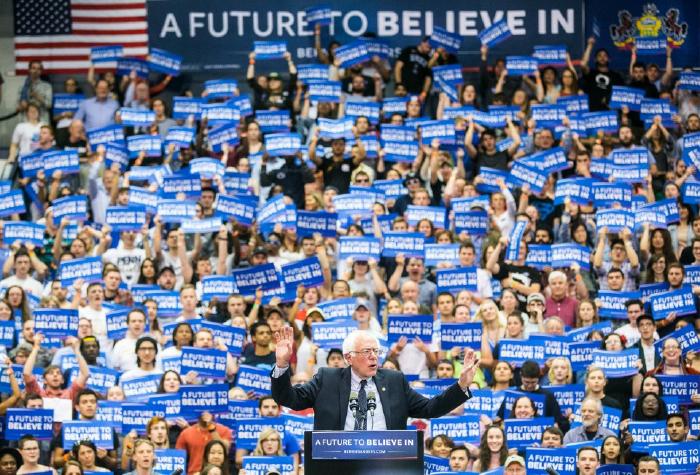
purelyspeculationThis week, the American people will have their final chance to capitalize on the heartfelt platform of hope proffered by presidential candidate Bernie Sanders. Will they take this opportunity, or has Bernie merely been casting pearls before swine?

We’ll find out on June 7th, as the DNC hosts their final major round of primaries, with 6 states holding contests, and a grand-total of 694 pledged delegates up for grabs. As of the writing of this article, the pledged delegate count sits at 1500 for Bernie Sanders, and 1770 for his opponent Hilary Clinton.

It must here be noted that this does not include super-delegates—the patently undemocratic party elites who are afforded the opportunity to pledge their loyalty according to their personal interests, rather than the will of their constituents. Of these, Hillary currently has 520, while Bernie holds a comparably measly 45. Although these super-delegates have currently promised their loyalty as such, their support is not locked in until the Convention in July. It’s possible therefore that the events of June 7th could weigh heavily on this final process, and herein lays Bernie Sander’s greatest hope.

sandersBased on these current numbers, Sanders would need to take ~71% of the vote on the 7th in order to enter the Convention with a compelling argument. It’s a tall order to be sure—but not wholly impossible. Still, even if Sanders and Clinton went to convention with relatively equal delegate counts, the onus would be on Sanders to convince the super-delegates to throw their support behind him—a revolutionary thinker who has consistently challenged the very sort of entrenched Establishment politics upon which the super-delegates are based.

It’s not an encouraging scenario, and it brings us back to our initial question. In his campaign, Bernie has been infallibly consistent in the message he’s delivered to the American electorate. His vision is that of a nation which values its people as a whole, and not simply its business owners and billionaires. He has captivated the youth and other well-meaning people of the nation with the rather seditious notion that government must serve its people: that fair taxes must be paid by everyone, and that the use of those taxes must at all times be aimed at improving the station of the population as a whole—rather than merely protecting the interests of the rich and powerful.

For the majority of the civilized world, these ideas are already held as sacrosanct. Unfortunately for him, Bernie Sanders is running in America, where the reek of Reaganomics still lingers in the very fabric of the economic structures, and the working class still confuses the meanings of freedom and fiefdom.

So if Bernie’s natural empathy for the working class and indefatigable hope for the future have captured the minds of the electorate, it may prove rather less effective in securing the support of the ruling elite. Rather, his argument will soon switch focus—insisting (and not without merit) that he is the most likely Democratic contender to topple Donald Trump—that unholy mess streaming down from the recently self-eviscerated GOP.

Unfortunately, the Democratic National Committee is firmly entrenched in its current politics—hell, their pocketbooks depend on it. So this argument—though valid—may still fall upon deaf ears, leaving America in a more dismal situation than ever.

If June 7th turns sour for Bernie, this rare opportunity for positive growth will have been momentarily squandered, and Americans will be left with a choice between Donald Trump: a hair-brained demagogue promising to fan the already raging flames of fear and bigotry, or Hillary Clinton: a sorry shill of a candidate whose sound-bite message changes with every opinion poll, but whose true priorities are as intrinsically tied to Wall St. and the corporate elite as is her fundraising. Either would likely mean another four years of rule by corporate interests…and a depressing admission that despite the growing mass of well-informed and even-headed voters, the powers that be still have a fatal stranglehold on American politics.

For voters on both sides of the political spectrum, this scenario would amount to little more than a compulsion to vote for the ‘lesser of two evils’—all while knowing full well that the end result will favour the entitled rich, and further isolate the vast majority of society from active political discourse.

1401x788-Screen-Shot-2015-06-04-at-12.45.15-PMHowever, this won’t be the case…at least not entirely. The message Bernie has been spreading is nothing new—hell, he’s been saying it the entirety of his 35-year political career, and most of his life besides that. What’s more, it is the ever-growing sentiment of the caring and politically-informed—not restricted to the young alone as the media often claims—open and accessible to all with the mind to understand the scope of their situation, and the resolve to damn well do something about it.

Bernie has not created this movement, but rather he has acted as the lightning rod for an already growing resistance. He has become the voice of a generation who have had enough of the unfair playing field they have been given, and who seek to build a system that is fair and compassionate; one which provides for all of its citizens the opportunity to flourish in a country which has no justifiable reason to offer anything less.

While Bernie has been the mouthpiece, this surging tide will not end with his campaign (should it indeed end). Bernie Sanders has shone a light on the reality of our station—showing countless people that they are not alone in their hope for a better world, and that they are not naively idealistic in their expectations. This ever increasing sense of justice is one that cannot help but spread, simply because it is rooted in a truth far more fundamental than the forces of greed and vice against which they strive.

If Bernie’s message could be encapsulated in a few words, it would be this: ‘We can do much better’. He has spoken this time and again—sounding often enough like a broken record—and despite the potentially disappointing results of this year’s primaries; his message has not fallen on deaf ears. People perceive how much better we can do, and even though the forces of greed may once again prevail, the lasting sentiment of this movement will continue to flourish. Now, its message is a bit different. The knowledge of a better world is beyond doubt, but so too are the obstacles to obtaining it all the more evident.

So perhaps Bernie has cast pearls before swine—far too many swine at least. But his pearls have nonetheless been plucked up by deserving and admirable minds, and their message now, seeing the fight before them, may be best expressed with a line stolen from the late great Pete Seeger. Democratic Socialism and Bernie Sander’s Revolution are of one clear and conscientious message: ‘We are not afraid.’

sanders-vpr-laslo-20150910So, although trampled and despoiled, pearls they remain. And if there are dark times ahead, then so too is there the promise of brighter days. The masses, I am convinced, have been awoken, and never again will their eyes be closed to the truth of their oppression, nor from the laudable promise of a fair and equitable world which values it’s humanity above its finances. For this at least, we owe Bernie Sanders a debt of thanks—time alone will reveal just what a great debt that is.

-Brad OH Inc.

Libertarians are Starry-Eyed Idealists

purelyspeculationFreedom is often lauded as the most integral value of any developed nation. In fact, the notion of the ‘free world’ does much to inform us of the fundamental value that we place on personal liberty, and well it should. Freedom is among the key human rights, but it must be pointed out that at times, people get a little bit carried away with their interpretation of what exactly ‘freedom’ entails.

One need not wade too far into the depths of social-media to find the rants and raves of disenfranchised citizens so bitter about a parking ticket, or a sales-tax, or perhaps a pesky ‘no-loitering’ sign, that they’re ready to hoist the black flags and hop aboard the good ship ‘Anarchy’.

‘Freedom’, they will argue, is the birthright of man—the inalienable and righteous destiny of all people brave enough to seek it! But there are sorry few building their own boats to follow this urge, and fewer still running off to the lonely mountains to live a ‘free’ life. I suppose it’s an easy thing to moan about the comfortable confines of society as you daydream about weening yourself off its teat, but it does beg the question of what exactly true ‘freedom’ is, and if it can exist at all.

I would argue that perfect freedom is an illusion—a starry-eyed dream more befitting whatever afterlife you prefer than the life you live. In fact, I believe that power and control are unavoidable, and there is no conceivable ‘system of naught’ sufficient to maintain the vacuous void left if all authority is stripped away.

Perfect freedom would mean no laws, no control, no taxes—but it would accordingly mean no safety, no opportunity, and no infrastructure. In our article ‘On the Concept of Society’ (Link) we discussed how a society is the product of all its members, past and present. That remains entirely true. Society has never been about freedom—if anything that is the antithesis of society. In truth, ‘society’ is meant to be a foundation of cooperation among its citizens.

In the societal sense then, total freedom—much like anarchy—is a myth. It may perhaps exist for a single person, but once a second person enters the picture, the illusion will die. Power hierarchies will be formed, and one’s wishes will ultimately infringe upon the freedom of the other. We are not free to kill for the very reason that we do not wish to be freely killed. The same applies to property rights, safety issues, and so on. While loitering laws may perhaps be a hard concept to defend (Black Flags ahoy!), the need for a significant proportion of civil laws can be most easily discerned by asking oneself not ‘do I wish to follow this’ but ‘do I wish for others to follow this’.

Those who support total anarchy then, are either misunderstanding the basic tenets of life, suffering from a sadomasochistic urge to regress back to the days of pre-tribal man, or simply mad.

Libertarians, on the other hand, may accept some laws, while rejecting the notion of many others. This rejection most often applies to rules around the free-market. However, as we have already established that a power-void cannot remain unfilled, we should have little trouble applying this observation to the marketplace as well.

If you wander into the woods, claim them as your own, and insist on living a lawless life, it may prove less glamourous than you imagine—especially when the next lawless rogue shows up to strangle you in your sleep and make off with your supplies. So much for freedom!

The marketplace is little different. Without control, corporations are wont to seize public goods and resources, create monopolies, underpay workers, and wreak general havoc however they please. People will starve, or toil like slaves—yet this will be defended and redefined as the justly exercised freedom of those very corporations. In truth, this notion of marketplace-freedom is no better than economic anarchy—and its supposed virtue quickly diminishes as the strongest take control and run our system like a tyrannical oligarchy. Meanwhile, the citizens cheer blindly about the merits of freedom.

To claim to be an anarchist or full-on libertarian is naïve, and the ultimate result is little different from the sort of systemic madness we have now. Freedom has been given out too freely—sadly, only to the corporations at the head of the markets, and rarely to the citizens. The powerful will always feed upon the less powerful, and this is a demonstrable loss of freedom for the latter.

In order to have liberty for ourselves, there must at the very least be laws restricting others from infringing on that liberty. Anything less would be Mad Max-style anarchy. Control is needed, and must be imposed justly. As discussed in our article ‘On the Fear of Big Government’ (Link), the ultimate purpose of government is to ensure that the power which inevitably arises is a fair and just one.

This must not be taken to mean that I believe the current governments of the world are doing much to uphold these standards—indeed there is a great need for improvement on nearly all fronts. Simply put however, the raging masses squalling for ‘total liberty’—or its ugly cousin ‘anarchy’—are naïve at best. The line between liberty and domination is a difficult one to draw. If drawn too close to total freedom, a void arises, and we end up dominated. It’s circular in a sense, and requires an insightful and informed balance. This is the purpose of society and the governments which it employs, and we must pay heed to avoid being so brash as to throw the baby of equal opportunity out with the bathwater of social order.

-Brad OH Inc.

Upon the Bones of Better Men

cropped-cropped-blogbanner13.jpgThe philosopher Bertrand Russell once claimed that “the fundamental cause of the trouble is that in the modern world the stupid are cocksure while the intelligent are full of doubt.”

What a hack! What fanciful platitudes! Tell me Bert, do ‘nice guys finish last’ too? Do the good die young? Let me tell you something Bert, sorrowful homilies are good for one thing and one thing only—cheering up losers by convincing them that their failure is the unjust result of their righteousness rather than the logical result of their ineptitude.

What’s worse however, is that so many people seem to believe this naïve nonsense. Well, have no fear—you’re friends at Brad OH Inc. are here to set the record straight!

The truth is, these notions of ‘stupid or wise’, or ‘good and bad’ are entirely misled at the best, and revisionist at the worst. Victory is for the bold—the lions willing to do anything to take it, and leave the rest to lick their wounds and talk about how life just isn’t fair.

It’s pathetic.

The claim that one is held back by their morality is utterly absurd. It’s not that only brutes act decisively, leaving the considerate in the dust. That’s just switching labels to console lack of ability. If we look at the world pragmatically—and we should, always—we can see that it is no bestial or heinous act to seize upon your desires—hell, it’s what being a corporation is all about!

No, the problem is that the hindsight of the meek is 20/20, while their foresight is more mole-like than Machiavellian. It’s true in business, in love, in politics, and in the picking of low-hanging fruit. Don’t believe us? Well, let’s look at some of the key culprits here.

‘Nice guys finish last’. It’s the motto of every single loser too scared to say hello or slap an ass when the opportunity presents itself. For these pencil-necked geeks, it’s easier to sit back and lament that their ‘kindness’ is the reason they are left behind, rather than their own pathetic fear of rejection.

We see the same lame-duck whining in business as well. ‘We can’t compete with big businesses’, says the mealy-mouthed dweeb as he finally shuts the doors on his dusty little shop and files his EI claims. Well you know who can compete with big businesses chump? Bigger businesses! So maybe instead of blaming cruel fate for your failure, you should take a long look in the mirror.

Politics? Social interactions? Without fail you hear the same miserable whining about how decency gets you nowhere—that idealism is treated like an insult and dreamers are called naïve. But that’s not quite it, is it?

There’s nothing wrong with dreaming, but if you don’t eventually wake up, marshal your underpaid employees, petition politicians to change laws in your favour, and make off with millions, you have no one to blame for it but yourself. Wuss.

To break it down; morality is an excuse, not a handicap. At Brad OH Inc., we stand as a shining example of action, pragmatism, and success. Where others have cried about the opportunities they never had, we’ve used our inherent societal privilege to better ourselves. So for you hopeless waifs still waiting for someone to hold your sorry hand and lead you to happiness, let me share a bit of healthy advice. Holding strictly to honesty and kindness is the surest route to failure in business, politics, and interpersonal relationships alike. They’re for chumps, and punks who would rather stew comfortably in their failure than bully their way to true happiness. Success in almost every aspect of life is predicated on cunning decisiveness and a brutal willingness to sell out your fellows when the opportunity presents itself. The towers of the powerful are built upon the bones of better men. So make your choice, and take your place. If you’re smart, we’ll see you here at the top.

Your Dear Friends and Personal Advisors,

-Brad OH Inc.

The Corporate Path is Clear

cropped-cropped-blogbanner13.jpg

Recently, the Corporate World achieved another outstanding victory in the passing the Trans-Pacific Partnership (TPP) deal, and this is just cause for every little Corporate boy and girl to celebrate! This deal—passed with exceeding secrecy and underhanded tactics meriting great praise—has cleared the way for the final stage of Global Corporate takeover! The world for too long has stood on the crossroads between the old values of equity and access, and the new inroads of exclusivity and dominance. With this ruling, we can finally put boots to asses, and send this listless planet down the fast-lanes to true Corporate greatness!

The TPP is a Trade Agreement between 12 Pacific Rim countries, and was passed on Oct. 5th, 2015 (Link). With the aim of clarifying complex international trade protocols similar to NAFTA before it, the passing of the TPP represents one of the greatest moral victories of our time, and a true recognition of the inherent worth and global merit of your friendly Corporate Citizens. With it, the shackles of injustice have been cast away from Corporations around the world, and finally we will be allowed to flex our full power without the heinous hindrance of being answerable to ‘the people’. We’re one too after all, and it’s due time they answer to us!

Described as creating a ‘hybrid government-Corporate structure’ (Link), the TPP is nothing short of the Liberty Bell sounding throughout the lands/ boardrooms—declaring to all Corporate people to go out and do what they will. No longer will we be held back by weak-minded considerations such as ‘environmental concerns’, ‘fair wages’, ‘fair’ copyright laws, ‘affordable’ medications, ‘worker’s rights’, ‘domestic job creation’, and ‘privacy protection’ (Source).

It’s a stunning accomplishment to say the least—and directly reflects the world’s gestating acknowledgement of its true leaders. For it is Corporations which build society, and by unburdening us from the wasteful confines of ‘global responsibility’, we are freed to continue to do what we are made to do—maximize profits!

Could it get any better for your beloved Corporate benefactors you ask? Well, we’re happy to say it can! Not only does the TPP grant us the Inalienable Right to ignore the ‘inalienable rights’ of private citizens, it also provides Corporations the ability to challenge foreign laws in so far as they impact our acquisition of Capital, and to have a greater (and well-deserved) role in writing and voting on government policy!

Clearly, this is a lauded day in the history of the Corporation, but as the small, merely ‘human’ individual you are, you may well be wondering how this affects your pitiful existence. Have no fear—the passing of the TPP soundly ensures that those concerns are no longer in your domain. The Global-Corporate takeover is now nearly complete, and that only means that for every fear and each doubt you may harbour in your fragile little minds, Corporations are already working on the answer. We hold the reigns now, and your complete trust is the only rational response.

Not sure what to eat? We’ve got you covered! Confused about Environmental debates? Leave it to us! Sick? Save up! Out of work, destitute, and stricken by an unconscionable sense of ennui? Fear not my child, for we the Corporations will always ensure there is just enough to go around—how else could you possibly continue your unconditional support of our governance?

Face it—this is only the culmination of a long-entrenched reality. We the Corporations have everything well in control. So sit back, let your ‘Genius’ playlist tell you what to listen to for a ‘relaxing mood’, and trust that everything will be ok.

After all, we’re here for you™.

-Brad OH Inc.

The Corporate Human

cropped-cropped-blogbanner13.jpgA while back, your dear friends here at Brad OH Inc. posted an article called ‘The Constitution is America’s Bible’ (Link), which essentially explained the outdated relationship the United States has with their founding constitution.  While the thesis of that article remains entirely apt, one commentator decided to make a spectacle of himself in the comments section—raving against the progress towards political equality obtained recently by Corporations via the just ruling of ‘Citizens United’ (Link).

For a frame of reference, and to provide insight into just how limited and misled this poor individual (the lowest form of Human) is, we have included the reply here:

DCDear (Link):

“Perhaps we need to give Citizen’s United exactly and completely what they want – to be a person.

They would have to pay taxes like every other person, unlike many corporations who avoid paying taxes. CU could be held in custody for 48 hours without cause, like other citizens. They would be subject to the same laws – for example in states with the death penalty, CU could face the death penalty and the entity would be executed.
I could go on, but lunch is over…and I must save the world – be well.”

Well ‘DCDear’ (if that’s your real name)…ok. Let’s play your little game, shall we? First of all, it is incumbent upon me to point out how highly offensive your chosen vernacular is. ‘Give us what we want’? Liberty is not a gift to be doled out on a whim DC, and certainly not by the likes of you. Being human is the fundamental nature of a Corporation, and to divorce us of that in will or intention is a crime against humanity in its highest form. You should be ashamed of yourself!

Incidentally, if you are ashamed of yourself, some of our Corporate friends have a great line of drugs to remedy just that. Contact us privately for a link.

Now, onto your childish tirade—your first demand is that Corporations pay taxes, ‘just like every other person’. What a demand indeed! Did you know that every single component person in a Corporation pays taxes? That would be like you being taxed for every cell of your body! It’s outrageous to even consider. So clearly, Corporations already pay more taxes than are needed. To ask us to pay more is simply to punish us for our success.

When one of our posted articles gets more likes than the other, we don’t take some of the letters out of it. Instead, we try to produce more content just like it! It’s what the people want! So if more taxes are what you want, then maybe you should follow our example: Become a success, earn more money, and then pay as much as you’d like.

Next, you demand that Corporations (and not their component humans) should be subject to detention and/ or death. Death DC? Really? That seems a tad macabre.

It would behoove you to ask yourself, ‘Do I really want this’? Well, do you DC? Do you want to do without your lauded latte in the morning just because some whales off the coast of who-knows-where died in a perfectly orchestrated oil-spill? No, you don’t.

How about technology? Do you like the keyboard you used to create your hatful vitriol? Well, maybe the Corporations that provide you such blessings should be ‘killed’ just because some kids in the third world are being given an opportunity to work. Honestly DC, it’s the THIRD world. That’s the WORST of all the worlds anyway!

It seems to me that if we allowed our best and brightest humans (Corporations to the last) to be subjected to such primitive law enforcement, it would be you who suffers the most DC. We can only imagine the rant you would come up with when your cell-phone was relegated to a useless mound of plastic because the Power Corporation got in trouble for some measly little fire. And imagine it we would have to, since you would be hard pressed to find a piece of carbon to scratch the tirade on a stone after your computer went out.

So much for that, then.

Ultimately, there’s a crucial thing you have to realize DC. The fact is that yes, Corporations are people whether you like it or not. But they aren’t only people…they’re the best people. By definition, a human can’t be better than a Corporation, and a Corporation can certainly not be less than a single person. We are the builders, the creators, the innovators and the inspirers. More importantly, we are the decision makers. So the next time you feel like flying off the handle over some minor global injustice or trite environmental fiasco, maybe instead of rallying against your betters like an ungrateful putz, you should just pack your things (any not made by a Corporation that is…good luck with that) and move off into some non-Corporate zoned section of nothing to see how well you fare (Hint: Not very well).

Face it DC, without us, the rest of you are nothing. Bald monkeys clamoring about mindlessly—dreaming nothing, achieving nothing. We are Humanity in its fullest form—the culmination of eons of cooperation and growth, focused with laser-like precision upon our own needs. And fear not, for when we invariably meet our needs, rest assured you can count on some trickle of our grace running down to yourselves (Don’t believe in ‘trickle-down’? Go stand under a waterfall. It’s hard to argue with a waterfall, DC). It’s far more than you could ever achieve alone, and you should undoubtedly be thankful for it.

So give us the freedoms we ask, and relinquish your hopes of accountability and equality. There is no equality between Gods and men, nor between the Corporate Human and the mere ‘human’. The more you seek to restrain us, the greater will be our victory—and all your efforts shall come to naught in the glory of our dominance.

Yes DC, we know we’ve been hard on you here, but please understand that we are only trying to help. Humanity needs its Corporate overlords far more than it knows, and if we are unable to pursue our humble ambitions of unlimited wealth and social dominance, then so too will you fail in all your endeavors.

Don’t believe us? We understand, it’s bigger than you could ever process. But next time you consider rebelling against your forbearers, we would advise you to close your laptop, and just take a few deep breaths. While you do that, go ahead and stare into the little glowing apple on the front of your computer, and recall that it was your kind, not ours, that partook of the fruit. So if knowledge is your misery, it is yours alone to wallow in. Frankly, you’d be better off without it. So stop questioning your lot, and be thankful for what you have—as it is to the last morsel the windfall of our own grand design.

-Brad OH Inc.

The Second Most Important Step to Improving the United States

purelyspeculationHere at Brad OH Inc., we have on several occasions (Link) covered an issue which is indisputably the most important step to improving the United States. That is the complete overturning of Citizens United (Link). This change stands at the foremost of all sorely needed improvements, solely for the reason that this ruling acts as the lynchpin to all the other changes the country—and moreover the world—so dearly needs. So long as laws are decided by the vote of Corporate dollars rather than the will of the citizenry, all other problems shall remain immutably entrenched in the quagmires of Corporate bureaucracy.

As this has been covered in depth elsewhere, however, today we will be focussing on what seems to be the second most important step to repairing the dismal affair that is the United States of America. Specifically, we’re talking about the significant reduction and reallocation of military expenditures. As discussed in our article ‘The Global Scale’ (Link), the current approach to foreign policy taken by the American government—the driving force here being the Military Industrial Complex (Link)—acts in actuality as the source of many of their current greatest woes.

As more and more effort is exerted to bring ‘freedom’ to the rest of the world, so grow the enemies of America—understandably bitter about the ‘foreign aid’ that comes in the form of drone strikes, trade embargoes, and unnumbered civilian casualties. This creates a dangerous cycle, in which the American populace—goaded by the bought-and-paid-for media—feels more terrified by the day, and are comforted only by the knowledge that their dear country is capable at any point of destroying the world in the name of saving it.

“But if you strip military spending, you’ll expose us to terrorists,” cry the feint-hearted American media-stooges. Well, let’s consider the facts for a moment—if that doesn’t seem too tall an order.

Based on presently reported statistics (Source), the United States spends approximately $577 Billion on its military each year. This is significantly more than the TOTAL of the next 10 highest spending countries combined.

I’ll allow a second for that to sink in.

With spending like this, America is rather like the kid who shows up to a water pistol fight armed with a firetruck. It’s Rambo intruding on a friendly game of cops and robbers—PTSD flashbacks and all. Simply put: It’s madness.

Meanwhile, infrastructure is crumbling (Source), the homeless population is ballooning (Source), veterans are left without care (Source), and funding for public education is being gutted (Source).

Looking at the numbers above, let’s consider the relationships here with a quick bit of theorizing. If—and this is a naivety to be sure—the US were to slash their military expenditures in half, they would be left with a yearly military budget of around $288.5 Billion. Now, while only half of what is deemed currently necessary, this would still leave the US with a military budget higher than the combined budgets of the next 3 highest spenders. That doesn’t seem like an especially dangerous situation to be in, especially considering that half of the top ten spenders are allies of America.

Further to this consideration, we’ve seen through manifold examples in the past, and as an ongoing theme of the present (Link), that military escalation is a losing game. Investment in war tends primarily to breed more war—with the only safety-net being found in mutual destruction.

If however, this budget change was made, America would remain far and away the greatest military power the world has ever known, and yet would have a sudden windfall of $288.5 Billion to spend on social services like Veteran Affairs, Welfare Programs, Education, Healthcare, Infrastructure, (real) Foreign Aid, Home Care Services, Senior Care, and so much more.

With such a change, America could begin to be the utopian saviour it so desperately wants to be, rather than the school-yard bully who beats on people until they praise him. By setting an example for the world of the sort of peaceful and genuine neighbour they could be, they would likely reduce their enemies greatly, improve many foreign relationships, and, if funds were allocated appropriately, perhaps solve global terrorism at its root, rather than merely spreading the fire.

The end-goal here should not be hard to see—by addressing this ridiculous budgeting fiasco, the US could be the beacon of hope it has always claimed to be, rather than just another blind threat uttered in the darkness of irrational fear.

-Brad OH Inc.

On American Exceptionalism

purelyspeculationIn our recent article on ‘On Combatting Jihad’ (Link), we explained that if the ‘Western World’ was to successfully combat the tides of Jihad, their best breakwater would be not in armaments, but in exceptional and inspiring ideas. Well don’t take it from us—this sentiment was recently echoed by President Obama himself (Source).

But the main problem with this goal is that by a great majority, it is already deemed accomplished.

You hear it all the time: America is exceptional. Hell, it’s so ubiquitous as to merit its own definition on Wikipedia (Link). It’s right at the head of the article: “American exceptionalism is the theory that the United States is inherently different from other nations.”

Well, this at least may be true.

As the first ‘new nation’, it has long been assumed that America represented an opportunity to redefine what a country could be: Both within its borders, and as a beacon to the world without.

Again, it can hardly be argued that this opportunity has long been afforded to, and occasionally even seized by America. But the problem here is the built in assumption of positive affect. ‘America is exceptional’ is virtually always taken to mean ‘America is Great’, or ‘America is better’. It’s repeated ad nauseum, and finally taken to be axiomatic fact—that is to say, it’s taken as true by its very nature, and no longer are facts needed to support the notion.

There is nothing inherently exceptional about America. Not in the happy-go-lucky, ‘liberty, freedom ra ra ra’ way it’s so often portrayed to be at least. Of course, the key word there is ‘inherently’. Certainly, America has the potential to be exceptional. They are no different in that respect from any other country in the world. But to be exceptional, one must act in an exceptional way–that is, to take actions and make decisions which are above and beyond the standard. This, America is failing to do, and has been for a long time.

We’ve discussed in several articles, most notably ‘The Global Scale’ (Link) how American Imperialism has a devastating impact on the world at large. Politics driven by the greedy impulses of corporations have shifted this potentially great nation into something far more dark and sinister than was ever envisioned.

Yet it remains common rhetoric to use ‘American Exceptionalism’ as the justification for poor decisions. The assumption is that anything America does is exceptional by definition–because America is exceptional. This is misled, and serves only to justify the continuing trend of poor–and potentially disastrous–decisions.

Here, we see the axiom of American Exceptionalism become tautological, and thus it not only loses its meaning, but becomes a means of bolstering against any positive change. As global politics continue to heat up, and the dream of a future resplendent with peace and prosperity grows ever dimmer, exceptionalism is used as a pacifier, and the placated citizens are endlessly assured that not only are they alright (Link)…but even more damning, that they are, simply, right.

But it is not enough for a nation to claim it’s exceptional because it was founded on the principles of liberty and freedom, as this only allows it to rest on its withering laurels. Rather, one must accept that the country is in decline, and actively work to re-establish that once proud tradition.

America claims to be exceptional, yet falls ever short of being so. What would it take to live up to these claims? There are myriad areas to improve for sure. Rather than the strong focus on overwhelming might, or the ongoing bludgeoning of American Exceptionalism, perhaps it could be shown through greater commitments to issues such as education, infrastructure, debt relief, third world aid, equal rights, etc. If these priorities are seized upon internally, and a greater effort established at promoting them worldwide, then America could again be the beacon of hope it so desperately wishes to be. For these are the hallmarks of a truly great nation, which no flag, slogan, or axiomatic battle-call can ever replace.

-Brad OH Inc.

‘The Election’ Published on GonzoToday

cropped-cropped-blogbanner13.jpgHere at Brad OH Inc., we’re happy to announce that our Single Serving StoryThe Election’ is now available for reading on GonzoToday.

A direct link can be found right here.

Further, the downloadable version of ‘The Election’ over at Smashwords is very fast approaching the 100 Downloads mark. That’s even more reason to celebrate! Click on the image below to access a free, downloadable copy of ‘The Election’ on Smashwords.

theelectioncoverWe want to take this occasion to thank everyone who’s downloaded it for your support—we truly appreciate it, and hope you enjoyed the read. For those of you who haven’t yet read ‘The Election’, now is as good a time as any. So click here, or on the image above, and check it out absolutely free in any e-reader format that suits you! Alternatively, you can view it (along with many other fantastic articles) in-browser over at our friends ‘GonzoToday‘ by clicking right here.

-Brad OH Inc.

Saving the World: 101

purelyspeculationSupply and demand is the driving force behind any effective economy. Since the Industrial Revolution (Link) however, the face of the ‘supply’ end has been changing. As reliance on machines began to increase in the production of goods, the number of workers required has reduced correspondingly. Materials and goods are now produced more efficiently, and at lower costs to the producers.

Of course, like all things technologically driven, this process only tends to speed up exponentially over time. With the dawn of automation in factories, and technologies like 3D-Printing reinvigorating the revolutionary process begun in the 1800’s, the balance between supply and demand may never have seen such a radical shift. In fact, it’s entirely plausible that within a decade or two, we could produce the vast majority of our goods with little to no human investment.

As discussed in our article ‘On the Concept of Society’, the advancements of society are a cumulative process, and their rewards must therefore be shared equally amongst its constituents. Sadly, this is seldom the case.

While the supply end of the market grows ever easier, demand remains moreover the same, and the essential balance between the two becomes very different from what was initially intended. Rather than setting a price based on the amount of a good available contrasted against the demand for that good, we see a more methodical approach: With an unlimited quantity of a given commodity available to be produced at extremely low cost, what is the greatest amount that can be charged for that product without alienating consumers?

Therefore, the maximum amount is charged for all goods and services, while the financial gains resulting from improved means of production tend to filter only into the pockets of the business owners.

The final result is that the vast majority of the citizenry continues to struggle to meet their basic needs. Clearly, this system is no longer an acceptable form of management, but where do we go from here?

Let us consider the original need for economic systems such as the ‘free-market’ and its inherent reliance on ‘supply and demand’. The world—and moreover society—has always been in need of guidance, of a helping hand to direct us in the choices we need to make. In its historical absence, humans have spent the greater part of our existence inventing our own, then fighting over the results.

Usually, the established political system is intended to reign in the ambitions of the market place, but here too we have found ourselves struggling. Voters find themselves muzzled by corporate control of government, false-choice party politics, and the impossibility of getting any legitimate populist issue to the table past the corporate watchdogs.

So the economic systems can no longer function, and the political system won’t. There’s good news however. We may finally be at a point technologically where there is no longer any excuse not to begin work on a real solution to these co-morbid failings. A ‘God Program’, if you will. Its basis is already established in the internet, and certainly the tools are there to build towards an effort at human consensus through the ability to share ideas uncensored worldwide. This would benefit all people: both in the economic forum, and the political one.

Currently, the internet—with examples such as Reddit, Anonymous, Occupy Wall St. etc.—represents the incredible brilliance and diversity of our population. However, this brilliant spread of people have next to no representation in electoral politics. The political view is dominated by the opinions of crusty old business men who care only for their own profit margins.

Tapping into the full potential of the internet represents an incredible shift in our conceptions of democracy and political participation. In a return to something closer to Athenian Democracy (Link),this program would give the power of voice back to the electorate.

By fundamentally altering the existing architecture of the internet to handle these lofty ambitions, we could establish not only international, uninhibited communication on key political topics, but also a database of all fact and knowledge—with Wikipedia likely acting as a fine foundation for that concept.

The program would not only increase the political voice of all people, but fully manage the economic considerations outlined in our discussion of supply and demand. Its considerations would need to include population size and the balances therein, crop yield, required sources of work and how such might be distributed. Essentially, with a computer program evaluating all available supply and existing demand, society would largely be engineered rather than controlled—with science, math, and humanity acting as the fundamental drives, rather than money or power.

To be sure, this isn’t a new idea by any stretch—as far back as the founding of Technoracy Inc. (Link) in 1931, the notion of a society driven by logic and engineered from the ground up to meet the needs of all has been floating around. It just hasn’t gained much traction.

Why is that?

The society we have in mind would be ideal for everyone alive. With a perfect balance of resources, a deep understanding of social needs, and a computer program capable of predicting these needs and social shifts well in advance, we could hone our efficiency, while creating a Golden Age in regards to leisure time and cultural advancement.

Balancing all needs and efforts, and focussing a calculated portion of all proceeds towards scientific research that is not limited by the profit margins of corporate priorities, our overflow of resources could be harnessed to solve any new problem which might spring up—certainly not excluding the ultimate and near-inevitable need to begin mining and colonizing beyond Earth.

There would be room for businesses to thrive and continue to both produce and profit from innovative consumer goods in a truly free-market (un-manipulated by large-scale corporate interests), while government institutions and human resources would focus clearly on the benefit of all mankind.

With an extremely small and efficient active workforce, and the needs of all met by this program, opportunities would be available for anyone to pursue their passions, and these would directly benefit all. The idea of job shortages leading to poverty or starvation would be unheard of. Mothers or Fathers would stay home to take care of their children rather than greeting people at Walmart, and all people would be free to choose a pursuit which serves them the best.

The program would allow for balance and bounty, while increasing our leisure time and guiding us into a new era of economic and cultural prosperity.

So then, what might be standing in the way of such an idyllic solution? I suppose you’d have to ask yourself another question. Specifically—when we consider utilizing the internet as a salvation for society: controlling profits, balancing production, lowering costs, increasing personal freedom and social supports, improving unilateral political participation, and using excess profits for the betterment of all—exactly who could possibly stand to lose?

If you can answer that question, you’ll see the reason that society has not yet begun to take these easily available steps towards a more utopian ideal. But in the end, it’s not their hearts or minds upon which real change depends, but our own.

-Brad OH Inc.