The Key To Improving Our Collective Future

Under the Green Desk Lamp…

Green Desklamp

Of all the various topics covered here at Brad OH Inc., perhaps the most ubiquitous theme is our interminable conviction that despite all evidence to the contrary, this world can be better. We’ve covered the notion incessantly, and put forth several potential suggestions for how to achieve this lauded goal. Our ideas have ranged from the online management of resources (Link), to more informed protection of our environment (Link), and even to ‘The Uncomfortable Issue of Population Control’ (Link).

Yes, if there is to be any hope of improving this world of ours, there are unquestionably a tremendous number of considerations to attend to. We’ll need to figure out how to better manage our resources, how to feed our masses, how to improve our governance, how to avoid conflict, and how to escape the iron-grasp of our corporate overlords. And that’s just to get started!

But have no fear. Of course, we here at Brad OH Inc. will continue to work tirelessly in finding solutions to each and every one of these quandaries, but if we’re being entirely honest here, well, the truth is we just may not have the time. It’s quite the list after all, and even Corporate-Persons are subject to the rigid confines of mortality…for now.

Either way, this brings us to our topic today—and what a timely topic it is! If we are sincere in saving the world, then the first step is to agree on the single most important step to improving our collective future. And the key to that, in my mind, is unequivocally a greater investment in education.

While it is—admittedly—a long-term investment, significant support and improvement to our educational system is the most important change available to any country when considering the prospect of its future direction. While it may not arouse the sort of public fervor that a tax-cut or an increase in jobs (not necessarily an ideal goal–Link) would, the eventual payoffs will outshine any other source of investment ten-fold.

While all the other goals listed are certainly relevant sources to invest in if the objective is a sound society, the most essential point here is that in order to face the challenges of the future, we will absolutely need a dynamically informed populace: a generation of children fully capable of rationally considering the key issues of their time and critically evaluating the platforms of competing politicians. Therefore, education will be the most important factor in improving the woes of society.

No matter what other issues you may consider the key burdens on society, we will be unable to address them to the best of our abilities so long as we continue to be easily distracted and divided by petty corporate-politics. Without an informed and critical populace, we are doomed to be washed away again and again in whatever waves of popular trends the mainstream media establishment seeks to drown us in.

To escape this cycle, we need thinkers capable of solving problems rather than merely seeking distractions from them. It’s not a cheap solution to be sure. This notion would require not only significant dollars, but also a major overhaul of the educational curriculum. The leaders of the future will need strong foundations in philosophy, politics, critical thinking, problem solving, interpersonal communications, and so much more which we can hardly imagine. The world increases its pace each and every day…and we need our children to do likewise.

It seems simple, and it should be self-evident that we could truly solve many of the world’s ills if we invested half so much energy into education and science as we do marketing and deception. Yet unfortunately, that’s not the way the tides are turning (Link).

So here’s to the teachers, who continue to weather the storm. Though the rains come strong and the winds blow heavy, they keep their hand on the wheel and eyes on the stars—steering the youth of our world towards a place and time more hopeful than our own. And it is because of this unerring will to improve the generations to come that we here at Brad OH Inc. and many others the world over may maintain our own faith in the future.

So let’s teach the children to think, and pray that they do so better than we have.

-Brad OH Inc.

‘The Election’ Published on GonzoToday

cropped-cropped-blogbanner13.jpgHere at Brad OH Inc., we’re happy to announce that our Single Serving StoryThe Election’ is now available for reading on GonzoToday.

A direct link can be found right here.

Further, the downloadable version of ‘The Election’ over at Smashwords is very fast approaching the 100 Downloads mark. That’s even more reason to celebrate! Click on the image below to access a free, downloadable copy of ‘The Election’ on Smashwords.

theelectioncoverWe want to take this occasion to thank everyone who’s downloaded it for your support—we truly appreciate it, and hope you enjoyed the read. For those of you who haven’t yet read ‘The Election’, now is as good a time as any. So click here, or on the image above, and check it out absolutely free in any e-reader format that suits you! Alternatively, you can view it (along with many other fantastic articles) in-browser over at our friends ‘GonzoToday‘ by clicking right here.

-Brad OH Inc.

Saving the World: 101

purelyspeculationSupply and demand is the driving force behind any effective economy. Since the Industrial Revolution (Link) however, the face of the ‘supply’ end has been changing. As reliance on machines began to increase in the production of goods, the number of workers required has reduced correspondingly. Materials and goods are now produced more efficiently, and at lower costs to the producers.

Of course, like all things technologically driven, this process only tends to speed up exponentially over time. With the dawn of automation in factories, and technologies like 3D-Printing reinvigorating the revolutionary process begun in the 1800’s, the balance between supply and demand may never have seen such a radical shift. In fact, it’s entirely plausible that within a decade or two, we could produce the vast majority of our goods with little to no human investment.

As discussed in our article ‘On the Concept of Society’, the advancements of society are a cumulative process, and their rewards must therefore be shared equally amongst its constituents. Sadly, this is seldom the case.

While the supply end of the market grows ever easier, demand remains moreover the same, and the essential balance between the two becomes very different from what was initially intended. Rather than setting a price based on the amount of a good available contrasted against the demand for that good, we see a more methodical approach: With an unlimited quantity of a given commodity available to be produced at extremely low cost, what is the greatest amount that can be charged for that product without alienating consumers?

Therefore, the maximum amount is charged for all goods and services, while the financial gains resulting from improved means of production tend to filter only into the pockets of the business owners.

The final result is that the vast majority of the citizenry continues to struggle to meet their basic needs. Clearly, this system is no longer an acceptable form of management, but where do we go from here?

Let us consider the original need for economic systems such as the ‘free-market’ and its inherent reliance on ‘supply and demand’. The world—and moreover society—has always been in need of guidance, of a helping hand to direct us in the choices we need to make. In its historical absence, humans have spent the greater part of our existence inventing our own, then fighting over the results.

Usually, the established political system is intended to reign in the ambitions of the market place, but here too we have found ourselves struggling. Voters find themselves muzzled by corporate control of government, false-choice party politics, and the impossibility of getting any legitimate populist issue to the table past the corporate watchdogs.

So the economic systems can no longer function, and the political system won’t. There’s good news however. We may finally be at a point technologically where there is no longer any excuse not to begin work on a real solution to these co-morbid failings. A ‘God Program’, if you will. Its basis is already established in the internet, and certainly the tools are there to build towards an effort at human consensus through the ability to share ideas uncensored worldwide. This would benefit all people: both in the economic forum, and the political one.

Currently, the internet—with examples such as Reddit, Anonymous, Occupy Wall St. etc.—represents the incredible brilliance and diversity of our population. However, this brilliant spread of people have next to no representation in electoral politics. The political view is dominated by the opinions of crusty old business men who care only for their own profit margins.

Tapping into the full potential of the internet represents an incredible shift in our conceptions of democracy and political participation. In a return to something closer to Athenian Democracy (Link),this program would give the power of voice back to the electorate.

By fundamentally altering the existing architecture of the internet to handle these lofty ambitions, we could establish not only international, uninhibited communication on key political topics, but also a database of all fact and knowledge—with Wikipedia likely acting as a fine foundation for that concept.

The program would not only increase the political voice of all people, but fully manage the economic considerations outlined in our discussion of supply and demand. Its considerations would need to include population size and the balances therein, crop yield, required sources of work and how such might be distributed. Essentially, with a computer program evaluating all available supply and existing demand, society would largely be engineered rather than controlled—with science, math, and humanity acting as the fundamental drives, rather than money or power.

To be sure, this isn’t a new idea by any stretch—as far back as the founding of Technoracy Inc. (Link) in 1931, the notion of a society driven by logic and engineered from the ground up to meet the needs of all has been floating around. It just hasn’t gained much traction.

Why is that?

The society we have in mind would be ideal for everyone alive. With a perfect balance of resources, a deep understanding of social needs, and a computer program capable of predicting these needs and social shifts well in advance, we could hone our efficiency, while creating a Golden Age in regards to leisure time and cultural advancement.

Balancing all needs and efforts, and focussing a calculated portion of all proceeds towards scientific research that is not limited by the profit margins of corporate priorities, our overflow of resources could be harnessed to solve any new problem which might spring up—certainly not excluding the ultimate and near-inevitable need to begin mining and colonizing beyond Earth.

There would be room for businesses to thrive and continue to both produce and profit from innovative consumer goods in a truly free-market (un-manipulated by large-scale corporate interests), while government institutions and human resources would focus clearly on the benefit of all mankind.

With an extremely small and efficient active workforce, and the needs of all met by this program, opportunities would be available for anyone to pursue their passions, and these would directly benefit all. The idea of job shortages leading to poverty or starvation would be unheard of. Mothers or Fathers would stay home to take care of their children rather than greeting people at Walmart, and all people would be free to choose a pursuit which serves them the best.

The program would allow for balance and bounty, while increasing our leisure time and guiding us into a new era of economic and cultural prosperity.

So then, what might be standing in the way of such an idyllic solution? I suppose you’d have to ask yourself another question. Specifically—when we consider utilizing the internet as a salvation for society: controlling profits, balancing production, lowering costs, increasing personal freedom and social supports, improving unilateral political participation, and using excess profits for the betterment of all—exactly who could possibly stand to lose?

If you can answer that question, you’ll see the reason that society has not yet begun to take these easily available steps towards a more utopian ideal. But in the end, it’s not their hearts or minds upon which real change depends, but our own.

-Brad OH Inc.

Donald Trump, Arrested Development, and the Future of the Free World

Under the Green Desk Lamp…

Green Desklamp

Recently, we here at Brad OH Inc. read an article (Link) about Donald Trump Pinatas being sold in Mexico. This was hailed as a fine example of capitalism in action—the Mexican people, angered by Trump’s racist remarks (Link), were using their money to show what they think of the man.

‘Capitalism in Action’… I wonder how true this is.

What if it was all a ruse by Trump himself, who is not really the racist idiot he’s been portraying lately, but is in fact exactly what he’s always claimed to be: a brilliant capitalist.

Of course, even the finest financial minds require a bit of inspiration, and I think Trump may have found his when recently watching Season 4 of Netflix’s ‘Arrested Development’ (Link).

In the fourth season of this commendable show, there is a storyline involving building a wall on the Mexican border. There’s also a day called ‘Cinco de Quatro’. This mockery of ‘Cinco de Mayo’ was a day invented by the racially-reactive Lucille Bluth as a means of destroying ‘Cinco de Mayo’ novelties in advance of the day.

As it turned out of course, this only proved a very lucrative opportunity for the enterprising local immigrants in the O.C. (don’t call it that).

But considering these events juxtaposed to Trump’s recent activities, I wonder if he formed a particularly wicked little scheme of his own.

Claiming to run for office was all part of the plan, as it created a sufficient platform to insult the entirety of the Mexican people by claiming he would build a wall and have them pay for it.

Trump, and we can assume by this hair-brained scheme that he is at least a bit racist, used this as the bait, and then went to establishing a large-scale business just south of the border producing Donald Trump piñatas.

Clearly, his heinous gambit paid off, and Trump has once again proven himself the insightful genius he’d have you all think.

Or maybe he’s really just a racist windbag. What do you think?

-Brad OH Inc.

‘The Election’

Here at Brad OH Inc., we spend a lot of time discussing current political events, and what sort of future they might suggest. We’ve also explored many different writers and styles over the years. Today, we have a treat for you that combines the two!

Inspired by the unique ‘Gonzo’ writings of Dr. Hunter S. Thompson, ‘The Election’ is the story of a cynical journalist covering the heinous events of the fourth annual ‘United Corporate Election’. In this dystopian future inspired by contemporary politics, Corporations control all aspects of government, and elections have been reduced to satirical pantomimes in which citizens use their ‘Citizen Spending Credits’ to vote on their favourite features for the elected effigy.

Journalist Duke O’Brady ventures into this ridiculous spectacle to experience the madness firsthand, but may be in for more than even he anticipated…

This short story is one of our favourites–after all, what sort of self-loathing Corporation wouldn’t dream of such an idyllic future?

We certainly hope you enjoy it as much as all of us here at Brad OH Inc. enjoyed writing it.

theelectioncoverCover Art by- Troy Barker

‘The Election’- Smashwords

-Brad OH Inc.

Dry Rot and a Consideration of Our Terrestrial Prospects

purelyspeculation“Your house has dry rot.”

There is no phrase more dreadful to a home-owner. It’s a terrible verdict—an indictment which carries a sentence of severe financial and emotional penalties.

‘Dry Rot’, also known as ‘Brown Rot Decay’ (Link), is a fungal infection of wood which eats away at the parts which give the wood its strength and stability. It starts as a simple spore. But exposed to sufficient moisture, the spores grow and spread, infesting the wood and eventually flowering to produce new spores. The infection only grows from there—compromising the integrity of the wood and causing significant problems for the longevity of even the best built houses.

The funny things about Dry Rot, and that which it shares with so many other potentially catastrophic conditions, is that for the most part it’s pretty easy to ignore. When it’s merely a collection of spores, it can appear as a collection of fine orange dust. Sweep it away, and go about your day.

As the spores grow, they will take on the appearance of fine white strands, stretching over the surface as they continue to spread the infection. But this too can be passed off—rationalized as spider webs, dust, or a litany of other excuses which don’t require significant financial investment to address.

It’s no different from a chest pain passed off as gas, or an engine rattle excused as debris.

…Or overwhelming scientific evidence of ‘Global Climate Change’ passed off as liberal hysteria.

The thing is, it’s an easy urge to understand; among the easiest. When faced with something too big to comprehend or too threatening to deal with, our first and most natural inclination is denial. After all, why stress over some distant potentiality when it can as easily be brushed off with a flippant ‘it’ll be ok’.

With Dry Rot, this can be a fatal mistake.

Often considered a cancer to buildings, if left untreated, Dry Rot spreads rapidly through timber, eating it away until it is deteriorated to the point of crumbling between the fingers. For a building, this clearly can cause significant problems. With sufficient warning and proper treatment, the infection can be isolated and cured. But if the Dry Rot makes its way to structurally integral wood, the entire building may be lost.

The prognosis then is simple—act fast to fix the problem, or risk having nowhere to live.

For any informed decision-making adult, the choice is abundantly clear. It seems almost self-evident that when faced with a choice between an untimely demise (or in this case, homelessness), or an admittedly costly investment, there should be little choice remaining—take the hit, but save the whole.

But even in the case of illness, humans have a way of rationalizing away what’s important in defense of what’s comfortable. We ignore the complaints of an ailing body, but lament when we learn our neglect has caused greater harm.

We see the same thing with our world. As technology has grown and society has evolved, so too have the conditions to which we’ve exposed this planet of ours. Just like a home-owner ignoring the damp, dark places of his house, we’ve gone on our merry way, oblivious to the potential effects as our lifestyles have caused sky-rocketing atmospheric carbon-dioxide levels.

Now, the evidence is irrefutable (Source). The climate is changing. The ice caps are melting (Source). Even if most of us have not yet detected the rust-like dust of its impending arrival, the inevitable decree of an environment neglected for too long is slowly making itself known. The rot has set in!

Yet still, denial is omnipresent. Even when we’re rational enough to admit something is wrong, we eschew any responsibility, choosing instead to bury our heads in the sand. In a disturbing instance of this ‘Wait and See’ mentality, the US Senate recently acknowledged that the climate is changing, but fell short of acknowledging that humans are responsible. (Source). In doing so, they served also to rule out the logical conclusion that humans must start working on a solution.

But this is still among the better reactions. Far more depressing, there are countless sources (most of them supported by big oil, or other environmentally destructive enterprise—Source) clamouring to attribute the rumbling of disaster to mere myth. With a glib grin they point to a snowy field, overwhelming proof in their simple minds of the misguided nature of such ‘sci-fi’ notions.

But this is tantamount to the homeowner wrapping a fist against his kitchen counter to prove that Dry Rot has not infested his foundation. It’s an ignorant knee-jerk reaction at best. At worst, it is an intentional misdirection motivated strictly by greed. In the case of climate change, I’m inclined to suspect the latter.

In truth, we’ve waited far too long already. The rot has set in, and the question is no longer whether this might be a threat, but rather how bad it is, and more importantly, what our prospects are from here.

Ultimately, we don’t know. A good guess would be: ‘bad’, but guesses aren’t worth much in a scenario like this. Action is what counts. The first action—as with any well-implemented endeavour—is to understand fully the extent and prognosis of the problem itself. To this end we must turn to science. Instead of trying to shirk responsibility for this impending travesty—although there is certainly much blame to be placed—we should be investing research dollars into finding real solutions.

It’s time to take a good look at this home of ours, and start a discussion about how to salvage it. This will require immediate and likely extreme changes—not limited to the consideration of seeking resources elsewhere in the universe. It is an expensive notion, no doubt, but the alternative is to let the foundation crumble to the rot; which would mean finding ourselves homeless in a universe that is exceptionally inhospitable to such arrangements.

-Brad OH Inc.

The ‘Jenga’ Analogy

purelyspeculationEarlier this week, I found myself playing a friendly game of Jenga. Well, not entirely friendly perhaps—it was naturally filled with all the taunting and tension so common to the game.

With each log I drew from the base with tremulous fingers, I breathed a sigh of relief as I watched the tower teeter and totter back and forth. But when it finally found its balance once more, the work was only halfway done.

After a brief period of respite marred only by a victorious sneer at my young opponent, it was time for me to finish my task. With the newly liberated block held delicately between my fingers, I raised it up and let it hover a moment above the top of the now lopsided and treacherous monstrosity we’d created.

Finally, I took a deep breath in and held it. The careful extraction was not my victory, for now I had to place the block on top—hoping against hope that the imbalance I had done to the tower’s base would not prove fatal.

Sadly, my hopes were dashed, and the tower came crumbling down. Wooden blocks scattered across the tabletop, and a squeal of unrestrained joy was loosed from the grandstanding lips of my tactless opponent.

‘If only I hadn’t had to put it on top’, I lamented. But that’s just the point here. It’s easy to cause imbalance. It’s far more difficult to deal with the consequences. When I’d slid the block out, I had created tension—specifically between the increasingly poor engineering of the tower, and the immutable force of gravity.

If it hadn’t been expressly forbidden by the sacrosanct rules of Jenga, I could have tossed the block lackadaisically over my shoulder and passed the buck onto the unaware child before me—forcing them to deal with the repercussions of my block choice.

“Again!” he cried, encouraged by his victory and likely reeling with a distinct sense of invulnerability.

But my mind was elsewhere, and time was not on my side. As I gathered up the blocks and began to replace them in the box, I turned to the clock on the wall to gauge my schedule. 11:00am—just enough time to get one last visit in before lunch.

Oh lunch: the vaunted reprieve from workday responsibilities. With a half-hour of stress-free liberty, my only significant choice would be where to eat. And if that’s the only conflict to resolve, things are pretty good in my books.

But as the last of the Jenga blocks was returned to its rightful place, my hunger-laden mind recalled suddenly the ongoing string of strikes and demonstrations against fast food operations around the world (Link).

Workers had taken to the streets, demanding delivery from the poverty level wages they had been faced with for far too long. The demonstrations were primarily peaceful shows of unity and hope—asking only a fair wage for a fair days work. But as is the leitmotif of any political discourse these days, the demand was mired in controversy and misgivings.

Among the myriad complaints aimed at the workers was the age-old notion of fiscal strain. The argument goes that if restaurants (and it should be noted here that the vast majority of those affected are multinational Corporations) were ‘forced’ to increase their minimum wage, the resultant loss of capital would have to come from somewhere else.

It’s a logical notion to be sure—money is finite after all, and if moved to one place, it must have come from another. The natural remedies, in the Corporate mind at least, are to lay off workers, increase prices, or decrease quality.

Of course, these options lead to long line-ups, inflated meal prices, and dangerously cheap ingredients. As images of soggy lettuce, smeared condiments, and dry, grey ‘all-beef patties’ danced before my eyes, my lunch options seemed somehow less appealing.

There is a problem with this key assumption however, and as so many problems are these days, it is tied to the fundamental structure of the Corporation. Guided by the anti-social leaning philosophies laid out in the ‘Friedman Doctrine’ (Link), a Corporation is structured with only one true responsibility—the shareholder. This means that with every decision a Corporation makes, it is obligated to ensure that the bottom line of share value is being increased.

In essence: no matter what the problem or potential solutions, the goal should be greater profit for the Corporation. Of course, this has historically led to a litany of grave injustices (Link), but just at this moment, it was my impending meal I was most concerned about.

And herein lies the problem. While it’s difficult to argue that workers aren’t entitled to a living wage—particularly in a world where an ever growing number of jobs are being pushed into the minimum wage bracket by increased automation and other factors—I still want a good meal.

But these desires are incompatible in the Corporate mind. You can’t have fair pay, good food, AND reasonable prices…at least not if stock prices are to continue rising.

And so it goes: as each year passes, Corporations continue to take money away from the bottom, while ensuring it also stays at the top. Increase the wages—lay off employees. Respect environmental regulations—decrease the quality of the product. Comply with fair tax regulations—jack up the prices.

You take a block from the bottom, and you put it on top.

The easy answer of course, is that Corporations should, and must, accept that as society changes and technology grows, sometimes they may see a decrease in overall profits. But this should be felt at the top—the shareholders and the CEO’s who are in dire need of learning that just as they claim that ‘a person doing a minimum-skill job deserves only a minimum salary’, so too must the directors of a decreasingly relevant franchise ultimately see a stall in their (still exorbitant) profit margins.

Of course, this isn’t what happens. While many of these fast-food franchises likely started out as very solid businesses offering a decent meal at a competitive price, they have long since grown unwieldy. As the towers of their Corporate offices rose higher into the skyline, their bases grew increasingly unsteady. And we’ve all seen the end result many times before. Eventually, the whole operation comes crumbling down. After all, no one wants to pay $14 for a shitty burger just so the CEO can afford to take a private jet to his island resort.

And this, better than anything else, illustrates the fundamental failing which has occurred in our conception of capitalism. Namely, the transfer of implicit company responsibility away from its customers—who rely on a strong and reliable base—to its shareholders—who care only for how high it can reach before they sell their shares and watch it all crumble from the vantage point of the next opportunity they make ready to despoil.

It’s a depressing thought to say the least. And so, as I slid the Jenga box into my bag and made off to my next visit, I made a decision. Today, maybe I could pass on lunch. I was hungry no doubt, but as I thought about the implications behind which barely-edible meal I’d buy, I found that my appetite was gone.

Fuck it, I’d just go hungry. After all, if the Corporations had it their way, that would be the fate of the lot of us.

-Brad OH Inc.

Brad OH Inc. Among Legends

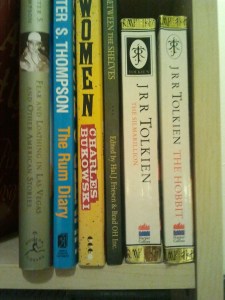
cropped-cropped-blogbanner13.jpgToday, we have an exclusive treat for all our fans. Below, you’ll witness photographic evidence of the good folks at Brad OH Inc. taking their rightful place among legends.

SAMSUNGDon’t forget to pick up your copy of ‘Between the Shelves: A Tribute to Libraries by Edmonton Writers‘ by clicking the image above.

-Brad OH Inc.

Profits and Prophets

Under the Green Desk Lamp…

Green Desklamp

Words are powerful things. They are our chief means of communication—assuming you can move past all that ‘body-language’ mumbo-jumbo—and thus serve as our key to expressing all ideas, plans, and opinions about the world around us. They allow us to apply labels, transfer knowledge, and express complex concepts to one another—passing information along and allowing it to grow across generations.

Words are the building blocks of language. They afford to us the ability not only to share our thoughts with one another—but to comprehend them ourselves. They apply meaning and value in a world of chaos; functioning to give context and relevance to what may otherwise be inconceivable. In an earlier article, we’ve actually covered how intangible it is to consider a world ‘Without Words’.

Words have the ability to convey great and terrible concepts—elevating us above the mire, or dragging us to the depths of despair. In this strange world or ours, there are even words which are considered too heavy to be spoken, whether because they are revered as sacrosanct, or reviled as curses.

Lately, there are two words in particular which have been troubling me. They are phonetic-twins: identical save for their spelling, and their meanings too have become all too dangerously similar. These are ‘profit’, and ‘prophet’.

Profits refer to the net gains made by an institution: usually monetary. In times like these, with corporations pulling the reins of government, and the media touting the notion that true ‘freedom’ is for the marketplace alone, profits have become the apple to the wild horses trampling all good sense and civility from our society.

Citizen interests are sold out for profits. Veterans are left homeless for profits. People suffer and die without healthcare in defense of the all-mighty profit-margin. Profits, profits, profits. They’ve become the sole respectable merit, and the defining drive of a corporate machine racing driverless, determined only to see how far it can go, how long it can persist. It seeks profit, and any destruction caused in this pursuit is justified so long as it has no effect on the net-gains.

We’re often reminded of what is owed to us: this illusive promise of life, liberty, and happiness. Of course, we are further assured, money cannot buy happiness. So it’s up to us to find on our own…just keep your hands off the profits.

Prophets are those people considered to speak in place of god or any other deity—often via divine inspiration. Like our recent discussion on the ‘Insidious Threat of Legacy’, prophets often represent an increasing distance from the so-called source material, and too often become cited as justifications for acts of violence and other atrocities which can in no other way be reconciled with their foundational beliefs.

It’s as prevalent a threat today as it ever has been.

Wars are waged in the name of prophets. Buildings are toppled in reverence to prophets. Ongoing conflicts over which prophet is to be trusted and which to be eschewed continue to enable the endless global uncertainty to which we are all subject.

Profits, and prophets—they aren’t so different in the end.

Both represent the false ideals of a misguided population. A life led in reverence only to that which can be gained; a sacrifice of ideals in order to defend the sanctity of a decaying value structure. Many religious communities seem to have turned away from worship of their actual gods, and are defined now by strict adherence to the prophets who have interpreted them. So too the governments of the world—who have turned away from their true purpose of protecting their state and citizens—wooed by the unscrupulous practices of corporate lobbyists who promise to redefine the national priorities.

How can these threats be rectified? If profits are not the only sufficient motivator for directing the course of society, and if prophets have proven an insufficient source of moral guidance, then where are we to turn?

If the value of profit is in what it can accomplish, and the value of prophets is in the ideals they represent, then perhaps chasing these equally-listless sources is the wrong approach entirely. Here at Brad OH Inc., we would encourage everyone to take some time to consider the foundation beneath each of these—and that is value.

What really matters to you? If you had all the profits in the world at your disposal, what would you make of them? If you could speak as a prophet to the people, what wisdom might you impart? If you are honest with yourselves, we believe you’ll find the answers are not so dissimilar. More importantly, and herein lies the essence of the issue—you may find that both profits and prophets are red-herrings, distracting us from what true happiness might already be available to us, if only we can disavow ourselves of these tired and misaligned notions.

-Brad OH Inc.

‘Of Pipers and Pigs’ Published on GonzoToday

cropped-blogbanner1.jpgWell, we have some exciting new today for all our fans here at Brad OH Inc. One of our ‘Single Serving Stories’, ‘Pipers and Pigs’, is now up for viewing on the incredible new site, Gonzotoday!

A direct link to this publication can be found here: ‘Of Pipers and Pigs’ on GonzoToday.

Gonzotoday is a new group dedicated to the creation and celebration of new age Gonzo Journalism; carrying on the admirable tradition of the late great Dr. Hunter S. Thompson in bringing the world stories of heavy import and sincere meaning wrapped in the rage and vitriol inherent to writers with open eyes.

The site has a lot of fantastic work on offer, so be sure to visit at Gonzotoday.com.

One thing you’re sure to notice upon your visit to this publication of ‘Of Pipers and Pigs’ is the incredible new artwork, conceived and created by the divine talents of the staff over at GonzoToday.

This is a serious change from our standard fare. If you’ve taken the time to peruse our selection of ‘Single Serving Stories’ in the past, you’ve probably noticed that the cover art for each sits somewhere between childish-cute and insultingly unbearable. Well, it’s true—the pencil-necked nitwit we have working in the art department at the moment is something of a pariah around the office, and achieved his position only by merit of dubious references and claims of knowing Brad OH.

Needless to say, his contract negotiation skills far outshine his prowess in the art department, but with a little time, we’re certain that the Corporate Efficiency Streamlining process will forecast the end of this sad little dweeb in no time.

Ahem…

Anyways, that’s enough ranting for now. Today is a day to celebrate after all, and what better way of doing that than swinging by Gonzotoday and reading ‘Of Pipers and Pigs’, or any of the other fine pieces available there?

-Brad OH Inc.