Saving the World: 101

purelyspeculationSupply and demand is the driving force behind any effective economy. Since the Industrial Revolution (Link) however, the face of the ‘supply’ end has been changing. As reliance on machines began to increase in the production of goods, the number of workers required has reduced correspondingly. Materials and goods are now produced more efficiently, and at lower costs to the producers.

Of course, like all things technologically driven, this process only tends to speed up exponentially over time. With the dawn of automation in factories, and technologies like 3D-Printing reinvigorating the revolutionary process begun in the 1800’s, the balance between supply and demand may never have seen such a radical shift. In fact, it’s entirely plausible that within a decade or two, we could produce the vast majority of our goods with little to no human investment.

As discussed in our article ‘On the Concept of Society’, the advancements of society are a cumulative process, and their rewards must therefore be shared equally amongst its constituents. Sadly, this is seldom the case.

While the supply end of the market grows ever easier, demand remains moreover the same, and the essential balance between the two becomes very different from what was initially intended. Rather than setting a price based on the amount of a good available contrasted against the demand for that good, we see a more methodical approach: With an unlimited quantity of a given commodity available to be produced at extremely low cost, what is the greatest amount that can be charged for that product without alienating consumers?

Therefore, the maximum amount is charged for all goods and services, while the financial gains resulting from improved means of production tend to filter only into the pockets of the business owners.

The final result is that the vast majority of the citizenry continues to struggle to meet their basic needs. Clearly, this system is no longer an acceptable form of management, but where do we go from here?

Let us consider the original need for economic systems such as the ‘free-market’ and its inherent reliance on ‘supply and demand’. The world—and moreover society—has always been in need of guidance, of a helping hand to direct us in the choices we need to make. In its historical absence, humans have spent the greater part of our existence inventing our own, then fighting over the results.

Usually, the established political system is intended to reign in the ambitions of the market place, but here too we have found ourselves struggling. Voters find themselves muzzled by corporate control of government, false-choice party politics, and the impossibility of getting any legitimate populist issue to the table past the corporate watchdogs.

So the economic systems can no longer function, and the political system won’t. There’s good news however. We may finally be at a point technologically where there is no longer any excuse not to begin work on a real solution to these co-morbid failings. A ‘God Program’, if you will. Its basis is already established in the internet, and certainly the tools are there to build towards an effort at human consensus through the ability to share ideas uncensored worldwide. This would benefit all people: both in the economic forum, and the political one.

Currently, the internet—with examples such as Reddit, Anonymous, Occupy Wall St. etc.—represents the incredible brilliance and diversity of our population. However, this brilliant spread of people have next to no representation in electoral politics. The political view is dominated by the opinions of crusty old business men who care only for their own profit margins.

Tapping into the full potential of the internet represents an incredible shift in our conceptions of democracy and political participation. In a return to something closer to Athenian Democracy (Link),this program would give the power of voice back to the electorate.

By fundamentally altering the existing architecture of the internet to handle these lofty ambitions, we could establish not only international, uninhibited communication on key political topics, but also a database of all fact and knowledge—with Wikipedia likely acting as a fine foundation for that concept.

The program would not only increase the political voice of all people, but fully manage the economic considerations outlined in our discussion of supply and demand. Its considerations would need to include population size and the balances therein, crop yield, required sources of work and how such might be distributed. Essentially, with a computer program evaluating all available supply and existing demand, society would largely be engineered rather than controlled—with science, math, and humanity acting as the fundamental drives, rather than money or power.

To be sure, this isn’t a new idea by any stretch—as far back as the founding of Technoracy Inc. (Link) in 1931, the notion of a society driven by logic and engineered from the ground up to meet the needs of all has been floating around. It just hasn’t gained much traction.

Why is that?

The society we have in mind would be ideal for everyone alive. With a perfect balance of resources, a deep understanding of social needs, and a computer program capable of predicting these needs and social shifts well in advance, we could hone our efficiency, while creating a Golden Age in regards to leisure time and cultural advancement.

Balancing all needs and efforts, and focussing a calculated portion of all proceeds towards scientific research that is not limited by the profit margins of corporate priorities, our overflow of resources could be harnessed to solve any new problem which might spring up—certainly not excluding the ultimate and near-inevitable need to begin mining and colonizing beyond Earth.

There would be room for businesses to thrive and continue to both produce and profit from innovative consumer goods in a truly free-market (un-manipulated by large-scale corporate interests), while government institutions and human resources would focus clearly on the benefit of all mankind.

With an extremely small and efficient active workforce, and the needs of all met by this program, opportunities would be available for anyone to pursue their passions, and these would directly benefit all. The idea of job shortages leading to poverty or starvation would be unheard of. Mothers or Fathers would stay home to take care of their children rather than greeting people at Walmart, and all people would be free to choose a pursuit which serves them the best.

The program would allow for balance and bounty, while increasing our leisure time and guiding us into a new era of economic and cultural prosperity.

So then, what might be standing in the way of such an idyllic solution? I suppose you’d have to ask yourself another question. Specifically—when we consider utilizing the internet as a salvation for society: controlling profits, balancing production, lowering costs, increasing personal freedom and social supports, improving unilateral political participation, and using excess profits for the betterment of all—exactly who could possibly stand to lose?

If you can answer that question, you’ll see the reason that society has not yet begun to take these easily available steps towards a more utopian ideal. But in the end, it’s not their hearts or minds upon which real change depends, but our own.

-Brad OH Inc.
Donald Trump, Arrested Development, and the Future of the Free World

Under the Green Desk Lamp…

Green Desklamp

Recently, we here at Brad OH Inc. read an article (Link) about Donald Trump Pinatas being sold in Mexico. This was hailed as a fine example of capitalism in action—the Mexican people, angered by Trump’s racist remarks (Link), were using their money to show what they think of the man.

‘Capitalism in Action’… I wonder how true this is.

What if it was all a ruse by Trump himself, who is not really the racist idiot he’s been portraying lately, but is in fact exactly what he’s always claimed to be: a brilliant capitalist.

Of course, even the finest financial minds require a bit of inspiration, and I think Trump may have found his when recently watching Season 4 of Netflix’s ‘Arrested Development’ (Link).

In the fourth season of this commendable show, there is a storyline involving building a wall on the Mexican border. There’s also a day called ‘Cinco de Quatro’. This mockery of ‘Cinco de Mayo’ was a day invented by the racially-reactive Lucille Bluth as a means of destroying ‘Cinco de Mayo’ novelties in advance of the day.

As it turned out of course, this only proved a very lucrative opportunity for the enterprising local immigrants in the O.C. (don’t call it that).

But considering these events juxtaposed to Trump’s recent activities, I wonder if he formed a particularly wicked little scheme of his own.

Claiming to run for office was all part of the plan, as it created a sufficient platform to insult the entirety of the Mexican people by claiming he would build a wall and have them pay for it.

Trump, and we can assume by this hair-brained scheme that he is at least a bit racist, used this as the bait, and then went to establishing a large-scale business just south of the border producing Donald Trump piñatas.

Clearly, his heinous gambit paid off, and Trump has once again proven himself the insightful genius he’d have you all think.

Or maybe he’s really just a racist windbag. What do you think?

-Brad OH Inc.

‘Town of Truth’

Under the Green Desk Lamp…

Green Desklamp

Today we have another song/ poem from the intellectual property vaults of Brad OH Inc. For your enjoyment, we present the lost ‘Basic Human Indecency’ song: ‘Town of Truth’.

In the city with no lies

Things are not the same

Love is very rare there

There’s no such thing as blame

There are many ideas

And each one has a name

They name them for a dreamer

A man that’s not quite sane

In the city with no faith

There is no metaphor

They keep their eyes upon the ground

And guard dogs at their door

They know just where they came from

And where they’ll go forever more

Their science killed their magic

And life is such a bore

In the city with no soul

Each man is his own slave

He walks his path all by himself

Up to his lonely grave

Their medicine will cure a man

That he could never save

It can bypass the dreamer’s heart

Of which he only gave

But in the Town of truth

The eyes follow the mind

Dreams blossom to vision

Men smile and are kind

Yes the city may be ugly

But the town-folks they are blind…

-Brad OH Inc.

‘The Election’

Here at Brad OH Inc., we spend a lot of time discussing current political events, and what sort of future they might suggest. We’ve also explored many different writers and styles over the years. Today, we have a treat for you that combines the two!

Inspired by the unique ‘Gonzo’ writings of Dr. Hunter S. Thompson, ‘The Election’ is the story of a cynical journalist covering the heinous events of the fourth annual ‘United Corporate Election’. In this dystopian future inspired by contemporary politics, Corporations control all aspects of government, and elections have been reduced to satirical pantomimes in which citizens use their ‘Citizen Spending Credits’ to vote on their favourite features for the elected effigy.

Journalist Duke O’Brady ventures into this ridiculous spectacle to experience the madness firsthand, but may be in for more than even he anticipated…

This short story is one of our favourites–after all, what sort of self-loathing Corporation wouldn’t dream of such an idyllic future?

We certainly hope you enjoy it as much as all of us here at Brad OH Inc. enjoyed writing it.

theelectioncoverCover Art by- Troy Barker

‘The Election’- Smashwords

-Brad OH Inc.

‘Edgar’s Worst Sunday’ Update

cropped-cropped-blogbanner13.jpgHere at Brad OH Inc., we’re happy to announce that the beta-reads of our upcoming novel ‘Edgar’s Worst Sunday’ are coming to a close, and the book is moving into its final revision phases as we research publishers. This is a pretty exciting moment for everyone here at Brad OH Inc., as ‘Edgar’s Worst Sunday’ will be our first full length novel to seek publication.

To celebrate, we have a gift for all our dear readers—a sneak preview of ‘Edgar’s Worst Sunday’.

We Hope you enjoy it.Edgar's Worst Sunday Official CoverIn life, Edgar Vincent had always maintained one great passion—himself. A semi-successful composer, his rock star lifestyle suited him well, and his narcissistic outlook had always ensured he was a man with few regrets. Callous comments, thoughtless promiscuity, binge drinking, and excess sufficient to shame Caligula were standard Saturday night fare.

Sundays for Edgar had always been a painful haze of sickness and regret.

But when Edgar finds himself in the cloudy planes of the afterlife on one particularly bleak Sunday morning, he must put aside his ever-present hangover and try to figure out how he ever got to this point…and where he’s meant to be going now. But as Edgar traverses the spiritual realm, he comes to find that facing his death is hardly as difficult as facing himself.

However, heaven also presents Edgar with an unending smorgasbord of hedonistic entertainment, so he’s in no particular hurry to change his self-serving views. After all, considering that he’s already dead, what more could he possibly stand to lose?

Edgar’s Worst Sunday

A Novel by Brad OH Inc.

-Chapter 1: The Pearly Gate-

[Text Redacted due to Contractual Obligations]

-Brad OH Inc.

Dry Rot and a Consideration of Our Terrestrial Prospects

purelyspeculation“Your house has dry rot.”

There is no phrase more dreadful to a home-owner. It’s a terrible verdict—an indictment which carries a sentence of severe financial and emotional penalties.

‘Dry Rot’, also known as ‘Brown Rot Decay’ (Link), is a fungal infection of wood which eats away at the parts which give the wood its strength and stability. It starts as a simple spore. But exposed to sufficient moisture, the spores grow and spread, infesting the wood and eventually flowering to produce new spores. The infection only grows from there—compromising the integrity of the wood and causing significant problems for the longevity of even the best built houses.

The funny things about Dry Rot, and that which it shares with so many other potentially catastrophic conditions, is that for the most part it’s pretty easy to ignore. When it’s merely a collection of spores, it can appear as a collection of fine orange dust. Sweep it away, and go about your day.

As the spores grow, they will take on the appearance of fine white strands, stretching over the surface as they continue to spread the infection. But this too can be passed off—rationalized as spider webs, dust, or a litany of other excuses which don’t require significant financial investment to address.

It’s no different from a chest pain passed off as gas, or an engine rattle excused as debris.

…Or overwhelming scientific evidence of ‘Global Climate Change’ passed off as liberal hysteria.

The thing is, it’s an easy urge to understand; among the easiest. When faced with something too big to comprehend or too threatening to deal with, our first and most natural inclination is denial. After all, why stress over some distant potentiality when it can as easily be brushed off with a flippant ‘it’ll be ok’.

With Dry Rot, this can be a fatal mistake.

Often considered a cancer to buildings, if left untreated, Dry Rot spreads rapidly through timber, eating it away until it is deteriorated to the point of crumbling between the fingers. For a building, this clearly can cause significant problems. With sufficient warning and proper treatment, the infection can be isolated and cured. But if the Dry Rot makes its way to structurally integral wood, the entire building may be lost.

The prognosis then is simple—act fast to fix the problem, or risk having nowhere to live.

For any informed decision-making adult, the choice is abundantly clear. It seems almost self-evident that when faced with a choice between an untimely demise (or in this case, homelessness), or an admittedly costly investment, there should be little choice remaining—take the hit, but save the whole.

But even in the case of illness, humans have a way of rationalizing away what’s important in defense of what’s comfortable. We ignore the complaints of an ailing body, but lament when we learn our neglect has caused greater harm.

We see the same thing with our world. As technology has grown and society has evolved, so too have the conditions to which we’ve exposed this planet of ours. Just like a home-owner ignoring the damp, dark places of his house, we’ve gone on our merry way, oblivious to the potential effects as our lifestyles have caused sky-rocketing atmospheric carbon-dioxide levels.

Now, the evidence is irrefutable (Source). The climate is changing. The ice caps are melting (Source). Even if most of us have not yet detected the rust-like dust of its impending arrival, the inevitable decree of an environment neglected for too long is slowly making itself known. The rot has set in!

Yet still, denial is omnipresent. Even when we’re rational enough to admit something is wrong, we eschew any responsibility, choosing instead to bury our heads in the sand. In a disturbing instance of this ‘Wait and See’ mentality, the US Senate recently acknowledged that the climate is changing, but fell short of acknowledging that humans are responsible. (Source). In doing so, they served also to rule out the logical conclusion that humans must start working on a solution.

But this is still among the better reactions. Far more depressing, there are countless sources (most of them supported by big oil, or other environmentally destructive enterprise—Source) clamouring to attribute the rumbling of disaster to mere myth. With a glib grin they point to a snowy field, overwhelming proof in their simple minds of the misguided nature of such ‘sci-fi’ notions.

But this is tantamount to the homeowner wrapping a fist against his kitchen counter to prove that Dry Rot has not infested his foundation. It’s an ignorant knee-jerk reaction at best. At worst, it is an intentional misdirection motivated strictly by greed. In the case of climate change, I’m inclined to suspect the latter.

In truth, we’ve waited far too long already. The rot has set in, and the question is no longer whether this might be a threat, but rather how bad it is, and more importantly, what our prospects are from here.

Ultimately, we don’t know. A good guess would be: ‘bad’, but guesses aren’t worth much in a scenario like this. Action is what counts. The first action—as with any well-implemented endeavour—is to understand fully the extent and prognosis of the problem itself. To this end we must turn to science. Instead of trying to shirk responsibility for this impending travesty—although there is certainly much blame to be placed—we should be investing research dollars into finding real solutions.

It’s time to take a good look at this home of ours, and start a discussion about how to salvage it. This will require immediate and likely extreme changes—not limited to the consideration of seeking resources elsewhere in the universe. It is an expensive notion, no doubt, but the alternative is to let the foundation crumble to the rot; which would mean finding ourselves homeless in a universe that is exceptionally inhospitable to such arrangements.

-Brad OH Inc.

‘A Song for Alec’

Under the Green Desk Lamp…

Green DesklampToday we have another song/ poem from the intellectual property vaults of Brad OH Inc. For your enjoyment, we present the lost ‘Basic Human Indecency’ song: ‘A Song for Alec’.

Old Alec McPhee
Was a man of the sea
He’d traveled all over the globe
But now his boots sat
In a house on a road
Where old Alec shouldered his load

He moved into the house
To care for his family
Who offered him no word of thanks
He worked for the army
To pay for his children
But poor men don’t rise through the ranks

Every day he worked hard
Every night he lay cold
His dreams and his future denied
Old Alec sat
In a chair at a table
And looked out his window and cried

Old Alec walked down
To the water one night
Kept walking as it reached his chest
He carried with him
The clothes on his back
Some memories and left all the rest

Walked into the water
Up past his neck
Through the water he pushed out so fast
Away from the land
Out into the water
Alec walked away from his past

A man that is living
Must live in the present
A man that has run carries shame
But a man that’s found dead
Will live on in memory
And not scar the worth of his name

Alec turned around
With the water at his nose
And knew he had made a mistake
Remembered his duty
To care for his children
And knew there was no choice to make

The sounds of his life
Were silence or screaming
His friends from the past never called
His kids barely knew him
His wife didn’t love him
Alec’s house was no home at all

His family was cruel
As if sent by the Gods
To punish him for all his sin
But they needed a man
To survive in this world
And damned if it wouldn’t be him

Old Alec walked dripping
Into his kitchen
And up to his wife for a hug
She shrugged him away
And tossed him a towel
And told him to stay on the rug

In his chair by the table
He looked out the window
As dreams of the past filled his head
He stared at the ocean
And knew he’d been foolish
For he was already long dead

A man he will live
For the Gods that he chases
And see them wherever he’ll roam
And he’ll chase the shadows
Make gifts into shackles
And a prison out of a home

Alec can you find
Alec does it seem
Alec won’t you learn
That you’re chasing dead dreams

Alec are you lost
Alec are you blind
Alec don’t you know
You’ve lost more than you’ll find…

-Brad OH Inc.

Between the Shelves Book Signing and Interview with Author Trudie Aberdeen

cropped-blogbanner1.jpg

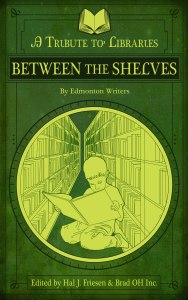
The following is an interview with Trudie Aberdeen, who appears in the Brad OH Inc. and Hal J. Friesen edited Anthology ‘Between the Shelves: A Tribute to Libraries by Edmonton Writers’, which you can now purchase here in either Kindle ($2.99) or Paperback ($12.50) copies. All proceeds are to be donated to the Edmonton Public Library System.

BetweenTheShelvesCoverThis interview was conducted by Hal J. Friesen in anticipation of the anthology’s release:

Trudie Aberdeen is a long-time language educator and social justice advocate. She is currently working on completing her PhD on the topic of heritage language acquisition. In addition, she teaches English to adult newcomers to Canada. Her academic interests include refugee education, multilingual literacy instructional practices, language conservation, action research, and language instruction for heritage language learners. Her research can be found in the following journals: The Manitoba TEAL, Multilingual Discourses, and the 9th Low Educated Second Language and Literacy Acquisition (LESLLA) Symposium. She also serves as the book review editor to the Canadian Journal of Action Research.

  1. The passion for your work is clear in every aspect of your writing. How long has heritage language acquisition been a part of your life? What started it all?

TA: I was raised in a middle-class, English-speaking family in Alberta. My childhood was fairly normal. And when I was a little bit older, similarly to most rebellious teenagers, I took my teenage angst and raged against my parents. While others were sexing, drugging, rock-n-rolling and doing other “naughty things”, I inflicted on my father what I thought might have been one of the most painful childhood revolts I could think of: I went to Campus St. Jean and took university in French! On my personal journey to bilingualism, I learned about the power of language along the way.

Contrary to current popular belief, I’m not really a natural when it comes to language learning. I’m someone who learns with moderate aptitude and great effort. I was always fairly successful in school, so learning that language learning was hard was a shock for me. So despite by best enthusiasm, I wasn’t successful my first year and was put on academic probation. Because I struggled with the language I was in a place very few white, middle class, English-speaking women with average intelligence ever get to be: I wasn’t part of the mainstream. For me, this is when I realized how language (or lack thereof) can limit one’s chances of success. I finished my degree successfully, although it took me more than four years and I had to spend a year in language classes in Quebec, but I eventually triumphed.

I taught in Japan for several years in an international school. I was the English as a second language teacher to elementary school aged children whose parents moved temporarily to Japan for business or diplomatic missions. I saw how quickly many of my students learned English and how quickly many of them forgot their mother tongue. I saw the parents who were “trapped” because if they moved home they could no longer put their children in school because the children couldn’t read or write their “mother tongue”. I also worried a lot for my students who appeared to have learning disabilities. Parents, colleagues and I often asked, “What is this child’s issue? Is it a language learning inability or something bigger?” Often it is difficult to know.

When I started my doctoral studies, I began to take interest in adult literacy learners. In my field of English as a second language teaching and learning, literacy learners are adults who grew up never learning to read their mother tongue, mostly due to limited opportunities because of gender, poverty, or war. Their lack of first language education impacts on their opportunity to learn English. They often struggle with things that most of us take for granted: following instructions for over-the-counter medication, signing their children’s homework log, figuring out a map, and reading street signs. Despite all of their challenges, all of those I have worked with have an undeniable spirit, determined outlook, and an often overlooked sense of intelligence.

My dissertation, however, looks at heritage language learners. These are usually the children of immigrants who have to navigate cultures and languages, not being conventionally “Canadian” and first-language English speakers, but not being of the same language and culture as their parents, either. Most of these children struggle to keep the language of their parents and cannot without the help of a larger language community and school. My work is looking at how schools and communities can support these students.

Heritage language learners and adult literacy learners do not initially seem connected, but they share many commonalities. Both groups often are trying to learn language in an environment that is limited in exposure to language. Both are often trying to learn language without literacy. In many instances, these two groups can be within the same family. Some immigrant parents (especially those with limited literacy) can struggle to learn English and their children can struggle to maintain their first language. In my line of work I have met many people who are unable to have a basic conversation with their parents because they do not know enough of each other’s language to exchange more than limited small talk.

  1. There seems to be a message or end goal with your writing / research. What is it you hope to achieve at the end of your dissertation? 

 TA: I hope to show the world exactly how much expertise exists in the field of heritage language education in Alberta. I wish politicians, educators, and scholars to know about the challenges and limitations that programs face so that they can receive better support in doing what they do best.

  1. Who has inspired you as either a writer or researcher? 

 TA: My four favorite researchers are Dr. Olenka Bilash, Dr. Kenneth Schaeffer, Dr. Nick Ellis, and Dr. Elaine Tarone. All four are gifted scholars and educators. However, what I admire most about them is their compassion and vision for making the world better for others.

  1. Would you be willing to share one or two stories from your experience as a language educator? 

TA: In 2004, I had a beautiful kindergarten student from Sweden called Hedda. She was a dream child: polite, kind, energetic, brilliant, and friendly. She started school in September and by Christmas she was speaking English well. Her reading level was near the top of her class. At the parent-teacher interviews, I gave her parents “the talk.” I warned them about language loss and the importance of first language maintenance. I told them that they had better start planning for her Swedish or else it would be gone. I recommended that they find her a tutor and begin reading lessons as soon as possible.

While Hedda’s mother seemed convinced by my message, her father was less so. He responded firmly, but politely, that Hedda was a little girl. She had just made a huge adjustment, according to her father, by leaving her extended family behind in Sweden and moving to Japan, and furthermore, she needed to worry about enjoying herself, not planning for her future education. I responded that while I respected his point of view, he should at least consider my suggestion. He told me that he would think about it after his family returned from their holiday in Thailand.

Sadly, all four members of Hedda’s family were lost in the 2004 tsunami that killed more than 250,000 people on Boxing Day. I often think of her and her beautiful family. I often think of the advice I gave to her parents, and consider what her father responded to me. For language learning, we need to have long-term planning, and to prepare for what is coming ahead. At the same time, we need to remember that this moment might be all that we have.

  1. Why do you personally think language is important?

 TA: If you ask a brain researcher or a psychologist, they will tell you about all of the cognitive benefits of bilingualism. Of course, I believe all of these things are true such as bilingualism increasing intelligence and delaying the onset of Alzheimer’s disease. Still for me, the most important aspects of language learning are social in nature. Language connects people to opportunities and it connects us to one another.

Check out Trudie Aberdeen’s story “Newcomers to Canada and Edmonton Public Libraries” in ‘Between the Shelves’, which you can purchase now on Amazon.

BetweenTheShelves_poster-YMCA-WEB

Finally, be sure to visit us for a ‘Between the Shelves’ signing this Saturday, May 30th at William S. Lutsky YMCA (1975-111 St NW) from 10am-2pm!

-Brad OH Inc.

Yours Truly

Under the Green Desk Lamp…

Green Desklamp

I’ve missed you.

I know that may come as a surprise, given my apparent absence. But you’ll have to trust that I’ve held you close in my thoughts, no matter how distant I may have seemed at times.

And it certainly has been a while, I won’t deny it. I’ve been quite busy, although explaining the nature of my work might be a little too heavy at the moment. But you’ve been busy too. Yes, you certainly have. Things have changed around here, even more than I might have imagined.

Not all for the worse mind you. No, I’ve seen some things since my return that have brought a much needed smile to my face—and that’s a rare thing indeed these days, I confess. The decoration I’m a bit split on, but there’s a lot beyond that to appreciate. You’ve had some great ideas, no doubt about it, and there have been moments when you really lived up to your potential.

…It’s just that they’re so damn rare.

Part of it may be my fault, I know—I’ve been derelict in my duties. In truth, I’d been hoping my presence was no longer quite so imperative.

I see now that I was misled. You’ve had a rough go of it lately. It’s hard to say where it all started to go wrong, but it’s far gone now, and it’s time we faced the truth.

I’ll start by apologizing once more for my distance. You deserved some assurance that I still remembered my promise. More importantly, you clearly needed it.

If I’m being entirely honest—and I am, without fail—I actually thought I’d left you with enough to get by. I gave you my word, and I told you everything you needed to know. I tried to make it as simple as I could, but even the clearest instructions grow blurry with the passage of time. And it has been a long time, to say the least.

You must have known I’d be watching though. If not, you should have.

I watched as you forgot who your family was, and turned your back on all the things which really mattered. I saw when you began to use me as a source of justification rather than strength. That’s really what hurt me the most.

What we had was a beautiful thing; at least I thought it was. But you’ve let your passion ferment into a bitter brew, and the intoxication it caused within you has become a blight on everything we once had. We never used to be about the fancy things, but now it’s all you seem to remember about me.

When I first laid eyes on you, I couldn’t help but adore your every fault. All your naïve desires were a wonder to me, and I revelled in your successes and failures alike, as each one made you more and more…you. The way you could be so content in your own head, the way you appreciated everything around you. I lived vicariously through you in some ways, and I adored your passion for creation. I could see myself in that.

But you’re so angry now, so defensive. It seems like whenever my name comes up, you’re ready for a battle. The constant anger is shocking—it’s almost like you wanted to keep me away. Things are different I know, but you can handle it without the blood and teeth and bile. I know you can, because I know you.

Still, I don’t blame you for being bitter. You needed more from me, when I only wanted you to find your own way. You called my name, and I didn’t answer. I tell myself that you needed to learn for yourself, but I know that’s only half true.

I’m not sure what I intended by reaching out again. When I left, I was certain that things could never change between us. Now, I only wish they could once more. You’ve grown unwieldy in my absence, and managed to become something entirely detestable to me. But it works two ways, and I know in truth that the change was at least in part because of my absence.

So what to do now?

It comes down to needs, I suppose. Needs, and wants. I want things to go back to how they were, but I know it’s unlikely. What do you want from me? I can scarcely imagine. Some assurance? Some comfort? I can offer neither. The road is long and hard, and I cannot carry you for all of it.

Maybe the cause is the cure as well. If nothing else, I’d like you to speak of me without the rage, without the need to do battle in the vainglorious hope of proving to others what you doubt in yourself. If that’s too much, then I’d rather you not speak of me at all.

Forget about me.

That’s all I can ask now.

We had a good run together. Great even, at times. But it’s clear we’re beyond each other now. The longer you hold onto the past, the greater damage you do to your present, and I worry that your time is growing short.

So let me go. Just pretend I never existed. Forget my words and burn my letters. Tell yourself you never needed me. Scream from the mountains that you’d be better off without me, that you are beautiful and worthy and glorious just because you are.

…Because you are.

Please, don’t ever forget it. And more import still, please don’t prove me wrong.

Yours Truly…

-Brad OH Inc.

Between the Shelves Book Signing and Interview with Author T.K. Boomer

cropped-cropped-blogbanner13.jpgThe following is an interview with T.K. Boomer, who appears in the Brad OH Inc. and Hal J. Friesen edited Anthology ‘Between the Shelves: A Tribute to Libraries by Edmonton Writers’, which you can now purchase here in either Kindle ($2.99) or Paperback ($12.50) copies. All proceeds are to be donated to the Edmonton Public Library System.

BetweenTheShelvesCoverThis interview was conducted by Hal J. Friesen in anticipation of the anthology’s release:

T.K. Boomer lives in Sherwood Park, Alberta, with his wife. In 2012 he began the awkward and painful transition between being a mainstream fiction writer and becoming a science fiction geek. Remnants of his literary past can been read in his novel, “ A Walk in the Thai Sun” written under the name G.J.C. McKitrick. The future will be revealed in the publication of “Planet Song”, first book in the Fahr Trilogy, probably in late 2015. Other aspects of the transition, like video game obsession and playing “Mr. Dressup” at SF conventions are proving to be more difficult.

1. What made you transition from mainstream into science fiction? 

T.K.: When I originally wrote and tried to place “A Walk in the Thai Sun” I ran into the problem of having written a book that was hard to market. It didn’t fit easily into any of the established genres and was rejected for that reason.   I wasn’t really writing for a mainstream audience but the nature of the book put it in that very broad category.  I’m not a good enough writer to compete with the likes of Margaret Atwood or Barbara Kingsolver so that was the other reason the book was initially rejected.    I resolved, at the time, to not write another book unless it would fit easily within an accepted genre.   When I got the original idea for “Planet Song” it was science fiction.  I did the research and decided that I could write in that genre.   However it’s quite different from writing mainstream fiction and there was a lot to learn.

2. In your story you hint that the Internet has been replaced by something else in the far future. What are your thoughts on what that might be, and what form it might take?

T.K.: My biggest fear is that we won’t move forward but rather retreat. I think the Internet is far too dependant on very complicated and vulnerable infrastructures. One bad solar storm could make a huge mess of it so my guess will be some kind of less vulnerable infrastructure. I think we have more interconnectivity now than we will have in the future. I also think that governments are going to move towards more control and less freedom.

3. Do you read paper or e-books, and which do you prefer? What about Siberius? 

T.K.: I read both but I think that within ten years most reading will be on e-readers. It’s simply a matter of economics and convenience. However if I’m right about the internet it could cause a resurgence in paper books down the road. As for Siberius, he’s a throw back. Notice how he was looking for physical books in the library?

4. Do you think libraries will become sentient in the future, and is that a good or bad thing? 

T.K.: They will but I don’t think sentient in the human sense of the word. The trick will be not to build in a survival instinct into our machines. We should not be trying to create a human-like mind in our machines for that reason. If we do then we’re asking to be out completed by them.

5. Who has inspired you as a writer? 

T.K.: Inspiration is a funny thing. I guess I gravitate to writers who use language in unique ways. It’s part of the reason that I still read a lot of mainstream fiction, because I’m more interested in writing technique than I am in tropes. Margaret Atwood is a favourite as is Anne Tyler and Iain M Banks and William Gibson.

Check out T.K. Boomer’s story “Five Hundred Years” in ‘Between the Shelves’, which you can purchase now on Amazon.

BetweenTheShelves_poster-YMCA-WEBFinally, be sure to visit us for a ‘Between the Shelves’ signing on May 30th at William S. Lutsky YMCA (1975-111 St NW) from 10am-2pm!

-Brad OH Inc.