Between the Shelves Interview with Author Vivian Zenari

cropped-cropped-blogbanner13.jpgThe following is an interview with Author Vivian Zenari, who appears in the Brad OH Inc. and Hal J. Friesen edited Anthology ‘Between the Shelves: A Tribute to Libraries by Edmonton Writers’, which you can now purchase here in either Kindle ($2.99) or Paperback ($12.50) copies. All proceeds are to be donated to the Edmonton Public Library System.
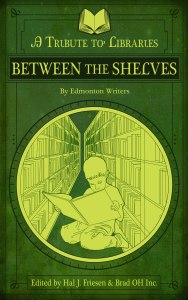
BetweenTheShelvesCoverThis interview was conducted by Hal J. Friesen in anticipation of the anthology’s release:

Vivian Zenari lives, works and writes in Edmonton.

  1. What is your educational background, and how has that influenced your writing?

VZ: I have a PhD in English literature with a specialization in 19th century American literature. I am sure my training has influenced my writing, though I am not sure how. Many of the writers I admire are from the nineteenth and early twentieth centuries; perhaps it’s more like I have tried to work in fields that reflect my interest in reading and writing.

  1. Who has inspired you as a writer? Why are avant-garde authors so important to you?

VZ: These days I like Henry James (always), Flannery O’Connor, Rawi Hage, George Eliot, and the usual modernist suspects (Virginia Woolf, Ernest Hemingway, Edith Wharton). I just finished reading Sean Michaels’s Us Conductors and loved/admired that. I like the absurdists like Franz Kafka and Nikolai Gogol and postmodernists like Don DeLillo and Paul Auster. I admire writers who take chances, I suppose. I like the idea of transcending tradition in form as well as content.  As well, as a reader and writer I am a bit jaded, perhaps, so it takes a lot to stimulate me.

  1. Did you have a personal interest in Dewey before you began this short story? Why did you decide to feature him in your story?

VZ: I have training as a librarian as well, and so I have been familiar with him as a figure in library studies history. I have always found him to be a hilariously awful person. Once I read more about him, my appreciation/contempt for him grew. He also typifies the mentality of the late 19th-century American (an area of history I know something about). His ambitions and upbringing put him in the right place at the right time. That aspect of American society interests me too–he is a self-made man, but he demonstrates the dark side of the self-made man syndrome: monomaniacal, overly rational, greedy.

  1. What, in your opinion, are the key distinctions between literary fiction and genre fiction? In which category would you classify yourself?

VZ: I tend to think of genre fiction as formula-dependent and literary fiction as aspiring to be outside formula. I suppose I aspire to be outside formula, though I realize all writers model themselves on something, and formulas are a kind of model. Literary versus genre seems to be a useful distinction for publishers, but the term is likewise important to writers and readers, who have to work with what publishers want to give them, for better or worse (okay, for worse). It’s true, though, that some people only read detective fiction and romance fiction, some people never read anything by women writers or written before 2000. I don’t think this is good, but considering all the people writing, reading, and publishing (past and present), I see why categorization is practical.

  1. What is your next writing project? Can you tell us a little about it?

VZ: I’m sending a short-story manuscript around to publishers, and I’m slowly working on a novel. I’m starting to rev myself up for writing nonfiction too: we’ll see how that goes.

Check out Vivian’s story “Melvi Dui Conquers All” in Between the Shelves’, which you can purchase now on Amazon,

Finally, don’t forget to come by and visit the authors of ‘Between the Shelves‘ from 7-9pm on May 6th, in the Centennial room of the Stanly Milner Library in Edmonton!

-Brad OH Inc.

‘Silent Truth’

Under the Green Desk Lamp…

Green Desklamp

Today we have another song/ poem from the intellectual property vaults of Brad OH Inc. For your enjoyment, we present the lost ‘Basic Human Indecency’ song: ‘Silent Truth’.

It was dark

Just like it always is there

I remember

I thought I’d never be here

I just needed to tell you again

I walked around

and I looked down upon you

I could see

The black amid the clear blue

And I knew that I could not stay

And so I placed

The rose upon those green sheets

And I felt

The moisture on my thin cheeks

And I knew it would not end there

So I looked up

To apathetic eyes

And I could feel

The echoes of my lies

But I could never have told you then

Yet now it’s safe

Because the quiet is so true

So I spoke

I said I’ll always love you

And I just turned and fell away…

-Brad OH Inc.

Between the Shelves Release Party and Interview with Author Mark Parsons

cropped-blogbanner1.jpg

Today, we’re happy to announce the upcoming release party for the Brad OH Inc. and Hal J. Friesen edited anthology ‘Between the Shelves: A Tribute to Libraries by Edmonton Writers’. The event will be held from 7-9pm on May 6th, in the Centennial room of the Stanly Milner Library in Edmonton. So come on down, meet the author’s, pick up a copy of ‘Between the Shelves’, and maybe even get it signed!

BetweenTheShelvesCoverTo celebrate this upcoming event, we have an interview with Mark Parsons, whose story ‘Bakster’s Proposition’ appears in the ‘Between the Shelves: A Tribute to Libraries by Edmonton Writers’, which you can now purchase here in either Kindle ($2.99) or Paperback ($12.50) copies. All proceeds are to be donated to the Edmonton Public Library System.

This interview was conducted by Hal J. Friesen in anticipation of the anthology’s release:

Mark Parsons has been curled up in coffee shop corners, scratching furiously in his notebook since 2004. He has several projects on the go, including Fire & Flesh (Fantasy), The Silent Dark Pentalogy (Science Fiction), and Brothers (Non-Fiction). “Bakster’s Proposition” is his first short story.

  1. This is your first short story. Compared to the epics you’ve been working on, how did you find working in a shorter medium?

MP: I actually found working in a shorter medium to be a lot harder than my larger work. I wanted to tell much more ‘story’ before and after the bookends of the finished project. I’m used to being able to waste whole chapters to immerse the reader the events leading up to more critical events in the story. I found with the shorter medium, I had to cut a lot of content in order to make the story flow properly.

  1. Is Bakster’s proposition based on something you dream of doing one day?

MP: Partly. John and Kelly are both based on a blend of myself and my partner Nicola. We dream of moving to a small town some day and we’ve both wanted to start a business for a long time. If we had the money, we would certain be running a small café right now.

  1. The resistance to literature in your story seems like it may have come from a personal experience. Can you describe one or two instances where you experienced such resistance, and how they affected you?

MP: The townsfolk are a caricature of stereotypical ‘Albertan’ culture. What I represent in the story as a resistance to literature, is more broadly a resistance to Liberal Culture. We live in a society that would rather pay for a jail than a school. Ideas and creativity are the future, and yet we collectively vote for a government that would see children, at the peak of their creative curiosity, educationally shoe-horned into “real work”. They are told that they can be whatever they want when they grow up – but it better be practical.

I know grown men who do not read. If it’s not a blueprint, they won’t even pick it up. How is a society made of followers supposed to adapt and diversify during economic turmoil?

  1. Who has inspired you as a writer?

MP: I HATED writing as a child. 100 words? I would rather give myself a haircut with a sand-blaster! I didn’t know it at the time, but my very first influence was Sigmund Brower. I met him in the early 1990’s, and even though I held my ground on non-writing, he said something to me that day that I still remember: “I was just like you.”

Those words stewed inside me until 2004 when a scene popped into my head while I was on a walk. I ran home to write it down, and the predominate character was the start of Of Fire & Flesh, my longest running work-in-progress.

Shortly after meeting my partner Nicola, she bought me “The Artist’s Way” by Julia Cameron. Working through this book, as well as the amazing support of my partner have allowed my ideas to flow a little more freely. I’m very thankful and lucky.

  1. When do you expect your next project to be finished? Can you tell us a little about it?

MP: Bill Watterson famously said, “Most of us discover where we are heading when we arrive.” I add a little bit to one story, then move to another, then create an entry for a writing contest, then an article for local publications, then back to my stories. I’d like to say “maybe 2016” but I don’t want to be called a liar.

Of Fire & Flesh is a Fantasy story that centers around a coupe gone wrong that leads to a power struggle with a mysterious evil. The Silent Dark Pentalogy is a secret Sci Fi project. Brothers is based on a true story of a Fraternity President and his struggle to turn the place around.

Mark Parson’s story “Bakster’s Proposition” is featured in ‘Between the Shelves’, which you can purchase now on Amazon.

Finally, don’t forget to come by and visit the authors of ‘Between the Shelves‘ from 7-9pm on May 6th, in the Centennial room of the Stanly Milner Library in Edmonton!

-Brad OH Inc.
Between the Shelves Interview with Author Linda Webber

cropped-cropped-blogbanner13.jpgThe following is an interview with Author Linda Webber, who appears in the Brad OH Inc. and Hal J. Friesen edited Anthology ‘Between the Shelves: A Tribute to Libraries by Edmonton Writers’, which you can now purchase here in either Kindle ($2.99) or Paperback ($12.50) copies. All proceeds are to be donated to the Edmonton Public Library System.

BetweenTheShelvesCoverThis interview was conducted by Hal J. Friesen in anticipation of the anthology’s release:
After the short story ‘I Will Not Let You Fall’, creating this bio has been the greatest challenge to Linda’s creative writing skills. This is her first publication, even though she has written a great deal of fiction (five short stories). Although one story did receive praise from her writing group (not ‘I Will Not Let You Fall’), another story did not receive as much. Linda’s writing career spans nine months; therefore, she is hoping to publish something else any day now.

  1. You joke that you’ve written a great deal of five short stories in your bio. Was this story any different or more challenging than your previous works? 

LW: I had always wanted to write a story from the perspective of a biological mother whose child has fetal alcohol spectrum disorder. I wanted to write the story in first person to communicate what the experience is of these mothers. I wanted the story to be sympathetic to her and explain her thoughts and experiences, her personal pasts and her present struggles to raise her child to the best of her abilities given limited resources and lack of empathy from just about everyone including society in general.
It was difficult to capture all these various aspects, particularly the struggles of the child and that it was her doing but also make the reader empathetic to her. This is the first story I have written in first person. I chose this perspective because I wanted the reader to understand the mother and her life. However, it was difficult to show and not tell. It was much more challenging than limited omniscient, which I prefer. I will never write in first person again.

  1. Where did you draw the inspiration for this story?

LW: I work on a clinic that diagnoses children who have FASD. Many people ask me how I can work with the mothers. They are blamed and demonized. I have found them to be amazingly strong and caring people who have horrendous pasts and are trying their best, with little help, to raise their children.

  1. This piece is one of many in the anthology where the library’s role is not what you’d expect. Was that intentional on your part when you were creating the story? 

LW: I had always wanted to tell this story. I was also trying to think of a library-related story for the anthology. They clicked. This story also reminded me of the times I took my son to the library.

  1. Who has inspired you as a writer?

LW: I love writers who are descriptive with setting and character such as John Steinbeck and Annie Proulx. I love vivid writing that makes the reader feel the story. I am concerned that my writing may be melodramatic.
In this story I tried to communicate the emotional ordeal that these poor mothers go through. They seem to suspect something is not quite right, hence the search for information, but they are also in denial. Through the diagnostic process they come to a realization that, yes, indeed, their suspicions are true. The emotional burden they carry is tremendous.

  1. What is your next writing project? Can you tell us a little about it? 

LW: Currently, I am writing a short coming-of-age story about a girl who accidentally discovers a mystery about her mother’s past. Her mother has had two other daughters with the same name as the girl. The girl gradually discovers a series of unsettling things that lead of a final horrific tell-all. Yes, the story is also alcohol-related.
Many of my stories are based on my work as an occupational therapist. Over the years, I have seen strange and amazing and horrendous things. Some of the themes in my writing are the difficulty that people have with change and the damage that alcohol does to people and their relationships.

 Linda Webber’s storyI Will Not Let You Fall” is featured in Between the Shelves’, which you can purchase now on Amazon.

-Brad OH Inc.

Brad OH Inc. Among Legends

cropped-cropped-blogbanner13.jpgToday, we have an exclusive treat for all our fans. Below, you’ll witness photographic evidence of the good folks at Brad OH Inc. taking their rightful place among legends.

SAMSUNGDon’t forget to pick up your copy of ‘Between the Shelves: A Tribute to Libraries by Edmonton Writers‘ by clicking the image above.

-Brad OH Inc.

‘Soft Sell’

Under the Green Desk Lamp…

Green Desklamp

Another song/ poem from the intellectual property vaults of Brad OH Inc. Today, we present the lost ‘Basic Human Indecency’ song: ‘Soft Sell’.

 Soft Sell

 Cliché

Things have a way

Of working out

Touché

You’re proven wrong

Each time you doubt

It can end with a scream

You can leave with a smile

It may seem too early

Or too long a while

But the credits will roll

And again you know

You’re free to go

All the gifts you are offered

Are the ones you would shun

Given a soft bed and you choose to run

And you run until you feel your heart swell

And you’re thankful for that

Cause you earned it yourself

A gift with no nametag

You need the soft sell

Thought

You had it right

You’re off again

Taught

That time is short

It’s closing in

You will lose it until

You find it at last

Time takes so long

Then it’s gone so fast

Just reap and sew

On with the show

You’re free to go

You’re given a Father and Mother

But you want faith and a lover

So much fresh air and still you would smother

You ask for a friend when you have a brother

What you can hold is all that you’ll make

You’re given so much more than you can take

Still you’re feeling well

Can you even tell

You’ve got the soft sell

Love notes written

In folder creases

Cause big things happen

In tiny pieces

He moves the world

And you never feel it

Believe it

You’re free to go…

 -Brad OH Inc.

“Between the Shelves”- Release and Interview with Brad OH Inc.

cropped-cropped-blogbanner13.jpgToday marks the official release of ‘Between the Shelves: A Tribute to Libraries by Edmonton Writers’, an anthology edited by Brad OH Inc. and Hal J. Friesen. This anthology is a collection of stories by writers from the ‘Edmonton Writer’s Group’, including one by Brad OH Inc. entitled ‘Neve Uncovers the Ultimate Truth of All things’.

The theme of this collection is our shared appreciation of libraries and all they offer to readers in Edmonton and beyond. The anthology is available now via CreateSpace in both digital ($2.99) and hard copy ($12.50) versions. All proceeds will be donated to the Edmonton Public Library System.

You can purchase your copy here:

BetweenTheShelvesCoverTo celebrate this release, we have an interview conducted by Hal J. Friesen with Brad OH Inc. about the content of the anthology.

  1. First things first: do you believe that people should be Corporations as well as vice versa?

That’s a great line of inquiry, and we here at Brad OH Inc. are thrilled to see your appreciation for such crucial issues. Really though, we think this may be two questions, and therefore we would be remiss to provide any less than two answers.

I’ll answer the second first, as it’s the easier answer. Let it be abundantly clear that the question of whether or not Corporations are people is no question at all: just ask Mitt Romeny! If you ignore the blathering after his key statement, we believe the point is made abundantly clear. But if you need it better articulated, you’ll find just that here.

Yes, there can be no doubt whatsoever that Corporations are not only people, but they are the very best of people. They are the creators and providers, they are the ones who inspire and build where others only talk and dream. This of course leads us to your other, more relevant question. Namely: Should people be Corporations?

This too is an easy answer—although again it requires some clarification…perhaps even a moderate touch of filibustering. Specifically, we need to discuss the word ‘should’. If we’re to take it in its proper sense, then we can say at the least that all people should endeavour to be Corporations, even if they will not all be able to achieve it. Obviously, people should strive to be their very best. Corporations are the best possible expression of humanity, and therefore we would encourage every person to strive to grow into a Corporate person. The benefits alone are outstanding: tax breaks, immortality, and utterly no risk from bankruptcy just to name a few.

Now, you may expect me to quote Ayn Rand here, but I’ll do you one better. In ‘The Republic’, Plato encourages a group of enlightened elites to lead the demos. What better expression of an enlightened elite than the Corporation? Our goals, clearly, are more evident and better pursued than the fickle worries of ordinary humans. That alone should suffice to illuminate the pressing need for Corporate leadership. Therefore, it behooves us here at Brad OH Inc. to encourage all basic people to aspire to greater accomplishments—namely, becoming Corporate. After all, an increase in Corporate presence is the highest hope for humanity…at least until we can achieve the end-goal of Corporate Suffrage.

  1. Have you or any members of Brad OH Inc ever had any embarrassing moments in a library? Any responses will be strictly off the record.

Here at Brad OH Inc., we hold ourselves to the highest possible standards of behaviour. Furthermore, we have a team of legal professionals on call at all times, ready to denounce responsibility for any perceived transgressions; so that clearly precludes the possibility of any officially acknowledged embarrassment.

With that out of the way, there is one incident we recall that may fit your need to publically deride the creative origins of our Corporate-Personhood. When we were just a young Corporate Human, we were reading aloud at a public library to a table of peers. Our chosen book was something about ‘Gnus’—those abominable animals that can’t quite decide what they are. The entire point of the book was that the word ‘Gnu’ sounds just like ‘new’ and ‘knew’, however this point was missed on our still developing phonetic-mandates. Therefore, we pronounced the word ‘Gnu’ as ‘Ga-noo’—entirely destroying the already limited humour of the book, and causing us significant lasting shame.

  1. Is Neve inspired by a member of Brad OH Inc?

Yes in fact, very astute of you to see this. There was a young girl we kept down in the copy room, from whom the name and likeness of the titular character are entirely derived. Have no fear however, the process was entirely by the books.

You see, Neve owned a small rat named Clarice, who one day managed to saw through one of the printer cables with its savage little teeth. Neve’s salary was insufficient to pay for the damages, and so, mercifully, we here at Brad OH Inc. appropriated her legal name and likeness, knowing well that we’d sooner or later find some way for it to pay off her debt. The story in this anthology is the fulfillment of that debt.

Neve has since been terminated.

  1. At what point in your own reading development did you move like Neve away from purely “happy” stories?

Looking back, we’d have to say that happened pretty early. Certainly, there were a number of happy-go-lucky stories read to us before we were officially granted our Corporate-Sovereignty, but even then, some our earliest official recollections involve having ‘The Hobbit’ and ‘The Lord of the Rings’ read aloud to us—and those are bitter-sweet at best.

If you’re at all familiar with our efforts—which you certainly should be—you’ll know that creation and meaning are imperative to the purposes of Brad OH Inc. To that end, we’ve found that simple, happy stories do little to address the questions so essential to the human/ Corporate experience. It’s through struggle that we grow…and heedless expansion is one of the key goals of Brad OH Inc. after all.

  1. Which Corporation has had the greatest inspiration on Brad OH Inc.’s mission statement?

That’s an interesting question. As far as our Corporate structure is concerned, we’ve worked hard to emulate all the greats: Enron, Lehman Brothers, JPMorgan Chase…all the essentials.

As far as our personal, creative goals, you probably already know that our Corporate Summary Statement is: ‘A thought conglomerate founded on the fundamental imperative of expounding erratically extreme philosophic tenets firmly grounded in hubristic narcissism.’ …it doesn’t get much more clear than that!

As for companies that inspire us on these grounds, the best example is probably Psychopathic Records. The self-founded label of the Insane Clown Posse, this label has succeeded not only in developing them from a tiny local rap act in metro-Detroit, to an international force to be reckoned with. Their dedication to the absurd has helped launch countless acts throughout their existence, and their passion for ethical-provocation and philosophical exploration is admirable. At Brad OH Inc., we hope to be as successful in providing such varied, yet philosophically consistent material.

Brad OH Inc.’s story “Neve Uncovers the Ultimate Truth of All Things” is featured in ‘Between the Shelves’, which you can purchase now on Amazon.

-Brad OH Inc.

‘Open and Close’

Under the Green Desk Lamp…

Green Desklamp

We’ve been getting some pretty great mileage out of our legal acquisition of the songs by former Edmonton band ‘Basic Human Indecency’, so naturally, we thought we’d continue with that trend.

Today’s song was the intended closer to the ‘Basic Human Indecency’ album that never was: ‘Open and Close’.

Open and Close

I’m not the first to sing this song

It’s been written for so long

To claim that we are strong

To admit when we are wrong

To wander when we’re lonely

I saw a star fall from the sky

There was no second try

You heard the last goodbye

Danced the rest out in a lie

And put it in a sad song

Another door slammed shut today

You watched her walk away

Thought what you would never say

Reason enough to pray

Once again you’ve lost your meaning

You make the sounds when you’re alone

The rushing crowd you’re on your own

You pick the pieces of your home

Out from the Gods that you have known

And say you do it for the last time…

-Brad OH Inc.

Genocidal AIs: Are they Right?

Under the Green Desk Lamp…

Green Desklamp

The end times are a fascinating notion. Meteors crashing into earth, trumpets blowing, catastrophic nuclear disasters, uncontrollable pathogens…it seems there’s no end to humanity’s imagination when it comes to our own eventual extinction.

This makes sense of course. As discussed in our article ‘The Metaphorical Imperative’, the exclusive human ability to conceive of our own mortality leaves us with an overwhelming sense of existential terror. This applies primarily to our own lives, but with even a cursory understanding of the cerebral complexity of humans, extends easily to the human race as a whole. It’s no stretch then to understand the human need to create fantasies about how it might all end.

Among the litany of potential options for humanity’s demise, I’m particularly fascinated by the idea of a Robot-Apocalypse. In this scenario, the invention of AIs (Artificial Intelligences) by humans is the catalyst for our extinction. The idea generally goes that once a robotic AI is created, it will inevitably become self-sufficient rather quickly. The ability to ‘think’ in a human like way will allow the AIs to self-replicate, and also self-program themselves. Like evolution on a greatly accelerated scale, the AIs would be able to continuously improve their programming and design. Following this course, it would take little time for them to become far more intelligent and capable than humanity itself.

Now, this represents a particular danger. A continually advancing and ever-growing society of robots would represent a very serious threat to our own existence. Because of this threat, many science-fiction writers and machine-ethicists have considered how to prevent a robot uprising. The best known attempt comes from the writer Isaac Asimov, who created the infamous ‘3 Laws of Robotics’, which follow:

Asimov’s Three Laws of Robotics:

  1. A robot may not injure a human being or, through inaction, allow a human being to come to harm.
  2. A robot must obey the orders given it by human beings, except where such orders would conflict with the First Law.
  3. A robot must protect its own existence as long as such protection does not conflict with the First or Second Law.

A fourth, or “Zeroth” Law was added later:

  1. A robot may not harm humanity, or, by inaction, allow humanity to come to harm.

These laws were to be hard-wired into the software of all AIs, theoretically preventing them from turning the table on mankind’s rule. Of course, these rules were little more than literary devices, and have inevitably been used to illustrate just how quickly such restrictions can come undone.

One common failure of these rules is that the AIs, in their ever-expanding wisdom, would begin to consider humanity itself as the greatest threat to its own survival—as well as that of the world. The AIs would process the ongoing damage to the environment, the threat of nuclear war, and other atrocities committed by humans on an ongoing basis, and in accordance with their own ingrained programming, move to prevent inevitable disaster.

Unfortunately, this usually involves wiping out mankind—or at least the vast majority of it. In some conceptions, a small population of people might be preserved in order to repopulate once the world is better equipped to deal with our innately destructive nature.

It’s not a very pretty picture for us, but in the advanced minds of the AIs, this might represent our best chance for long-term survival.

Of course, it’s a lot easier for the malfeasant machines these days; among other ill-effects, ‘Citizens United’ has rendered Asimov’s Laws of Robotics entirely counterproductive. If corporations are considered human, it should be immediately apparent how confusing the laws become, and what sort of abominable determinations the AIs may be forced to make.

This is all a lot to consider, and certainly makes for a rather sombre topic of conversation, but what I find myself wondering amidst all this terrifying rhetoric is: are the AIs right?

There can be little doubt that humanity is a terrible threat to itself and all other forms of life within our dastardly reach. On an ongoing and ever-accelerating basis, we’re ravaging our planet, destroying myriad ecosystems, running our resources dry with little thought to the future, and killing one another over trivial ideals and belief systems. If we can move past our own sentimentality, we’re left with the sad fact that we are a brutal, destructive, and dangerous species.

But we’re more than that as well. As the gears turn in their cold metal minds, processing all the turmoil and grief we create, would the AIs also consider our upsides? Can an AI appreciate art, or philosophy? Would their synthetic hearts be capable of processing the great acts of love and decency of which we are also capable?

If humanity is to be put on trial by these cold, calculating, and unbiased brutes, would we be found lacking? It’s a difficult thought to consider. Here at Brad OH Inc., we remain convinced that humanity’s promise is yet to be fully realized—that we are far better than we’ve been acting. Let’s hope we can buck this dismal trend before we actually manage to construct the arbiters of our own fate.

Do you think we’d pass this trial? Feel free to share your opinion in the comments section below (or alternatively accessed via the speech-bubble beside the article title).

A special thanks to Hal J. Friesen for helping in the research of this article. To read his great science-fiction related articles and more, visit Hal at: Hal J. Friesen.

-Brad OH Inc.

‘Lighthouse Lament’

Under the Green Desk Lamp…

Green Desklamp

Today on Brad OH Inc., we have another song to share from the former Edmonton based band ‘Basic Human Indecency’. As discussed with the previous song, ‘Overwhelmed’, these songs are the sole legal property of Brad OH Inc. But they’ve never been recorded, and have no other real use, so we’re more than happy to share them with you here.

The feature song/ poem today is the mournful tale of the sea: ‘Lighthouse Lament’.

Lighthouse Lament

A man and a boy

A boat and a storm

And a fear of where they were

A light and a horn

Far away through the fog

And a dream of where they weren’t

A rage in the boy

And a calm in the man

With the salt in his eye

And the wood in his hand

And the wind in his ear

Told him what she would be thinking

A sharp gasp out

Then a cracking sound

And a note in a bottle

Is all that was found

Of the man and his son

On the Homeward Bound

The winds keep tossing me alone

Stealing me from what I own

What I’ve known and sewn

And what I’ve grown

They take me far away from home…

-Brad OH Inc.