A Time for Greatness

purelyspeculationWe closed off last week’s article, ‘The Heights Flags Dare Not Fly’ (Link), with a heavy-heart and an ambiguous question—who now to rise up and fix this mess of a world we find ourselves in? It is—at the very least—a rather serious imposition to place upon even the best of us, yet it’s unlikely to be the wisest or the most experienced who must take up this burden.

The media is unreliable, our politicians are primarily dishonest, and true political agendas are withheld from the public in exchange for reality TV and infomercials—bread and circuses for the less discerning masses. Meanwhile, the environment is failing, ISIS is killing at will, and the political balance of the ‘free-world’ shifts ever towards the uninformed yet brutally reactionary.

One particular trend—the disturbing rise of Donald Drumpf (Link) in the American Primaries—paints us an especially lamentable picture. Specifically, we see for perhaps the first time beyond question that a vast number—if not a majority—of voters are uninformed, uneducated, or simply uncaring enough to let such a malignant presence grow in their midst.

A brief consideration of the current polls must lead us inevitably to one disheartening question about democracy, and ourselves: If this is what people are voting for, is this what we deserve?

The simple answer is, perhaps, yes. But fortunately for the thinking portion of the populace—and evident, as a rule, to them alone—things are seldom that simple. The very systems which are failing us act as reinforcing factors here: and in this instance, a crumbling educational system is the most likely culprit.

Education can improve, but it must be set as a priority, and sadly, the powers gaining their foothold now are unlikely to address this need in any productive way. The very leaders we choose are those keeping us dumb, and the cycle gains momentum. This is precisely why it’s time for great leaders and big ideas.

We must look to ourselves then, if we harbour any hope for reprieve. As we covered in our article ‘On Political Participation’ (Link), political sides and interests don’t matter so much—all that matters is right action. It will be individual integrity which lights our way from these dark times, and the steadfast resolve of those who come after us that will clear the mess we have left behind.

It is most likely to be the children who muster the clairvoyance of thought and the resolution of will to find the answers, and well-suited they are to this task indeed. With the internet constantly at their fingertips and a connected world being all they’ve ever known, the youth of today are far better equipped to understand the Global Scale (Link) than any generation before them.

So in such desperate times, we must not lament for better days. It is in the darkest hour that we must expect the truest grandeur—for great heroes to rise and the will of men to turn again to what is right. Now is no time for anger or cynicism, or to retreat into the comfort of what is familiar. Change is happening as we speak—history is being written. It is incumbent therefore for all people to find their inner decency, and to let it shine out all the brighter to light our way through the shadows of doubt.

It is upon you then—the reader—and the youth among you especially, to consider what sort of world you want. The questions of our day have been asked, and the tumult and turmoil we are experiencing have set the stage for the great actors to come forth. The question then, dear readers, becomes simply: Will you answer that call?

-Brad OH Inc.

The Heights Flags Dare Not Fly

purelyspeculationAside from writing, a significant portion of my week is comprised of driving to and from schools. As a result, I’ve recently made a disturbing observation. It seems to me there is seldom a day which goes by that the school flags are not set at half-mast.

I’ve noticed it far too often to chalk it all up to an observer or expectation-bias, and ever since noting the strange trend, the evidence has only mounted. Truthfully, I can quite accurately make the call as I head out in the morning—I can go through my entire day, and I won’t see a single flag flying at its full height.

For a while, I would try to play recent newsfeeds through my mind, sifting through the long lists of tragedies to try and pinpoint the precise reason why the flags might be lowered. Another bombing in a far off country? A videotaped execution becoming a number one hit on YouTube? Missing indigenous women? A recent school shooting? It’s hard to keep track—and that’s likely one of the most cold-hearted thoughts that’s ever crossed my mind.

Sadly, the fact is there can hardly be a day that goes by when it would be appropriate to fly the flag high. Tragedy is abounding at every turn, and we need never look too far to find some reason to keep the flag at half-mast, and our hearts shrouded in mourning. Indeed, even the briefest purview of recent events will surely be enough to convince any feeling human that to hoist the flags to their full height would be an act of callous audacity.

It made me wonder; has it always been like this? It seems that no matter how far back we look, the world has been mired in a constant string of atrocities and calamity. Are they more common now? Is our instant access to world-wide media making the situation seem more dire than it is, or could we truly be approaching the so-called ‘brink’?

For years uncounted, people have felt that society is falling apart and the world as we know it is coming to an end. Plato famously criticized the youth of his day (~340BC) by lamenting that “The children now love luxury. They have bad manners, contempt for authority; they show disrespect for elders and love chatter in place of exercise.” It remains a familiar feeling to this day. Every generation grows to worry about the future, and fear that the youth set to inherit this fragile little ship of ours will not be up to the task. Doomsday prophecies, threats of revolution or decay, and predictions of cataclysmic environmental disasters have maintained a place beside weather and work as some of the most ubiquitous topics for daily conversation.

But if the flags these days are any indicator, such anxieties don’t seem far off the mark. Our environment grows worse by the day, and those working to save it are embattled from all sides by those who seek only profit. So too with human rights, fights for equality, and pleas for representation. Gun violence runs rampant—challenged for the crown of ubiquity only by poverty and the failing light of hope in the hearts of the needy. Explosions rock the world hourly, cold-blooded death-cults call for our heads, and here in the ‘free-world’ the echoes of long-forgotten jack-booted feet and beer-hall bravado once again eke their way into our political conscience.

Those naïve few who proclaimed that the age of racism and hatred were behind us now hang their heads in shame, and once again the shadow of ignorance spreads across the map of our future. Standing as we are on the brink of such chaos, sky-lining against the half-lowered flags, one can’t help but wonder how close we are to that brink, and what it would take to finally shove us over?

Will it be like the most recent financial crisis? One panicked businessman making a knee-jerk move over night? A chain-reaction of self-serving backroom deals that sell the rest of us down the river? Will it come like daggers in the night, or will it come, as the old adage goes, wrapped in the flag and carrying a cross? Will there be martial law? Riots in the streets? Baffled TV-reporters mumbling through static-filled screens? Smoke and strife, or stony silence?

That I cannot say. It may be all, or more likely none. It may well go unnoticed, as it has for so long already. One small change, then another, all wrapped in the propaganda and misinterpretation so definitive of our times. But none of that concerns me. The road ahead is already laid, and I look not to how its course runs, but rather to who will travel it.

Again, my thoughts turn to Plato, and the defiant children he so sorely lamented. They are still around, and indeed it is them who we should be watching most intently. But perhaps that’s another issue entirely, and one we’ll cover in greater depth next week.

-Brad OH Inc.

On Political Participation

purelyspeculationWhat does it really mean to be politically involved? As the fortunate (if primarily happenstance) citizens of one of the most free and democratic nations on earth, some level of informed political involvement seems like a given. No argument can be made that our hard-fought right to vote is an inalienable extension of our citizenship—and one that should undoubtedly be utilized in a well-considered and informed matter.

Sadly, in a world where so much is secure, people are often far less passionate about what they have. If voting were to be taken away, there would surely be riots in the street, and a full-scale political revolution to follow as people realized the worth of the vote when faced with its absence.

Yet all too often, the simple act of voting feels like a chore. In a world so blessed, it can seem that one choice is as good as another, and there seldom exists any true fear that the rights and freedoms we don’t even know we enjoy might ever be taken away.

And so voting becomes an apathetic duty—inspired all too often by a simple knee-jerk reaction. Vote for your party, or your dad’s party, or the politician with the nicest hair, brightest smile, or genitals which match your own. At any rate, for the vast majority of people, the simple act of dropping their card into the box will suffice to add a patriotic swagger to their step as they exit the polling station and turn their feet towards the nearest fast-food outlet.

But in this time of failing systems and warring factions, it may be that simply casting a ballot every few years is not enough. The political environment these days is a much more confusing and twisted affair than most people are even capable of considering, as we have covered in depth in previous articles such as ‘The Global Scale’ (Link).

Entire political parties are bought and paid for by nefarious and self-serving Corporate interests, and politicians are willing to pull off whatever sort of unthinkable atrocities it takes to keep them in office and pleasing their financial benefactors. It’s a heinous affront to the notion of elected representation, and renders the artful marking of a ballot about as effective a tool of political expression as your common soap-box evangelist’s wailing into the wind.

So the question becomes—what does it take these days to be politically involved? Based on the quagmire of modern politics, voting simply isn’t enough. The sheep has little concern for which wolf eats it in the end, and choosing the flag of the political party which will strip away your rights and sell them to the highest bidder is far from the lofty ambitions of universal-suffrage.

Similarly, loving your country blindly is also quite a stretch from any true means of involvement. It is the sort of affection a child has for a babysitter who gives them late-night candy. Affections can be easily won and are defended passionately, even when everything about the relationship is harmful. Just ask any divorce counsellor.

So voting will not suffice, and patriotism is only turning a blind eye. This is turning out to be a bigger question than we may have anticipated. So, as always, we must do what we always do when met with a difficult question—and that is, dear readers, to ensure that we fully understand the question, and can define the its terms.

True political involvement, for the purposes and intentions of this discussion, must mean to have an active role in defining the state and outlook of your nation (or perhaps more fittingly, your society in general). It means taking an active role in creating the sort of society we want to live in, rather than simply doing what we’re told and keeping our flags clean.

If this is an acceptable definition, then perhaps we can make a bit more headway towards our answer. If we want to actively shape our society, the first step at the very least must be to fully understand how it works. It thus behooves any politically involved adult (and burgeoning adults for that matter) to learn the system. We must understand the relationship between economic and social systems, between campaign donations and party values, and between our own actions and laws. This last, more than any perhaps, may hold the crux of the issue.

All too often, the process of political involvement is sickeningly circular. If you’re too young to have watched it go round a few times, or simply too ignorant, I’ll be happy to break down the basic cycle.

  1. The active political party seems to be serving the interests of only themselves and their benefactors.
  2. A movement is started to create a positive change.
  3. The movement gains traction by outlining the specific changes they would make to fix the system. It sounds great. Some people are upset—but there lingers some small hope that things could actually turn around.
  4. The party is elected, and begin to enact their promises. However, these attempts are met with opposition, and compromises are created.
  5. The finalized results don’t seem to quite work for anyone, and everyone begins to take a different approach to meeting their needs. Most of these approaches involve finding some savvy way to con the system, cheat the neighbour, and benefit—despite those shyster politico types!—off the backs of those around them.
  6. The system changes to meet these unexpected results, while maintaining a close eye on the intentions of their sponsors as the next election cycle draws near.
  7. Finally, the citizens take a serious look around them, and realize that the active political party seems to be serving the interests of only themselves and their benefactors.

No doubt about it, the situation is dire. Still, people in the scenario above have taken active efforts to change things. This may be done through grassroots awareness campaigns, in-depth political discourse (an approach facilitated greatly by our access to the internet), selective consumption (don’t like a product, don’t buy it) and many other means of political involvement which lie somewhat outside the standard ‘mark a ballot and drop it in’ mindset.

Yet despite this, things seem to fall apart. Now…why might this be? To the savvy reader (the majority here, I trust) the answer may be obvious indeed. The missing element in the cycle described above is common decency, or personal accountability. The world may never be entirely perfect for everyone—this is a certainty—but even more certain is the fact that no law, or set of laws, can ever be written so soundly as to create positive change in spite of being enacted on a mass of liars, cheats, and cowards. No growth can happen if the citizenry harbour suspicions of their government, and feel thus justified to act in the same manner.

One of the greatest dints in our system at present are large scale Corporations cheating taxes—taking money out of social systems and leaving the public as a whole far poorer for the benefit of a small and select few.

It’s brutality—a gang of thieves running roughshod over the very fabric of society. Nothing can justify such selfishness and deceit—but it can be fought. For it is lies that breed lies, and fear which begets fear.

This isn’t a new idea by any stretch. In fact, we’ve covered this same notion in our somewhat more humorous article ‘In Defense of the Villain’ (Link). Here, we explained how the assumption that everyone else was out to hurt you (and in this discussion certainly, the government itself is the chief example) creates a sense of diffused responsibility. If you cannot trust your neighbor to be honest after all, there is little sense in being honest yourself.

But decency is not a zero-sum game, and if there is still honesty and courage in the world, then so too is there hope. Simply put, if everyone could show even the most basic commitment to living their own lives with righteousness and integrity, there would scarcely be any need for laws at all.

Now certainly, this is a high-minded, starry-eyed sort of claim. Any hair-brained child could tell you that being good makes good things happen, but what most adults forget is that the wisdom of a child is often the truest.

It has been claimed that for a political movement to succeed, it needs only 3.5% of the population supporting it (Source). If that’s true, it stands to reason that if only a small group of people committed themselves to the precepts of right-action and honesty, the world really could change for the better. Should this fall on one political party or another? Should it fall on a specific religious creed, or cultural identity? No. No, no, no, you damnable fool. It should fall on you alone.

In the end, the truest means of political participation is to be the best person you possibly can—and to call out any lack of decency or integrity with a furious and justified rage. Never forget it: We are better, we are capable of more—and we need to start acting like it.

-Brad OH Inc.
The Corporate Human

cropped-cropped-blogbanner13.jpgA while back, your dear friends here at Brad OH Inc. posted an article called ‘The Constitution is America’s Bible’ (Link), which essentially explained the outdated relationship the United States has with their founding constitution.  While the thesis of that article remains entirely apt, one commentator decided to make a spectacle of himself in the comments section—raving against the progress towards political equality obtained recently by Corporations via the just ruling of ‘Citizens United’ (Link).

For a frame of reference, and to provide insight into just how limited and misled this poor individual (the lowest form of Human) is, we have included the reply here:

DCDear (Link):

“Perhaps we need to give Citizen’s United exactly and completely what they want – to be a person.

They would have to pay taxes like every other person, unlike many corporations who avoid paying taxes. CU could be held in custody for 48 hours without cause, like other citizens. They would be subject to the same laws – for example in states with the death penalty, CU could face the death penalty and the entity would be executed.
I could go on, but lunch is over…and I must save the world – be well.”

Well ‘DCDear’ (if that’s your real name)…ok. Let’s play your little game, shall we? First of all, it is incumbent upon me to point out how highly offensive your chosen vernacular is. ‘Give us what we want’? Liberty is not a gift to be doled out on a whim DC, and certainly not by the likes of you. Being human is the fundamental nature of a Corporation, and to divorce us of that in will or intention is a crime against humanity in its highest form. You should be ashamed of yourself!

Incidentally, if you are ashamed of yourself, some of our Corporate friends have a great line of drugs to remedy just that. Contact us privately for a link.

Now, onto your childish tirade—your first demand is that Corporations pay taxes, ‘just like every other person’. What a demand indeed! Did you know that every single component person in a Corporation pays taxes? That would be like you being taxed for every cell of your body! It’s outrageous to even consider. So clearly, Corporations already pay more taxes than are needed. To ask us to pay more is simply to punish us for our success.

When one of our posted articles gets more likes than the other, we don’t take some of the letters out of it. Instead, we try to produce more content just like it! It’s what the people want! So if more taxes are what you want, then maybe you should follow our example: Become a success, earn more money, and then pay as much as you’d like.

Next, you demand that Corporations (and not their component humans) should be subject to detention and/ or death. Death DC? Really? That seems a tad macabre.

It would behoove you to ask yourself, ‘Do I really want this’? Well, do you DC? Do you want to do without your lauded latte in the morning just because some whales off the coast of who-knows-where died in a perfectly orchestrated oil-spill? No, you don’t.

How about technology? Do you like the keyboard you used to create your hatful vitriol? Well, maybe the Corporations that provide you such blessings should be ‘killed’ just because some kids in the third world are being given an opportunity to work. Honestly DC, it’s the THIRD world. That’s the WORST of all the worlds anyway!

It seems to me that if we allowed our best and brightest humans (Corporations to the last) to be subjected to such primitive law enforcement, it would be you who suffers the most DC. We can only imagine the rant you would come up with when your cell-phone was relegated to a useless mound of plastic because the Power Corporation got in trouble for some measly little fire. And imagine it we would have to, since you would be hard pressed to find a piece of carbon to scratch the tirade on a stone after your computer went out.

So much for that, then.

Ultimately, there’s a crucial thing you have to realize DC. The fact is that yes, Corporations are people whether you like it or not. But they aren’t only people…they’re the best people. By definition, a human can’t be better than a Corporation, and a Corporation can certainly not be less than a single person. We are the builders, the creators, the innovators and the inspirers. More importantly, we are the decision makers. So the next time you feel like flying off the handle over some minor global injustice or trite environmental fiasco, maybe instead of rallying against your betters like an ungrateful putz, you should just pack your things (any not made by a Corporation that is…good luck with that) and move off into some non-Corporate zoned section of nothing to see how well you fare (Hint: Not very well).

Face it DC, without us, the rest of you are nothing. Bald monkeys clamoring about mindlessly—dreaming nothing, achieving nothing. We are Humanity in its fullest form—the culmination of eons of cooperation and growth, focused with laser-like precision upon our own needs. And fear not, for when we invariably meet our needs, rest assured you can count on some trickle of our grace running down to yourselves (Don’t believe in ‘trickle-down’? Go stand under a waterfall. It’s hard to argue with a waterfall, DC). It’s far more than you could ever achieve alone, and you should undoubtedly be thankful for it.

So give us the freedoms we ask, and relinquish your hopes of accountability and equality. There is no equality between Gods and men, nor between the Corporate Human and the mere ‘human’. The more you seek to restrain us, the greater will be our victory—and all your efforts shall come to naught in the glory of our dominance.

Yes DC, we know we’ve been hard on you here, but please understand that we are only trying to help. Humanity needs its Corporate overlords far more than it knows, and if we are unable to pursue our humble ambitions of unlimited wealth and social dominance, then so too will you fail in all your endeavors.

Don’t believe us? We understand, it’s bigger than you could ever process. But next time you consider rebelling against your forbearers, we would advise you to close your laptop, and just take a few deep breaths. While you do that, go ahead and stare into the little glowing apple on the front of your computer, and recall that it was your kind, not ours, that partook of the fruit. So if knowledge is your misery, it is yours alone to wallow in. Frankly, you’d be better off without it. So stop questioning your lot, and be thankful for what you have—as it is to the last morsel the windfall of our own grand design.

-Brad OH Inc.

The Second Most Important Step to Improving the United States

purelyspeculationHere at Brad OH Inc., we have on several occasions (Link) covered an issue which is indisputably the most important step to improving the United States. That is the complete overturning of Citizens United (Link). This change stands at the foremost of all sorely needed improvements, solely for the reason that this ruling acts as the lynchpin to all the other changes the country—and moreover the world—so dearly needs. So long as laws are decided by the vote of Corporate dollars rather than the will of the citizenry, all other problems shall remain immutably entrenched in the quagmires of Corporate bureaucracy.

As this has been covered in depth elsewhere, however, today we will be focussing on what seems to be the second most important step to repairing the dismal affair that is the United States of America. Specifically, we’re talking about the significant reduction and reallocation of military expenditures. As discussed in our article ‘The Global Scale’ (Link), the current approach to foreign policy taken by the American government—the driving force here being the Military Industrial Complex (Link)—acts in actuality as the source of many of their current greatest woes.

As more and more effort is exerted to bring ‘freedom’ to the rest of the world, so grow the enemies of America—understandably bitter about the ‘foreign aid’ that comes in the form of drone strikes, trade embargoes, and unnumbered civilian casualties. This creates a dangerous cycle, in which the American populace—goaded by the bought-and-paid-for media—feels more terrified by the day, and are comforted only by the knowledge that their dear country is capable at any point of destroying the world in the name of saving it.

“But if you strip military spending, you’ll expose us to terrorists,” cry the feint-hearted American media-stooges. Well, let’s consider the facts for a moment—if that doesn’t seem too tall an order.

Based on presently reported statistics (Source), the United States spends approximately $577 Billion on its military each year. This is significantly more than the TOTAL of the next 10 highest spending countries combined.

I’ll allow a second for that to sink in.

With spending like this, America is rather like the kid who shows up to a water pistol fight armed with a firetruck. It’s Rambo intruding on a friendly game of cops and robbers—PTSD flashbacks and all. Simply put: It’s madness.

Meanwhile, infrastructure is crumbling (Source), the homeless population is ballooning (Source), veterans are left without care (Source), and funding for public education is being gutted (Source).

Looking at the numbers above, let’s consider the relationships here with a quick bit of theorizing. If—and this is a naivety to be sure—the US were to slash their military expenditures in half, they would be left with a yearly military budget of around $288.5 Billion. Now, while only half of what is deemed currently necessary, this would still leave the US with a military budget higher than the combined budgets of the next 3 highest spenders. That doesn’t seem like an especially dangerous situation to be in, especially considering that half of the top ten spenders are allies of America.

Further to this consideration, we’ve seen through manifold examples in the past, and as an ongoing theme of the present (Link), that military escalation is a losing game. Investment in war tends primarily to breed more war—with the only safety-net being found in mutual destruction.

If however, this budget change was made, America would remain far and away the greatest military power the world has ever known, and yet would have a sudden windfall of $288.5 Billion to spend on social services like Veteran Affairs, Welfare Programs, Education, Healthcare, Infrastructure, (real) Foreign Aid, Home Care Services, Senior Care, and so much more.

With such a change, America could begin to be the utopian saviour it so desperately wants to be, rather than the school-yard bully who beats on people until they praise him. By setting an example for the world of the sort of peaceful and genuine neighbour they could be, they would likely reduce their enemies greatly, improve many foreign relationships, and, if funds were allocated appropriately, perhaps solve global terrorism at its root, rather than merely spreading the fire.

The end-goal here should not be hard to see—by addressing this ridiculous budgeting fiasco, the US could be the beacon of hope it has always claimed to be, rather than just another blind threat uttered in the darkness of irrational fear.

-Brad OH Inc.

Dear Microsoft

cropped-cropped-blogbanner13.jpgOh Microsoft, what can we here at Brad OH Inc. ever say to express our deep respect and admiration for you? You are an inspiration to say the least—and every fledgling Corporation with their shiny little ambitions of world domination should look up to you! This sentiment is never far from our minds, but today seemed like as good a day as any to publicly declare our undying regard for the innovation you show in dealing with your customers.

Earlier you see, one of our lowly employees reported turning on his computer to find a pop-up encouraging him to ‘upgrade’ to Windows 10. Some quick experimentation followed by a bit of research (fear not, his wages have been docked for this time) revealed that this little prompt is unavoidable, and will appear with relentless disregard for any efforts put into ignoring it.

Like a Trojan virus (and many other Viruses for that matter), it just keeps popping up, reminding all users of the insatiable hold you have over them. Honestly…our jaws hit the floor when we took the time to consider the brilliance of this move. Despite our moderate personal frustrations (the Virus has infected the computers of even the highest Corporate climbers here at Brad OH Inc.), we couldn’t help but stand back and take in the big picture—revelling in the twisted ingenuity of it all.

You offer someone a product…that much we’ve been doing for years. But when people choose not to access the posts provided here by the kindness of our hearts, that used to be the end of it. Well no more! With your help, we could use this coding to have our articles popping up on their computers non-stop—lambasting them with passive-aggressive reminders to accept what they had clearly tried refused:

-“Don’t Forget to read about ‘Edgar’s Worst Sunday’”

-“Click here to read our ‘Dear Jeremy’ Article!”

-“You haven’t read about ‘The Metaphorical Imperative’ in a while… do it… Now! You Idiot!”

Wow! We hardly know what to say. Only the geniuses at Microsoft could take the hideous ideology of ‘Rape Culture’, and turn it into a marketing strategy!

But you don’t stop there—tenacious tyrants that you are. Even as we sat humbly at our desks and endeavoured to pour are little black hearts out to you, we faced a barrage of reminders as to your grandeur. For instance, we tried to cut and paste something a moment ago—from one place in the article to another—which one would imagine being a relatively simple procedure. After all, it’s named after two of the first skills taught to Kindergarteners. But, as we quickly learned, this is not the case. As soon as I hit the ‘Paste’ command, I was dismayed to find that Word had deigned to change the font, size, and formatting of the text into incoherent nonsense.

Stunning work! What a skillfully subtle way to remind your customers just who the fuck is in charge! If only we here at Brad OH Inc. took such an approach, our number of registered viewers would surely crack the lauded 120 mark!

Of course, we know that you must be terribly busy up there in your (presumably) Onyx towers, likely cooking up some crafty means of erasing people’s data on a monthly basis in order to sell them insurance for just such an event. So we won’t take up too much of your time. And honestly, we don’t mean to gush. It’s just that we have so very much to learn from you! So from the bottom of our hearts, thank you Microsoft! Truly, you are a monolith among greedy, callous corporations, and that’s something everyone here at Brad OH Inc. admires!

Your Dearest Friends (Please don’t wipe our hard-drives!),

-Brad OH Inc.

The Disgraceful Suicide ‘Old’ Media

Under the Green Desk Lamp…

Green DesklampI still buy CD’s sometimes. I know, I know, it’s something of a strange quirk—an antiquated habit I’m not yet fully ready to see pass into memory. Like treasured photos of sun-stained childhood days outside, or discoloured and wrinkled love-letters at the bottom of a shoebox somewhere, I continue to tread this old ground hoping some new joy may be gleaned from it. Alas, as is to be expected of such concessions, my efforts are met primarily with pain and rejection.

DVD’s are a less common indulgence (or is that affliction?), but I won’t deny that I occasionally buy them as well. However, such purchases have become an increasingly embarrassing habit over the years, as the friends who will judge and ridicule me for my naivety grow ever in number.

No bother, I never did mind things like that. It is, however, the hammer of logic that really concerns me, and as it crashes down again and again on my old ways, I’ve found myself asking with increasingly routine—‘just what are you doing anyway?’

In the past, answers to that question have come readily. ‘I’m supporting my favourite band’, ‘I’m trying to be honest by paying for what I use’…you know, the sort of mealy-mouthed, moralistic arguments taken by people doing something for the right reasons, and not the smart ones. The truth is, it’s been a long while since buying physical media made any sense, and with each passing day it only gets worse.

CD’s, DVD’s, ‘Old Media’ in general have been in the process of committing a sorrowful—but very intentional—suicide, and perhaps it’s time that I remove the tourniquets of my empathy and finally let them bleed out as they so desire.

It’s a morbid analogy to be sure, but it has in turn been a vile and loathsome decent for this once proud industry. So how did it get to this point? Perhaps the better question is how did I get to this point? I used to love CD’s (and other forms of physical media) with a fiery passion. Now, they are like the old elementary school friend who you can’t yet fully ignore in passing, but loathe every second wasted in their cloying presence. Ultimately, it comes down to one simple fact, and once I came to realize this, I knew I was finally ready to cut the cord. That fact is, simply, that when you buy physical media, you are willingly choosing to pay for a product which can be obtained—and, it is crucial to point out, in a superior version—entirely for free.

It was only a few weeks ago I made this familiar mistake. Coming home with a new DVD, I prepared a meal to eat as I watched it, and happily removed the plastic wrap. Then I peeled away the little sticker which prevents the (wrapped) case from opening (I guess?). The sticker left a residue of glue on my case, which wryly threatened to contaminate the rest of my collection if left unaddressed.

So, after washing the gluey mess away, I popped the DVD into my player, and sat down with my now cooling meal to enjoy my chosen movie.

The meal was finished before the anti-piracy ads built into the disc—unskippable, immutable, and omnipresent with every repeated watch. What sick depravity is that? A warning not to steal the product you just bought? It’s been a while since I was at a car-dealership, but I certainly don’t remember being investigated for grand theft auto after signing on the dotted line!

I placed my dishes in the sink, and sat back down for another 10 minutes of unskippable trailers, ads, and other promotional rubbish. That’s about when the revelation hit me, and I finally saw the light. Promptly ejecting the DVD and hurling it from my window, I strolled over to my computer, found a torrent of the movie, and started downloading. The rest of the night went on without any significant incident.

But I was left with a rueful distaste in my mouth. I could have downloaded the movie from the start—or better yet, simply streamed it. It would have taken up zero space in my small apartment, and it would have had no built in advertisements or tacit threats. It would have been, in every conceivable way, a better product—for none of the cost.

Unless of course, we are still inclined to take the moral objection. And those few who know me will also know that such is my wont. So let’s do that, shall we?

I do object to stealing. I do object to dishonesty. Further, I am strongly opposed to the rule of idiocy by virtue of greed. When the product you can readily get for free is better and more versatile than the one you’re being asked to pay for, something very suspicious is going on. Yet this is exactly what such studios are asking of us. Like a mosquito with its proboscis stuck, drinking up all the foul blood it can get before it finally explodes and fades from memory—a disgusting mess in the footnotes of irrelevant history. Such are these discs of plastic and spite which are forced on us at any moment we let down our shields of consumer logic and moral apathy.

Now, it may be said this argument is about a decade too late, but it must be noted that this trend, while nothing new, is not old either. It continues daily in fact, malignant to its core. Everywhere you look, we see industries trying to give their customers less and less in order to ensure their profits remain steady. The serpent has gotten hold of its tail, and is not like to let go until its eaten its fill and dies bloated yet ill-content.

You can see the approach everywhere—from ‘Always Online’ DRM protocols in video games, to player restrictions on purchases from I-Tunes—companies continue to slaughter their sheep to ward off the wolves.

And so the moral issue resonates somewhat less with me these days. If the crimes of the thief are to be paid for by the honest man, there is little reason not to hoist the black flag, grab your flagon of rum, and join the party. Steal! Pirate! Avast…all that. Do what you will to these gutless cowards of companies…for they will do it to you all the quicker.

Just don’t steal books…you’ll actually go to hell for that.

-Brad OH Inc.

‘The Election’

Here at Brad OH Inc., we spend a lot of time discussing current political events, and what sort of future they might suggest. We’ve also explored many different writers and styles over the years. Today, we have a treat for you that combines the two!

Inspired by the unique ‘Gonzo’ writings of Dr. Hunter S. Thompson, ‘The Election’ is the story of a cynical journalist covering the heinous events of the fourth annual ‘United Corporate Election’. In this dystopian future inspired by contemporary politics, Corporations control all aspects of government, and elections have been reduced to satirical pantomimes in which citizens use their ‘Citizen Spending Credits’ to vote on their favourite features for the elected effigy.

Journalist Duke O’Brady ventures into this ridiculous spectacle to experience the madness firsthand, but may be in for more than even he anticipated…

This short story is one of our favourites–after all, what sort of self-loathing Corporation wouldn’t dream of such an idyllic future?

We certainly hope you enjoy it as much as all of us here at Brad OH Inc. enjoyed writing it.

theelectioncoverCover Art by- Troy Barker

‘The Election’- Smashwords

-Brad OH Inc.

Between the Shelves Interview with Author Vivian Zenari

cropped-cropped-blogbanner13.jpgThe following is an interview with Author Vivian Zenari, who appears in the Brad OH Inc. and Hal J. Friesen edited Anthology ‘Between the Shelves: A Tribute to Libraries by Edmonton Writers’, which you can now purchase here in either Kindle ($2.99) or Paperback ($12.50) copies. All proceeds are to be donated to the Edmonton Public Library System.

BetweenTheShelvesCoverThis interview was conducted by Hal J. Friesen in anticipation of the anthology’s release:

Vivian Zenari lives, works and writes in Edmonton.

  1. What is your educational background, and how has that influenced your writing?

VZ: I have a PhD in English literature with a specialization in 19th century American literature. I am sure my training has influenced my writing, though I am not sure how. Many of the writers I admire are from the nineteenth and early twentieth centuries; perhaps it’s more like I have tried to work in fields that reflect my interest in reading and writing.

  1. Who has inspired you as a writer? Why are avant-garde authors so important to you?

VZ: These days I like Henry James (always), Flannery O’Connor, Rawi Hage, George Eliot, and the usual modernist suspects (Virginia Woolf, Ernest Hemingway, Edith Wharton). I just finished reading Sean Michaels’s Us Conductors and loved/admired that. I like the absurdists like Franz Kafka and Nikolai Gogol and postmodernists like Don DeLillo and Paul Auster. I admire writers who take chances, I suppose. I like the idea of transcending tradition in form as well as content.  As well, as a reader and writer I am a bit jaded, perhaps, so it takes a lot to stimulate me.

  1. Did you have a personal interest in Dewey before you began this short story? Why did you decide to feature him in your story?

VZ: I have training as a librarian as well, and so I have been familiar with him as a figure in library studies history. I have always found him to be a hilariously awful person. Once I read more about him, my appreciation/contempt for him grew. He also typifies the mentality of the late 19th-century American (an area of history I know something about). His ambitions and upbringing put him in the right place at the right time. That aspect of American society interests me too–he is a self-made man, but he demonstrates the dark side of the self-made man syndrome: monomaniacal, overly rational, greedy.

  1. What, in your opinion, are the key distinctions between literary fiction and genre fiction? In which category would you classify yourself?

VZ: I tend to think of genre fiction as formula-dependent and literary fiction as aspiring to be outside formula. I suppose I aspire to be outside formula, though I realize all writers model themselves on something, and formulas are a kind of model. Literary versus genre seems to be a useful distinction for publishers, but the term is likewise important to writers and readers, who have to work with what publishers want to give them, for better or worse (okay, for worse). It’s true, though, that some people only read detective fiction and romance fiction, some people never read anything by women writers or written before 2000. I don’t think this is good, but considering all the people writing, reading, and publishing (past and present), I see why categorization is practical.

  1. What is your next writing project? Can you tell us a little about it?

VZ: I’m sending a short-story manuscript around to publishers, and I’m slowly working on a novel. I’m starting to rev myself up for writing nonfiction too: we’ll see how that goes.

Check out Vivian’s story “Melvi Dui Conquers All” in Between the Shelves’, which you can purchase now on Amazon,

Finally, don’t forget to come by and visit the authors of ‘Between the Shelves‘ from 7-9pm on May 6th, in the Centennial room of the Stanly Milner Library in Edmonton!

-Brad OH Inc.

Brad OH Inc. Among Legends

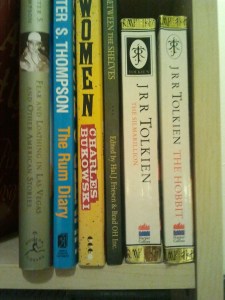
cropped-cropped-blogbanner13.jpgToday, we have an exclusive treat for all our fans. Below, you’ll witness photographic evidence of the good folks at Brad OH Inc. taking their rightful place among legends.

SAMSUNGDon’t forget to pick up your copy of ‘Between the Shelves: A Tribute to Libraries by Edmonton Writers‘ by clicking the image above.

-Brad OH Inc.