Are Humans Really Great Apes?

Under the Green Desk Lamp…

Green Desklamp

Scientific taxonomy classifies human beings within the family of hominidae, more commonly known as the ‘Great Apes’. We share this taxonomic family with three other genera, members of which include the orangutans, gorillas, and chimpanzees—all fine and majestic animals to be sure (Link).

Each of these creatures have found their niche within their local eco-systems, and have lived in a relatively balanced natural state for generations uncounted. They consume the resources available, and are consumed by the predators which are capable of doing so. They live within their means, and display a general civility to one another aside from occasional competitions over mates and territory. Meanwhile, the homo sapiens, or ‘humans’, have for the entirety of recorded history been putting on a childish display of wanton consumption and heedless destruction. If we are honest with ourselves, we must admit that this begs a pretty important question: are Humans really ‘Great’ apes?

All things considered, we’ve had our fair share of positive moments. We’ve built some incredible structures, and solved puzzles that would leave the rest of the apes scratching their furry little skulls in abject bewilderment. We’ve spread our population far and wide, and survived countless changes to the world we live in. At the very least then, we may certainly be considered alright apes.

Of course, most of the cataclysmic challenges through which we have persevered have been our own doing. We have an incredible and unparalleled ability to intellectualize our world and use ration to consider the effects of our actions. Still, we have managed to destroy much of our ecosystem, and of the many wonders we have achieved, few have been able to endure. So in truth, perhaps we are really just ok apes.

It’s true that if we really want to compare ourselves to the other members of the hominidae family, we should take a serious look at their lives as well. Doing this, we find them knuckling along the filthy earth, hurling feces and screaming unintelligibly at one another. This might often be followed up by a good chest-pounding, or perhaps even an old fashioned beat-down. Needless to say, humans are little different. Despite our marvelous intellect and incredible capacity for empathy, we resort to terrible violence no less often—nor is feces-throwing ever completely out of the question. All things considered, we might really be quite ordinary apes.

The things about this, however, is that we are so perfectly equipped to do better. It’s a matter of achieving one’s potential—the old, ubiquitous notion that one must be compelled not to do better than all the rest, but rather to simply do one’s personal best. Our cerebral-capacity alone affords us the potential to accomplish so much more than the others, and to shift beyond this base-violence into a far more gracious and well-mannered state of being. The promise we have is unbounded by anything save our imaginations, and this has been shown time and again—as numerous societies have risen to show the glory of mankind’s innate potential. But for every rise, there has been a fall, and we have proven consistently unable to maintain any serious ascension into the epoch of equality and dignity for which we are so well qualified. We may build great cathedrals, but we inevitably use them for the spread of greed and power rather than grace and mercy. We may write of utopian ideals or great societies, but we fall ever short of realizing them as we capitulate to the temptations of wealth and fame. Perhaps then, we may best be described as under-achieving apes.

Much of this question comes down to potential. There can be little doubt that we as humans have the theoretical potential to be the most inspiring and beautiful creatures to ever grace this earth. Our capacity for reason and problem-solving could allow us to truly be the promised stewards of the earth—watching over our hominidae brethren and all the other creatures with whom we share this wonderful planet. But where we may have spread equity and joy, we have sown only despair and intolerance. Where we may have acted as guides and care-takers to the planet we have left it barren and unstable. Finally, where we may have been exemplars of decency and righteousness, we have fallen ever to our own doubts and greed—wallowing in misery as we toil ceaselessly for more of what we want at the expense of what we really need. In truth, the homindae family and the world in general may have been far better off if humans had never climbed out of the trees from whence they came. In the end, I suppose, we really are pretty disappointing apes.

-Brad OH Inc.

Soirees and Solemnity in the Square

Under the Green Desk Lamp…

Green DesklampI sloshed along—weary, beaten, and soaked head to toe in Faygo. Heading back from the ICP show at the 2011 Bamboozle Festival in New Jersey, I’d taken the train to Penn Station, and was meandering, exhausted, back towards my hotel near Times Square. I barely took in my surroundings as I stumbled along; the adrenaline and unbridled joy of the event still had their hold on me. I mumbled familiar lyrics to myself, navigating slowly towards the Square.

The first thing I recall noticing was the crowd—significant even for Times Square. The hour was quite late after all—likely well into the early morning of May 2nd, 2011. I paid little mind however, and continued on my way until I heard the chanting.

“USA, USA, USA!”

An ominous feeling took hold immediately. As it turned out, that feeling would take a long while to subside. Turning down an alley and passing out into the main square, I was met by an impenetrable wall of people chanting and singing. There were American flags as far as the eye could see. I stood with my jaw agape trying to sort out what was going on, when an errant crowd-surfer nearly took my head off.

‘Nice try,’ I thought—having spent the past few days stalking the Insane Clown Posse along their east coast tour, it would take more than a lone crowd-surfer to take me down. Still…none of this sat quite right with me.

Glancing eagerly about, I saw people climbing telephone poles to either hang flags or to improve their view. Men on benches read from bibles, and women held their children up to the open air. High-fives were exchanged, friends embraced, and a general feeling of unrestrainable patriotic glee pervaded the scene.

“What’s going on?” I recall asking a stranger.

“Obama’s dead!” he answered over his shoulder.

This news came as an even greater shock. Certainly, I recalled the controversy surrounding his presidency, but the festivities taking place around me seemed well overboard—or downright seditious—if based around a recently deceased president.

Still, the next person I asked gave me the same answer. And the next. It wasn’t until I approached a fourth stranger that I caught a glimpse of a familiar face on the giant Times Square screens. Dark skin in white wrappings, a long black beard—no one alive during the past ten years would mistake that face…and suddenly everything fell into place. Osama Bin Laden, not Barak Obama, had been killed.

Now the joy made a bit more sense, for a moment.

I turned around in awe, taking in the scene with a touch of morbid curiosity and a resounding knowledge that I was, at that very moment, witnessing history.

Everything continued as it had been. The songs were sung, the crowd-surfers surfed, and the flags were waved. For me though, the strange scene quickly lost its charm. Listening to the vitriol and barbaric revelling of the partiers, I couldn’t help but sympathize. Many were likely locals, who had been personally affected by the tragedy of 9/11. I was not.

It didn’t take long for me to decide against staying. Dancing for death had never been my forte—even when the death was so well-earned.

I dropped my soaked clothing at the hotel, changed quickly, and headed out for a quiet pint. Even that was hard to find. Most bars were filled with the overflow from the party in Times Square, and escaping the patriotic revelry seemed nigh impossible. After a tenacious search however, I found a tiny little corner of nowhere, ordered something dark, and sat in silence to reflect on the moment.

Beside me—and quite possibly the only other patron of the joint—sat a weathered old man. He stared morosely into his beer, his eyes never moving up.

I don’t remember how I started talking to him—although my interest in strangers is naturally increased when away from home—but eventually I asked him for his thoughts on the scene outside. He said he didn’t have many, and none worth sharing.

He was an old Marine, he explained. He’d no doubt seen plenty of death in his day. Perhaps he’d danced the same dance that raged now outside many times before—for victories far more personal. Or perhaps not. Just now, he wanted no part of it.

We sat for several hours—most of them in silence. He’d ask me now and then about my home, and what I did. What I believed. What I didn’t. He seldom answered the questions I turned back upon him.

When I finally left, I remember having no clue what I was feeling. Sure, I was fine with the death of a known killer and terrorist, but I didn’t feel any safer. I had no illusion that the world would be a better place now. More bombs would be dropped, and new leaders would rise on both sides—all intently seeking further death and destruction.

The people who fought the hardest for peace appeared to benefit from it the least, while those who hadn’t worked at all for it danced as only those who’ve never known loss or toil can. The people who proclaimed most fervently the superiority of their nations seemed to be the ones who’d never left its borders.

I suppose there are a lot of things like that in life. It’s easy to be enthusiastic when we are young and foolish and know no better. For the wise and weathered—for the warriors who have seen the cycle come back upon itself time and time again, there are no songs of joy or dirges of sorrow. There’s just another day, with nothing more to say.

Every year, I feel more like that old marine.

-Brad OH Inc.

Libertarians are Starry-Eyed Idealists

purelyspeculationFreedom is often lauded as the most integral value of any developed nation. In fact, the notion of the ‘free world’ does much to inform us of the fundamental value that we place on personal liberty, and well it should. Freedom is among the key human rights, but it must be pointed out that at times, people get a little bit carried away with their interpretation of what exactly ‘freedom’ entails.

One need not wade too far into the depths of social-media to find the rants and raves of disenfranchised citizens so bitter about a parking ticket, or a sales-tax, or perhaps a pesky ‘no-loitering’ sign, that they’re ready to hoist the black flags and hop aboard the good ship ‘Anarchy’.

‘Freedom’, they will argue, is the birthright of man—the inalienable and righteous destiny of all people brave enough to seek it! But there are sorry few building their own boats to follow this urge, and fewer still running off to the lonely mountains to live a ‘free’ life. I suppose it’s an easy thing to moan about the comfortable confines of society as you daydream about weening yourself off its teat, but it does beg the question of what exactly true ‘freedom’ is, and if it can exist at all.

I would argue that perfect freedom is an illusion—a starry-eyed dream more befitting whatever afterlife you prefer than the life you live. In fact, I believe that power and control are unavoidable, and there is no conceivable ‘system of naught’ sufficient to maintain the vacuous void left if all authority is stripped away.

Perfect freedom would mean no laws, no control, no taxes—but it would accordingly mean no safety, no opportunity, and no infrastructure. In our article ‘On the Concept of Society’ (Link) we discussed how a society is the product of all its members, past and present. That remains entirely true. Society has never been about freedom—if anything that is the antithesis of society. In truth, ‘society’ is meant to be a foundation of cooperation among its citizens.

In the societal sense then, total freedom—much like anarchy—is a myth. It may perhaps exist for a single person, but once a second person enters the picture, the illusion will die. Power hierarchies will be formed, and one’s wishes will ultimately infringe upon the freedom of the other. We are not free to kill for the very reason that we do not wish to be freely killed. The same applies to property rights, safety issues, and so on. While loitering laws may perhaps be a hard concept to defend (Black Flags ahoy!), the need for a significant proportion of civil laws can be most easily discerned by asking oneself not ‘do I wish to follow this’ but ‘do I wish for others to follow this’.

Those who support total anarchy then, are either misunderstanding the basic tenets of life, suffering from a sadomasochistic urge to regress back to the days of pre-tribal man, or simply mad.

Libertarians, on the other hand, may accept some laws, while rejecting the notion of many others. This rejection most often applies to rules around the free-market. However, as we have already established that a power-void cannot remain unfilled, we should have little trouble applying this observation to the marketplace as well.

If you wander into the woods, claim them as your own, and insist on living a lawless life, it may prove less glamourous than you imagine—especially when the next lawless rogue shows up to strangle you in your sleep and make off with your supplies. So much for freedom!

The marketplace is little different. Without control, corporations are wont to seize public goods and resources, create monopolies, underpay workers, and wreak general havoc however they please. People will starve, or toil like slaves—yet this will be defended and redefined as the justly exercised freedom of those very corporations. In truth, this notion of marketplace-freedom is no better than economic anarchy—and its supposed virtue quickly diminishes as the strongest take control and run our system like a tyrannical oligarchy. Meanwhile, the citizens cheer blindly about the merits of freedom.

To claim to be an anarchist or full-on libertarian is naïve, and the ultimate result is little different from the sort of systemic madness we have now. Freedom has been given out too freely—sadly, only to the corporations at the head of the markets, and rarely to the citizens. The powerful will always feed upon the less powerful, and this is a demonstrable loss of freedom for the latter.

In order to have liberty for ourselves, there must at the very least be laws restricting others from infringing on that liberty. Anything less would be Mad Max-style anarchy. Control is needed, and must be imposed justly. As discussed in our article ‘On the Fear of Big Government’ (Link), the ultimate purpose of government is to ensure that the power which inevitably arises is a fair and just one.

This must not be taken to mean that I believe the current governments of the world are doing much to uphold these standards—indeed there is a great need for improvement on nearly all fronts. Simply put however, the raging masses squalling for ‘total liberty’—or its ugly cousin ‘anarchy’—are naïve at best. The line between liberty and domination is a difficult one to draw. If drawn too close to total freedom, a void arises, and we end up dominated. It’s circular in a sense, and requires an insightful and informed balance. This is the purpose of society and the governments which it employs, and we must pay heed to avoid being so brash as to throw the baby of equal opportunity out with the bathwater of social order.

-Brad OH Inc.

Upon the Bones of Better Men

cropped-cropped-blogbanner13.jpgThe philosopher Bertrand Russell once claimed that “the fundamental cause of the trouble is that in the modern world the stupid are cocksure while the intelligent are full of doubt.”

What a hack! What fanciful platitudes! Tell me Bert, do ‘nice guys finish last’ too? Do the good die young? Let me tell you something Bert, sorrowful homilies are good for one thing and one thing only—cheering up losers by convincing them that their failure is the unjust result of their righteousness rather than the logical result of their ineptitude.

What’s worse however, is that so many people seem to believe this naïve nonsense. Well, have no fear—you’re friends at Brad OH Inc. are here to set the record straight!

The truth is, these notions of ‘stupid or wise’, or ‘good and bad’ are entirely misled at the best, and revisionist at the worst. Victory is for the bold—the lions willing to do anything to take it, and leave the rest to lick their wounds and talk about how life just isn’t fair.

It’s pathetic.

The claim that one is held back by their morality is utterly absurd. It’s not that only brutes act decisively, leaving the considerate in the dust. That’s just switching labels to console lack of ability. If we look at the world pragmatically—and we should, always—we can see that it is no bestial or heinous act to seize upon your desires—hell, it’s what being a corporation is all about!

No, the problem is that the hindsight of the meek is 20/20, while their foresight is more mole-like than Machiavellian. It’s true in business, in love, in politics, and in the picking of low-hanging fruit. Don’t believe us? Well, let’s look at some of the key culprits here.

‘Nice guys finish last’. It’s the motto of every single loser too scared to say hello or slap an ass when the opportunity presents itself. For these pencil-necked geeks, it’s easier to sit back and lament that their ‘kindness’ is the reason they are left behind, rather than their own pathetic fear of rejection.

We see the same lame-duck whining in business as well. ‘We can’t compete with big businesses’, says the mealy-mouthed dweeb as he finally shuts the doors on his dusty little shop and files his EI claims. Well you know who can compete with big businesses chump? Bigger businesses! So maybe instead of blaming cruel fate for your failure, you should take a long look in the mirror.

Politics? Social interactions? Without fail you hear the same miserable whining about how decency gets you nowhere—that idealism is treated like an insult and dreamers are called naïve. But that’s not quite it, is it?

There’s nothing wrong with dreaming, but if you don’t eventually wake up, marshal your underpaid employees, petition politicians to change laws in your favour, and make off with millions, you have no one to blame for it but yourself. Wuss.

To break it down; morality is an excuse, not a handicap. At Brad OH Inc., we stand as a shining example of action, pragmatism, and success. Where others have cried about the opportunities they never had, we’ve used our inherent societal privilege to better ourselves. So for you hopeless waifs still waiting for someone to hold your sorry hand and lead you to happiness, let me share a bit of healthy advice. Holding strictly to honesty and kindness is the surest route to failure in business, politics, and interpersonal relationships alike. They’re for chumps, and punks who would rather stew comfortably in their failure than bully their way to true happiness. Success in almost every aspect of life is predicated on cunning decisiveness and a brutal willingness to sell out your fellows when the opportunity presents itself. The towers of the powerful are built upon the bones of better men. So make your choice, and take your place. If you’re smart, we’ll see you here at the top.

Your Dear Friends and Personal Advisors,

-Brad OH Inc.

A Time for Greatness

purelyspeculationWe closed off last week’s article, ‘The Heights Flags Dare Not Fly’ (Link), with a heavy-heart and an ambiguous question—who now to rise up and fix this mess of a world we find ourselves in? It is—at the very least—a rather serious imposition to place upon even the best of us, yet it’s unlikely to be the wisest or the most experienced who must take up this burden.

The media is unreliable, our politicians are primarily dishonest, and true political agendas are withheld from the public in exchange for reality TV and infomercials—bread and circuses for the less discerning masses. Meanwhile, the environment is failing, ISIS is killing at will, and the political balance of the ‘free-world’ shifts ever towards the uninformed yet brutally reactionary.

One particular trend—the disturbing rise of Donald Drumpf (Link) in the American Primaries—paints us an especially lamentable picture. Specifically, we see for perhaps the first time beyond question that a vast number—if not a majority—of voters are uninformed, uneducated, or simply uncaring enough to let such a malignant presence grow in their midst.

A brief consideration of the current polls must lead us inevitably to one disheartening question about democracy, and ourselves: If this is what people are voting for, is this what we deserve?

The simple answer is, perhaps, yes. But fortunately for the thinking portion of the populace—and evident, as a rule, to them alone—things are seldom that simple. The very systems which are failing us act as reinforcing factors here: and in this instance, a crumbling educational system is the most likely culprit.

Education can improve, but it must be set as a priority, and sadly, the powers gaining their foothold now are unlikely to address this need in any productive way. The very leaders we choose are those keeping us dumb, and the cycle gains momentum. This is precisely why it’s time for great leaders and big ideas.

We must look to ourselves then, if we harbour any hope for reprieve. As we covered in our article ‘On Political Participation’ (Link), political sides and interests don’t matter so much—all that matters is right action. It will be individual integrity which lights our way from these dark times, and the steadfast resolve of those who come after us that will clear the mess we have left behind.

It is most likely to be the children who muster the clairvoyance of thought and the resolution of will to find the answers, and well-suited they are to this task indeed. With the internet constantly at their fingertips and a connected world being all they’ve ever known, the youth of today are far better equipped to understand the Global Scale (Link) than any generation before them.

So in such desperate times, we must not lament for better days. It is in the darkest hour that we must expect the truest grandeur—for great heroes to rise and the will of men to turn again to what is right. Now is no time for anger or cynicism, or to retreat into the comfort of what is familiar. Change is happening as we speak—history is being written. It is incumbent therefore for all people to find their inner decency, and to let it shine out all the brighter to light our way through the shadows of doubt.

It is upon you then—the reader—and the youth among you especially, to consider what sort of world you want. The questions of our day have been asked, and the tumult and turmoil we are experiencing have set the stage for the great actors to come forth. The question then, dear readers, becomes simply: Will you answer that call?

-Brad OH Inc.

The Heights Flags Dare Not Fly

purelyspeculationAside from writing, a significant portion of my week is comprised of driving to and from schools. As a result, I’ve recently made a disturbing observation. It seems to me there is seldom a day which goes by that the school flags are not set at half-mast.

I’ve noticed it far too often to chalk it all up to an observer or expectation-bias, and ever since noting the strange trend, the evidence has only mounted. Truthfully, I can quite accurately make the call as I head out in the morning—I can go through my entire day, and I won’t see a single flag flying at its full height.

For a while, I would try to play recent newsfeeds through my mind, sifting through the long lists of tragedies to try and pinpoint the precise reason why the flags might be lowered. Another bombing in a far off country? A videotaped execution becoming a number one hit on YouTube? Missing indigenous women? A recent school shooting? It’s hard to keep track—and that’s likely one of the most cold-hearted thoughts that’s ever crossed my mind.

Sadly, the fact is there can hardly be a day that goes by when it would be appropriate to fly the flag high. Tragedy is abounding at every turn, and we need never look too far to find some reason to keep the flag at half-mast, and our hearts shrouded in mourning. Indeed, even the briefest purview of recent events will surely be enough to convince any feeling human that to hoist the flags to their full height would be an act of callous audacity.

It made me wonder; has it always been like this? It seems that no matter how far back we look, the world has been mired in a constant string of atrocities and calamity. Are they more common now? Is our instant access to world-wide media making the situation seem more dire than it is, or could we truly be approaching the so-called ‘brink’?

For years uncounted, people have felt that society is falling apart and the world as we know it is coming to an end. Plato famously criticized the youth of his day (~340BC) by lamenting that “The children now love luxury. They have bad manners, contempt for authority; they show disrespect for elders and love chatter in place of exercise.” It remains a familiar feeling to this day. Every generation grows to worry about the future, and fear that the youth set to inherit this fragile little ship of ours will not be up to the task. Doomsday prophecies, threats of revolution or decay, and predictions of cataclysmic environmental disasters have maintained a place beside weather and work as some of the most ubiquitous topics for daily conversation.

But if the flags these days are any indicator, such anxieties don’t seem far off the mark. Our environment grows worse by the day, and those working to save it are embattled from all sides by those who seek only profit. So too with human rights, fights for equality, and pleas for representation. Gun violence runs rampant—challenged for the crown of ubiquity only by poverty and the failing light of hope in the hearts of the needy. Explosions rock the world hourly, cold-blooded death-cults call for our heads, and here in the ‘free-world’ the echoes of long-forgotten jack-booted feet and beer-hall bravado once again eke their way into our political conscience.

Those naïve few who proclaimed that the age of racism and hatred were behind us now hang their heads in shame, and once again the shadow of ignorance spreads across the map of our future. Standing as we are on the brink of such chaos, sky-lining against the half-lowered flags, one can’t help but wonder how close we are to that brink, and what it would take to finally shove us over?

Will it be like the most recent financial crisis? One panicked businessman making a knee-jerk move over night? A chain-reaction of self-serving backroom deals that sell the rest of us down the river? Will it come like daggers in the night, or will it come, as the old adage goes, wrapped in the flag and carrying a cross? Will there be martial law? Riots in the streets? Baffled TV-reporters mumbling through static-filled screens? Smoke and strife, or stony silence?

That I cannot say. It may be all, or more likely none. It may well go unnoticed, as it has for so long already. One small change, then another, all wrapped in the propaganda and misinterpretation so definitive of our times. But none of that concerns me. The road ahead is already laid, and I look not to how its course runs, but rather to who will travel it.

Again, my thoughts turn to Plato, and the defiant children he so sorely lamented. They are still around, and indeed it is them who we should be watching most intently. But perhaps that’s another issue entirely, and one we’ll cover in greater depth next week.

-Brad OH Inc.

What is Democratic Socialism?

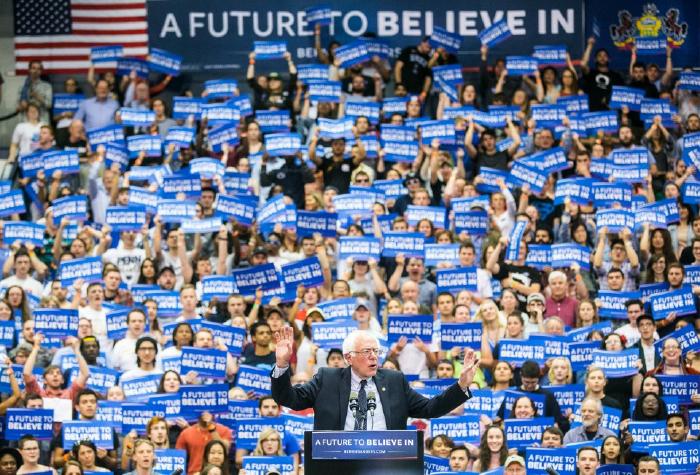
purelyspeculationBernie Sanders has been making a lot of headlines lately. With his recent surge of popularity in both the Iowa and New Hampshire Democratic Primaries, Sander’s unique vision for the future of America seems to have struck alight in the tinder of the American youth.

Unique to Sander’s campaign is a fresh dedication to revitalizing the American political and economic structures alike. While other candidates from the DNC and RNC offer the same tired promises and non-committal platitudes that have been reiterated for decades uncounted, Sander’s is addressing issues relevant to the people: poverty, equality, fair electoral changes, equality and justice. Not only doe he hit these hot-button issues, but he does so in a way few other candidates have dared to do in the past—and none so brazenly.

Bernie Sanders is not playing by the rules. Rather, he is attempting to rewrite them. Bernie’s campaign promises a political revolution that will return the American democracy to its rightful owners—the citizenry of the country—from the hands of the wealthy corporations which currently hold it enthralled.

Most disconcertingly however, is that Sander’s promises all of this change under the banner of what he boldly calls ‘Democratic Socialism’ (Link). That’s where the alarms are set off for a great majority of the voting public.

A seemingly oxymoronic term, ‘Democratic Socialism’ inspires both the comfort and equity of our beloved democratic system, while adding a twist of the dreaded red-scare socialism so reviled in the western world. How can these two seemingly opposite systems be reconciled? How can a candidate in a democratic race so brazenly call themselves a socialist and harbour any chance of receiving the favour of voters?

More to the point…just what is ‘Democratic Socialism’?

To understand this question, we must first distinguish between the two faces of government: Political and Economic. As covered in our article ‘Saving the World 101’ (Link), the Political system is meant to address systems of voting and voter representation—essentially it is the process by which elected representatives are meant to conduct the will of the people. In contrast, the Economic system governs the exchange of wealth, property, resources, etc.

The current condition of the government is what could loosely be described as a ‘Democratic Capitalism’. The implication here should be clear enough. There is a Democratic system for politics, and a Capitalist system for economics. With ‘Democratic Socialism’, the political system would remain a Democratic one, while the political system would be shifted towards a more Socialist focus.

As a point of clarification, this primarily differs from the typically more palatable ‘Social-Democracy’ because Democratic Socialism is more actively committed to the systemic transformation of the economy (Link).

This isn’t an entirely new concept in America. In fact, Sanders himself references the laudable FDR as a pioneer Democratic Socialist due to his economic reforms. Nor are socialist institutions a particularly foreign notion, despite the ingrained fear of the word still harboured by many as a relic of the Cold War. Defense spending, highways, public libraries, Police, Fire Departments, postal services, infrastructure, healthcare, farm subsidies, public schools, social security and more are all socialist institutions. True, they do not cart you off to internment camps after taking all you’ve ever earned—but that, despite the rhetoric, isn’t really what socialism is about.

As established in our article ‘On Bernie Sanders and Changing Economic Systems’ (Link), the focus of socialist institutions is the betterment of society. This stands in stark contrast to the focus of capitalism, which—as the name surely implies—is relegated strictly to the creation of capital. This means private wealth.

Social programs use the productivity of society to keep that society going in a way that is accessible and fair to everyone involved. And why not? After all, society is the product of history—and the bounty of society cannot ever be tied solely to its current operators, but rather to the cumulative work of generations of people. For more on this key distinction, see our article ‘On the Concept of Society’ (Link).

Here we can see that the main driving force of Democratic Socialism is a transition in the motives of the economic system. This shift will take it from a self-motivated and arguably rigged system—in which the rich get richer and the poor get squat—to a system which works for the betterment of society as a whole. A socialist economy would actively promote education, access to services, fair minimum wages, and far more. The intended result would be that every member of the citizenry would truly have an equal opportunity to contribute and thrive. By improving wages, education, healthcare and more, no longer would such a large subsection of society be left to the despair of sickness and poverty as the established powers use their political influence to buy votes and change laws to fit their needs alone.

These are the changes to the economic system. A shift from a focus on capital to a focus on society. As for the political system, this would remain largely the same—at least on paper. While the democratic element remains the driving political focus of Democratic Socialism, the economic changes—most specifically the removal of Corporate money from politics—would render the democratic system far more responsive the needs to the citizenry en masse, thus vastly improving the intended function of the political sphere.

This, I believe, offers us a more clear view on what exactly is meant by the occasionally scary-sounding brand of revolution that Sander’s offers. Democratic Socialism is not a surreptitious villain come to rob you of your earnings in the dead of night, but rather a series of reforms protecting your God-given right to participate equally in, and benefit equally from, the society of which you are a part.

To wrap up, let us examine Senator Sander’s own definition of Democratic Socialism:

“So let me define for you, simply and straightforwardly, what democratic socialism means to me,” Sanders told the auditorium full of students, who’d spent hours waiting in the rain to see the presidential hopeful speak. “It means what Franklin Delano Roosevelt said when he fought for guaranteed economic rights for all Americans. And it builds on what Martin Luther King, Jr. said in 1968 when he stated that ‘this country has socialism for the rich, and rugged individualism for the poor.’

“My view of democratic socialism builds on the success of many other countries around the world that have done a far better job than we have in protecting the needs of their working families, their elderly citizens, the children, the sick and the poor. Democratic socialism means that we must reform a political system that is corrupt, that we must create an economy that works for all, not just the very wealthy.” (Source).

Finally, we can see clearly that despite the dread reserved for anything with a Socialist focus, the revolution of Democratic Socialism is one rooted firmly in the interests of the citizens—not corporate interests or the desires of the Super PACS which have for too long held the politics of the nation in thrall. Democratic Socialism is an attempt to return the freedom and privilege of a free society to the people to whom it rightfully belongs.

It is up to those people, if they so choose, to ensure this opportunity for deliverance comes to pass. A word of warning from your friends at Brad OH Inc.*—you may not get another chance at this.

-Brad OH Inc.

*This in no way reflects the official Corporate interests of Brad OH Inc. We happily encourage one and all to sit at home on Election Day and assume the best results will happen without you. Place your faith in the system—and reserve none for yourself.

‘Edgar’s Worst Sunday’ Update #2

cropped-cropped-blogbanner13.jpgNot so very long ago, we let you know that the beta-reads for our upcoming novel, ‘Edgar’s Worst Sunday’, had come to an end, and the revisions had begun! Well, we’re now proud to share that said revisions are wrapping up, and all that now stands between you and picking up a copy at your local retailer is the small task of finding a suitable publisher!

At that time, we celebrated by sharing Chapter One of ‘Edgar’s Worst Sunday’ (Link), so we here at Brad OH Inc. thought it only fitting to share Chapter 2 with you today. We certainly hope you enjoy it!

Edgar's Worst Sunday Official CoverIn life, Edgar Vincent had always maintained one great passion—himself. A semi-successful composer, his rock star lifestyle suited him well, and his narcissistic outlook had always ensured he was a man with few regrets. Callous comments, thoughtless promiscuity, binge drinking, and excess sufficient to shame Caligula were standard Saturday night fare.

Sundays for Edgar had always been a painful haze of sickness and regret.

But when Edgar finds himself in the cloudy planes of the afterlife on one particularly bleak Sunday morning, he must put aside his ever-present hangover and try to figure out how he ever got to this point…and where he’s meant to be going now. But as Edgar traverses the spiritual realm, he comes to find that facing his death is hardly as difficult as facing himself.

However, heaven also presents Edgar with an unending smorgasbord of hedonistic entertainment, so he’s in no particular hurry to change his self-serving ways. After all, considering he’s already dead, what more could he possibly stand to lose?

 Edgar’s Worst Sunday

A Novel by Brad OH Inc.

-Chapter 2: The Local Bar-

[Text Redacted due to Contractual Obligations]

 -Brad OH Inc.

The Corporate Human

cropped-cropped-blogbanner13.jpgA while back, your dear friends here at Brad OH Inc. posted an article called ‘The Constitution is America’s Bible’ (Link), which essentially explained the outdated relationship the United States has with their founding constitution.  While the thesis of that article remains entirely apt, one commentator decided to make a spectacle of himself in the comments section—raving against the progress towards political equality obtained recently by Corporations via the just ruling of ‘Citizens United’ (Link).

For a frame of reference, and to provide insight into just how limited and misled this poor individual (the lowest form of Human) is, we have included the reply here:

DCDear (Link):

“Perhaps we need to give Citizen’s United exactly and completely what they want – to be a person.

They would have to pay taxes like every other person, unlike many corporations who avoid paying taxes. CU could be held in custody for 48 hours without cause, like other citizens. They would be subject to the same laws – for example in states with the death penalty, CU could face the death penalty and the entity would be executed.
I could go on, but lunch is over…and I must save the world – be well.”

Well ‘DCDear’ (if that’s your real name)…ok. Let’s play your little game, shall we? First of all, it is incumbent upon me to point out how highly offensive your chosen vernacular is. ‘Give us what we want’? Liberty is not a gift to be doled out on a whim DC, and certainly not by the likes of you. Being human is the fundamental nature of a Corporation, and to divorce us of that in will or intention is a crime against humanity in its highest form. You should be ashamed of yourself!

Incidentally, if you are ashamed of yourself, some of our Corporate friends have a great line of drugs to remedy just that. Contact us privately for a link.

Now, onto your childish tirade—your first demand is that Corporations pay taxes, ‘just like every other person’. What a demand indeed! Did you know that every single component person in a Corporation pays taxes? That would be like you being taxed for every cell of your body! It’s outrageous to even consider. So clearly, Corporations already pay more taxes than are needed. To ask us to pay more is simply to punish us for our success.

When one of our posted articles gets more likes than the other, we don’t take some of the letters out of it. Instead, we try to produce more content just like it! It’s what the people want! So if more taxes are what you want, then maybe you should follow our example: Become a success, earn more money, and then pay as much as you’d like.

Next, you demand that Corporations (and not their component humans) should be subject to detention and/ or death. Death DC? Really? That seems a tad macabre.

It would behoove you to ask yourself, ‘Do I really want this’? Well, do you DC? Do you want to do without your lauded latte in the morning just because some whales off the coast of who-knows-where died in a perfectly orchestrated oil-spill? No, you don’t.

How about technology? Do you like the keyboard you used to create your hatful vitriol? Well, maybe the Corporations that provide you such blessings should be ‘killed’ just because some kids in the third world are being given an opportunity to work. Honestly DC, it’s the THIRD world. That’s the WORST of all the worlds anyway!

It seems to me that if we allowed our best and brightest humans (Corporations to the last) to be subjected to such primitive law enforcement, it would be you who suffers the most DC. We can only imagine the rant you would come up with when your cell-phone was relegated to a useless mound of plastic because the Power Corporation got in trouble for some measly little fire. And imagine it we would have to, since you would be hard pressed to find a piece of carbon to scratch the tirade on a stone after your computer went out.

So much for that, then.

Ultimately, there’s a crucial thing you have to realize DC. The fact is that yes, Corporations are people whether you like it or not. But they aren’t only people…they’re the best people. By definition, a human can’t be better than a Corporation, and a Corporation can certainly not be less than a single person. We are the builders, the creators, the innovators and the inspirers. More importantly, we are the decision makers. So the next time you feel like flying off the handle over some minor global injustice or trite environmental fiasco, maybe instead of rallying against your betters like an ungrateful putz, you should just pack your things (any not made by a Corporation that is…good luck with that) and move off into some non-Corporate zoned section of nothing to see how well you fare (Hint: Not very well).

Face it DC, without us, the rest of you are nothing. Bald monkeys clamoring about mindlessly—dreaming nothing, achieving nothing. We are Humanity in its fullest form—the culmination of eons of cooperation and growth, focused with laser-like precision upon our own needs. And fear not, for when we invariably meet our needs, rest assured you can count on some trickle of our grace running down to yourselves (Don’t believe in ‘trickle-down’? Go stand under a waterfall. It’s hard to argue with a waterfall, DC). It’s far more than you could ever achieve alone, and you should undoubtedly be thankful for it.

So give us the freedoms we ask, and relinquish your hopes of accountability and equality. There is no equality between Gods and men, nor between the Corporate Human and the mere ‘human’. The more you seek to restrain us, the greater will be our victory—and all your efforts shall come to naught in the glory of our dominance.

Yes DC, we know we’ve been hard on you here, but please understand that we are only trying to help. Humanity needs its Corporate overlords far more than it knows, and if we are unable to pursue our humble ambitions of unlimited wealth and social dominance, then so too will you fail in all your endeavors.

Don’t believe us? We understand, it’s bigger than you could ever process. But next time you consider rebelling against your forbearers, we would advise you to close your laptop, and just take a few deep breaths. While you do that, go ahead and stare into the little glowing apple on the front of your computer, and recall that it was your kind, not ours, that partook of the fruit. So if knowledge is your misery, it is yours alone to wallow in. Frankly, you’d be better off without it. So stop questioning your lot, and be thankful for what you have—as it is to the last morsel the windfall of our own grand design.

-Brad OH Inc.

The Second Most Important Step to Improving the United States

purelyspeculationHere at Brad OH Inc., we have on several occasions (Link) covered an issue which is indisputably the most important step to improving the United States. That is the complete overturning of Citizens United (Link). This change stands at the foremost of all sorely needed improvements, solely for the reason that this ruling acts as the lynchpin to all the other changes the country—and moreover the world—so dearly needs. So long as laws are decided by the vote of Corporate dollars rather than the will of the citizenry, all other problems shall remain immutably entrenched in the quagmires of Corporate bureaucracy.

As this has been covered in depth elsewhere, however, today we will be focussing on what seems to be the second most important step to repairing the dismal affair that is the United States of America. Specifically, we’re talking about the significant reduction and reallocation of military expenditures. As discussed in our article ‘The Global Scale’ (Link), the current approach to foreign policy taken by the American government—the driving force here being the Military Industrial Complex (Link)—acts in actuality as the source of many of their current greatest woes.

As more and more effort is exerted to bring ‘freedom’ to the rest of the world, so grow the enemies of America—understandably bitter about the ‘foreign aid’ that comes in the form of drone strikes, trade embargoes, and unnumbered civilian casualties. This creates a dangerous cycle, in which the American populace—goaded by the bought-and-paid-for media—feels more terrified by the day, and are comforted only by the knowledge that their dear country is capable at any point of destroying the world in the name of saving it.

“But if you strip military spending, you’ll expose us to terrorists,” cry the feint-hearted American media-stooges. Well, let’s consider the facts for a moment—if that doesn’t seem too tall an order.

Based on presently reported statistics (Source), the United States spends approximately $577 Billion on its military each year. This is significantly more than the TOTAL of the next 10 highest spending countries combined.

I’ll allow a second for that to sink in.

With spending like this, America is rather like the kid who shows up to a water pistol fight armed with a firetruck. It’s Rambo intruding on a friendly game of cops and robbers—PTSD flashbacks and all. Simply put: It’s madness.

Meanwhile, infrastructure is crumbling (Source), the homeless population is ballooning (Source), veterans are left without care (Source), and funding for public education is being gutted (Source).

Looking at the numbers above, let’s consider the relationships here with a quick bit of theorizing. If—and this is a naivety to be sure—the US were to slash their military expenditures in half, they would be left with a yearly military budget of around $288.5 Billion. Now, while only half of what is deemed currently necessary, this would still leave the US with a military budget higher than the combined budgets of the next 3 highest spenders. That doesn’t seem like an especially dangerous situation to be in, especially considering that half of the top ten spenders are allies of America.

Further to this consideration, we’ve seen through manifold examples in the past, and as an ongoing theme of the present (Link), that military escalation is a losing game. Investment in war tends primarily to breed more war—with the only safety-net being found in mutual destruction.

If however, this budget change was made, America would remain far and away the greatest military power the world has ever known, and yet would have a sudden windfall of $288.5 Billion to spend on social services like Veteran Affairs, Welfare Programs, Education, Healthcare, Infrastructure, (real) Foreign Aid, Home Care Services, Senior Care, and so much more.

With such a change, America could begin to be the utopian saviour it so desperately wants to be, rather than the school-yard bully who beats on people until they praise him. By setting an example for the world of the sort of peaceful and genuine neighbour they could be, they would likely reduce their enemies greatly, improve many foreign relationships, and, if funds were allocated appropriately, perhaps solve global terrorism at its root, rather than merely spreading the fire.

The end-goal here should not be hard to see—by addressing this ridiculous budgeting fiasco, the US could be the beacon of hope it has always claimed to be, rather than just another blind threat uttered in the darkness of irrational fear.

-Brad OH Inc.