Outrage Marketing

Last week, we talked about the insidious practice known as ‘Clickbait’. While Clickbait is a loathsome gimmick used to draw simple people to even more simple ends—namely ad-revenue—there are other marketing practices which present an even more surreptitious threat.

Specifically, the topic today is the tactic known as ‘Outrage Marketing’.

For those unfamiliar, Outrage Marketing is the nihilistic attempt to create a large-scale controversy in order to get your branding out to a larger audience. This is a far deeper concept than Clickbait, and requires a good-deal more care as we explore the potential pros and cons therein.

In general, Outrage Marketing relies on making some innocuous statement or observation that has nothing to do with the product being sold. It presents a moving—or provocative—tableau, set to complementary music, and usually only the closing logo will identify exactly what is being sold.

The hope here is that the inevitable controversy created will continue to carry the name of the product, thus getting the product into the mouths and minds of far more people than a simple, direct, and informative ad could ever hope to.

For ease of discussion, let us risk taking part in the cycle by looking to a recent example. In order to minimize our role in these questionable practices, no links will be provided—advertising doesn’t come free here at Brad OH Inc.

Earlier this year, Gillette released an ad that challenged toxic masculinity, providing negative examples of male behaviour, then asking whether or not this was really ‘the best a man could get’.

In the interest of full personal disclosure, I loved the content of the ad. Toxic masculinity is a dangerous blight on our society, one which leads men into dangerous patterns of denying any emotion but anger, and which forces countless women to live in fear of the terrible results of such a hideous mindset.

It is a cultural norm which must be challenged at every turn—discussed, broken down, and replaced with a mindset that encourages a full and complete range of emotional intelligence for our boys.

The question that remains is—should an international razor company be the one leading this conversation?

It should be noted that this article is not an attack on any company in particular, but rather an exploration of corporate responsibility, and the limits thereof.

At the end of the day, Gillette is a corporation—which means that their sole purpose is to make money for their shareholders. That’s it—that’s the ingrained structure of any extant corporation, and to expect any other behaviour from them is naïve at best.

On their part, the ad was nothing more than an attempt to increase sales by forcing their name into public discourse—hardly less cynical than a corporation sponsoring a war, or schoolyard fight. They created a commotion, and plastered their logo above it.

Of course, they still sell ‘ladies razors’ at a significantly higher price-point than men’s, despite being identical save for the pink dye. This alone should hint at the fact that their commitment to positive gender relations only goes revenue deep.

It’s all about provocation meeting brand-recognition, and can be dumbed down to little more than corporate sponsored controversy. The fact that they were inarguably on the ‘right’ side of the debate is of little consequence—if the research indicated that the money was on the other side, you can be damn sure they’d flip.

Ultimately however, there is an insidious subtext here which may go unnoticed. It’s hard to say where this starts and ends, but the ability to sell using inflammatory content guaranteed to get a reaction is a smaller part of the general public’s constant demand for controversy and outrage. This ties back in to our last article on Clickbait.

On the whole, we seek entertainment and distraction over consideration and reflection. The result—or perhaps the parallel—to this constant demand for outrage, is its propensity to contribute to the further creation and distribution of the truly outrageous. After all, people will sell whatever the hottest ticket is, and when outrage sells even when utterly unattached to truth, we find ourselves in a precarious position where people no longer bother to question what’s true and what isn’t, but only parrot the most exciting stories that fit within their already established viewpoint.

But don’t take our word for it; take a look at this, you simply won’t believe it!

Click Here.

-Brad OH Inc.

Facts that Only 12% of Readers Will Understand! You Won’t BeLieve #3!

Of course, a claim like that is absolutely ridiculous. It would be impossible to verify to any respectable degree, and is entirely worthless with or without such verification. Still…was it part of the reason you clicked the link today?

Honestly, did you want to prove you weren’t among that miserable 98% of idiots who will never understand what you do?

Did you even bother to check the math above, or did knowing more than 98% just sound better than knowing more than 88% of people?

Did you check that time?

I’ll admit, the entire block of text above has been a heinous waste of time, but read on…you won’t believe what’s next!

These are the sorts of headlines we see every day—whether trawling Facebook, or trying to make it through the coverage on your preferred ‘news’ site.

Clickbait is the simple understanding that people interact with things that engage them—that cause a reaction, rather than things that present an interesting idea, or a challenging but important topic. People as a mass don’t want the best, they want what’s catchy.

Spoiler alert: This works because people are—on the whole—dumb animals, who are simply reacting to stimuli in whatever way comes natural to them.

Do any of these seem familiar to you?

  • You won’t believe…
  • People can’t stop…
  • Find out what people in your neighbourhood are all talking about…
  • The secret they don’t want you to know…
  • They are trying to erase this one secret from the internet…
  • Only 82% will know this…

When you see wild claims like this, rest assured that the underlying promise is nothing more than vapid tripe for cheap clicks. Ultimately, it’s nothing more than a cynical attempt to increase page hits, and hence advertising revenue.

Nonetheless, many people spend the better part of their time online falling into these incessant traps, supporting websites which generate profit, but not content. Of course, since the model works, it continues to be reinforced, which makes such Clickbait ever more prevalent, and real content that much harder to find.

The secret behind this success is triggering a reaction from a title, and more often than not, that reaction is an urge to prove that you, the reader, are better than ‘those statistics’ the title refers to. You know better, you are better, you have something other people don’t, and dammit, you’ll prove it by following the instructions and typing an English word with two O’s!

If you see an article with 5M comments all disproving the grandiose claim of the article, it might be worth considering that you’ve been duped.

So, here’s a bit of advice, from us to you. The next time you read something online that gives you an urge to prove you’re especially smart or special—just save yourself the trouble.

You aren’t.

With our warmest regrets,

-Brad OH Inc.

What Should a Government Be?

All too often, political conversations of any sort—whether by public, or by politicians themselves—sink quickly into the mires of partisan politics. Teams of left and right, red and blue, create straw effigies of the other’s values, and burn them upon the altars of their own smug self-righteousness.

This is a matter of hopeless grandstanding—and seldom serves to advance the policies of either side. Elections are won and lost on insults and rumours, and the greater good of the people is abandoned to the wayside of this sickening side-show.

There is a good exercise which can help people of either viewpoint learn more about not only their opponents, but themselves. Setting aside personal emotions and group identities, one may challenge themselves instead to describe only what they believe a government’s role should be. What should it provide, protect, or prohibit—and on what grounds? What is its purpose?

Try to do this without reference to actual individuals, and certainly not to specific parties. Discuss only ideas of the primary functions that must be served.

It is important not to hang yourself on lofty words with little meaning. Freedom, peace, liberty—such words hold high aspirations, but speak little to practical realities. What do they truly mean to you, and how are they to be upheld?

We discussed these concepts in one article, ‘Greed and the Village’, using a simple tribal village as a model for the type of considerations that must be pondered.

We also discussed the fears around giving power to government in the article ‘On the Fear of Big Government’, where we established the wild and barbaric reality of a world with no authority.

Is it a government’s role to protect businesses, or people? Which people, and from what? Are there exclusions to this protection? What happens when the rights of one violates the rights of others? What about when the growth of a company enriches its members but casts many others into poverty?

Is this a natural and enviable result of a free market, or an economic violence which must be redressed?

These are the questions, and the approach to engagement, which can lead people of wildly different persuasions to not only challenge their own beliefs and grow in the process, but also to find the common ground with those who they long considered their rival.

There are very few people on either side of the spectrum who truly want the young to suffer, or women to be scared, or people to live in hateful captivity. By accusing those who think differently of such intentions, we vilify them and close off all possibility of informed debate. Only by remaining open, and seeking sincerely to find the underlying values for ourselves and our opponents, can we hope to find answers which can unite and help people, rather than serving only to reinforce the wild and destructive division that serves only the powerful.

What do you think?

-Brad OH Inc.

Project FearNaught- ‘What Does It Take to Change the World?’

Let’s get back to the question at hand. In the opening article of Project: FearNaught, I said that I wanted to start the conversation that changes the world.

That’s exactly what I intend to do.

What does it take to change the world? That is the question. The answer is still in development, and each of you reading this now will play a role, if you have the strength of will to rise up and join me.

Many different answers have been offered. Some will say that love is the only thing that can change the world. Others will argue that honest education and the ability to think critically are what’s needed.

It may require small acts of kindness. It may take discipline, and virtue.

What does it take to change the world? It takes all of these things, and more. It also takes honesty. Honesty with ourselves, and honesty with each other. Sometimes it will demand honesty to each other. That’s a scary thing. But there’s no room for fear here.

Fear leads to withdrawal, and hence to ignorance. This fast grows into resentment, blame and hatred. Some may say that fear leads to self-betrayal, but this is not true. There is nothing a man can do to betray his inmost truths. He only reveals them. And fear, fear can do this like nothing else.

Fear has changed the world many times.

Fear of the way things used to be, and fear of how they could be. Fear of change, and fear of losing what we have.

Fear of the other.

Fear of ourselves.

Fear of standing up and shouting—only to find that we are alone.

So, what does it take to change the world? Fear. Or a lack thereof. Sure, love can do it, so can education. So too can all those other things in varying degree—but that’s precisely because those gifts are the death of fear.

You don’t need love to change the world. You don’t need schools, or libraries, or healthcare. Fear alone can change the world.

Fear is at the root of all human ambition and control. It is fear which keeps us willing to accept our present circumstances, and fear that has delivered us into them.

And that’s why fear is our target…

So, what does it take to change the world?

If a man seeks to change the world, he must first change himself.

I do not have all the answers, and it will be up to the good readers of this site to take this spark and set it to light upon the tinders of their own communities. By design, ‘Project: FearNaught’ has room for all, and by design it requires the input and participation of the masses. This is not a top-down proclamation, but an essential call for community discourse. With that being said, it must also be stated that, by its very nature, ‘Project: FearNaught’ demands utter self-sincerity of its readers and participants. Without that, you will be reading the potential answers to questions you’ve yet to articulate.

So, take this with you— for if you want change, then it’s your responsibility to make it happen. Take it to the streets. Look fear in the eye, and call it out on sight. Own it in yourself, and point it out in others. For we must first know our fear if we seek to escape its paralyzing hold.

Think, talk…and Fear Naught.

Be part of the debate:Project FearNaught is an effort to start the conversation that changes the world. As such, your voice is key to our ambition. To add your input, questions, or comments, click here.

-Jeremy Arthur

‘Truth Ink.’

How to be a Decent Human

Under the Green Desk Lamp…

I’m not a great person.

Sometimes I’m not even good, exactly.

I’d like to think I’m alright.

At the very least, I certainly try to be decent.

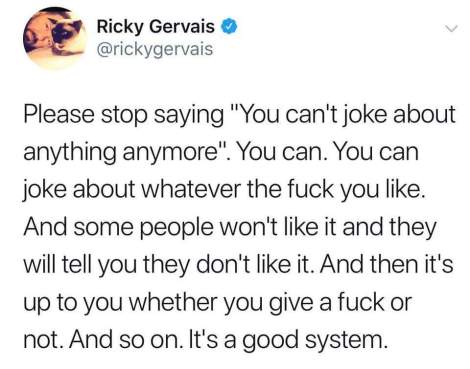
It’s not such a complicated thing really. I read a quote from comedian Ricky Gervais recently. He was commenting on the idea that people felt like they couldn’t joke anymore, and how that really wasn’t the case. The full quote is below.

fb_img_1546643404716

The crux of this really comes down to how a person reacts to a contrary opinion. Yes, you can tell a joke, but if it ends up hurting someone else that hears it, the question becomes not ‘was the joke funny’, but rather, ‘do you give a shit’?

Caring about other people is, after all, one of the chief qualifiers of decency.

If you tell a joke (or any other sort of comment or action) that gets a negative reaction, you don’t have to defend the joke, or your values, or lament the days where we could say anything we wanted and expect others to choke back their pain in defense of your ‘humour’.

People might be hurt. They may be upset or offended. And you, despite the joke being yours—and assuming it was not meant to hurt—can hear that pain.

It may come as a surprise that you can even ask questions. Not to challenge or undermine their feelings, but to better understand their experience to the extent they are comfortable sharing it.

In the end, you may both be able to learn something, transforming a painful encounter into an opportunity for mutual growth.

It’s not always easy, and no one likes being called out or corrected. It can be uncomfortable, even confusing at times to realize that something you’ve said or done has been deemed inappropriate by another.

What do you say? What do you do?

Well, one simple trick is to start with an apology. You don’t have to fully understand the nuance of differing opinions—it can be enough to understand that another is hurting, and that you are sorry for that. People sometimes need their pain acknowledged, and your obstinate focus on the hilarity of your joke should never undermine that need.

After that, there may be room for discussion, learning and growth. It’s important to remember of course, that the learning just may include the fact that the joke simply wasn’t funny, and that you should not repeat it.

That can be enough.

It’s not that you can’t discuss things anymore—it’s just that the discussion needs to have two sides. You’re not being told not to be yourself—unless you’re an asshole—and certainly, you can still feel free to joke around. Just realize that sometimes, there will be people who will point out the flaws of that joke. From there, it’s up to you to improve the approach, content, or delivery… or risk proving that the real joke is you.

-Brad OH Inc.

Re-Share: EViL

Under the Green Desk Lamp…

This post was originally from March 19th, 2017. It remains sadly relevant however, and we thought it deserved a re-share.


In the great old stories, it’s never hard to spot the source of evil. It may be a winged beast, or a black rider, or a simple, unblazoned ring sitting on a table, just waiting to change the world…

In reality, however, it’s rarely so easy. Evil may take many guises, and come from any direction. Is evil inherent to humanity? Can it ever be prevented?

Education, equal opportunity and the provision of basic needs and human rights is the most obvious answer, for by removing the greatest temptations towards desperate actions, we are most likely to see them decrease. Yet there seems to be an evil in this world which pervades and permeates even the best intentions. It sprouts up no matter what we do. It finds the cracks, or makes them, and it’s dark blossom unfolds often where it is looked for the least.

Traditionally, there are two ends of the polarity in response. One is to be jaded and fearful, rejecting everything different lest it bring evil in with it. This may prevent the terror from without, but it transforms the hearts of people, and creates hatred and evil within.

The other side would be unending faith in the goodness of human kind, sometimes to the open denial of the gathering clouds. This is idealistic, and often this school of thought is quickly met by the bitter reminder that in the end, best intentions cannot ward off evil acts.

We cannot be too careful, or too careless. Vigilance is the price of peace, and those who would deny the presence of evil may soon suffer its harsh truth.

Alas that we do not have a ring to focus on and destroy. Evil is a more insidious thing than that, manifested most often in the sins of pride, greed, and avarice—the strongest motivators of human vice. We cannot see it, nor cast it into the volcano to banish it forever.

Yet the discerning heart can feel it grow. Where will it strike? None can say.

Still, if you pay attention, you can feel the tension in the air, smell the fresh tinders and see the sparks dancing against the black night sky. Old threats and bedtime stories are alive again. Evil grows…now is the time for heroes.

-Brad OH Inc.

Who Are We?

Under the Green Desk Lamp…

One phrase that’s heard with depressing frequency these days is the impotent refrain of “this is not who we are”.

It begs the question—who are we?

That’s a pretty deep question to anyone but an asshole.

Personally, I’m a little bit different around pretty much everyone I know.

I notice their sense of humour, the tones and facial expressions they respond to best, establish nicknames and idioms to go back to in need.

Alone? That’s a wildcard.

Still, I don’t expect that’s what makes someone something.

Is it their actions?

Their stories?

The changes they’ve made?

The happiness they’ve created?

…Who am I?

A soul, lost and confused, trying it’s best to do good for the world. Taking it all in—the good, the bad, the perverse, the fanatical. Working to process it all, to understand it all, to bring it all together, and in the light remind it.

…Who it was in the beginning.

-Brad OH Inc.

Project FearNaught- ‘We’re All Going to Die’

Sad but true—we are all going to die. The awareness of death is a distinct privilege for humans—our cerebral capacity allows us to foresee our inevitable endpoint in a way that no other animal can imagine. This ‘mortality salience’ is among the driving forces of humanity, and has been the genesis of countless stories and myths, as well as a key feature of almost all major religions.

The question always becomes: What happens when we die? It’s as if some certainty to this quandary might settle our nerves when the time comes—and well it may. However, the funny thing about death is that not many get the chance to report back. So, whether it’s pearly gates, Elysium fields, an endless void, or something entirely different, we are left to wonder.

Today however, we are going to take this issue head-on—providing a minimalist view of the afterlife which should be accessible to all, and act as an effective guidepost for personal moral accountability. This is not meant to be taken as a proof or even a strong belief, but rather a fundamental jumping off point: a basic answer, and a prompt for greater personal insight.

Whether you seek admittance into Heaven, Valhalla, or any other similar notion, what I want to provide for you today is a roadmap of behaviour guaranteed to get you there.

In order to do so, I will present you with five simple assumptions. Once these assumptions are accepted, I will outline a fundamental interpretation of the afterlife which will suffice to guide the action of any man, woman, or child seeking a positive post-mortem experience.

The 5 Assumptions are:                          

  1. We have a sense of right and wrong:

Specifically, the assumption is that we can feel good or bad about actions we have taken. For instance, if we think about betraying a friend, we may feel guilty. If we consider being there to help a loved one, we may feel proud or valued.

  1. Our experience of time is relative to our experience of pleasure/ pain:

This one sounds a bit more complex than it is. What I am seeking here is a basic recognition that when we have a good time, it seems to fly, and that when we suffer, time seems to drag.

  1. Death is the greatest displeasure:

As animals driven by animal instincts, our general inclination is to avoid death at all costs. Essentially, our own death is the worst thing to experience.

  1. When you die, your life flashes before your eyes:

It may be that none of you are as well-equipped as me to accept the truth of this one. It’s an old concept for sure, and one that I myself have recently experienced and will attest to in a roundabout sort of way.

  1. A number cannot be divided by zero:

This one may come as a twist, but in order to finish this concept, we need to agree on this basic mathematic principle—specifically regarding calculus and graphing.

Now, based on the five assumptions we just agreed on, we can imagine a very interesting and poignant thing happening the moment we die. First of all, as I’m sure you can surmise, you’re going to have your life flash before your eyes. On top of that, since we agreed that you have some semblance of morality, you are going to have certain feelings—some positive, some negative—about the way you have lived.

However, we’ve also agreed that our experience of time slows down as we experience more adverse situations, and further, that death is the worst thing to experience. Considering this in relation to our final fact, I ask that you imagine a graphic function for a moment.

For this graph, we will have the X-Axis represent our experience of pain. The lower the value, the more pain we experience.

The Y-Axis will represent our experience of time. The greater the value, the more relative time any given moment seems to take.

Since death is the worst possible experience, as the X-Axis approaches death (or a zero divisor), the value of the Y-Axis (our relative experience of time) grows exponentially greater without ever reaching said zero.

This is called an asymptote. The Y-Value will veer upwards towards infinity as the X-Value creeps closer to its natural dead-end. According to the precepts of our graph, what this means is that as we approach the moment of death, we find ourselves in a single moment experienced as an eternity.

So here we are, stuck in an eternal moment, looking back at our lives, and feeling good or bad about it—or some mixture of both.

This concept affords to us a vision of eternity which compels us to virtue, not to avoid punishment—which is no true virtue at all, merely coercion—but for the reward of decency itself. It is a functional clearing of the dogma and artifice which has grown over the reliefs of truth, and tasks us simply with being prepared to face ourselves and our actions not only on the day of our death, but each preceding day as well.

This to me is the most basic understanding needed to live a righteous life. The concept we should take away from it, simply put, is that we should take no action we would not be comfortable looking back on for eternity.

Share this, and use it each day. Think on your actions, and encourage others to do likewise. For Project: FearNaught to change the world, we must confront our virtues and vices head-on. That is the purpose here. The task may be daunting, but it can be accomplished…have no fear.

Be part of the debate:Project FearNaught is an effort to start the conversation that changes the world. As such, your voice is key to our ambition. To add your input, questions, or comments, click here.

-Jeremy Arthur

‘Truth Ink.’

Where the Children Sleep

Under the Green Desk Lamp…

Over here, the children sleep,

In warm and comfy beds,

They dream of games and food and joy,

And peace is in their heads.

Will they see their friends at school?

Will they see a parade?

Will their parents yell today?

Or will their anger fade?

Over there, the children sleep,

On ground filthy and cold,

Will they have the same tomorrow?

Perchance will they be sold?

Will they have friends remaining,

When the bombs somehow bring peace?

Will their parents hold them tight,

or dying will they cease?

Yet we continue on our way,

Dividing here and there,

With more than enough to go around,

And make it ‘us’, everywhere.

Around the world, the children sleep,

The darkening night away,

And do they dream in that deep sleep,

About a better day?


-Brad OH Inc.

Rhapsody

Under the Green Desk Lamp…

Civil discourse these days has become pretty uncommon. You’ll rarely hear a debate that doesn’t soon slip into name calling and paranoid wailing.

It’s both sides.

Everyone is simply too afraid. Afraid of everything, yet somehow afraid of all the wrong things.

That fear is the problem, and it stunts any level of intelligent discourse by wheeling us into knee-jerk reactions and assumptions—making our conclusions for us. When angry and afraid, you go with what you know: Red or Blue.

That’s the thing about political thought however, it never quite fits into a single definition. Try as they may, there is no binary option that can capture the nuance of human belief—of our values.

Values, now there’s a word that’s thrown around a lot in politics, yet never really utilized the way it should be. Values, after all, are what it really comes down to. The truth of it is, I strongly suspect that a measure of fundamental values would show a far less divided picture of humanity than a typical measure of political preferences.

Behind the rhetoric and uproar, there do remain basic rights and wrongs, and obvious decencies which I still believe the vast majority of people can agree upon. These are values which go beyond culture and language.

They are innate to us, and are denied only by the most wretched of deviants, or those desperate souls who by poverty or avarice have found themselves denied entirely of their moral compass.

What would happen then, if people were to put aside their labels and colours—the brand names of political philosophy—and turn away from their hot button issues to discuss instead the basic values they hold dear.

No loose terms like freedom here. Tell me what that really means.

What do you love?

What do you fear?

What do you hate?

Do you realize the last answer is most likely the twisted spawn of some unknowable combination of the former two?

Or that the second closely follows the first?

Really though. If the world at large could manage such civil debate for a while—I mean really keep it going, get deep, and avoid falling back into the ‘yeah but’ type thinking which somehow convinces us that the forces of reality must in the end overwhelm the deepest of truths—what might be the result?

And what would you have to say?

-Brad OH Inc.