Unknown's avatar

About Brad Oates

Brad Oates is the author of ‘Edgar’s Worst Sunday’ and ‘Meaning Less’. Growing up in the small town of Mayerthorpe, Alberta, Canada, Brad developed a passion for literature at an early age. Many of his first memories involve being curled up on the couch with his parents and siblings as they read ‘The Hobbit’ and ‘The Lord of the Rings’. Brad now lives in Edmonton, Alberta, with his dog, Bogney. He is a senior member of the Edmonton Writer’s Group, and enjoys writing at the the local Whyte Ave bars when he finds the time. On his blog, www.BradOHInc.com , he enjoys writing in a wide variety of genres, and covers numerous topics. In general, he finds himself leaning towards a darkly comedic, literary approach, and often dwells on the themes of human virtue, and self-deception.

‘Edgar’s Worst Sunday’ Update #2

cropped-cropped-blogbanner13.jpgNot so very long ago, we let you know that the beta-reads for our upcoming novel, ‘Edgar’s Worst Sunday’, had come to an end, and the revisions had begun! Well, we’re now proud to share that said revisions are wrapping up, and all that now stands between you and picking up a copy at your local retailer is the small task of finding a suitable publisher!

At that time, we celebrated by sharing Chapter One of ‘Edgar’s Worst Sunday’ (Link), so we here at Brad OH Inc. thought it only fitting to share Chapter 2 with you today. We certainly hope you enjoy it!

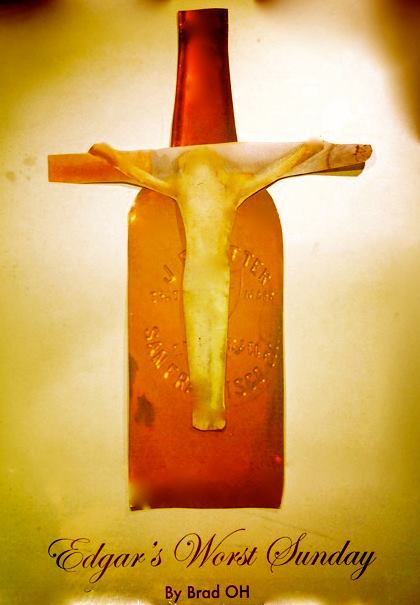
Edgar's Worst Sunday Official CoverIn life, Edgar Vincent had always maintained one great passion—himself. A semi-successful composer, his rock star lifestyle suited him well, and his narcissistic outlook had always ensured he was a man with few regrets. Callous comments, thoughtless promiscuity, binge drinking, and excess sufficient to shame Caligula were standard Saturday night fare.

Sundays for Edgar had always been a painful haze of sickness and regret.

But when Edgar finds himself in the cloudy planes of the afterlife on one particularly bleak Sunday morning, he must put aside his ever-present hangover and try to figure out how he ever got to this point…and where he’s meant to be going now. But as Edgar traverses the spiritual realm, he comes to find that facing his death is hardly as difficult as facing himself.

However, heaven also presents Edgar with an unending smorgasbord of hedonistic entertainment, so he’s in no particular hurry to change his self-serving ways. After all, considering he’s already dead, what more could he possibly stand to lose?

 Edgar’s Worst Sunday

A Novel by Brad OH Inc.

-Chapter 2: The Local Bar-

[Text Redacted due to Contractual Obligations]

 -Brad OH Inc.

Everything is Everything

Under the Green Desk Lamp…

Green Desklamp

Yeah, it’s a Bruce Springsteen lyric (Link), but that’s not what this article is about. Well, I guess if ‘everything is everything’, then it must perforce be at least partially about that, but really, now you’re just being pedantic, and should be ashamed of yourself for such childish behaviour. Still, it’s a line you hear often enough—usually eliciting a stoic nod or an enlightened shrug, and little true thought is every really put into it. So, what do we mean when we say ‘everything is everything’? Well, just that in a way, yet not quite….

Certainly, everything is connected. From societal values, to child-rearing theories, to tax levels, to individual self-esteem, to war, to faith…one thing affects another in an unending and unwieldly domino effect. With clear vision and an open mind, it is all but impossible not to see the interconnected nature of all things. We’re not trying to go full ‘Butterfly Effect’ here, because we all know that butterflies affect nothing but children, but it must certainly be acknowledged that to have a serious and insightful discussion about any one topic, we must necessarily call upon and consider infinitesimal other issues.

Let’s start with an example. A popular issue these days is gun control. The argument in its shortest form is whether allowing easy access to guns creates a safer or a less safe society. Proponents of easy access to firearms, when not ranting about the constitution, focus on the old adage that ‘if you make guns illegal, only criminals will have guns.’ Well, that’s a tautological truth to be sure, but does it get to the heart of the issue?

Opponents of easy firearm access take a different route—claiming rather that by increasing access to guns, we allow for a more violent and reactive culture. That, combined with the ease of access, leads to greater gun violence.

Both sides have some relevant points, but to focus on the limited standards of these political movements alone is to miss the nuance and depth of the issue—and this is the case with most anything that is debated towards a specific, pragmatic end while lacking due reverence to the holistic ‘big picture’.

This article is not about gun-control per say, but rather the ways which we currently discuss the hot-button issues of our times. By keeping on the blinders and considering major topics within the narrow confines currently prescribed to them, it is easy to entirely miss how our decisions affect the world around us—and conversely—how they are affected by the very same.

In our recent article ‘The Key to Improving Our Collective Future’ (Link), we discussed why we consider education to be among the key factors in improving the world for all its sorry inhabitants. This notion remains a prescient topic in our current considerations. We’ve now established how everything is affected by everything else, but perhaps the single most impactful factor of any era is the reigning attitude of its people.

Humanity is a malleable lot—able to adapt not only physically over the long term, but also mentally, emotionally, and intellectually in the much shorter term. This is why our decisions must be more universally informed. From education, to taxes, poverty, war, governance, media and more—it is all connected, all around the world. The way we fashion our society is the way we raise our people. So what do we want humanity to be in the long run, and what is sustainable for us? Greed and envy and violence? Likely not, but this is what our present society breeds.

To have a culture predicated on the pervasive tenets of fear and greed, and then act appalled when its citizens turn feral and succumb to vice is disingenuous. People are the product of their environments, and we must arrange for a society which fosters the sort of people and values we claim to hold dear. Everything is everything, after all, and it’s imperative we take this idea wholly to heart.

It is a broad picture to consider, and certainly no easy solution will present itself. It is therefore beholden upon us to engage in open dialogue—and not just among our own familiar peer-groups. We must consider the worldwide implications of our values, and reflect honestly on how the standards we set, and the systems we create, work to shape the masses of humanity around us. It is, like it or not, entirely on us to make these decisions, for fate is an unreliable guide, and apathy the surest source of misdirection.

The considerations are vast, but not insurmountable if our will is harnessed in common cause. From improving our economic and fiscal balance (Link), to fully accounting for the vast potential of our nature (Link), we must give due consideration to what sort of culture we truly want to be, and then explore the most effective holistic steps to achieving it.

For in the end, the goal of a society must be finding and realizing the best way to raise the human animal in its masses. How we are raised is what we become, after all. What must humans be to thrive and to live in harmony with the planet? It’s a lot to weigh, but tell me what sort of people you wish to be surrounded by, and I will tell you what sort of world we must devise.

-Brad OH Inc.

The Corporate Path is Clear

cropped-cropped-blogbanner13.jpg

Recently, the Corporate World achieved another outstanding victory in the passing the Trans-Pacific Partnership (TPP) deal, and this is just cause for every little Corporate boy and girl to celebrate! This deal—passed with exceeding secrecy and underhanded tactics meriting great praise—has cleared the way for the final stage of Global Corporate takeover! The world for too long has stood on the crossroads between the old values of equity and access, and the new inroads of exclusivity and dominance. With this ruling, we can finally put boots to asses, and send this listless planet down the fast-lanes to true Corporate greatness!

The TPP is a Trade Agreement between 12 Pacific Rim countries, and was passed on Oct. 5th, 2015 (Link). With the aim of clarifying complex international trade protocols similar to NAFTA before it, the passing of the TPP represents one of the greatest moral victories of our time, and a true recognition of the inherent worth and global merit of your friendly Corporate Citizens. With it, the shackles of injustice have been cast away from Corporations around the world, and finally we will be allowed to flex our full power without the heinous hindrance of being answerable to ‘the people’. We’re one too after all, and it’s due time they answer to us!

Described as creating a ‘hybrid government-Corporate structure’ (Link), the TPP is nothing short of the Liberty Bell sounding throughout the lands/ boardrooms—declaring to all Corporate people to go out and do what they will. No longer will we be held back by weak-minded considerations such as ‘environmental concerns’, ‘fair wages’, ‘fair’ copyright laws, ‘affordable’ medications, ‘worker’s rights’, ‘domestic job creation’, and ‘privacy protection’ (Source).

It’s a stunning accomplishment to say the least—and directly reflects the world’s gestating acknowledgement of its true leaders. For it is Corporations which build society, and by unburdening us from the wasteful confines of ‘global responsibility’, we are freed to continue to do what we are made to do—maximize profits!

Could it get any better for your beloved Corporate benefactors you ask? Well, we’re happy to say it can! Not only does the TPP grant us the Inalienable Right to ignore the ‘inalienable rights’ of private citizens, it also provides Corporations the ability to challenge foreign laws in so far as they impact our acquisition of Capital, and to have a greater (and well-deserved) role in writing and voting on government policy!

Clearly, this is a lauded day in the history of the Corporation, but as the small, merely ‘human’ individual you are, you may well be wondering how this affects your pitiful existence. Have no fear—the passing of the TPP soundly ensures that those concerns are no longer in your domain. The Global-Corporate takeover is now nearly complete, and that only means that for every fear and each doubt you may harbour in your fragile little minds, Corporations are already working on the answer. We hold the reigns now, and your complete trust is the only rational response.

Not sure what to eat? We’ve got you covered! Confused about Environmental debates? Leave it to us! Sick? Save up! Out of work, destitute, and stricken by an unconscionable sense of ennui? Fear not my child, for we the Corporations will always ensure there is just enough to go around—how else could you possibly continue your unconditional support of our governance?

Face it—this is only the culmination of a long-entrenched reality. We the Corporations have everything well in control. So sit back, let your ‘Genius’ playlist tell you what to listen to for a ‘relaxing mood’, and trust that everything will be ok.

After all, we’re here for you™.

-Brad OH Inc.

On Bernie Sanders and Changing Economic Systems

purelyspeculation

These days, ‘Socialism’ is a word bandied about like a knife in the dark. Even as society yearns for sustainable solutions to its present malaise, the red dread of Socialism lingers from years long past, and hearts are turned away from any consideration that is not entirely beholden to the dominant theory of Capitalism.

Capitalism alone has long been held as the only acceptable means of governing fiscal policy. With its general ‘survival of the fittest’ mentality, it has often proven over the years to stimulate the growth of businesses big and small, acting for the benefit of all consumers.

But it must also be noted that Capitalism is strictly a consideration of economic affairs. More specifically, it is not concerned with managing social affairs. Rather, it is (as the name implies) concerned strictly with the managing of Capital. This system made perfect sense when there was so much building and work to be done that there was enough work for all—work and be paid, take part!

But such is no longer strictly the case. In a world of ever increasing automation of labour, combined with scarcities of non-renewable resources, the system of Capitalism works only to strangle out the ‘excess’ in humanity, not to foster anything new. This is why it behooves us to consider changing to a system which more accurately reflects our present situation.

It’s not an easy thing to consider however. As discussed in our article ‘The Constitution is America’s Bible’ (Link), society harbours a terrible reticence to ever change what has worked for it in the past—even if it clearly no longer functions as intended. In a world where more and more people are falling below the poverty line—where infrastructure is failing, and where the rich take an ever growing portion of domestic product, it may well be that the aims of Capitalism are as outdated and ineffectual as many of the clauses in the constitution itself.

As established, the domain of Capitalism is relegated to Capital alone—money, and the making thereof. But when the woes of the world are increasingly tied to the misappropriation of wealth—a policy fully enabled by Capitalism in its present form—it shouldn’t be such a stretch to see the inherent value in the notion of Socialism, which places its value rather on society and social balance. That is, of course, if you can take off your red-tinted glasses long enough to consider our need.

True, Communism doesn’t make sense in a system with countless jobs, but nobody motivated to do them. Conversely, Capitalism once made sense in a system where jobs needed to be created for the expansion of a nation. There were bridges and roads to build, cities to design, etc. So it made sense that the opportunities should be open to all, and that the hardest working and most innovative and industrious should be justly rewarded. This was a situation of natural opportunity and abounding incentive.

Now, with populations swelling worldwide and the increase of technology reducing available jobs, this system simply no longer seems quite so pragmatic. Our society must be retooled to allow for anyone working a job—be it CEO of a Corporation or shoveling snow off the streets—to be provided for sufficiently to raise a family with another stay-at-home partner. This would allow for true growth in society: smarter, healthier, better behaved children, less crime, better/ happier citizens, and far greater hope for the future than the current approach of shovelling all of societies spoils into the coffers of the elites—as set up through the dated Capitalist system—and allowing the rest to starve or rot.

If Capitalism, and the assumptions it entails, no longer fit, then there is a clear and pressing need for a radical paradigm shift not only in politics, but in our fundamental assumptions about society in a global world. This notion has already been discussed in some detail in our article, ‘On Saving the World 101’ (Link).

But this is not a new idea by any stretch, and an attentive viewer can already see the desire for change growing in the disenfranchised masses the world over. At the head of this charge is one man who stands out from all other politicians…the justifiably lauded Bernie Sanders (Link).

Risking the wrath of the socially-entrenched, Bernie pulls no punches…openly labelling himself a ‘Democratic Socialist’—a term which to many seems a contradiction at best, and often something more akin to a full on assault of social-normative values.

But Bernie sets himself apart from so many others wailing atop their soapboxes about change and hope (this writer notwithstanding). First of all, among politicians he is a rarity by the sole virtue of his sterling voting record (Link), which shows a long history of voting in favour of his constituents on issues ranging from access to Healthcare, to promoting peaceful resolutions of conflict, to increasing social supports for society’s most disadvantaged. Further still, Bernie raises his money from the independent contributions of actual voters—taking little to no money from banks, lobbyists, ‘think-tanks’, or others of their ilk.

On top of this, Bernie’s platform (Link) reveals the truth of his definition of ‘Democratic Socialism’. The focus here is on improving access to resources for all, on creating greater equity in our world, and preventing the powerful from emptying the pockets of society through market manipulation and lobbying for changes which benefit only themselves. Bernie seeks to put an end to the bastardized system which Capitalism has slowly morphed into, and design instead a system which represents the current needs of our waning culture.

Everyone talks about change and hope—such words are little more than devalued political currency to be cast about to the naive masses in exchange for votes. But among all of the traits which make Bernie an exemplar among political figures is not only the evidence of his true character, but his unyielding belief that the world can truly be a better place if we only work together.

Still, no measure of earnest intention can quell the fears so closely associated with Socialism, and more specifically, Communism. The media is quick to paint Bernie as a devilish red commie—determined to strip us of all we own and hold dear. He’ll take our money, take our Gods, and take our self-worth, spreading it all so thin as to somehow leave everyone worse off than they started. It’s a twisted view of his platform (and math) to be sure, and even a cursory consideration of facts would reveal the falsity of these fears (Link). In fact, Bernie’s ideas are not wholly unique, and many countries in the world have already found great reprieve by turning their own values away from Capital, and towards Society.

But we would be remiss to ignore the entirely justified fear of Socialism. Collectivist paradigms in the past have certainly proven to be a dangerous precipice to cross over. But no matter the danger of the journey, when we are pressed by dire need, more dangerous still is the risk of inaction.

The most common attack on Communism is that if a comfortable life is provided for all citizens, then no one would ever be motivated to do anything. This is a fallacy. People are naturally, biologically driven to produce and achieve. To provide not just for their children, but for their community. This is an evolutionary trait, which is not switched off based on societal circumstances.

The drive is natural and insatiable, like our biological drive towards sugars and fats which are now counterproductive yet ongoing even in this unnatural environment. If the basics of life were assured, and none were prevented from contributing according to their talents and proclivities, the benefit would surely be to society and civilization as a whole. Arts and the humanities would flourish, and the human spirit, unbounded to the threats of poverty and death, would finally be able to realize its highest potential.

To clarify, what I am talking about here—and what Bernie proposes—is far from the Communism of old. Money would still be earned, and not all wages would be entirely equal. Jobs would not be done away with entirely, but rather revalued regarding their need and impact. Rather than a CEO seeing unlimited riches from selling an increasingly insufficient and potentially hazardous product (such as evidenced in the fast food or tobacco industries), we would find a wealth of jobs created in areas of healthcare, infrastructure, education, arts and myriad other opportunities to better society.

There is, even now, no shortage of work to be done or of people willing to do it. What exists instead is a devaluation of any work which does not benefit a table of shareholders—no matter what the social impact of their product is. This is because current priorities for labour are not aimed at satisfying the needs of the many, but rather the pocketbooks of the few.

This is modern Capitalism—and that is precisely what needs to change. It is a shift in values, not in ambition. For despite the tired times we find ourselves in, we must hold to the promise of morning, when light shall come again and illuminate a world better than any we have before imagined.

With all the present hype and cynical gusto around the reality TV show called ‘politics’—Bernie Sanders is the only candidate who rises above the din. He has passion, honesty…and most importantly, an actual plan for saving the world. While candidates such as the infernal Donald Trump bellow hollow promises about making America great again to boisterous applause, Bernie alone offers the actual tools to do so. And if we were smart, we would take them happily, and work with his momentum to achieve what we must all surely hold to be our ultimate goal—the betterment of society, of culture and of our shared lives on this Earth.

-Brad OH Inc.

The Juggalo Gang Designation

The Gentleman Juggalo LogoThe Insane Clown Posse (ICP) (Link) are no strangers to hate and controversy, and have even gone so far as to proudly wear the label of ‘World’s Most Hated Band’ (Link) like a badge of honour. But recently, things were taken in an unimaginably strange direction, when the FBI took the absurd action of labelling the Juggalos (the dedicated followers of ICP’s music) as a hybrid gang (Link).

The move was a very serious one, and has needlessly affected countless Juggalos since (Link). By labelling the Juggalos a gang, the FBI and United States government have created a near insurmountable obstacle for many law-abiding music-lovers. At present, having a ‘Juggalo’-related tattoo, merchandise, etc. could prevent a person from joining the military, could be considered a breach of probation terms, has been cited to affect custody agreements between parents, and extend sentences for minor crimes—reclassifying them as gang-related crimes (Source).

Even the self-styled ‘Most-Hated Band’ sees this as a step too far. While they’ve borne the brunt of media scorn with an optimistic grin, the ICP have taken the FBI Gang-ruling to court. Backed by the ACLU (Link), and toting a long list of grievances reported by Juggalos to stem from the ruling, ICP have invested a great deal of time and capital into suing the Federal Government to justify or overturn the ruling.

…Not bad for a couple of Clowns.

Thus far, the lawsuit has met with little success, initially being thrown out of court, and continuing to languish under delays and red-tape. But say what you will about ICP’s music, their fight against this ruling is entirely justified, and potentially one of the more important debates of our time in the realm of art and music.

You see, a gang is something which essentially functions to create meaning for an individual who suffers a desperate lack of such. It can provide a place of belonging, an identity, even a sense of purpose and community. Unfortunately, these perceived benefits tend to come—in the case of organized, criminal gangs—with their share of drawbacks—ranging from risk of injury or death, to the harm of others, and of course criminal charges.

But gangs aren’t the only way for a wayward person to find meaning. As discussed in our article, ‘The Metaphorical Imperative’ (Link), stories and art can also serve this function. By finding a sense of acceptance, guidance, and structure in the confines of a well-constructed metaphor, people throughout history have escaped from the dismal confines of their daily life and been elevated to something far greater.

In the case of ICP, this is quite literally what happened. As discussed in our article, ‘Circular Journey’ (Link), Violent J and Shaggy 2 Dope initially founded ICP (then ‘Inner City Posse’) as a legitimate (if somewhat unimposing) street-gang. Rapping was just a small part of that identity. But as Violent J shares in his book, ‘Behind the Paint’ (Link), the Inner City Posse quickly fell prey to the more dangerous gangs of inner city Detroit at the time, experienced myriad legal conflicts, and all but fell apart. Violent J, ultimately finding himself in a jail cell, came to the epiphany that the gang life was not for him, and resolved thereafter to focus his efforts on music.

The Inner City Posse soon became the Insane Clown Posse, and the rest was history. ICP’s musical career is what raised them out of the gang life and gave them purpose. Likewise, many of their colleagues at their self-founded ‘Psychopathic Records’ came from similar backgrounds, and as such ICP stand as a true bastion against the gang life in Detroit. They have been a source of reprieve for anyone seeking something more meaningful for their lives. In fact, they have created purpose and employment opportunities in the poverty stricken city of Detroit, where the government has only lamented for the lost.

This effect continues today. When asked exactly what ‘Juggalos’ are, the most common answer you can expect to get is ‘family’. ICP have created for their fans a sense of unity and belonging rarely achieved—whether in music, community organizations, or even religious institutions. They have fostered a sense of meaning and purpose for countless youth—often as disenfranchised and wayward as the two Clowns were in their early life.

It is true that throughout their music, there have been themes of violence, misogyny, and even gang affiliation. In point of fact, in the song ‘Gang Related’, Violent J states it in unambiguous terms: ‘Do you rep the Hatchetman—you’re in a gang!’.

Now surely to the wise men and women of the US court system, this is as clear a confession as you could ever ask for. But the funny thing about art is that what is said is not always meant to be taken literally—that’s the beauty of metaphor after all. This point is not some foreign notion, nor is it a stretch to expect the good people of the judicial system to maintain this basic understanding of the creative process. In his song ‘Nebraska’, Bruce Springsteen admits to the mindless killing of ten individuals, but it’s unlikely he will ever be summoned before a jury on those charges, isn’t it?

Ultimately, the ‘Gang’ designation placed on the Juggalos is an affront to freedom of expression. What’s more, considering the incredible work ICP have done to improve the city of Detroit, and how their work has saved innumerable people from the gang life, it seems rather akin to striking at the hand that’s doing your work.

If the government had the clairvoyance to provide for its citizens in an informed and just way, it may be we would see far fewer people so devoid of meaning and desperate to belong. As it is however, we must simply embrace the power of music (and all metaphor) to provide these intrinsic human needs, and fight doggedly against any judicial ruling which seeks to punish the well-intentioned for fear that their decency would unveil the system’s own complacency.

So fight on ICP! The Juggalos—and the artistic world moreover—are behind you. The Wicked Clowns will never die!

-Brad OH Inc.

The Fiasco on TuffPuff Mountain

Under the Green Desk Lamp…

Green Desklamp

The peak of the mountain was still a ways off when everything started to sour.

Earlier that day, the world had been filled with all the resplendent promise of nature, and I, along with 2 friends, decided to scale the peak of TuffPuff Mountain, under which we’d been camping for the last few days.

The rock was warm and rough under my hands as I pulled my way inch by inch up the sheer face of a small cranny, my back wedged against the stone behind me as I picked my handholds and made my way along. The air was warm, and the sun on my face sped my way towards the small enclave of light shining above me.

With a final surge, I heaved myself onto the shelf of the mountain, panting and exhausted, yet thrilled with the excitement of my progress. Turning, I stopped to take in the vast distance I had come. Below, I could see my campsite, a tiny dot beside the shimmering green lake, so far below me now.

DSCF2924‘From the Top Down’

Exultation—I’d never been a climber, so this tenuous foray brought a sense of inspiration and pride to me I had been sorely in need of. But the view brought something else as well, and as I watched the great black thunderheads rolling across the valley, I knew immediately that the journey down would be far different than the way up.

There was no hope in climbing down the cliff-face with the rain so close—that would surely mean a terrible plummet and tragic conclusion. Three of us had journeyed up from our campsite, but one had split off just before the cliff-face—unwilling to risk scaling this potential hazard.

He was the smart one.

The plan had been to reach the peak, take in the view, and enjoy a meandering wind back down through the wooded slopes on the further side. Any ideas or detours along the way were to be welcomed with the sort of earnest glee inherent to the free-wheeling voyages of vacationers out in the elements. Now, all that had changed. Where moments ago the potential of the day had been wild and boundless, now we had only one goal: Get off the mountain.

We turned east, hoping to intercept our wiser friend on the trek back to camp…but first we needed to find a safe means of getting down from the heights we’d climbed…back down to the somewhat gentler slopes on the side of the mountain.

I remember the first crack of lightning—loud like nothing I’d ever heard. Like the wrath of God smiting down upon the cold stone all around us.

Then came the rain.

A wall of water and hail, it hit us hard, and head on. A ceaseless tempest moving into us—as if to drive us further up the mountain, away from any hope of safety.

Hurrying along the stony precipice, scouting for potential paths, the storm only increased. With each ear-shattering crack of lightning, the wet hair on my arms rose from the charge in the air.

But with every potential path we spotted, we were met with disappointment alone. Our approach proved each to steep, or too wet. One would be rocky and near vertical, the next slick with snow and ice. And all were hazardous—with new-formed streams rushing down their lengths.

We’d lost sight of our other friend now, and the palpable tension between my companion and I was already reaching a crescendo—the unspoken words between us driving home but two clear ideas: one strike of lightning would kill us up here, and there was no safe way down.

With all hope exhausted, and the storm worsening by the minute, our desperation peaked, and searching about us for deliverance, we were only met with damnation.

Before us stretched a long plain of ice—a sharp slope of about 40 feet that ended in a rocky cliff face…then a long drop.

Beside the ice was a steep incline of rock and mud, and the water washing down it had turned it into a veritable waterfall. All the while, rocks dislodged from above came tumbling past us, threatening an early end to our faint hopes.

He went first—inching and sliding his way down the ice—planted on his ass and clawing to maintain his grip.

Then it was my turn.

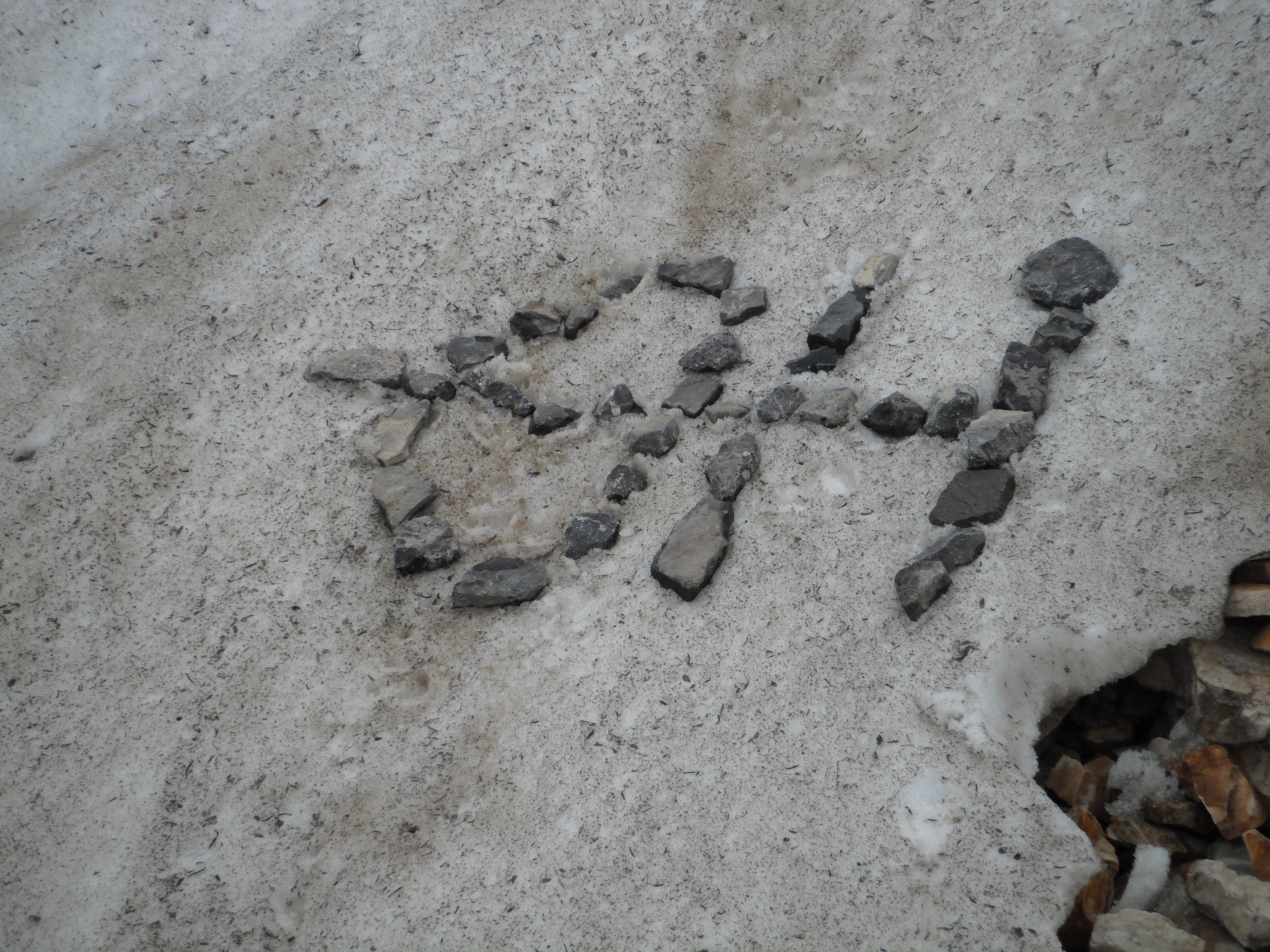
DSCF2918Would this be my Gravemarker?

My instincts raged—the same way they had when I’d went skydiving the summer before. Standing upon the lip of the plane door, looking out into the endless blue, a wordless voice had spoken in my ear, telling me it was a dreadfully bad idea to jump from a perfectly good plane.

The voice was louder now. ‘Sliding down a snowy mountainside in a lightning storm will not end well.’

I had no doubt the voice was right.

But some of my friend’s panic about our imminent lightning-death had spread to me now, despite my earlier sentiments that it would sooner be the decent that brought about our end. Besides that, he was already down past the point of return, and I was loathe to part with another friend in such dreadful circumstances.

And so I went.

It started slowly enough. Clutching my heavy wooden staff in one hand, I inched along. My empty right hand dug into the snow, and I slid bit by bit as the freezing water soaked into my pants.

But I was going faster now. Then faster still. I knew what was happening…my mind processed the math of it faster than it could articulate the threat. Faster and faster. I dug deeper into the ice, tearing my skin and cracking my nails as I slid along.

I could see the rocks below, growing larger with their approach. My friend had nearly reached them.

I was sliding far too fast to stop now. With a final, desperate effort, I clutched my staff in both hands, and slammed the point into the ice, hoping to create an anchor.

The staff broke, twisting my wrist and sending its two halves scattering down the mountain.

Everything after was too fast for conscious thought, yet I remember vividly the bleak sentiment which settled immediately into my conscience. ‘That was my only shot’.

The pull of the staff before it broke had set me spinning, and so I sped down the slope—20 feet, 30 feet, 35…the rocks were close now, and I fully understood what was coming.

Before I hit the rocks, I glimpsed my friend just below me. Colliding with him would surely send us both tumbling over the edge. As a matter of instinct, I jammed my left foot out to brace against the impact.

It hit hard.

Hard like nothing I’ve ever felt.

In the din of the tempest, I couldn’t hear the bones shatter.

Three of them, I later learned. My ankle utterly destroyed.

Despite the effort, I slammed into my friend. Then we were both rolling. Tumbling head over feet, like a child somersaulting down a peaceful summer hill.

End over end I fell, stone and sky blurring together—an all encircling tomb.

The voice was in my head again. ‘So, this is how it ends.’

There were other thoughts too—wordless but present.

A lonely dog.

A mourning family.

A touch of humility, a touch of pride…plenty of regret.

Then peace, and the thrill of adventure, bouncing and rolling down the ice-slick slopes of the mountainside for who knows how many seconds.

…Then curtains. Faster than thought, there was no doubt in my heart that the end was only a blink away. ‘One more rotation, maybe two.’ Then my skull would hit some rock and pour my brains into the torrent of water, down the stone, and finally into the lake—about two kilometers below.

The bruises I discovered later bespoke the force of my fall. But I felt none of that just then. One final thought came to me—‘It’s not a bad death.’

Then a hard thump, and I slid to a stop against a dark brown rock. I saw my friend roll over once more, then back flip over the ledge. ‘Dead,’ I had no doubt.

The ground against my hands was cold and wet as I pushed myself to my feet. I remember what I expected to see—a little black form, bouncing and tumbling down the slope so far from me now. Hopeless.

But there he was—about five feet below, springing to his feet with the frantic energy of a panicked child. “Brad, we’ve got to get out of this lightning!” he screamed. Then, turning, he fled off on his way back towards camp.

It seemed like the only logical choice, so I moved to follow.

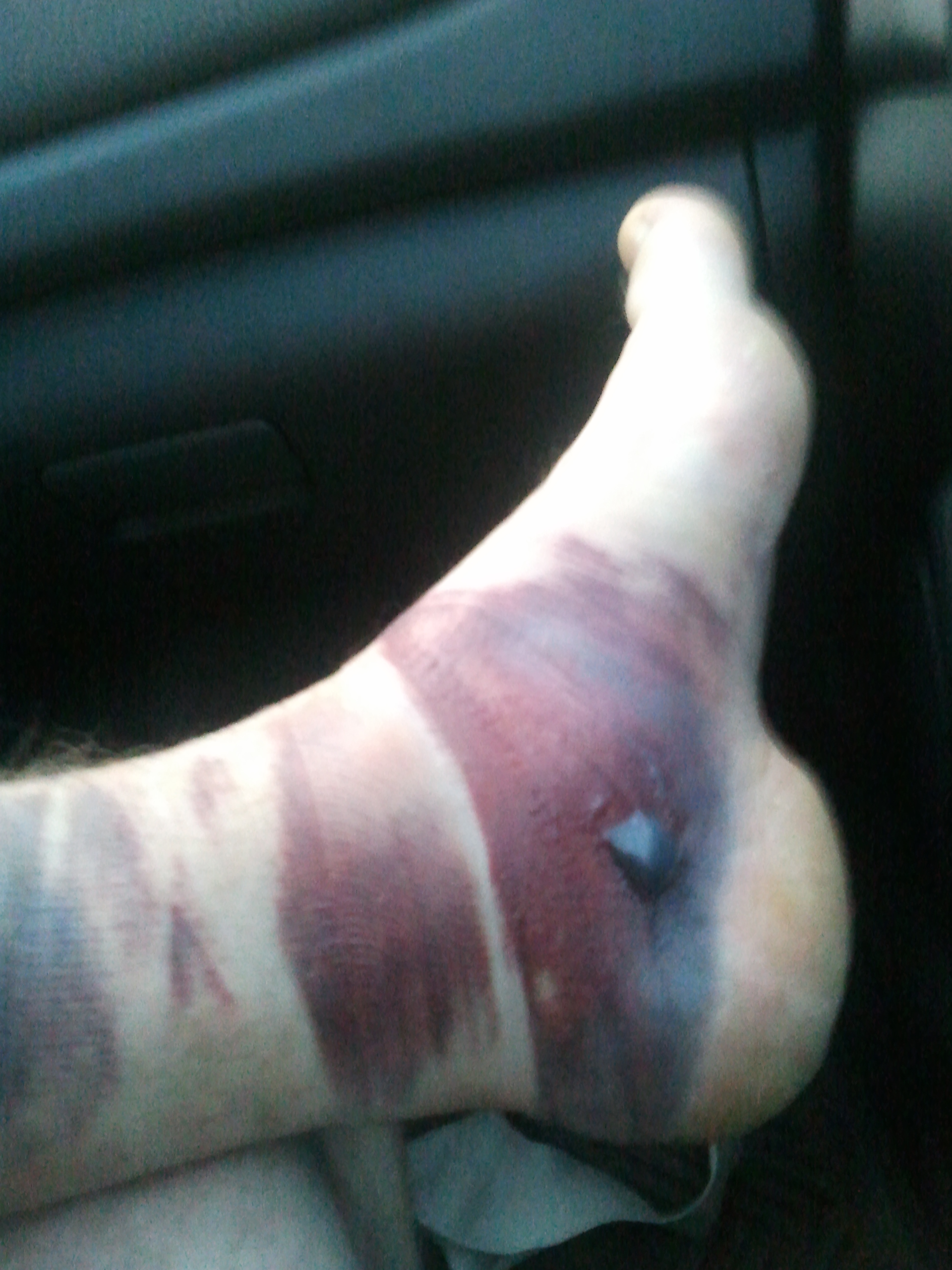
It wasn’t until I hit the ground again that I perceived the state of my foot. Then my head was a cacophony of alarm bells and sirens.

SAMSUNGA Dismal Scene.

I rolled onto my back, pulling my knee to my chest. Touching my ankle, I knew immediately it was far too bad to walk on.

My friend was a speck in the distance now. The storm continued. I was shaking from head to toe—from the cold, from the pain, from the adrenaline.

Freezing to death in the fetal position on a mountainside didn’t promise the same vainglorious ending I’d just missed out on, however.

And so I pushed on.

A few steps here, then I’d fall again. There was no self-conscious muting of my screams. With each step, each fall, I let them come. They were between the mountain and I now, and if I didn’t get back to camp fast, my secret would surely be safe.

I cursed my friend for leaving me.

I bemoaned my ambition for taking me here.

I lamented things I hadn’t done, and regretted things I had.

But just then, there was only one thing to be done.

One step. Then another.

A hundred steps…a thousand.

Much of the journey I spent seated—pulling myself downward with my one good leg. The other slid along by my side.

My pants were shredded now, and I chuckled like a madman at the spectacle I must have been. Bloody, exposed, and broken. A damn fool human who had taken it all too far.

It wasn’t an unfamiliar feeling, and yet something was entirely different about it. Moments ago, I had accepted entirely—deep down in my bones—the fact that I was about to die. Not only that, I’d even felt that it would have been a good death. Guts, glory…all that. But when the dust settled, I found myself broken, battered, and helpless as my ‘friend’ retreated down the mountainside, flatly rejecting my pleas and condemning me to my fate. It was a complete reversal of fortunes. From a blaze of glory to a sad, pathetic, wet little thing sliding down the rocky face of the mountain. I was humbled, and humiliated. And yet, the humiliation was worth it entirely, I knew, to be able to go on with life. It was worth it in spite of—nay, perhaps even because of the suffering it entailed.

This was the crucial lesson I took of those terrible slopes—that to suffer through and persevere when faced with no alternative is no cruel fate, but a blessing rather; a testament of the human spirit and the greatness we are capable of when no easier way is afforded to us. In adversity there is growth, and only through struggle can we achieve our highest potential.

I would go on, I knew, step after step, never again to toil in the mires of apathy or flippancy.

Step after step. Ice and rock passed into trees and valleys. The lake grew bigger. The storm pounded ever on.

But there was no doubt anymore. Not since I found out that movement was possible. I would make it back to camp. I’d get off this cursed mountain if only to strangle that damn snake of a ‘friend’ who’d left me up there to die.

I didn’t in the end.

I may have actually hugged him. It’s hard to say.

When I got to flat ground, I made my way along by grasping pine branches and dragging myself forward. Pain was nothing now. The damage was already done. Survival was all that remained.

I remember stumbling into camp. The first thing I saw was the friend we’d separated from part way up—safe and sound. This was a relief. The entire journey down, he’d been in my thoughts—and I’d often considered the dread I would feel if I’d made it back to camp to find him absent. That would inevitably have meant a trip back up the mountain. Damn the storm, damn my foot. If he was left up there, I’d have to go after him.

We would both have died.

‘Another good death.’

The next thing I saw was the friend who’d left me there. But the anger was gone now.

Before that day, I’d never faced the certainty of my own death. Grudges mattered less now.

In a day, I would be home with my dog. He wouldn’t need to be lonely. My family wouldn’t need to mourn. More than any of that, I’d learned something incredible about my own potential. To look into the eye of doom and persevere is an uplifting experience.

…and that was something I needed to hang onto.

I bound my ankle with a tensor bandage, and curled up in my flooded, freezing tent with a bottle of cheap white rum.

The next day meant a seven kilometer hike down the steep, wooded slopes back to the highway and my car.

But now, I had no doubt that I could handle it.

-Brad OH Inc.
‘Never Uncovers the Ultimate Truth of All Things’

Recently, the myriad authors of the ‘Edmonton Writer’s Group’ (Link) published our second anthology, ‘Between the Shelves’ (Link) . This book was sold in support of the Edmonton Public Library System (Link), and to that end has gone on to raise over $700 in donations!

We here at Brad OH Inc. want to thank everyone for their support. Today, we add our contribution, ‘Neve Uncovers the Ultimate Truth of All Things’ (Link), to our list of ‘Single Serving Stories’ (Link), meaning you can download it now for free over at Smashwords (Link).

Neve Uncovers the Ultimate Truth of All Things- Cover‘Never Uncovers the Ultimate Truth of All Things’- Smashwords

We certainly hope you enjoy this new format for ‘Neve Uncovers the Ultimate Truth of All Things’! But don’t forget, if you haven’t already bought your copy of ‘Between the Shelves’ (Link), you can do so now right here (Link)!

BetweenTheShelvesCover‘Between the Shelves’- Amazon

Remember, there are 10 other stories by local Edmonton authors in the anthology, so click here (Link) to grab your copy now. After all, every dollar earned goes towards the worthy cause of supporting the Edmonton Public Library System (Link)!

-Brad OH Inc.

The Corporate Human

cropped-cropped-blogbanner13.jpgA while back, your dear friends here at Brad OH Inc. posted an article called ‘The Constitution is America’s Bible’ (Link), which essentially explained the outdated relationship the United States has with their founding constitution.  While the thesis of that article remains entirely apt, one commentator decided to make a spectacle of himself in the comments section—raving against the progress towards political equality obtained recently by Corporations via the just ruling of ‘Citizens United’ (Link).

For a frame of reference, and to provide insight into just how limited and misled this poor individual (the lowest form of Human) is, we have included the reply here:

DCDear (Link):

“Perhaps we need to give Citizen’s United exactly and completely what they want – to be a person.

They would have to pay taxes like every other person, unlike many corporations who avoid paying taxes. CU could be held in custody for 48 hours without cause, like other citizens. They would be subject to the same laws – for example in states with the death penalty, CU could face the death penalty and the entity would be executed.
I could go on, but lunch is over…and I must save the world – be well.”

Well ‘DCDear’ (if that’s your real name)…ok. Let’s play your little game, shall we? First of all, it is incumbent upon me to point out how highly offensive your chosen vernacular is. ‘Give us what we want’? Liberty is not a gift to be doled out on a whim DC, and certainly not by the likes of you. Being human is the fundamental nature of a Corporation, and to divorce us of that in will or intention is a crime against humanity in its highest form. You should be ashamed of yourself!

Incidentally, if you are ashamed of yourself, some of our Corporate friends have a great line of drugs to remedy just that. Contact us privately for a link.

Now, onto your childish tirade—your first demand is that Corporations pay taxes, ‘just like every other person’. What a demand indeed! Did you know that every single component person in a Corporation pays taxes? That would be like you being taxed for every cell of your body! It’s outrageous to even consider. So clearly, Corporations already pay more taxes than are needed. To ask us to pay more is simply to punish us for our success.

When one of our posted articles gets more likes than the other, we don’t take some of the letters out of it. Instead, we try to produce more content just like it! It’s what the people want! So if more taxes are what you want, then maybe you should follow our example: Become a success, earn more money, and then pay as much as you’d like.

Next, you demand that Corporations (and not their component humans) should be subject to detention and/ or death. Death DC? Really? That seems a tad macabre.

It would behoove you to ask yourself, ‘Do I really want this’? Well, do you DC? Do you want to do without your lauded latte in the morning just because some whales off the coast of who-knows-where died in a perfectly orchestrated oil-spill? No, you don’t.

How about technology? Do you like the keyboard you used to create your hatful vitriol? Well, maybe the Corporations that provide you such blessings should be ‘killed’ just because some kids in the third world are being given an opportunity to work. Honestly DC, it’s the THIRD world. That’s the WORST of all the worlds anyway!

It seems to me that if we allowed our best and brightest humans (Corporations to the last) to be subjected to such primitive law enforcement, it would be you who suffers the most DC. We can only imagine the rant you would come up with when your cell-phone was relegated to a useless mound of plastic because the Power Corporation got in trouble for some measly little fire. And imagine it we would have to, since you would be hard pressed to find a piece of carbon to scratch the tirade on a stone after your computer went out.

So much for that, then.

Ultimately, there’s a crucial thing you have to realize DC. The fact is that yes, Corporations are people whether you like it or not. But they aren’t only people…they’re the best people. By definition, a human can’t be better than a Corporation, and a Corporation can certainly not be less than a single person. We are the builders, the creators, the innovators and the inspirers. More importantly, we are the decision makers. So the next time you feel like flying off the handle over some minor global injustice or trite environmental fiasco, maybe instead of rallying against your betters like an ungrateful putz, you should just pack your things (any not made by a Corporation that is…good luck with that) and move off into some non-Corporate zoned section of nothing to see how well you fare (Hint: Not very well).

Face it DC, without us, the rest of you are nothing. Bald monkeys clamoring about mindlessly—dreaming nothing, achieving nothing. We are Humanity in its fullest form—the culmination of eons of cooperation and growth, focused with laser-like precision upon our own needs. And fear not, for when we invariably meet our needs, rest assured you can count on some trickle of our grace running down to yourselves (Don’t believe in ‘trickle-down’? Go stand under a waterfall. It’s hard to argue with a waterfall, DC). It’s far more than you could ever achieve alone, and you should undoubtedly be thankful for it.

So give us the freedoms we ask, and relinquish your hopes of accountability and equality. There is no equality between Gods and men, nor between the Corporate Human and the mere ‘human’. The more you seek to restrain us, the greater will be our victory—and all your efforts shall come to naught in the glory of our dominance.

Yes DC, we know we’ve been hard on you here, but please understand that we are only trying to help. Humanity needs its Corporate overlords far more than it knows, and if we are unable to pursue our humble ambitions of unlimited wealth and social dominance, then so too will you fail in all your endeavors.

Don’t believe us? We understand, it’s bigger than you could ever process. But next time you consider rebelling against your forbearers, we would advise you to close your laptop, and just take a few deep breaths. While you do that, go ahead and stare into the little glowing apple on the front of your computer, and recall that it was your kind, not ours, that partook of the fruit. So if knowledge is your misery, it is yours alone to wallow in. Frankly, you’d be better off without it. So stop questioning your lot, and be thankful for what you have—as it is to the last morsel the windfall of our own grand design.

-Brad OH Inc.

The Little Book of Bourbon

Under the Green Desk Lamp…

Green Desklamp

The stink of sweat, and the wet hiss of street cars. Saxophones screech from dark alcoves like debutantes that took a wrong turn.

Pedestrians rule the streets, beaten up cars working around them like Indians in a barnyard. New Orleans is a city alive in the truest sense—throbbing with its own potential, adorned in its own inequity like Joseph’s spastic coat.

Here, a man can drink on the streets—paved with cobblestone and flanked by sweaty brick buildings 300 years old.

Citizens crazed—with heat, booze, or lust I cannot tell—approach and talk cordially amongst themselves, and this stranger as well.

As the absinthe flows, the thick, cloying air lightens in tandem with the mood, and the night is alive with a thousand potential stories both new, and as old as the dry bones used by the Voodoo Mama just around the corner, ready to divine fortunes for a false smile and a real fee.

Some men look at a city and decide upon its potential early. They go to bed with the falling sun, counting the hours until they can rise to cut deals and exploit the less proactive denizens of this shared hell they inhabit.

Others rise late and party till dawn, seeing the promise of the city instead scrawled upon the cobblestone alleys and dark crevices of the establishments reborn at dusk; eager to meet and engage with the searing enthusiasm burning in a city alight in its own decadence.

For them there is no hell—and heaven is just a street corner away.

I struggle daily with an overwhelming compulsion to defy the norm, to taste and touch as much of life as time will allow while balancing an ‘acceptable’ life. Others fight for normalcy in a world fraught with turmoil. The most we can take from this is the weight of experience on the psyche, and the importance of mad rushes of varied tastes and flourishes of culture. Old cities like this are a natural extension of the social impulse…a thing lost in more modern complexes.

The Natchez steamboat screeches calliope tunes at me as I pass misshapen statues and covens of filthy pigeons. The $300 I came with has been reduced to a dirty pack of crumpled ones.

My knuckles are bloody—seafood or scuffles, I cannot be certain.

I stop to listen to a soapbox evangelist, the frenzy of vacation scaring off my familiar apathy. But his words are unfamiliar, unexpected. He says that religion is an affront to the spirit. God is an ideal. Original sin—as it is described, is the animal nature in us all, whereas God is the perfect goal we are meant to aspire towards.

True or not—this is not the point; the goal is soul, and perfection is a high watermark to all the savage bastards on this earth.

There is a great sense of ownership in this city. Men speak of renovations like child-rearing, and date each building with the care of tracking genealogy.

The ancient weight of history rests upon the streets like a shroud, cloaking the denizens in its comforting embrace, and a sense of community identity permeates all.

It was around 4:00pm, in a small jazz club off Bourbon, when I realized that I’d never leave this town alive if I couldn’t acquire a strengthened taste for straight liquor and twisted people. But there is something horribly sleazy about drinking fine Bourbon from kitschy party cups. Like hiding cocaine in an animal shaped children’s party balloon.

There can be no doubt that I am yet to find true equilibrium. The battle between the boisterous extrovert and the mumbling, cantankerous recluse wages on daily.

Also, I’m a big fan of absinthe.

It’s a funny line to walk—being tugged between the joys and regrets so inherent to a life well lived.

But if a man can persist, and persevere beyond the quagmires he so ceaselessly chooses to embroil himself in, soon enough the straight road may reveal itself.

And just like that, things were making sense again. The night must get dark before the stars appear again to light the way. And if they need still further darkness… it’s always waiting on Bourbon St. …just a breakdown away!

The Little Book of BourbonI’ve learned I lean towards an older crowd than my own age merits, more towards the 50+ blues crowd, willing to truly talk without any of the flirtatious pretension. But this knowledge does little to ease my mind.

A lovely lady lives behind the bar at ‘The Blue Note’ off Bourbon and St. Louis, and feeds me tastes of each drink she makes, providing shots for words as she purrs siren-like about her life and times in NOLA.

She was good, but he was better. She had the kind of angel voice and deadly looks that could with a word command a man into the sickest sort of depravities even he would never have imagined himself capable of. But he had the sort of prodigious talent, and plucked those strings with rhythm and precision sufficient to lift that same man to higher planes of self.

I’ve got to get out of this place. A city of saints and sinners in the truest sense—both more than willing to send a man off his rails and leave him begging for more while reeling with sickness and exhaustion… just as long as you tip.

But not just the tip. They’ll take it all. Your money, your ideals, your direction. Everything that separates a man from these goddamn flea-bitten apes you see on discovery channel as you drink your box wine and eat your cold pizza.

I’ll be dragged down for sure. Deeper than the determined bodies clawing their way up; jealous of those laying in the moldy crypts—spiting sea-levels and buoyancy for the sweeter rumours of voodoo and ancient evils.

No—they’re for another time. I’ll be down in the bayous, a bottle of Jameson clutched in my hand as the gators feast on my bones.

Elsewhere, a woman will stand alone, singing ‘Bohemian Rhapsody’ acapella as a man elsewhere strums out Beethoven on his guitar.

What am I rambling about?

I’ve got to get out of this place before I’m just a stain on its streets.

I’ve heard it said—both recently and before, that all the great things mankind has done have been the result of the powerful—corporations, empires, tyrants—these are the builders, and this I cannot deny.

But the stage is nothing without its actors, and the great stories and moments have always arisen from the fearless few willing to rise up and rage against the rat bastards with everything that makes us human and keeps us animal.

In the face of the depravity and madness I’ve faced, I still cast my lot proudly not with the world builders, but with the rabble and ravers of humanity.

I just need a woman with an eye for photography or an ear for music—either one will do.

I realized rather early on, but feel it all the more pressingly now, that this city must cease to fear the magic of the past and learn to harness that of the present.

A Guest Article by your Friend and Ours,

-Duke O’Brady

The Second Most Important Step to Improving the United States

purelyspeculationHere at Brad OH Inc., we have on several occasions (Link) covered an issue which is indisputably the most important step to improving the United States. That is the complete overturning of Citizens United (Link). This change stands at the foremost of all sorely needed improvements, solely for the reason that this ruling acts as the lynchpin to all the other changes the country—and moreover the world—so dearly needs. So long as laws are decided by the vote of Corporate dollars rather than the will of the citizenry, all other problems shall remain immutably entrenched in the quagmires of Corporate bureaucracy.

As this has been covered in depth elsewhere, however, today we will be focussing on what seems to be the second most important step to repairing the dismal affair that is the United States of America. Specifically, we’re talking about the significant reduction and reallocation of military expenditures. As discussed in our article ‘The Global Scale’ (Link), the current approach to foreign policy taken by the American government—the driving force here being the Military Industrial Complex (Link)—acts in actuality as the source of many of their current greatest woes.

As more and more effort is exerted to bring ‘freedom’ to the rest of the world, so grow the enemies of America—understandably bitter about the ‘foreign aid’ that comes in the form of drone strikes, trade embargoes, and unnumbered civilian casualties. This creates a dangerous cycle, in which the American populace—goaded by the bought-and-paid-for media—feels more terrified by the day, and are comforted only by the knowledge that their dear country is capable at any point of destroying the world in the name of saving it.

“But if you strip military spending, you’ll expose us to terrorists,” cry the feint-hearted American media-stooges. Well, let’s consider the facts for a moment—if that doesn’t seem too tall an order.

Based on presently reported statistics (Source), the United States spends approximately $577 Billion on its military each year. This is significantly more than the TOTAL of the next 10 highest spending countries combined.

I’ll allow a second for that to sink in.

With spending like this, America is rather like the kid who shows up to a water pistol fight armed with a firetruck. It’s Rambo intruding on a friendly game of cops and robbers—PTSD flashbacks and all. Simply put: It’s madness.

Meanwhile, infrastructure is crumbling (Source), the homeless population is ballooning (Source), veterans are left without care (Source), and funding for public education is being gutted (Source).

Looking at the numbers above, let’s consider the relationships here with a quick bit of theorizing. If—and this is a naivety to be sure—the US were to slash their military expenditures in half, they would be left with a yearly military budget of around $288.5 Billion. Now, while only half of what is deemed currently necessary, this would still leave the US with a military budget higher than the combined budgets of the next 3 highest spenders. That doesn’t seem like an especially dangerous situation to be in, especially considering that half of the top ten spenders are allies of America.

Further to this consideration, we’ve seen through manifold examples in the past, and as an ongoing theme of the present (Link), that military escalation is a losing game. Investment in war tends primarily to breed more war—with the only safety-net being found in mutual destruction.

If however, this budget change was made, America would remain far and away the greatest military power the world has ever known, and yet would have a sudden windfall of $288.5 Billion to spend on social services like Veteran Affairs, Welfare Programs, Education, Healthcare, Infrastructure, (real) Foreign Aid, Home Care Services, Senior Care, and so much more.

With such a change, America could begin to be the utopian saviour it so desperately wants to be, rather than the school-yard bully who beats on people until they praise him. By setting an example for the world of the sort of peaceful and genuine neighbour they could be, they would likely reduce their enemies greatly, improve many foreign relationships, and, if funds were allocated appropriately, perhaps solve global terrorism at its root, rather than merely spreading the fire.

The end-goal here should not be hard to see—by addressing this ridiculous budgeting fiasco, the US could be the beacon of hope it has always claimed to be, rather than just another blind threat uttered in the darkness of irrational fear.

-Brad OH Inc.