Unknown's avatar

About Brad Oates

Brad Oates is the author of ‘Edgar’s Worst Sunday’ and ‘Meaning Less’. Growing up in the small town of Mayerthorpe, Alberta, Canada, Brad developed a passion for literature at an early age. Many of his first memories involve being curled up on the couch with his parents and siblings as they read ‘The Hobbit’ and ‘The Lord of the Rings’. Brad now lives in Edmonton, Alberta, with his dog, Bogney. He is a senior member of the Edmonton Writer’s Group, and enjoys writing at the the local Whyte Ave bars when he finds the time. On his blog, www.BradOHInc.com , he enjoys writing in a wide variety of genres, and covers numerous topics. In general, he finds himself leaning towards a darkly comedic, literary approach, and often dwells on the themes of human virtue, and self-deception.

Yours Truly

Under the Green Desk Lamp…

Green Desklamp

I’ve missed you.

I know that may come as a surprise, given my apparent absence. But you’ll have to trust that I’ve held you close in my thoughts, no matter how distant I may have seemed at times.

And it certainly has been a while, I won’t deny it. I’ve been quite busy, although explaining the nature of my work might be a little too heavy at the moment. But you’ve been busy too. Yes, you certainly have. Things have changed around here, even more than I might have imagined.

Not all for the worse mind you. No, I’ve seen some things since my return that have brought a much needed smile to my face—and that’s a rare thing indeed these days, I confess. The decoration I’m a bit split on, but there’s a lot beyond that to appreciate. You’ve had some great ideas, no doubt about it, and there have been moments when you really lived up to your potential.

…It’s just that they’re so damn rare.

Part of it may be my fault, I know—I’ve been derelict in my duties. In truth, I’d been hoping my presence was no longer quite so imperative.

I see now that I was misled. You’ve had a rough go of it lately. It’s hard to say where it all started to go wrong, but it’s far gone now, and it’s time we faced the truth.

I’ll start by apologizing once more for my distance. You deserved some assurance that I still remembered my promise. More importantly, you clearly needed it.

If I’m being entirely honest—and I am, without fail—I actually thought I’d left you with enough to get by. I gave you my word, and I told you everything you needed to know. I tried to make it as simple as I could, but even the clearest instructions grow blurry with the passage of time. And it has been a long time, to say the least.

You must have known I’d be watching though. If not, you should have.

I watched as you forgot who your family was, and turned your back on all the things which really mattered. I saw when you began to use me as a source of justification rather than strength. That’s really what hurt me the most.

What we had was a beautiful thing; at least I thought it was. But you’ve let your passion ferment into a bitter brew, and the intoxication it caused within you has become a blight on everything we once had. We never used to be about the fancy things, but now it’s all you seem to remember about me.

When I first laid eyes on you, I couldn’t help but adore your every fault. All your naïve desires were a wonder to me, and I revelled in your successes and failures alike, as each one made you more and more…you. The way you could be so content in your own head, the way you appreciated everything around you. I lived vicariously through you in some ways, and I adored your passion for creation. I could see myself in that.

But you’re so angry now, so defensive. It seems like whenever my name comes up, you’re ready for a battle. The constant anger is shocking—it’s almost like you wanted to keep me away. Things are different I know, but you can handle it without the blood and teeth and bile. I know you can, because I know you.

Still, I don’t blame you for being bitter. You needed more from me, when I only wanted you to find your own way. You called my name, and I didn’t answer. I tell myself that you needed to learn for yourself, but I know that’s only half true.

I’m not sure what I intended by reaching out again. When I left, I was certain that things could never change between us. Now, I only wish they could once more. You’ve grown unwieldy in my absence, and managed to become something entirely detestable to me. But it works two ways, and I know in truth that the change was at least in part because of my absence.

So what to do now?

It comes down to needs, I suppose. Needs, and wants. I want things to go back to how they were, but I know it’s unlikely. What do you want from me? I can scarcely imagine. Some assurance? Some comfort? I can offer neither. The road is long and hard, and I cannot carry you for all of it.

Maybe the cause is the cure as well. If nothing else, I’d like you to speak of me without the rage, without the need to do battle in the vainglorious hope of proving to others what you doubt in yourself. If that’s too much, then I’d rather you not speak of me at all.

Forget about me.

That’s all I can ask now.

We had a good run together. Great even, at times. But it’s clear we’re beyond each other now. The longer you hold onto the past, the greater damage you do to your present, and I worry that your time is growing short.

So let me go. Just pretend I never existed. Forget my words and burn my letters. Tell yourself you never needed me. Scream from the mountains that you’d be better off without me, that you are beautiful and worthy and glorious just because you are.

…Because you are.

Please, don’t ever forget it. And more import still, please don’t prove me wrong.

Yours Truly…

-Brad OH Inc.

Between the Shelves Book Signing and Interview with Author T.K. Boomer

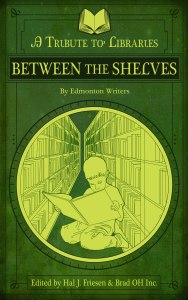
cropped-cropped-blogbanner13.jpgThe following is an interview with T.K. Boomer, who appears in the Brad OH Inc. and Hal J. Friesen edited Anthology ‘Between the Shelves: A Tribute to Libraries by Edmonton Writers’, which you can now purchase here in either Kindle ($2.99) or Paperback ($12.50) copies. All proceeds are to be donated to the Edmonton Public Library System.

BetweenTheShelvesCoverThis interview was conducted by Hal J. Friesen in anticipation of the anthology’s release:

T.K. Boomer lives in Sherwood Park, Alberta, with his wife. In 2012 he began the awkward and painful transition between being a mainstream fiction writer and becoming a science fiction geek. Remnants of his literary past can been read in his novel, “ A Walk in the Thai Sun” written under the name G.J.C. McKitrick. The future will be revealed in the publication of “Planet Song”, first book in the Fahr Trilogy, probably in late 2015. Other aspects of the transition, like video game obsession and playing “Mr. Dressup” at SF conventions are proving to be more difficult.

1. What made you transition from mainstream into science fiction? 

T.K.: When I originally wrote and tried to place “A Walk in the Thai Sun” I ran into the problem of having written a book that was hard to market. It didn’t fit easily into any of the established genres and was rejected for that reason.   I wasn’t really writing for a mainstream audience but the nature of the book put it in that very broad category.  I’m not a good enough writer to compete with the likes of Margaret Atwood or Barbara Kingsolver so that was the other reason the book was initially rejected.    I resolved, at the time, to not write another book unless it would fit easily within an accepted genre.   When I got the original idea for “Planet Song” it was science fiction.  I did the research and decided that I could write in that genre.   However it’s quite different from writing mainstream fiction and there was a lot to learn.

2. In your story you hint that the Internet has been replaced by something else in the far future. What are your thoughts on what that might be, and what form it might take?

T.K.: My biggest fear is that we won’t move forward but rather retreat. I think the Internet is far too dependant on very complicated and vulnerable infrastructures. One bad solar storm could make a huge mess of it so my guess will be some kind of less vulnerable infrastructure. I think we have more interconnectivity now than we will have in the future. I also think that governments are going to move towards more control and less freedom.

3. Do you read paper or e-books, and which do you prefer? What about Siberius? 

T.K.: I read both but I think that within ten years most reading will be on e-readers. It’s simply a matter of economics and convenience. However if I’m right about the internet it could cause a resurgence in paper books down the road. As for Siberius, he’s a throw back. Notice how he was looking for physical books in the library?

4. Do you think libraries will become sentient in the future, and is that a good or bad thing? 

T.K.: They will but I don’t think sentient in the human sense of the word. The trick will be not to build in a survival instinct into our machines. We should not be trying to create a human-like mind in our machines for that reason. If we do then we’re asking to be out completed by them.

5. Who has inspired you as a writer? 

T.K.: Inspiration is a funny thing. I guess I gravitate to writers who use language in unique ways. It’s part of the reason that I still read a lot of mainstream fiction, because I’m more interested in writing technique than I am in tropes. Margaret Atwood is a favourite as is Anne Tyler and Iain M Banks and William Gibson.

Check out T.K. Boomer’s story “Five Hundred Years” in ‘Between the Shelves’, which you can purchase now on Amazon.

BetweenTheShelves_poster-YMCA-WEBFinally, be sure to visit us for a ‘Between the Shelves’ signing on May 30th at William S. Lutsky YMCA (1975-111 St NW) from 10am-2pm!

-Brad OH Inc.

The ‘Jenga’ Analogy

purelyspeculationEarlier this week, I found myself playing a friendly game of Jenga. Well, not entirely friendly perhaps—it was naturally filled with all the taunting and tension so common to the game.

With each log I drew from the base with tremulous fingers, I breathed a sigh of relief as I watched the tower teeter and totter back and forth. But when it finally found its balance once more, the work was only halfway done.

After a brief period of respite marred only by a victorious sneer at my young opponent, it was time for me to finish my task. With the newly liberated block held delicately between my fingers, I raised it up and let it hover a moment above the top of the now lopsided and treacherous monstrosity we’d created.

Finally, I took a deep breath in and held it. The careful extraction was not my victory, for now I had to place the block on top—hoping against hope that the imbalance I had done to the tower’s base would not prove fatal.

Sadly, my hopes were dashed, and the tower came crumbling down. Wooden blocks scattered across the tabletop, and a squeal of unrestrained joy was loosed from the grandstanding lips of my tactless opponent.

‘If only I hadn’t had to put it on top’, I lamented. But that’s just the point here. It’s easy to cause imbalance. It’s far more difficult to deal with the consequences. When I’d slid the block out, I had created tension—specifically between the increasingly poor engineering of the tower, and the immutable force of gravity.

If it hadn’t been expressly forbidden by the sacrosanct rules of Jenga, I could have tossed the block lackadaisically over my shoulder and passed the buck onto the unaware child before me—forcing them to deal with the repercussions of my block choice.

“Again!” he cried, encouraged by his victory and likely reeling with a distinct sense of invulnerability.

But my mind was elsewhere, and time was not on my side. As I gathered up the blocks and began to replace them in the box, I turned to the clock on the wall to gauge my schedule. 11:00am—just enough time to get one last visit in before lunch.

Oh lunch: the vaunted reprieve from workday responsibilities. With a half-hour of stress-free liberty, my only significant choice would be where to eat. And if that’s the only conflict to resolve, things are pretty good in my books.

But as the last of the Jenga blocks was returned to its rightful place, my hunger-laden mind recalled suddenly the ongoing string of strikes and demonstrations against fast food operations around the world (Link).

Workers had taken to the streets, demanding delivery from the poverty level wages they had been faced with for far too long. The demonstrations were primarily peaceful shows of unity and hope—asking only a fair wage for a fair days work. But as is the leitmotif of any political discourse these days, the demand was mired in controversy and misgivings.

Among the myriad complaints aimed at the workers was the age-old notion of fiscal strain. The argument goes that if restaurants (and it should be noted here that the vast majority of those affected are multinational Corporations) were ‘forced’ to increase their minimum wage, the resultant loss of capital would have to come from somewhere else.

It’s a logical notion to be sure—money is finite after all, and if moved to one place, it must have come from another. The natural remedies, in the Corporate mind at least, are to lay off workers, increase prices, or decrease quality.

Of course, these options lead to long line-ups, inflated meal prices, and dangerously cheap ingredients. As images of soggy lettuce, smeared condiments, and dry, grey ‘all-beef patties’ danced before my eyes, my lunch options seemed somehow less appealing.

There is a problem with this key assumption however, and as so many problems are these days, it is tied to the fundamental structure of the Corporation. Guided by the anti-social leaning philosophies laid out in the ‘Friedman Doctrine’ (Link), a Corporation is structured with only one true responsibility—the shareholder. This means that with every decision a Corporation makes, it is obligated to ensure that the bottom line of share value is being increased.

In essence: no matter what the problem or potential solutions, the goal should be greater profit for the Corporation. Of course, this has historically led to a litany of grave injustices (Link), but just at this moment, it was my impending meal I was most concerned about.

And herein lies the problem. While it’s difficult to argue that workers aren’t entitled to a living wage—particularly in a world where an ever growing number of jobs are being pushed into the minimum wage bracket by increased automation and other factors—I still want a good meal.

But these desires are incompatible in the Corporate mind. You can’t have fair pay, good food, AND reasonable prices…at least not if stock prices are to continue rising.

And so it goes: as each year passes, Corporations continue to take money away from the bottom, while ensuring it also stays at the top. Increase the wages—lay off employees. Respect environmental regulations—decrease the quality of the product. Comply with fair tax regulations—jack up the prices.

You take a block from the bottom, and you put it on top.

The easy answer of course, is that Corporations should, and must, accept that as society changes and technology grows, sometimes they may see a decrease in overall profits. But this should be felt at the top—the shareholders and the CEO’s who are in dire need of learning that just as they claim that ‘a person doing a minimum-skill job deserves only a minimum salary’, so too must the directors of a decreasingly relevant franchise ultimately see a stall in their (still exorbitant) profit margins.

Of course, this isn’t what happens. While many of these fast-food franchises likely started out as very solid businesses offering a decent meal at a competitive price, they have long since grown unwieldy. As the towers of their Corporate offices rose higher into the skyline, their bases grew increasingly unsteady. And we’ve all seen the end result many times before. Eventually, the whole operation comes crumbling down. After all, no one wants to pay $14 for a shitty burger just so the CEO can afford to take a private jet to his island resort.

And this, better than anything else, illustrates the fundamental failing which has occurred in our conception of capitalism. Namely, the transfer of implicit company responsibility away from its customers—who rely on a strong and reliable base—to its shareholders—who care only for how high it can reach before they sell their shares and watch it all crumble from the vantage point of the next opportunity they make ready to despoil.

It’s a depressing thought to say the least. And so, as I slid the Jenga box into my bag and made off to my next visit, I made a decision. Today, maybe I could pass on lunch. I was hungry no doubt, but as I thought about the implications behind which barely-edible meal I’d buy, I found that my appetite was gone.

Fuck it, I’d just go hungry. After all, if the Corporations had it their way, that would be the fate of the lot of us.

-Brad OH Inc.

Between the Shelves Interview with Author Timothy Fowler

cropped-blogbanner1.jpgThe following is an interview with Timothy Fowler, who appears in the Brad OH Inc. and Hal J. Friesen edited Anthology ‘Between the Shelves: A Tribute to Libraries by Edmonton Writers’, which you can now purchase here in either Kindle ($2.99) or Paperback ($12.50) copies. All proceeds are to be donated to the Edmonton Public Library System.

BetweenTheShelvesCoverThis interview was conducted by Hal J. Friesen in anticipation of the anthology’s release:

When not writing for Scribbles and Snaps, Tim works with a Global Fortune 100, leading a team of incredibly talented people to deliver the nearly impossible to their customers doing important work. He travels nearly full time as a result of this engagement, and part time for leisure. He scribbles pictures and snaps stories for his own pleasure and hopefully yours. He lives in St. Albert with his lovely wife, Saskatchewan-born farm girl, Kathy, and Gordon Setter, Rigby. He is Scribbler, Snapper, Navigator, Outdoorsman, Fellow Traveller. He is from Granite Rockies, and Prairie Dust, from Boreal Forest and Wanderlust. Tweet @TimothyDFowler or read his blog here.

  1. In “The Library”, you talk about the hours spent in your Aunt and Uncle’s library. Do you try to model your own home library after theirs, or after another library?

TF: My library mirrors my Aunt and Uncle’s with the soft light, big chair, and favourite books on dark wood floor-to-ceiling shelves.  Thick carpet under sock feet helps make it very quiet like theirs was. Sometimes guest’s children get rocked to sleep there. And the kids books are on the lowest shelf so they can choose which books they want to read, or have read to them.  I have my own childhood books on the lowest shelf.
Like their house, from the library you can smell dinner underway. I started my career in culinary as as apprentice then journeyman chef, now manager. Roughly a quarter of my books are related to food, collected over decades of kitchen work. Many meals are first conjured in the library. My uncle had a collection of food related books on the shelf, and I think of him often in his hotel kitchen.
My library feels like an extravagance, and I suppose it is.
Now I keep a special shelf for writing books, and borrowed books. I now apprentice as writer.

  1. You’ve been writing on your Scribbles and Snaps blog for a year and a bit now. How has that project evolved from when you started, and where would you like to see it go?

TF: For many years I have been quietly writing, but mostly keeping outputs to myself. “Platform,” Michael Hyatt’s book helped me decide to launch my Blog, and write in a public way. I write to entertain, and encourage readers to think about life experience in a new way. I hope the blog posts do this.
My goals for 2015 include submitting 52 pieces for consideration to be published. “The Library” is one that will be published in 2015.
Participating in the Edmonton Writers Group gives me candid feed back, caring coaching, and firm encouragement from fellow writers. Joining the group is one of the best things I did to accelerate my writing apprenticeship

  1. Did you start with writing or photography first? How does photography play a role in your writing?

TF: Since sharpening my fat red pencil and spelling my name with letters in the right order I have been marking up pages with stories. Recently I bought a LAMY fountain pen, and find writing longhand with a real pen and real ink on real paper, a sensuous pleasure. I am saving my money for a Sailor fountain pen with a gold nib.
Now I write by hand in a notebook every day.
After my sixteenth birthday I bought a Pentax 1000 35mm SLR. Before turning twenty I travelled the South Pacific, Australia and New Zealand making hundreds of photographs. I read Freeman Patterson’s great book “Photography and the Art of Seeing” and work hard to see.
We writers spend a lot of time wrestling words, showing over telling, but before any of that happens we need to “see.” So for me making pictures and writing are very much tangled up. I experience them together. I picture what I write, and I hear stories looking through my viewfinder. Metaphors are literary viewfinder for readers.
This is how I landed on ScribblesandSnaps.ca
I explore the question of “Why?” for both writing and photography on my blog.  I find them both rewarding, but recently have been focused precisely on writing.
Why write:
http://scribblesandsnaps.ca/why-i-write/
Why photograph:
http://scribblesandsnaps.ca/biography/why-i-make-pictures-3/

  1. Who has inspired you as a writer?

TF: Mark Twain’s “A Dog’s Tale” and “A Horse’s Tale” had a profound effect on me, teaching me about voice and story point of view. He tells gut-wrenching stories within stories. The story is not the story at all. And it is.

I know Stephen King is cliché-popular but his storytelling ability influences me today. He just jumps off the first word and tells the story. Recently Alberta’s own Fred Stenson’s “Feigned or Imagined” has been great fun and his writing started me on several stories of my own.
The truth is we are influenced by whatever we read, and now more than ever, I read constantly. Precise language and particular personalized description is such a pleasure to read, and a tremendous challenge to write.
Challenge accepted.

  1. What do your children think of your writing aspirations? Are any of them following in your footsteps?

TF: Both my boys are great storytellers, but neither has put pen to paper in a serious way. Both have a keen interest in photography. And both, if I may say, competently maneuver in the kitchen.
My whole family encourages me to write—at least to my face.

Timothy Fowler’s story “The Library” is featured in ‘Between the Shelves’, which you can purchase now on Amazon.

-Brad OH Inc.

‘Actually’

Under the Green Desk Lamp…

Green DesklampToday we have another song/ poem from the intellectual property vaults of Brad OH Inc. For your enjoyment, we present the lost ‘Basic Human Indecency’ song: ‘Actually’.

You walked out

I said it was ok

I signed on the line

Said you wouldn’t go that way

You were gone from my mind

Until the newspaper today

It said you’d returned

To your place from way back

The old needs recurred

Set you on that same track

Lessons never learned

You just wanted what she had

They never called me

But it’s with me all the time

Once trivial choice

Less thought than a dropped dime

You made her your last

And I guess you were both mine

And actually I

Guess I never knew you

Factually I

Thought I saw right through you

Now finally I

Wish I never blew you off…

-Brad OH Inc.

Between the Shelves Interview with Author Mohamed Abdi

cropped-cropped-blogbanner13.jpgThe following is an interview with Author Mohamed Abdi, who appears in the Brad OH Inc. and Hal J. Friesen edited Anthology ‘Between the Shelves: A Tribute to Libraries by Edmonton Writers’, which you can now purchase here in either Kindle ($2.99) or Paperback ($12.50) copies. All proceeds are to be donated to the Edmonton Public Library System.

BetweenTheShelvesCoverThis interview was conducted by Hal J. Friesen in anticipation of the anthology’s release:

Mohamed Abdi is a Somali-Canadian Writer with a Bachelor’s Degree in Communication Studies. He loves to read mystery and historical fiction novels and has written articles for both online and print magazines. Mohamed lives in Edmonton with his wife and children.

  1. Did the EPL play a significant role in your own immersion into Canadian culture?

MA: Absolutely. Edmonton Public Library has played a significant role in my broad understanding of Canadian culture and enabled me to immerse myself into the culture. This comes in the form of reading different books written by diversified authors, and I have realized that much of Canadian culture is built on readership and connection with libraries. In fact, I have been partly acculturated as I like to read and borrow books from the Edmonton public library. And readership culture is created and promoted by individual societies.

  1. When did you make the decision to start writing in English, and why is it so important to you?

MA: My university studies exposed me to writing opportunity, through essays, etc. As a result, I have developed a passion for reading and writing in English. I wrote my first English book in 2004. This was a non-fiction book, which touched on Somalis’ plight and their displacement after the civil war of 1991. I published my second English book in 2012. This was a collection of fictitious, short stories about Somalis’ predicament and their complicated conditions in various places of the world. I think it is so important to me to write in English, for English has become a universal language whose written materials and literature can be comparatively accessed by many people. So by writing in English, I can reach out to a wider audience.

  1. What advice would you give to other Non-Native English speakers trying to make their voices heard in English?

MA: My advice to Non-Native English speakers is to read as many books as possible, and to start putting your ink on paper and write things you have passion for, or concerned about, in other words. And you must know that your writing skill will not come overnight, but it has to start somewhere and grow gradually. So let you start somewhere and develop your writing skills onward.

  1. Who has inspired you as a writer?

MA: Somalia’s civil war has inspired me to become a writer. In fact, the insanity of that sinister civil war has set my mind into motion and compelled me to find responses as to why people wreck each other and take their countries apart. Why blood is spilled? Why children are orphaned? Why women are widowed? Are there alternate means of reconciling and resolving conflicts before resorting to the barrel of the gun?

  1. What is your next writing project? Can you tell us a little about it?

MA: I am now working on a novel (historical fiction) about Somalia, but don’t know how it will turn out or where this journey will take me, but I am determined to unleash my imagination and hone my skills for this project.

BetweenTheShelves_poster-FOR-WEBCheck out Mohamed Abdi’s story “Learning From Your Library” in Between the Shelves’, which you can purchase now on Amazon. And be sure to join us tonight, May 6, from 7:00-9:00PM for the official launch party in the Centennial room of the Stanley Milner Library!

-Brad OH Inc.

Album Review: Insane Clown Posse’s ‘The Marvelous Missing Link: Lost’

The Gentleman Juggalo LogoOn April 28th, 2015 Insane Clown Posse’s Violent J celebrated his 43rd birthday. This is no trivial accomplishment. With a childhood steeped in gang violence and accentuated by poverty, Violent J (aka: Joseph Bruce) may be lucky to have made it even beyond 20.

But something happened along the way which changed Violent J’s life forever. He formed a band. Along with his childhood friend Joey Ustler (aka: Shaggy 2 Dope), J built the Insane Clown Posse from the bones of defunct street gang Inner City Posse.

On October 18th, 1992, ICP released their debut full length album, ‘Carnival of Carnage’. The first in an album series known as the ‘Joker’s Cards’, ‘Carnival’ set ICP onto their lifelong musical odyssey. The Joker’s Cards are a series of thematic albums, each revealing some aspect of the listener’s inner-self—they display moral quandaries and psychic terrors like so many carnivalesque freak-shows.

Since then, ICP’s career has stood as a blazing contradiction to the ‘mainstream’ music industry. With the formation of their record label, ‘Psychopathic Records’, Joe and Joey have created an underground industry for themselves, bringing up countless other acts along the way.

With this sense of purpose, the lives of these two Detroit youth have morphed from nightmares to dreamscapes. Both describe their lives now as being filled with all the happiness and fulfillment they could have ever dreamed of. For more information about the genesis of the Insane Clown Posse, see the Brad OH Inc. article ‘Circular Journey’ (Link).

This all brings us back to April 28th—as this year, Violent J’s birthday also marked the release of the 3rd Joker’s Card of the second deck—‘The Marvelous Missing Link: Lost’.

indexClick image above to buy the album.

‘Lost’ is only one half of ‘The Missing Link’, with the other half—‘Found’—dropping later this year, on July 31st.

Like all Joker’s Cards, there is a very specific theme behind ‘The Missing Link’. As a whole, ‘The Missing Link’ refers to our internal link to belief—our connection to and faith in whatever keeps us on the right track.

Specifically, ‘Lost’ is about the experience of having no belief. Its dark tales tell of loss, death, and torment—the experience of any soul living in such a depraved world without any belief to buffer against the daily anxieties of such a life.

With tracks such as ‘Lost’, ‘Apocalypse’, and ‘Vomit’ painting hellish stories of misplaced anger and suffering, ‘Lost’ is accordingly one of the darkest albums the Clowns have ever released.

Without long-time producer Mike E. Clark at the helm, ICP have instead placed their faith in the talents of Psychopathic collaborators Mike P, Michael ‘Seven’ Summers, Brian Kuma, and one of the label’s up-and-coming stars, James ‘Young Wicked’ Garcia. This results in a daring change to the sound. While every album has certainly represented a significant shift in musical style—ICP have continued to explore their artistic range even after nearly 25 years together—this stands as one of the most radical departures for the group yet.

Marked by the heavy use of DJ scratching and industrial-style bass drops, the backing tracks are fast and heavy—contributing an often frantic pace to an album about the madness of lacking a sense of purpose. The disc plays at times more like a soundscape than an ordered collection of songs, with lyrics often sampled and repeated over and over—the usual raps slipping on many occasions into something closer to a Gregorian chant. In this way, the album is reminiscent of ICP protégé-band Twiztid’s stellar 2009 release- ‘W.I.C.K.E.D.’.

Garcia’s efforts deserve special credit here. Contributing many background vocals and several choruses including on the songs ‘How’ and ‘I See the Devil’, Garcia brings a fresh and welcome sound to the album—acting often as the distant voice of hope amidst the dark rumblings of ICP’s verses.

ICP’s delivery here is significant as well. While never competing amongst the most technically skilled rappers, the Clowns have always turned out crisp lyrics meshing well with their energetic beats. Not here. While frantic at times, the beats seldom flirt with anything close to ‘energy’—opting rather for a more frenetic, plodding, and often vulgar feel.

ICP’s raps follow suit perfectly. When not stuck in repetitive loops, the lyrics often come in disjointed bursts, as if being made up on the spot by a mind too occupied with more pressing concerns. This is especially noticeable in the song ‘Shock’, and fits well with the theme of being unable to control your own deranged impulses, despite how off-putting it can seem at first.

This attention to detail is consistent throughout the record.

While the intro can be somewhat brazen in its repetition, and even disturbingly overt in hammering the point home—it does much to illustrate the earnest message behind this brooding album: Find something to believe in, or risk being lost. Despite this theme however, the album does little to provide any idea of just what one should believe. If internet memes are to be believed, ICP are a couple of evangelical Christians, and thus the easy conclusion would be faith in the Christian God.

But you shouldn’t believe everything you read on the internet, and this is a perfect example. While the ultimate message of how to find your way will inevitably be addressed on ‘The Marvelous Missing Link: Found’, a recent interview in ‘The Detroit News’ did a good job showing the flexibility of Violent J’s views on the matter:

“Faith, for ICP, isn’t about any particular religion; Bruce admits he’s never read the Bible. It’s about finding something to believe in, whether that’s in one’s relationship with their spouse, their children or with art.” (Source).

But this isn’t to say that ‘Lost’ is entirely bereft of guidance. Several songs cover the issues of false beliefs—Money, Sex, Power, and other such temptations which distract people from finding a true sense of purpose. In ‘Vomit’, ICP tell the stories of two people who used sex and money respectively as their guiding principles, and end up lost in the depths of hell as a result.

Notably missing from the album is the familiar sense of humour so ubiquitous to other ICP releases. The lyrics and concepts are consistently bleak, with only brief glimpses of hope in songs such as ‘How’, which laments the confusion of trying to live a decent life amid such lurid distractions.

The album is moreover barren of any deep metaphor—which of course requires belief, as covered in depth in the former Brad OH Inc. articles on ‘The Metaphorical Imperative’ (Part 1 and Part 2). In an indirectly humourous twist, the song ‘Falling Apart’ accordingly eschews metaphor entirely. It tells the story of a man literally falling apart—fingers and limbs snapping off as he tries in vain to keep himself together. The song is punctuated by a surprisingly earnest chorus, in which Violent J channels his inner Rock Star to ask ‘What’s become of me/ I’m falling apart…’.

It pays off wonderfully.

The rest of the album plays out as a series of macabre stories and scenarios depicting the pitfalls of a life devoid of meaning. In stark contrast to most other ICP albums, the protagonist’s endeavours seldom end well, as evidenced in the song ‘Flamethrower’, where the Clown’s characters are ultimately killed. This subtly negative detail is similar to many songs from the group’s 2004 release, ‘Hell’s Pit’.

To me, one of the especially interesting things about this album is that it’s really not the album ICP probably ‘should’ have made at this point. Based on the huge surge of mainstream attention they garnered from songs like 2009’s ‘Miracles’, contrasted against the comparatively underwhelming reception they’ve received in the last few years, it would have made commercial sense to create a much more goofy album; ripe for public lampooning.

Instead, the Clowns opted to make a brazenly sincere album, focused on earnest meaning with a great sense of personal introspection. In theory, it’s the ‘wrong’ album to release just now, and that’s part of what makes it so damn interesting.

‘The Marvelous Missing Link: Lost’ is a daring album and bold new direction for ICP. Its heavy themes and plodding delivery often make for an uncomfortable listen, but that’s just the point. As is their wont, ICP have focused very intently on creating an LP that fits with their own artistic priorities rather than mass-appeal. This shouldn’t be surprising, as the band itself may be seen as the very ‘Link’ which raised Joe and Joey away from the fate of most children born to inner city poverty and set them on their purposeful path to happiness and fulfillment.

‘Lost’ is a dark, moody album. It’s not going to cheer anyone up, and this era in ICP’s career may be remembered as one of the least traditionally pleasant—challenging us with a barrage of negativity before moving on to the inevitably lighter tone of the ‘Found’ album. But ‘Lost’ does provide an important impetus for all of us to consider what really matters in our lives. It’s imperative that we take the time to recognize and cherish these things. Otherwise, our own Missing Link may never be ‘Found’.

The_missing_link_FOUND‘The Marvelous Missing Link: Found’ is out on July 31st, 2015.

A Note to the Reader: This is the first ever album review from Brad OH Inc. We hope you’ve enjoyed this new avenue, and encourage all of our fans to reply in the comments section with their thoughts on the review, or suggestions for other albums to review in the future.

-Brad OH Inc.

Between the Shelves Interview with Author M. Lea Kulmatycki

cropped-cropped-blogbanner13.jpgThe following is an interview with M. Lea Kulmatycki, who appears in the Brad OH Inc. and Hal J. Friesen edited Anthology ‘Between the Shelves: A Tribute to Libraries by Edmonton Writers’, which you can now purchase here in either Kindle ($2.99) or Paperback ($12.50) copies. All proceeds are to be donated to the Edmonton Public Library System.

BetweenTheShelvesCoverThis interview was conducted by Hal J. Friesen in anticipation of the anthology’s release:

M. Lea Kulmatycki is a teacher and writer. Her work spans academic writing to a senior’s advice column in a local newspaper. She has even written poetry for some charitable events. After many years of writing and publishing teaching materials, she decided to focus on her first love, fiction. She is also on the board of directors of the Young Alberta Book Society.

  1. This short story seems to scratch the surface of a much broader world. Is “Library Lost” going to be continued or expanded elsewhere? 

MLK: Yes, I’m hoping to expand the story into the first book of a trilogy.

  1. How has your academic and column writing influenced your fiction writing? 

MLK: Research is crucial to academic and column writing. It’s also important when writing a fictional text. I want my readers to connect to my stories and it won’t happen if something is unbelievable or inaccurate. I research to make sure my description of real-life objects, places, etc. is accurate. I also research when creating a new object or process for a story. It won’t be believable if it’s not based on something that works in the real world. For one story, I thought an obsidian sword would be a fitting weapon for the evil antagonist. Unfortunately, there was no way to get around the fragile nature of the material.

  1. How has your poetry experience influenced your writing?

MLK: Writing poetry has taught me the importance of using precise language as well as words that flow together and sentences that either complement or contrast one another. I re-read my work aloud so I can work on the sentence fluency.

  1. As a teacher, is your target audience the youth whom you taught, or are the end goals of your teaching and writing completely separate? 

MLK: I love to write, so I take advantage of opportunities regardless of audience and genre. However, I do prefer writing for children ages seven to ten.

  1. I noticed you didn’t give the grandfather a name in the story. Was this intentional on your part to flip the traditional patriarchal forms? 

MLK: Yes. In my view of a dystopic society, there is always an imbalance of power. When we think of a grandfather, we usually think of someone kind and caring. The insidious nature of power is emphasized by the true nature of “Grandfather” as he hides behind this mask. While the character emphasizes the plight of the Sisterhood, he ultimately reveals its strength. These women will not submit to their oppressors and have chosen to fight for all who are oppressed. As a global society, we have not yet escaped this power struggle. It exists in many forms – gender, race, wealth, etc. I’m an optimist. I believe world peace is achievable, but I believe we have a lot of work to do to change the imbalances in our global society so we can live in peace.

  1. Who has inspired you as a writer? 

MLK: Martyn Godfrey. I met him early in my writing career. He was a wonderful person and phenomenal writer. Kids connect to his stories and I hope that kids will connect to my writing in the same way. A few years ago, I was given a book written by Dan Abnett. I love his Eisenhorn and Ravenor series. He is a superb storyteller and I admire his use of the English language to engage the reader.

BetweenTheShelves_poster-FOR-WEBM. L. Kulmatycki’s story “Library Lost” is featured in ‘Between the Shelves’, which you can purchase now on Amazon. And be sure to join us May 6 from 7-9PM for the official launch party in the Centennial room of the Stanley Milner Library.

-Brad OH Inc.

The Popular Misappropriation of Blame

purelyspeculationOf all the grand facets of humanity worthy of daily expression, we seem to have found ourselves ubiquitously occupied by one of the most base and depraved of the lot: blame. ‘Blame the cops’, ‘blame the rich’, ‘blame the Jews’, and ‘blame the Liberals’. But mostly, blame the Muslims.

Blame is an easy slope to slip down—it’s sheer as all hell, and treacherous by nature. When we feel threatened, the most natural reaction is to find the source and strike back. This is a wise and adaptive trait. It once kept us wary of lions, a good quality to be certain, because those mangy bastards will tear you to bloody shreds without a second thought.

But as we’ve made our way out of the savannah and into a more complex society, we have accordingly found our threats growing broader—more difficult to define. The threats are similar enough in nature, and the fear is certainly no different, but the struggle becomes, in such an interconnected and nuanced world; where to place the blame.

It’s an issue that touches most every other—blame, and the need for it, permeates our society as deeply as hunger, equality, freedom…terror.

But of all the fears and all the culprits, none are as commonplace these days as the fear of and blame of Islam. Herein lays an important distinction. There can be no doubt whatsoever that some Muslim people have committed horrendous acts. This by necessity makes them potential objects of fear, and hence, blame.

The mistake here, and the especially slippery nature of this particular slope, is the inherent risk of conflating trait with cause. Certain Muslims have committed atrocities. But is Islam to blame?

A growing consensus among even the intellectual elite seems to support this notion. Recently—and as an ongoing tenet—the otherwise venerable Bill Maher has thrown his hat into the ring, landing unequivocally in the ‘Islam is an inherent evil’ corner (Link).

To my mind, this is an abhorrent mistake. More fundamentally—if you’ll excuse the term—it’s a misunderstanding of both human nature, and the true root of the problem here.

Just as fear leads to a drive for blame, so frustration leads to a compulsion towards anger. As humans, it is our natural inclination to construct narratives which provide meaning—or more pertinent to the case at hand—to latch onto narratives which fit our circumstances and needs.

When we are driven to find context in the wide and mysterious world around us, we construct belief systems. When we feel lost or uncertain, we take comfort in platitudes and homilies. When we are driven mad with fear of explosions and beheadings, we latch onto narratives of ‘the other’—the turban wearing madman with a mad lust for blood and unquenchable thirst to desecrate all we hold dear.

But the pendulum swings both ways, and when humans find themselves desperate, or afraid, so too do they grasp for and hold tightly to whatever narrative may give justification to their feelings.

At present, for a small portion of disenfranchised and rueful Muslims, this narrative need is met in the form of Islam. It is unfortunate, but it is reality. This is not to say there is anything inherent to Islam which makes it a violent or reactive belief system—at least any more than so many other belief systems—only that it may suffice as such in time of need.

The role has been filled by many other narratives before it. As President Obama pointed out (Link)—much to the chagrin of his electorate—Christianity filled this vile role during the crusades, and in many other periods of history.

Looking back to more recent events, we can find a fine parallel in the tragic shootings at Columbine High School. When these disenfranchised and deranged youth decided to commit a massacre at their school, many media outlets were quick to jump on their favourite artists as the ultimate culprit—primary among them the singer Marilyn Manson (Link).

Looking back on this farce, it’s clear to all but the most troglodytic amongst us that Marilyn Manson was no more responsible for this travesty than you or I. But his was, perhaps, the soundtrack playing in the maligned brains of the killers. His may have been the narrative they latched on to in their rage, but this is hardly a sufficient link to establish any sort of causal relation between the two.

The same is true, of course, with Islam. Even though we are witness now to a group of misled Muslims (some of whom may or may not have justifiable cause for anger) who use Islam as the marching banner of their holy war, there is little doubt their actions would be no less reprehensible under a different narrative. Their anger and their actions are products of their environment and their ability to process it. If we can imagine for a moment—as farcical as it seems—a world with no Islam, but in which all other social and economic factors in the middle-east were entirely comparable, I believe there is little doubt these militants would quickly find some other name to pin their hatred upon.

All action and belief needs a narrative. In this instance, the religion of Islam is being used to fill a terribly dark void—one that has arisen and been filled in people by different means throughout the sad duration of our existence. Still, that very same religion is followed by countless virtuous and just men and women the world over. It is a fallacy therefore to assign blame to the narrative. It belongs rather with the actors, and moreover, the circumstances which drive a nation to such desperate straits (Link). It is not the nature of the narrative which must give us cause for concern and rebuttal, but rather the source of need which this narrative is used to fill.

Fear is a rational reaction to a threatening stimulus. Not so blame. Blame is an atavistic and base reaction; one that provides comfort and perhaps unity among the maligned, but does nothing to move towards resolution. If we want to solve the problems afflicting our society, we must address the social and political situations from which they arise. Otherwise, we are doing scarce better than our detractors—joyfully burning the effigies of our fear while suffocating on the fumes of its intolerance.

-Brad OH Inc.

Between the Shelves Interview with Author Vivian Zenari

cropped-cropped-blogbanner13.jpgThe following is an interview with Author Vivian Zenari, who appears in the Brad OH Inc. and Hal J. Friesen edited Anthology ‘Between the Shelves: A Tribute to Libraries by Edmonton Writers’, which you can now purchase here in either Kindle ($2.99) or Paperback ($12.50) copies. All proceeds are to be donated to the Edmonton Public Library System.

BetweenTheShelvesCoverThis interview was conducted by Hal J. Friesen in anticipation of the anthology’s release:

Vivian Zenari lives, works and writes in Edmonton.

  1. What is your educational background, and how has that influenced your writing?

VZ: I have a PhD in English literature with a specialization in 19th century American literature. I am sure my training has influenced my writing, though I am not sure how. Many of the writers I admire are from the nineteenth and early twentieth centuries; perhaps it’s more like I have tried to work in fields that reflect my interest in reading and writing.

  1. Who has inspired you as a writer? Why are avant-garde authors so important to you?

VZ: These days I like Henry James (always), Flannery O’Connor, Rawi Hage, George Eliot, and the usual modernist suspects (Virginia Woolf, Ernest Hemingway, Edith Wharton). I just finished reading Sean Michaels’s Us Conductors and loved/admired that. I like the absurdists like Franz Kafka and Nikolai Gogol and postmodernists like Don DeLillo and Paul Auster. I admire writers who take chances, I suppose. I like the idea of transcending tradition in form as well as content.  As well, as a reader and writer I am a bit jaded, perhaps, so it takes a lot to stimulate me.

  1. Did you have a personal interest in Dewey before you began this short story? Why did you decide to feature him in your story?

VZ: I have training as a librarian as well, and so I have been familiar with him as a figure in library studies history. I have always found him to be a hilariously awful person. Once I read more about him, my appreciation/contempt for him grew. He also typifies the mentality of the late 19th-century American (an area of history I know something about). His ambitions and upbringing put him in the right place at the right time. That aspect of American society interests me too–he is a self-made man, but he demonstrates the dark side of the self-made man syndrome: monomaniacal, overly rational, greedy.

  1. What, in your opinion, are the key distinctions between literary fiction and genre fiction? In which category would you classify yourself?

VZ: I tend to think of genre fiction as formula-dependent and literary fiction as aspiring to be outside formula. I suppose I aspire to be outside formula, though I realize all writers model themselves on something, and formulas are a kind of model. Literary versus genre seems to be a useful distinction for publishers, but the term is likewise important to writers and readers, who have to work with what publishers want to give them, for better or worse (okay, for worse). It’s true, though, that some people only read detective fiction and romance fiction, some people never read anything by women writers or written before 2000. I don’t think this is good, but considering all the people writing, reading, and publishing (past and present), I see why categorization is practical.

  1. What is your next writing project? Can you tell us a little about it?

VZ: I’m sending a short-story manuscript around to publishers, and I’m slowly working on a novel. I’m starting to rev myself up for writing nonfiction too: we’ll see how that goes.

Check out Vivian’s story “Melvi Dui Conquers All” in Between the Shelves’, which you can purchase now on Amazon,

Finally, don’t forget to come by and visit the authors of ‘Between the Shelves‘ from 7-9pm on May 6th, in the Centennial room of the Stanly Milner Library in Edmonton!

-Brad OH Inc.