A Brad OH Inc. ‘Featured Artist’

cropped-blogbanner1.jpgToday at Brad OH Inc., we are happy to present featured artist, Troy Barker. Troy has been very busy behind the scenes creating a good deal of cover art for Brad OH Inc., Including that for our upcoming novel, ‘Edgar’s Worst Sunday’.

Edgar's Worst Sunday Official Cover‘Edgar’s Worst Sunday’ is the story of Edgar Vincent, a semi-successful composer who’s always had one great passion—himself.

In life, Edgar Vincent had been something of a cad. Callous comments, thoughtless promiscuity, binge drinking, and excess sufficient to shame Caligula were standard Saturday night fare.

Sundays for Edgar had always been a painful haze of sickness and regret.

But when Edgar finds himself in the cloudy planes of the afterlife on one particularly bleak Sunday morning, he must put aside his ever-present hangover and try to figure out how he ever got to this point, and where he’s meant to be going now.

However, heaven also presents Edgar with an unending smorgasbord of hedonistic entertainment, so he’s in no particular hurry to change his self-serving outlook. After all, considering that he’s already dead, what could he stand to lose?

Troy is also the man responsible for the cover art of ‘Man Wakes Up’, a Brad OH Inc. novel currently on hold in lieu of other projects.

MWU Official CoverYou can read more about ‘Man Wakes Up’ and ‘Edgar’s Worst Sunday’ on our ‘Novels’ page.

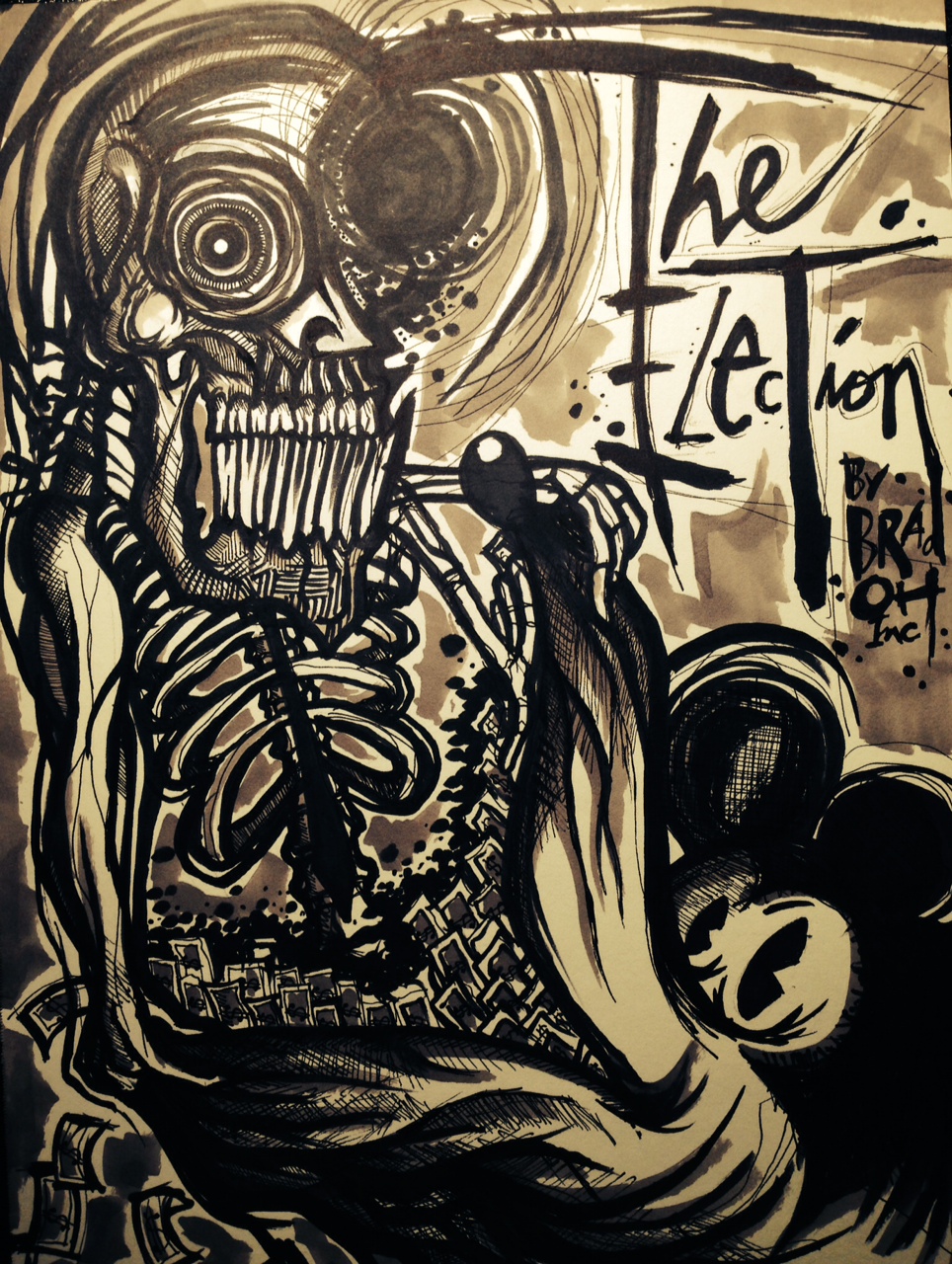
Finally, Troy is also the creator of the incredible cover art for ‘The Election’, an upcoming ‘Single Serving Story’ from Brad OH Inc. ‘The Election’ is the story of a cynical journalist covering the heinous events of the fourth annual United Corporate Election. This story is inspired by and dedicated to the late Dr. Hunter S. Thompson, and as such Troy was driven to do the cover in an amazing, Ralph Steadman based style.

theelectioncoverClearly, Troy is a considerable talent, and it’s our pleasure today to share him with you. Troy is available to do cover arts and various other commissions at negotiable prices, and can be contacted at Troy Barker. You’ll also find a sampling of other works by Troy on his page.

-Brad OH Inc.

The Religious Rights of Corporate America

purelyspeculation

Here at Brad OH Inc., we are firmly and indelibly entrenched in the minutiae of Corporate politics; or at least that’s what they’d have you believe. Given recent developments therefore, it would seem natural that we address the issue of Corporate Religion.

Recently, The U.S. Supreme Court ruled that employers may opt out of the Affordable Health Care Act’s (AHCA) provision of comprehensive birth control coverage based on grounds of religious freedom. The decision came as a result of the Supreme Court’s claim that ‘American families do not give up their constitutional right to religious freedom just because they open a family business.’ (Source)

The first point to clarify is that of Religious Freedom. Religious Freedom is an absolute necessity for any decent society, this I feel goes virtually without saying. The fundamental right to Religious Freedom is essential to allowing citizens of a diverse yet ultimately secular society to practice their faith in their own way without persecution.

Another core right in this society of ours is that to own and operate a business. In a society allegedly driven by free market enterprise and initiative, all citizens must have equal opportunity to join and function in the market place freely.

However, I believe that this issue represents a conflation of these two rights, and ultimately results in significant sacrifices to individual freedoms.

Religious freedom is fundamentally an individual right. Any citizen must be allowed to practice whatever faith they see fit, so long as in so doing they are not breaking any other laws, including bringing harm to other citizens.

However, the concept that a business too has the ability to practice religion is a deeply flawed notion, and serves moreover to allow the imposition of one person’s faith onto another; namely, that of the employer onto the employee.

In this particular case, businesses such as Hobby Lobby and Conestoga Wood Specialties are being given explicit permission to deny to their employees important health care provisions as a result of the owner’s religion. This strikes me not as an example of religious freedom being protected for the owners of these businesses, but rather an example of their religious values being legally imposed on their employees, much to their detriment.

Let’s examine the initial quote. The court claimed, as noted above, that ‘American families do not give up their constitutional right to religious freedom just because they open a family business’. I believe this to be true beyond debate. No law could or should be passed requiring business owners in America to have abortions, or eat pork, or to do anything else which violates their personal liberties. However, that’s not what’s happening here.

Rather, the ruling dictates that anyone working for them must conform to their particular religious beliefs—if you work for hobby lobby, your right to have contraceptives and other forms of birth control covered by the AHCA are forfeit. The natural extension would be for these businesses to say that no employee will be allowed to eat pork in their private lives. An absurdity to be sure—but healthcare and family planning choices are certainly just as much an aspect of private life as are dietary decisions.

Now, the business owners would claim that making them pay for these provisions is a violation of their individual right to Religious Freedom—not so. While they are free to practice their religion in any way they choose (within the confines of the law), they must be expected to operate their business in a way that respects all given laws of the nation they operate in—and healthcare can be no exception. By ruling otherwise, the Supreme Court is disrespecting the right to Religious Freedom for all employees, while falsely claiming the moral victory of defending it for the owners.

Now, I would be remiss if I didn’t clarify one important aspect of the equation at this point. In a respectable move, Congress assures that women affected by this ruling will be subsidized by the government rather than their employers. While that is a commendable step by the government, it is still skirting the issue, and opens the door for myriad other violations of personal freedoms grounded under such trite and non-consequential claims as Religious Freedom.

This approach opens a veritable Pandora’s Box. Inevitably challenges to Corporate Religious Freedom such as do-not-resuscitate orders and vaccine coverage will ultimately be laid on the government as well; another example of Corporations bastardizing the legal structure of our society to save costs, and allowing the government to foot the bill.

It comes down to a key issue we’ve covered before here at Brad OH Inc., namely the concept of Corporations being treated as people. It’s a dangerous and foolhardy idea to be sure, and it leads invariably to socially damning decisions such as these. When a business or Corporation is viewed as being fundamentally equal to an individual human being, the rights of the individual will unequivocally be trampled underfoot. That’s what’s happened here, and that’s what will continue to happen until this absurd notion is dismissed as the mad miscarriage of social justice that it is.

-Brad OH Inc.

The Misled Goal of Job Creation

purelyspeculation

In this troublesome economic climate, people often wonder what can be done to keep the majority of citizens gainfully employed. The most common solution bandied about is the creation of jobs, but I’m not convinced this is the correct answer. As a matter of fact, I’m not even convinced it’s the right question.

Creating jobs is an unsavory and archaic notion for any true politician of the people. The implication buried within the notion of job creation is that there is a scarcity of work, and therefore an abundance of people struggling to get by—desperate for any job that might put even a few extra dollars in their painfully neglected wallets.

This shift towards job shortage is not a new trend; there have been myriad elements contributing to job reduction for centuries. From assembly lines to industrialization, technological changes in society have always had a significant impact on the need for labour. On the other front, remaining jobs are continually outsourced to countries unable to protect the rights of their workers, allowing corporate profits to skyrocket while jobs previously available to our citizens are doled out to foreign workers for a pittance of pay.

With the impending shifts inherent to burgeoning fields like 3D-Printing and nanotechnology, the number of jobs is only poised to shrink even further, leaving more and more people out of work and desperate for money.

In this scenario, we must view labour as a societal need and resource both. Living wages however, must be taken as a right. Thus, there exists a clear need to balance the two intelligently.

The creation of low-paying jobs, capable of keeping people occupied while failing to supply a living wage is a deeply flawed solution. The notion that one must toil in obscure and needless positions just to get by is counter-intuitive in a society poised to benefit unilaterally from our continued advancement.

Make no mistake about it; the high functioning state of societies output at present is due to the cumulative effect of human progress, not the ingenuity of a few thousand people at present. The corporate executives currently pulling the strings have benefited from being in the right place at the right time just as much as business savvy or vision.

Still, history has shown us that the trend is to consider ‘job creation’ an invaluable resource mercifully allotted by these high level executives. This perspective is entirely wrong—the resources we must now be focusing on, finally, are our human ones.

So if job creation isn’t the answer, what is? Well, once again, we must consider if we’re asking the right question. The initial quandary was how to keep the majority of citizens gainfully employed—but I don’t think this is the right goal.

If we as a society have reached a point where we don’t have a need for everyone to be working, then forcing it is illogical and unnecessary.

With profits booming, and CEO’s taking home ever-increasing bonuses, perhaps the solution instead is to ensure that every available job is sufficient for a person to support themselves and their family.

It’s not a difficult idea, but the implications are further reaching than may be apparent.

A significant increase to minimum wage would allow for more stay-at-home parents—an investment in our future the worth of which is beyond measure. Further, with increased pay, the working class would have significantly more money to pump into the economy, which would only benefit the businesses.

Therefore, the result of increased wages would be two-fold. First, the number of jobs necessary to keep society fed would be decreased by as much as half, while the function of society (Raising healthy, well-adjusted children to carry it on) would be served all the better. Secondly, the economy itself would boom with the injection of blue-collar spending dollars, creating more robust business opportunities.

Now, I can already hear the incensed chattering of right-wing loons and business moguls, decrying how this would slice into their profit margin and collapse the free market.

While the economy has struggled and stagnated for the majority, corporate profits have been doing just fine, and high level executives continue to line their pockets with the fat of the land (Source).

The concept of protecting profits is a misnomer, and while these executives would like you to believe that increasing minimum wage would castrate their ability to function as a business entity, in truth the only thing being hurt would be the paycheques of the top 1%–a notion I am entirely comfortable with.

So there we have it. Rather than the ubiquitously heralded goal of creating jobs, the real solution may be to fix wages. By doing so, we could again create a society where kids have parents to come home to, where people aren’t forced to work 60 hours weeks just to rent a basement flat, and where the greed of the few does not necessitate the squalor of the many.

It’s really not such a bad idea, if you think about it.

-Brad OH Inc.
‘Of Pipers and Pigs’

Here at Brad OH Inc., we often sit and watch the happenings around the world, and we must admit—it’s all pretty confusing. Whether you’re a common-place reader, or the head of a successful corporation, the political climate of our current age is not an easy thing to navigate.
The story we have for you today, ‘Of Pipers and Pigs’, tells of an individual dealing with just such uncertainties. It’s about a man watching big things happening, while simultaneously questioning his own role in the events. After all, it’s an important thing for everyone to consider their role in the world, and what they can best do to improve things.
With that acknowledged, we here at Brad OH Inc. wholeheartedly encourage you to do your best to improve our world by downloading this newest free story! We hope you enjoy it.
As always, thanks for reading, and we here at Brad OH Inc. wish to remind you that while passion is good for poets, what we seek is power. Brad OH Inc. loves all our fans, and we sincerely hope that when the fight for corporate suffrage comes—you’ll remember your love for us.

Of Pipers and Pigs CoverOf Pipers and Pigs- Smashwords

-Brad OH Inc.