‘Of Pipers and Pigs’ Published on GonzoToday

cropped-blogbanner1.jpgWell, we have some exciting new today for all our fans here at Brad OH Inc. One of our ‘Single Serving Stories’, ‘Pipers and Pigs’, is now up for viewing on the incredible new site, Gonzotoday!

A direct link to this publication can be found here: ‘Of Pipers and Pigs’ on GonzoToday.

Gonzotoday is a new group dedicated to the creation and celebration of new age Gonzo Journalism; carrying on the admirable tradition of the late great Dr. Hunter S. Thompson in bringing the world stories of heavy import and sincere meaning wrapped in the rage and vitriol inherent to writers with open eyes.

The site has a lot of fantastic work on offer, so be sure to visit at Gonzotoday.com.

One thing you’re sure to notice upon your visit to this publication of ‘Of Pipers and Pigs’ is the incredible new artwork, conceived and created by the divine talents of the staff over at GonzoToday.

This is a serious change from our standard fare. If you’ve taken the time to peruse our selection of ‘Single Serving Stories’ in the past, you’ve probably noticed that the cover art for each sits somewhere between childish-cute and insultingly unbearable. Well, it’s true—the pencil-necked nitwit we have working in the art department at the moment is something of a pariah around the office, and achieved his position only by merit of dubious references and claims of knowing Brad OH.

Needless to say, his contract negotiation skills far outshine his prowess in the art department, but with a little time, we’re certain that the Corporate Efficiency Streamlining process will forecast the end of this sad little dweeb in no time.

Ahem…

Anyways, that’s enough ranting for now. Today is a day to celebrate after all, and what better way of doing that than swinging by Gonzotoday and reading ‘Of Pipers and Pigs’, or any of the other fine pieces available there?

-Brad OH Inc.

A Formal Tour of Brad OH Inc.

cropped-blogbanner1.jpgHello out there to our fine fans from everyone here at Brad OH Inc. Today, we thought we’d take the time to provide you with a formal tour of the place. After all, we know that fans of Brad OH Inc. hail from around the globe, and come from all walks of life and educational backgrounds. So if some of you can’t figure out how to use the navigation tools provided, or pale at the thought of exploring the page options on the top menu bar, we understand.

It’s our duty, as the responsible corporate entity we are, to ensure that even the simplest among you have the information necessary to get the most from your time here at Brad OH Inc.

Let’s start off with the (semi)weekly posts. Now, these posts, made most often each Sunday, are meant to be pretty straight-forward, and are even tagged under a variety of headings to allow a sense of the theme or topic right from the get-go. But that might be a little intellectually demanding for some of our less cerebral fans out there, so let’s just go ahead and outline the various post categories, and what exactly they are meant to represent:

(Note: You can click on the title of each category below to go straight to a list of all posts made in that category. This can also be done at any time via the little drop down menu directly to the right marked, ‘Post Categories’.)

Under the Green Desk Lamp:

‘Under the Green Desk Lamp’ is a regular feature here on Brad OH Inc. This category is the place for any sort of random musings to come off the reporting desks here at Brad OH Inc., and may cover such varied topics as philosophy, society, media, music, etc.

Disclaimer: The views and opinions expressed in the articles of ‘Under the Green Desk Lamp’ are not necessarily the views and opinions of Brad OH Inc.

Purely Speculation:

‘Purely Speculation’ is a series dedicated to facilitating conversation on key political issues. It’s an open forum for Brad OH Inc. contributors to voice their opinions on any matter associated with political direction–ranging from economic systems to globalization. Each article is meant to stand separately, and it’s the hope of everyone at Brad OH Inc. that these myriad opinions lead to some productive debate among the readers here at Brad OH Inc.

Disclaimer: The views and opinions expressed in the articles of ‘Purely Speculation’ are not necessarily the views and opinions of Brad OH Inc.

Requisite Things:

‘Requisite Things’ covers all functional topics here at Brad OH Inc. (just like this one). This is an opportunity for all of us here at Brad OH Inc. to address the reader directly, without the fanciful obfuscations inherent to ‘creative liberty’ and ‘artistic license’.

Disclaimer: The views and opinions expressed in the articles of ‘Requisite Things’ are the express property of, and directly reflect the views and opinions of everyone here at Brad OH Inc.

That covers the basic categories for our weekly posts, but there’s more than that on offer here at Brad OH Inc. Along the top of the blog, just under our stylish Corporate banner, you’ll see a menu with several different options on it. The first two (‘Home’ and ‘About Brad OH Inc.’) should be pretty self-explanatory. If not, we very much doubt we can help you in understanding, as any efforts on our part would inevitably be suffocated under the crippling weight of your own illiteracy.

As for the other two menu options, these will take you to separate pages within the Brad OH Inc. blog, each dedicated to some of the bigger projects coming down the pipe from the contributors here at Brad OH Inc.

They are as follows:

(Note: You can click on the title of each page below to go straight to that page.)

Novels:

This is where you will find the novels currently underway here at Brad OH Inc. While all are currently in various states of completion, you can read about the general premise at this time, as well as view the gorgeous cover art for each.

Single Serving Stories:

Brad OH Inc. is proud to be able to offer its fans quick, accessible reads. Who’s never arrived home from a long days work, looked at their dusty TV screen, their tired old I-pod, or their unaffectionate spouse and thought- ‘You know, what I need is a nice short story.’

Well, we heard you! This page is a place to keep track of all the short stories released here at Brad OH Inc. Feel free to browse, download, and share. Indeed, we live in a world of single serving meals, soaps, relationships and sincerity, so why not crack open a single serving story and enjoy yourself?

Each and every ‘Single Serving Story’ can be downloaded directly to your computer from the links provided at the end of the descriptions. This will take you to ‘SmashWords’, a free online publishing site. From there, you can choose your format and download completely free. We recommend PDF, but there are other options as well. All stories are completely free of charge.

Finally, a few other tools exist to help you get the most out of your time here at Brad OH Inc. On the right, directly under the ‘Post Categories’ drop-down explained above, you’ll find a couple of options to help you keep in touch with us here at Brad OH Inc.

Firstly, you can click to sign up to the blog. This option will provide e-mail notifications whenever a new post is made, ensuring you’ll never miss a story.

Secondly, you can opt to follow our official fan-page on Facebook, which will provide updates for all posts and happenings related to Brad OH Inc.

The Gravatar profile provides a bit more information on this writer, while the ‘My Books on Goodreads’ link provides access to the Goodreads profile for all published works from Brad OH Inc.

Well, that about sums it up folks—a comprehensive tour of everything we have on offer here at Brad OH Inc. Hopefully this helps you get the most out of your time here, because if your lack of understanding keeps you from realizing just what an excellent service we provide, then our product doesn’t grow, and that means we just aren’t doing our jobs. So familiarize yourself with the site, and spread the word—it is the first Central Commandment of the ‘Corporate Religion of Brad OH Inc.’, after all.

-Brad OH Inc.

The Trial of Puff the Magic Dragon

Under the Green Desk Lamp…

Green Desklamp

Puff the Magic Dragon—Marijuana menace, or allegory for the temporal nature of youthful innocence? This is the topic we’ll be exploring here today at Brad OH Inc.

Since the song was recorded in 1963 by the folk group ‘Peter, Paul, and Mary’ it has been the subject of much heated debate. On the surface, the song tells the tale of a fictional dragon—Puff—and a little boy—Jackie Paper—who comes to visit him in the land of Honah-Lee. Together, the pals frolic about, experiencing wonderful childish adventures together and forming a lifelong bond.

According to critics however, this fun little song is more than it appears—for underneath the playful tune and heartfelt lyrics lingers a threat so insidious and vile, it threatens to shake the very foundations of our dear society.

That’s right; we’re talking about the reefer.

Now, here at Brad OH Inc. we aren’t inclined to pass judgement on anything which doesn’t directly harm people save by the enforcement of its restriction; but moral judgements are beside the point here. The question we seek to answer is exactly this: is ‘Puff the Magic Dragon’ really a subversive allegory for drug use, or is it simply the story of innocence lost which it purports to be?

Let’s consider the evidence. Critics of the song claim that the words ‘Puff’ and ‘Paper’ are overt references to ‘puffing on a joint’—a marijuana cigarette rolled in, you guessed it, paper! Further, the ‘autumn mist’ referred to in the song is accepted as a clear reference to either marijuana smoke or a general drug-induced state. Finally, the word ‘dragon’ sounds a lot like ‘dragging’, a term for inhaling from a joint. Together, these observations are said to support the notion that the song is indeed a secret love song to the society-destroying problem of pot.

Pretty shaky evidence if you ask me, but let’s consider the other side of the coin for a minute. If this song isn’t about smoking pot, as can potentially be extrapolated from approximately four words contained within it, then just what the heck is it about?

Well, if we are to be so bold as to interpret the song literally—based on the entirety of the words in it and the story they form when put in order, then the song is about something much less dangerous—although perhaps a lot more scary.

‘Puff the Magic Dragon’ is, if taken literally, about the death of imagination. Throughout the majority of the song, Puff and his human friend Jackie experience countless adventures travelling around Honah-Lee. Near the end of the song however, the lyrics reveal a strange and terrible twist:

“Dragons live forever, but not so little boys,

Painted wings and giant’s rings make way for other toys,

One grey night it happened, Jackie Paper came no more,

And Puff that mighty dragon, he ceased his fearless roar.”

What has happened here, exactly? Well, if we are to take the lines as literal, then we are hearing about how the young Jackie Paper has outgrown his childish fantasies, and stopped daydreaming about the imaginary dragon of his youth. The rest of the song continues, telling about Puff’s overwhelming grief at having lost his friend, and retiring sadly into his cave.

If the song truly is about drugs however, these lines take on a far more sombre tone. Jackie Paper moving on from Puff—taken to mean his use of marijuana—and onto ‘other toys’ might imply Jackie falling into harder drugs; a harsh warning of the potential for marijuana to act as a ‘gateway drug’. The remainder of the song, this being the case, would describe, I suppose, how sad Puff/ Pot is that Jackie Paper no longer partakes.

It’s a strange image, to say the least.

So what are we to conclude? How shall we interpret these abysmal accusations? Is ‘Puff the Magic Dragon’ a simple song about growing up, or a veiled glorification of Marijuana and other drugs?

Well, the evidence is circumstantial at best, and moreover seems to have been gleaned from the song with the pointed desperation of an addict crawling the carpet in search of dropped narcotics. Dim-witted word-associations form the thrust of the argument, with no attention paid to context, narrative, or stated intention (song writer Peter Yarrow has expressed repeatedly that the song was written with no hidden meanings).

But maybe that’s the point. There’s no shortage of irony in the fact that a song about the loss of innocence is plagued to this day by hair-brained nitwits trying to find illicit intentions behind something innocent and good. Rather, it’s the leitmotif of a society driven to find that darkness—raised to be suspicious of anything with pure intentions.

Puff is most certainly just a dragon. Sadly however, until people give up their steadfast determination to darken the world around them with hysterical hatred and paranoia, he will remain a dragon under self-imposed isolation, grieving for better times.

And what of these fiends so desperate for someone to vilify that they would make effigy of a beloved childhood image? Who can they pin their hopes on if not Puff, where can they find the satisfactions of conspiracy and blame they so desperately desire?

I don’t know. Go ask Alice…

-Brad OH Inc.

The Uncomfortable Issue of Population Control

purelyspeculationLast week on Brad OH Inc., we discussed the old and misconstrued ‘Fear of Big Government’. In that article, we explored the common revulsion toward the notion of government intervention in the lives of its citizens, and the ubiquitous but erroneous assumption founded by the repugnant Ronald Reagan that we need to get government ‘off our backs’.

The core thesis we developed in that article was that while the actions of many governments have been less than desirable in both past and present, the true purpose of government is the protection and promotion of its citizens—a function which should not be feared but rather revered. To these ends, there are certain central domains in which government control must undoubtedly be focussed, primarily: healthcare, education, infrastructure, stable wages/ living conditions, scientific research, promotion of environmental concerns, and access to food and water.

This is admittedly a very basic list, but it does provide a functional framework for government interventions. All efforts in these areas must—in any democratic government meant to represent the people—be aimed not at increasing profits for corporations and special interest groups which line the pockets of government officials, but rather at solving problems and promoting the general welfare of the electorate.

A quick peruse of these topics will, however, reveal one common and absolutely key concept for any government hoping to moderate over a well-functioning society; the uncomfortable and cringe inducing issue of population control. While money must never be the dominant issue guiding government practice, it certainly is an important concern when discussing support of citizens balanced against fair taxation, and as such the population size of a country is a crucial consideration.

Perhaps ‘population control’ isn’t the right term. Depending on where we are going with these notions, a better term might really be ‘population management’. If a government is to promote equity and access amongst its citizens, then central to its task will be the ability to understand the size and growth rates of its populace, and design an intelligent and functioning society to accommodate this.

At present, the ongoing fear of big government is serving its role well, rallying citizens to follow the lead of the unscrupulous political right in decrying government involvement in anything that might possibly help the general welfare and direction of the nation, while allowing it only in promotion of economic gain for involved parties. The results are clear as day; it’s a strange and subversive sign of the times, that it’s our poor who grow fat as our rich stay healthy.

Corporate needs dominate the political spectrum, poisoning our citizens and environment alike as record profits are posted and the ‘free-market’ is heralded as a success.

Naïve fools the lot.

So if turning the reigns over to profit-driven corporations and entrusting them to care for the people of the nation isn’t the right approach—and it most certainly is not—then what is?

The key issue here is not whether we must change the current system, but what system will fill its stead. An issue like population management is a heavy one to discuss beyond doubt, but it must be addressed directly and with honesty intention if we are to avoid it’s becoming a taboo issue discussed only behind closed doors by parties of questionable motives.

It is a driving issue, and must be discussed by the whole of the population to be managed. For even if we deny the issue, it will be a key factor in how we manage our economy, food stores, treat the poor, provide education and healthcare, etc.

Clearly, the more people exist, the more demand for resources, and in an unideal world, hence more scarcity. Even if we learn to plan our resources around population, and ever increasing population would lead to heavy sacrifices rather quickly. Ultimately, when it comes to the effective management of a population, there are, as I see it, essentially three basic approaches.

The first approach would be to simply accept that some people are less entitled to the productivity of mankind than others. This is most similar to our current approach. In this scenario, resource access would be determined by factors such as social standing, property/ business ownership, socio-economic status, and more broadly, location of birth.

Taking a stand such as this one, resources would be divvied up by priority, with some people gleaning great wealth and prosperity from our system, while an ever-increasing number receives very little.

A second approach—and the one which makes this such a delicate issue—is the more conventional definition of ‘population control’. A policy like this would demand a clear account of extant resources, and a broad understanding of what sort of lifestyle citizens are entitled to. From there, it would be a simple matter of division to determine the ideal size of the population, and steps—ranging from sterilization, birth limits, eugenics, or population culling—would be taken to make the numbers match.

This scenario has been enacted several times in the past, and represents some of the darkest and most horrifying eras in human history.

Neither of these approaches to population management result in the sort of society that I—and I should hope any of my readers—would hope for. So then we are left with the question, if not these failed methods, then what?

Given the incredible state society has managed to reach in spite of our past missteps, and the unspeakable potential promised by a commercially freed and unleashed scientific community, I believe we are entirely capable of creating a third, more ideal solution. I have little doubt that the combined power of modern computing, science, and human vision is able to design a system to monitor and anticipate both changes in population size and need, as well as existing resources. Such information would allow for a more dynamic and responsive means of addressing scarcity.

Further, in order for such a system to be created and maintained, increased government funding would be necessitated towards science, education, and healthcare—the lot of which would perforce be universal human rights if we are to expect any positive shift in the direction of our society.

A streamlined scientific community, coupled with an economy dedicated to the positive growth of culture and equity, would be fully empowered to find creative solutions to production, provision, and other means of positive population management through a system motivated not by profit, but by simply improving the general human condition.

Furthermore, one key long-term goal would be that of interplanetary exploration. This would provide for both an alternate source of resources, and ultimately alternate planets to inhabit and build upon. But this might be better discussed in a… future article.

The roots of these convictions have already taken hold. Examples range from innovative solutions to solving urban food scarcity (Link), to active attempts at subverting the mounting energy crisis (Link), to community based food-sharing programs (Link). It is by examples such as these that we will work actively towards solutions, rather than merely using obfuscated politics to justify corporate-manufactured deficits.

The end-goal here is to plan for the world we want to live in, rather than cope with the one we’ve created through greed and ignorance. But first, we need to change our priorities. A culture which focusses solely on profit, and defines freedom strictly in market terms, is forever doomed to the scarcity and inequality inherent to such ideals. It is science, not business, which must be unleashed; that, and the passion of earth’s good people—determined to build a better world. On this front at least, I remain convinced that scarcity is not an issue.

-Brad OH Inc.

A Brad OH Inc. ‘Featured Artist’

cropped-blogbanner1.jpgToday at Brad OH Inc., we are happy to present featured artist, Troy Barker. Troy has been very busy behind the scenes creating a good deal of cover art for Brad OH Inc., Including that for our upcoming novel, ‘Edgar’s Worst Sunday’.

Edgar's Worst Sunday Official Cover‘Edgar’s Worst Sunday’ is the story of Edgar Vincent, a semi-successful composer who’s always had one great passion—himself.

In life, Edgar Vincent had been something of a cad. Callous comments, thoughtless promiscuity, binge drinking, and excess sufficient to shame Caligula were standard Saturday night fare.

Sundays for Edgar had always been a painful haze of sickness and regret.

But when Edgar finds himself in the cloudy planes of the afterlife on one particularly bleak Sunday morning, he must put aside his ever-present hangover and try to figure out how he ever got to this point, and where he’s meant to be going now.

However, heaven also presents Edgar with an unending smorgasbord of hedonistic entertainment, so he’s in no particular hurry to change his self-serving outlook. After all, considering that he’s already dead, what could he stand to lose?

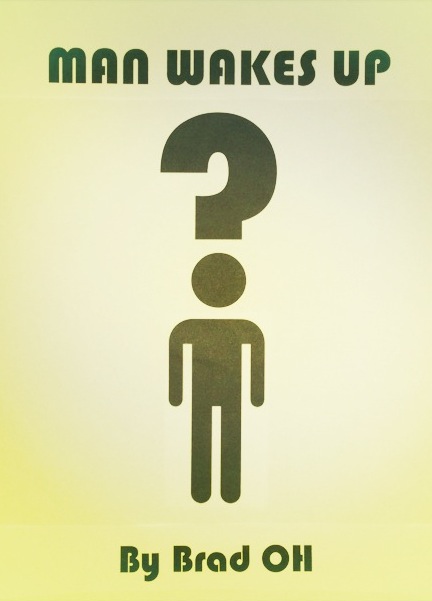
Troy is also the man responsible for the cover art of ‘Man Wakes Up’, a Brad OH Inc. novel currently on hold in lieu of other projects.

MWU Official CoverYou can read more about ‘Man Wakes Up’ and ‘Edgar’s Worst Sunday’ on our ‘Novels’ page.

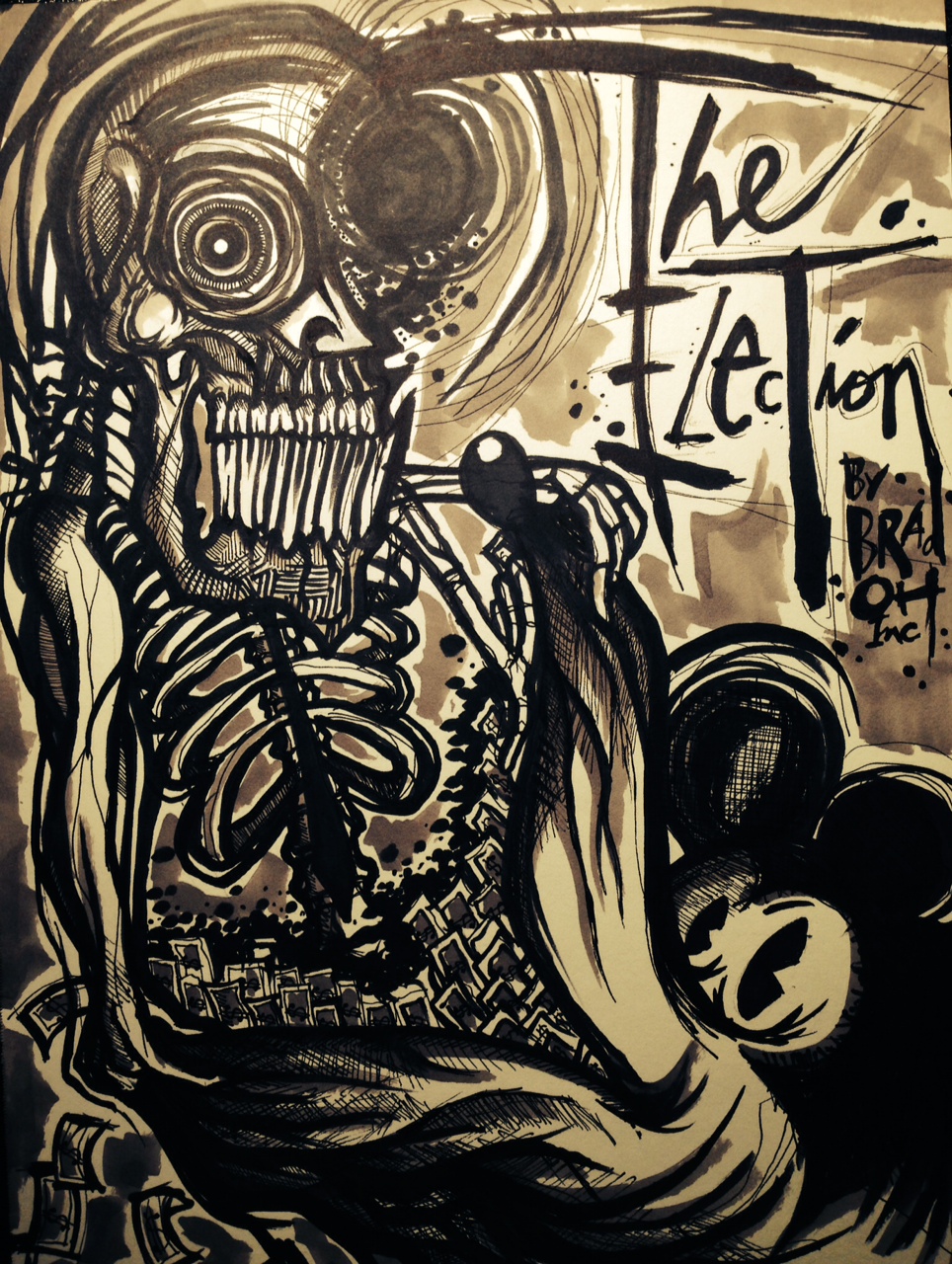
Finally, Troy is also the creator of the incredible cover art for ‘The Election’, an upcoming ‘Single Serving Story’ from Brad OH Inc. ‘The Election’ is the story of a cynical journalist covering the heinous events of the fourth annual United Corporate Election. This story is inspired by and dedicated to the late Dr. Hunter S. Thompson, and as such Troy was driven to do the cover in an amazing, Ralph Steadman based style.

theelectioncoverClearly, Troy is a considerable talent, and it’s our pleasure today to share him with you. Troy is available to do cover arts and various other commissions at negotiable prices, and can be contacted at Troy Barker. You’ll also find a sampling of other works by Troy on his page.

-Brad OH Inc.

In Defense of the Villain

Under the Green Desk Lamp..

Green Desklamp

There is a great deal of credit to be given to the pivotal villains in our lives. They are the flavour—the spices to the bland and basic nutrients of daily experience. Without the villains, there is no story, and without villains, it’s pretty damn hard to have a hero. Without the Joker, Batman is just some crazy asshole in tights; without Scar, Simba just an entitled burgeoning monarch.

Whether we look to the great novels of our time, or fine films—in daily life and even in professional wrestling, it’s inevitably the villains that make the story matter. They create the conflict, and more often than not, provide the personality so lacking in a world without them.

At Brad OH Inc., it’s a role we are often more than happy to play, and why not? Villains walk the less familiar path, and the great ones do so for reasons worthy to make us question what might otherwise be a simple matter of rote knowledge. They are the equation before the solution, the seduction preceding the climax.

In contrast, the hero is an easy role, and one driven merely by the most basic values and expectations which everyone should know. They’re accessible, simple, and fundamentally uninteresting. Ultimately, the hero can by nature do little more than reaffirm that which we already know, and while this can for a certainty be a great comfort at times, it lacks the potential to teach us anything new. Practice makes perfect—but mistakes are where the fun comes in.

Yet if you ask any given person, at any random time, you will with little variance hear them claim that they are a ‘good guy/ girl’, that they do what is right, and condemn its antithesis. It’s not a hard claim to make, and it shouldn’t be a difficult line to walk. The right choices are—or at the very least certainly should be—incredibly easy to make. Decency is a concept confined to no language, limited by no culture. It’s the same in most any society, and is the basis of every religion. Be honest, treat others well, consider the effects of your actions—Christ, I’m getting bored just typing it. Reiterating such basic concepts ad nauseum is like selling a math book with only the answers—it tells you everything, but teaches you nothing. It’s the job of the villain to provide the questions, and that is by far the more compelling role.

But while the villain may be the more fun and interesting role, it’s no earth-shaking thesis to say that decency remains the logical choice as far as actual action goes. After all, if everyone were to simply follow even the most basic principles of decency, we would be living in a veritable utopia of equity and compassion. A quick and informed look around however should tell even the most simple-minded observer that that is far from the case.

So what’s going wrong? Is it that the majority, or even a highly impactful minority, is choosing to play the villain role out of passion for its inherent interest? No, I don’t think so.

If we accept the basic assumption that the world would be paradise if everyone were to follow simple precepts of decency, and further that this is such a self-evident truth that awareness of it can never be far from any one person’s worldview, then the current state of the world presents us with a significant conundrum.

The problem as I see it is that for such a system of basic decency to have any success whatsoever, it must be a tenet to which everyone holds dear. Not a few, not even the majority. It’s a platitude to be sure, but in this case it’s true that even a few bad apples will spoil the barrel. If your neighbour is likely to rob you blind and leave you for dead, showing trust and decency is a quick ticket to being a victim.

For decency to work, it must be ubiquitous. To this end, the impetus to act morally is a shared responsibility of all; unfortunately, this tends to translate in the minds of the simple majority as tantamount to and inseparable from diffused responsibility.

Herein lies the problem. The perception of diffused responsibility is erroneous from the start, as it functions to break down faith in others, and provides excuses for the self. ‘It’s up to everyone, not just me’, is an easy call to arms for the ethically impaired, and could act as an effective summary of society at large. Ultimately, diffused responsibility serves as a lessened sense of purpose for everyone involved.

The fact that a successful society is the shared responsibility of so very many people makes the idea of personal responsibility seem like a distant pipe dream, whereas in truth it should serve to increase the motivation. In place of diffused responsibility, I would submit that it should be felt as a sense of compounded responsibility. The more people share in a responsibility—and the more significant the good that stands to be gained—the greater should be the personal impetus to adhere to it.

Obviously, that expectation is a fruitless hope, but there have been respectable approaches to creating this sense in the past. For starters, an obvious attempt is rule of law. This applies consequences to anyone who strays too far from the path of decency, as defined by the courts. Law certainly succeeds in maintaining a status quo, but the threat of punishment is insufficient to snuff out ill-will in those who see no future in honesty.

Another historical attempt to keep people adhering strictly to the righteous path has been religion. Religion has—to an extent—managed to help overcome the notion of diffused responsibility and settle on the greater ideal of compounded responsibility to be decent—at the threat of eternal fire. But with the rate of active practitioners dropping steadily (Source), and the very notion of faith being bastardized by legislation such as the Right to Corporate Religion (Source), there is again little in the way of keeping the average person from shirking this fundamental personal responsibility.

The death of god is one thing, the death of the human spirit is another entirely—and a far more regrettable one at that.

So what solutions remain? If the threat of punishment by measures such as laws only motivates cooperation as long as the benefit of compliance outweighs the motivation for misdeeds, and religion is increasingly ineffective at providing internal motivation to respect the compounded responsibility to decency, what options are we left with?

I think the key question here is, beyond the delectable irony of playing the villain role, why do so many people choose to break public trust—diffused responsibility notwithstanding?

Above, we established that the world would be a utopia if everyone simply made the right choices, and acted with dignity and respect. There would be no need for dishonesty or competition. However the problem that arises is distrust—if you cannot count on other people acting this way, then you will be ripped off and fooled. Thus, very few people bother to act correctly.

The problem here is that society is presently functioning as a zero-sum game: the gains of one are the losses of another. This is increasingly true in a world where Corporations are bleeding money out of the economy, hoarding it in non-taxable offshore accounts and leaving the population as a whole to struggle on with exponentially limited resources.

If our goal is a society where people will willingly make choices that benefit society as a whole, the solution is not singularly in punishing those who break this social contract, but rather in fostering a nation in which there exists the option for all people to safely make this choice.

With effectively balanced social supports: healthcare, welfare, affordable education and housing, etc., we could strive towards a society where living in a moral way will never leave a person wanting or starving. If citizens were not forced into unbearable debt, they could realistically get by simply living a just life. If people had that faith in their society, it would make true the false promises of all past religions.

Despite the fun of playing the villain, I firmly believe that people would choose to be good if it were a realistically safe path free of treachery and betrayal. If we want people to act morally, they must be provided with the option to do so unburdened by the threat of a neglected family life or crippling debt.

It is possible, but first we must move past the selfish machinery of Corporate profit-motivated nihilism which continues to keep the citizenry shackled to a lifestyle of simple survival without positive growth.

It’s just an idea mind you. It’s a complex issue, and there can be no doubt the obstacles in the way are unthinkably vast. In the meantime, there’s no sense in not enjoying ourselves. If we can’t have perfection, at least we can have fun! Here at Brad OH Inc., we’re happy to continue to play the villain, at least until a better role comes along.

-Brad OH Inc.