Fringe Fest Play Review- ‘Rigby Muldoon: Time Traveller for Hire’

cropped-cropped-blogbanner13.jpgLast Saturday I found myself skillfully navigating the crowded and popcorn reeking confines of the Edmonton Fringe Festival—lovely lady on my arm—in a hurried attempt to make it to the box-office in time. My friend Tom, the Stage Manager of the play I’d chosen to see, had advised me that advance tickets wouldn’t be strictly necessary, yet still an uneasy feeling mounted in my gut as I pushed through the mobs on the way to the PCL Studio Theatre.

As is often the case, my intuition had served me well—albeit late—and I arrived just in time to find the box office freshly out of tickets for ‘Rigby Muldoon: Time Traveller for Hire’. Damn my luck! What sort of fringe fest play sells out on its opening weekend?

Well, this one by all evidence. ‘Rigby Muldoon’ sold out its opening night in fact—and every other night since!

Written by Robyn Slack and directed by Olivia Latta, ‘Rigby Muldoon: Time Traveller for Hire’ is a noir-infused sci-fi comedy which tells the fascinating tale of aimless gamer-girl Annie Sinclair (Carina Morton), who is so desperate to undo the decisions of her past that she hires the services of the gritty and unabashedly noir-inspired time traveller: the titular Rigby Muldoon (Joshua Lee Coss).

Rigby And AnnieRigby Muldoon (Joshua Lee Coss) and Annie Sinclair (Carina Morton)

‘Rigby Muldoon’ was first test-read at Nextfest in June of this year, and only written in May. For such a relatively short turn-around time, the performance was impressively polished and professional—a 75 minute romp through time which brought consistent laughs to everyone in attendance.

While writer Robin Slack admits that the themes of the play are laid out on the table pretty early, the deft exploration of the subject matter keeps the audience guessing at several ongoing strands, while distracting like a skilled magician with a litany of jokes ranging from time-travel idiosyncrasies, to complex call back humour and even several plays at retro-inspired nostalgia (not limited to a Coolio reference!).

The tone of the show is unapologetic in its passionate dedication to what’s come before it—it’s innately chrono-conscious after all. The heavy noir imagery and attitudes manage to work incredibly well alongside the throwback video game references and 90’s irreverence which the cast find themselves mired in.

To give some context to the menagerie of mad settings and insightful writing you might find here, one stand-out scene involved a laser-tag shootout which served not only to make some key advances to the storyline, but also to utterly—and hilariously—tackle the concept of ‘trolling’. Take notes kids!

Of course, the humour isn’t limited to 90’s culture and unexpected twists: every facet of the stage design, costuming, and acting serves to solidify the intentionally overblown themes and self-aware quips. It seems at times that each scene might fit as well in a play of a totally different genre—but ‘Rigby’ is one of a kind!

In fact, as I sat watching the show in silent admiration, I realized how unsurprising it was that it had sold out every night it’s been put on. With its non-stop laughs and impressively subtle twists, it is the undeniable progeny of an unrestrained love for all things nerdy, coupled with an innate understanding of the fundamentals of good storytelling.
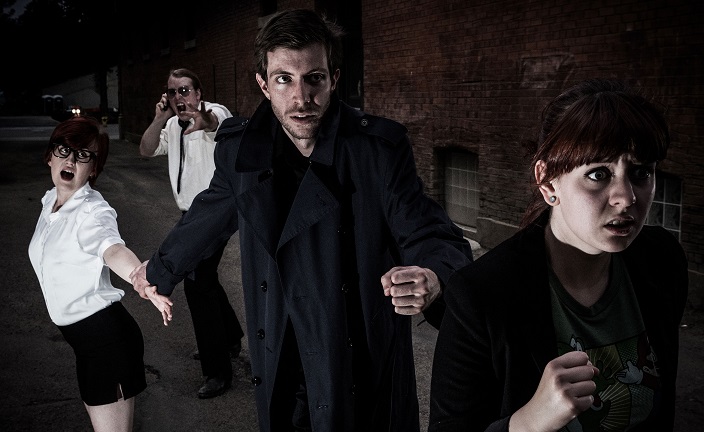
Group-1Left to Right: Laena Anderson, Robyn Slack, Joshua Lee Coss, Carina Morton

Speaking before the show with Writer Robyn Slack, I was assured that the play’s performance had exceeded his expectations. If so, he may be well-advised to broaden them before considering the next step for ‘Rigby Muldoon’. Its abundance of humour works on all levels while managing to make room for enough essential character building moments to keep the audience affectionately engaged throughout. My showing ended with an extended standing ovation from the sold-out crowd, and I can scarcely imagine the ending is much different no matter what night you attend.

As of the time of this posting, there are only two showings left of ‘Rigby Muldoon: Time Traveller for Hire’. You can catch it at the PCL Studio Theatre at the Edmonton Fringe Festival at the following times:

Saturday August 22nd – 8:45pm

Sunday August 23rd – 6:45pm

Just remember, unless you have the time-altering talents of the titular Rigby, you’d do well to learn from the mistakes of this writer and get your tickets in advance!

For More Info: Rigby Muldoon

-Brad OH Inc.

Album Review: Insane Clown Posse’s ‘The Marvelous Missing Link: Found’

The Gentleman Juggalo LogoOn April 28th of this year, the Insane Clown Posse released their album- ‘The Marvelous Missing Link: Lost’. This album was the first part of the 3rd Joker’s Card of the Second Deck. That’s a lot of jargon to sort through, but we here at Brad OH Inc. have you covered—just read our review of ‘The Marvelous Missing Link: Lost’ (Link) to help you sort it all out.

For now, suffice it to say that ‘The Marvelous Missing Link: Lost’ was one half of the two-part series known as ‘The Marvelous Missing Link’. The titular ‘Missing Link’ refers to our internal link to belief—our connection to and faith in whatever keeps us on the right track.

As such, ‘Lost’ was an exceedingly dark album both sonically and thematically. It described the existential horrors of living with no grounded set of beliefs—no sense of purpose to keep one rooted in positivity or faith. In our review of that album (Link), we discussed how this desperate state was represented in the genesis of the Insane Clown Posse themselves (Link). More to the point, the formation of the band may have been the moment when Violent J and Shaggy 2 Dope’s Missing Link was first ‘Found’.

This brings us to Part 2 of ‘The Marvelous Missing Link’—‘Found’.

The_missing_link_FOUNDClick image above to buy the album.

 ‘Found’ is a very different album from its predecessor, ‘Lost’. While ‘Lost’ focused on the absence of meaning in one’s life, ‘Found’ is the very opposite. With a theme of deliverance and hope, the positive basis of ‘Found’ is heard not only in its lyrics—which tend towards meaning and connection—but also in the sound of the album itself. Where ‘Lost’ was sonically a very dark and sinister record, dominated by industrial-loops and repetitive DJ scratches, ‘Found’ takes a different path entirely.

In fact, fitting to the subject matter, this release may stand as ICP’s most ‘mainstream’ sounding effort to date—with several songs (most notably the lead single, ‘Juggalo Party’) sounding not too dissimilar from the sort of jams you might expect in your typical nightclub. The content isn’t quite the same to be sure—it’s significant that this album sees the return of the Wicked Clown’s sinister sense of humour, which had been conspicuously absent on ‘Lost’—but the gentle rhythms and upbeat tempo provide for a much gentler aural experience.

Once again, this album has been produced without long-time collaborator Mike E. Clark. However, the now familiar team of Mike P, Michael ‘Seven’ Summers, Brian Kuma, and James ‘Young Wicked’ Garcia return to bring a fresh and effective sound to the album. The standout this time is ‘Seven’, whose smooth and flowing beats bring a reflective sense of peace to the album which is truly fitting for the subject matter at hand.

With the positive outlook and comforting tones of this album, the band is successful in bringing their audience a fun and reassuring experience. Song topics range from parties with friends, comfort in belief, and appreciating the time we have; all fitting well with the theme of the album. Others seem slightly less on point however, with songs such as ‘Lost at the Carnival’ or ‘Pineapple Pizza’ having little bearing on the overarching theme of the album, yet contributing in a broad Gestalt effect to deliver the familiar humour and style that the Juggalos demand.

‘Lost’ was certainly a more focussed album, never erring from its morose themes. ‘Found’ bounces around a bit more, providing for a more scenic if slightly distracted jaunt through many of the expected sights for those familiar with the band.

Similar to the track ‘Hell’s Forecast’ on the ‘Shangri-La’ album, the scattering of darker themed songs on this offering remind us how reticent ICP are to put out a wholly positive album. They know that the root of their fan base lies in ‘the Wicked Shit’ that started them off, and they are always more than happy to deliver. While this may ultimately mean that ‘Lost’ will stand as the greater artistic output of the two, ‘Found’ has an undeniable charm, and its positivity is unapologetically contagious—which is surely the point here.

Standout tracks include ‘OK’, ‘Lost at the Carnival’ (providing you have a system with good bass), ‘Juggalo Party’, ‘The World is Yours’, and ‘Time’. Other songs of note include the return to form ‘Shit-Talking’ song, ‘Get Clowned’, and the country-infused comedy track ‘Dreams of Grandeur’, which shows some heavy inspiration from their 2011 Jack White collaboration, ‘Mountain Girl’.

‘Mr. White Suit’ is something of a slow burner, but has been growing on me with repeated listens. The most direct ‘God’ allegory on the album, it’s a catchy track on its own, and an important departure from their standard fare of songs which does much to bring out the intended emotional effect of the album.

Still, while the narrative promise here was to explore the things which keep people connected to a sense of meaning or purpose, this album was less overt in its talk of higher powers than was ‘Lost’, particularly in the respective intros.

One important but subtle effort here is the distinction between the liner notes in each album. While ‘Lost’ was filled with images of violence and strife, in ‘Found’ we find images of friends and lovers, cooperation and progress. Similarly, while the Clowns (thankfully) avoid being too on the nose with their message, they do a good job throughout the album of incorporating themes of belonging and connection, while illustrating how little things such as friends, family, humour, and purpose can lift us out of the doldrums of a life devoid of meaning.

This mix of introspection and irreverence makes for a slightly off-focus, yet impressively poignant package. Too strong a focus on meaning may have left the album feeling heavy-handed. But by combining these topics with songs that are merely for fun, ICP accomplish their intentions with a more roundabout, show-don’t-tell delivery.

In our review of ‘Lost’ (Link), we explained why that album was not the one the Insane Clown Posse likely ‘should’ have released at the moment. ‘Found’ is much closer to that imaginary ideal. With its mix of upbeat bangers, comical irreverence, and anthemic crowd-pleasers, ‘Found’ is an album which—while it may not garner the level of media attention that 2009’s ‘Bang Pow Boom’ did (Link)—is certain to provide plenty of entertainment and meaning to the Juggalos.

And what better testament of success for this album? For just as the band itself acted as the ‘Missing Link’ for two young men in inner-city Detroit, so too have their musical efforts been the ‘Missing Link’ to countless people since—people who often have little else by way of meaning or purpose in their lives. To the Juggalos, the Insane Clown Posse have always been an opportunity to find that sense of purpose, and to that end, ‘The Marvelous Missing Link: Found’ is a terrific success.

-Brad OH Inc.

‘The Election’ Published on GonzoToday

cropped-cropped-blogbanner13.jpgHere at Brad OH Inc., we’re happy to announce that our Single Serving StoryThe Election’ is now available for reading on GonzoToday.

A direct link can be found right here.

Further, the downloadable version of ‘The Election’ over at Smashwords is very fast approaching the 100 Downloads mark. That’s even more reason to celebrate! Click on the image below to access a free, downloadable copy of ‘The Election’ on Smashwords.

theelectioncoverWe want to take this occasion to thank everyone who’s downloaded it for your support—we truly appreciate it, and hope you enjoyed the read. For those of you who haven’t yet read ‘The Election’, now is as good a time as any. So click here, or on the image above, and check it out absolutely free in any e-reader format that suits you! Alternatively, you can view it (along with many other fantastic articles) in-browser over at our friends ‘GonzoToday‘ by clicking right here.

-Brad OH Inc.

‘The Election’

Here at Brad OH Inc., we spend a lot of time discussing current political events, and what sort of future they might suggest. We’ve also explored many different writers and styles over the years. Today, we have a treat for you that combines the two!

Inspired by the unique ‘Gonzo’ writings of Dr. Hunter S. Thompson, ‘The Election’ is the story of a cynical journalist covering the heinous events of the fourth annual ‘United Corporate Election’. In this dystopian future inspired by contemporary politics, Corporations control all aspects of government, and elections have been reduced to satirical pantomimes in which citizens use their ‘Citizen Spending Credits’ to vote on their favourite features for the elected effigy.

Journalist Duke O’Brady ventures into this ridiculous spectacle to experience the madness firsthand, but may be in for more than even he anticipated…

This short story is one of our favourites–after all, what sort of self-loathing Corporation wouldn’t dream of such an idyllic future?

We certainly hope you enjoy it as much as all of us here at Brad OH Inc. enjoyed writing it.

theelectioncoverCover Art by- Troy Barker

‘The Election’- Smashwords

-Brad OH Inc.

Between the Shelves Book Signing and Interview with Author Trudie Aberdeen

cropped-blogbanner1.jpg

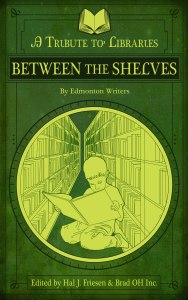
The following is an interview with Trudie Aberdeen, who appears in the Brad OH Inc. and Hal J. Friesen edited Anthology ‘Between the Shelves: A Tribute to Libraries by Edmonton Writers’, which you can now purchase here in either Kindle ($2.99) or Paperback ($12.50) copies. All proceeds are to be donated to the Edmonton Public Library System.

BetweenTheShelvesCoverThis interview was conducted by Hal J. Friesen in anticipation of the anthology’s release:

Trudie Aberdeen is a long-time language educator and social justice advocate. She is currently working on completing her PhD on the topic of heritage language acquisition. In addition, she teaches English to adult newcomers to Canada. Her academic interests include refugee education, multilingual literacy instructional practices, language conservation, action research, and language instruction for heritage language learners. Her research can be found in the following journals: The Manitoba TEAL, Multilingual Discourses, and the 9th Low Educated Second Language and Literacy Acquisition (LESLLA) Symposium. She also serves as the book review editor to the Canadian Journal of Action Research.

  1. The passion for your work is clear in every aspect of your writing. How long has heritage language acquisition been a part of your life? What started it all?

TA: I was raised in a middle-class, English-speaking family in Alberta. My childhood was fairly normal. And when I was a little bit older, similarly to most rebellious teenagers, I took my teenage angst and raged against my parents. While others were sexing, drugging, rock-n-rolling and doing other “naughty things”, I inflicted on my father what I thought might have been one of the most painful childhood revolts I could think of: I went to Campus St. Jean and took university in French! On my personal journey to bilingualism, I learned about the power of language along the way.

Contrary to current popular belief, I’m not really a natural when it comes to language learning. I’m someone who learns with moderate aptitude and great effort. I was always fairly successful in school, so learning that language learning was hard was a shock for me. So despite by best enthusiasm, I wasn’t successful my first year and was put on academic probation. Because I struggled with the language I was in a place very few white, middle class, English-speaking women with average intelligence ever get to be: I wasn’t part of the mainstream. For me, this is when I realized how language (or lack thereof) can limit one’s chances of success. I finished my degree successfully, although it took me more than four years and I had to spend a year in language classes in Quebec, but I eventually triumphed.

I taught in Japan for several years in an international school. I was the English as a second language teacher to elementary school aged children whose parents moved temporarily to Japan for business or diplomatic missions. I saw how quickly many of my students learned English and how quickly many of them forgot their mother tongue. I saw the parents who were “trapped” because if they moved home they could no longer put their children in school because the children couldn’t read or write their “mother tongue”. I also worried a lot for my students who appeared to have learning disabilities. Parents, colleagues and I often asked, “What is this child’s issue? Is it a language learning inability or something bigger?” Often it is difficult to know.

When I started my doctoral studies, I began to take interest in adult literacy learners. In my field of English as a second language teaching and learning, literacy learners are adults who grew up never learning to read their mother tongue, mostly due to limited opportunities because of gender, poverty, or war. Their lack of first language education impacts on their opportunity to learn English. They often struggle with things that most of us take for granted: following instructions for over-the-counter medication, signing their children’s homework log, figuring out a map, and reading street signs. Despite all of their challenges, all of those I have worked with have an undeniable spirit, determined outlook, and an often overlooked sense of intelligence.

My dissertation, however, looks at heritage language learners. These are usually the children of immigrants who have to navigate cultures and languages, not being conventionally “Canadian” and first-language English speakers, but not being of the same language and culture as their parents, either. Most of these children struggle to keep the language of their parents and cannot without the help of a larger language community and school. My work is looking at how schools and communities can support these students.

Heritage language learners and adult literacy learners do not initially seem connected, but they share many commonalities. Both groups often are trying to learn language in an environment that is limited in exposure to language. Both are often trying to learn language without literacy. In many instances, these two groups can be within the same family. Some immigrant parents (especially those with limited literacy) can struggle to learn English and their children can struggle to maintain their first language. In my line of work I have met many people who are unable to have a basic conversation with their parents because they do not know enough of each other’s language to exchange more than limited small talk.

  1. There seems to be a message or end goal with your writing / research. What is it you hope to achieve at the end of your dissertation? 

 TA: I hope to show the world exactly how much expertise exists in the field of heritage language education in Alberta. I wish politicians, educators, and scholars to know about the challenges and limitations that programs face so that they can receive better support in doing what they do best.

  1. Who has inspired you as either a writer or researcher? 

 TA: My four favorite researchers are Dr. Olenka Bilash, Dr. Kenneth Schaeffer, Dr. Nick Ellis, and Dr. Elaine Tarone. All four are gifted scholars and educators. However, what I admire most about them is their compassion and vision for making the world better for others.

  1. Would you be willing to share one or two stories from your experience as a language educator? 

TA: In 2004, I had a beautiful kindergarten student from Sweden called Hedda. She was a dream child: polite, kind, energetic, brilliant, and friendly. She started school in September and by Christmas she was speaking English well. Her reading level was near the top of her class. At the parent-teacher interviews, I gave her parents “the talk.” I warned them about language loss and the importance of first language maintenance. I told them that they had better start planning for her Swedish or else it would be gone. I recommended that they find her a tutor and begin reading lessons as soon as possible.

While Hedda’s mother seemed convinced by my message, her father was less so. He responded firmly, but politely, that Hedda was a little girl. She had just made a huge adjustment, according to her father, by leaving her extended family behind in Sweden and moving to Japan, and furthermore, she needed to worry about enjoying herself, not planning for her future education. I responded that while I respected his point of view, he should at least consider my suggestion. He told me that he would think about it after his family returned from their holiday in Thailand.

Sadly, all four members of Hedda’s family were lost in the 2004 tsunami that killed more than 250,000 people on Boxing Day. I often think of her and her beautiful family. I often think of the advice I gave to her parents, and consider what her father responded to me. For language learning, we need to have long-term planning, and to prepare for what is coming ahead. At the same time, we need to remember that this moment might be all that we have.

  1. Why do you personally think language is important?

 TA: If you ask a brain researcher or a psychologist, they will tell you about all of the cognitive benefits of bilingualism. Of course, I believe all of these things are true such as bilingualism increasing intelligence and delaying the onset of Alzheimer’s disease. Still for me, the most important aspects of language learning are social in nature. Language connects people to opportunities and it connects us to one another.

Check out Trudie Aberdeen’s story “Newcomers to Canada and Edmonton Public Libraries” in ‘Between the Shelves’, which you can purchase now on Amazon.

BetweenTheShelves_poster-YMCA-WEB

Finally, be sure to visit us for a ‘Between the Shelves’ signing this Saturday, May 30th at William S. Lutsky YMCA (1975-111 St NW) from 10am-2pm!

-Brad OH Inc.

Between the Shelves Book Signing and Interview with Author T.K. Boomer

cropped-cropped-blogbanner13.jpgThe following is an interview with T.K. Boomer, who appears in the Brad OH Inc. and Hal J. Friesen edited Anthology ‘Between the Shelves: A Tribute to Libraries by Edmonton Writers’, which you can now purchase here in either Kindle ($2.99) or Paperback ($12.50) copies. All proceeds are to be donated to the Edmonton Public Library System.

BetweenTheShelvesCoverThis interview was conducted by Hal J. Friesen in anticipation of the anthology’s release:

T.K. Boomer lives in Sherwood Park, Alberta, with his wife. In 2012 he began the awkward and painful transition between being a mainstream fiction writer and becoming a science fiction geek. Remnants of his literary past can been read in his novel, “ A Walk in the Thai Sun” written under the name G.J.C. McKitrick. The future will be revealed in the publication of “Planet Song”, first book in the Fahr Trilogy, probably in late 2015. Other aspects of the transition, like video game obsession and playing “Mr. Dressup” at SF conventions are proving to be more difficult.

1. What made you transition from mainstream into science fiction? 

T.K.: When I originally wrote and tried to place “A Walk in the Thai Sun” I ran into the problem of having written a book that was hard to market. It didn’t fit easily into any of the established genres and was rejected for that reason.   I wasn’t really writing for a mainstream audience but the nature of the book put it in that very broad category.  I’m not a good enough writer to compete with the likes of Margaret Atwood or Barbara Kingsolver so that was the other reason the book was initially rejected.    I resolved, at the time, to not write another book unless it would fit easily within an accepted genre.   When I got the original idea for “Planet Song” it was science fiction.  I did the research and decided that I could write in that genre.   However it’s quite different from writing mainstream fiction and there was a lot to learn.

2. In your story you hint that the Internet has been replaced by something else in the far future. What are your thoughts on what that might be, and what form it might take?

T.K.: My biggest fear is that we won’t move forward but rather retreat. I think the Internet is far too dependant on very complicated and vulnerable infrastructures. One bad solar storm could make a huge mess of it so my guess will be some kind of less vulnerable infrastructure. I think we have more interconnectivity now than we will have in the future. I also think that governments are going to move towards more control and less freedom.

3. Do you read paper or e-books, and which do you prefer? What about Siberius? 

T.K.: I read both but I think that within ten years most reading will be on e-readers. It’s simply a matter of economics and convenience. However if I’m right about the internet it could cause a resurgence in paper books down the road. As for Siberius, he’s a throw back. Notice how he was looking for physical books in the library?

4. Do you think libraries will become sentient in the future, and is that a good or bad thing? 

T.K.: They will but I don’t think sentient in the human sense of the word. The trick will be not to build in a survival instinct into our machines. We should not be trying to create a human-like mind in our machines for that reason. If we do then we’re asking to be out completed by them.

5. Who has inspired you as a writer? 

T.K.: Inspiration is a funny thing. I guess I gravitate to writers who use language in unique ways. It’s part of the reason that I still read a lot of mainstream fiction, because I’m more interested in writing technique than I am in tropes. Margaret Atwood is a favourite as is Anne Tyler and Iain M Banks and William Gibson.

Check out T.K. Boomer’s story “Five Hundred Years” in ‘Between the Shelves’, which you can purchase now on Amazon.

BetweenTheShelves_poster-YMCA-WEBFinally, be sure to visit us for a ‘Between the Shelves’ signing on May 30th at William S. Lutsky YMCA (1975-111 St NW) from 10am-2pm!

-Brad OH Inc.

Between the Shelves Interview with Author Timothy Fowler

cropped-blogbanner1.jpgThe following is an interview with Timothy Fowler, who appears in the Brad OH Inc. and Hal J. Friesen edited Anthology ‘Between the Shelves: A Tribute to Libraries by Edmonton Writers’, which you can now purchase here in either Kindle ($2.99) or Paperback ($12.50) copies. All proceeds are to be donated to the Edmonton Public Library System.

BetweenTheShelvesCoverThis interview was conducted by Hal J. Friesen in anticipation of the anthology’s release:

When not writing for Scribbles and Snaps, Tim works with a Global Fortune 100, leading a team of incredibly talented people to deliver the nearly impossible to their customers doing important work. He travels nearly full time as a result of this engagement, and part time for leisure. He scribbles pictures and snaps stories for his own pleasure and hopefully yours. He lives in St. Albert with his lovely wife, Saskatchewan-born farm girl, Kathy, and Gordon Setter, Rigby. He is Scribbler, Snapper, Navigator, Outdoorsman, Fellow Traveller. He is from Granite Rockies, and Prairie Dust, from Boreal Forest and Wanderlust. Tweet @TimothyDFowler or read his blog here.

  1. In “The Library”, you talk about the hours spent in your Aunt and Uncle’s library. Do you try to model your own home library after theirs, or after another library?

TF: My library mirrors my Aunt and Uncle’s with the soft light, big chair, and favourite books on dark wood floor-to-ceiling shelves.  Thick carpet under sock feet helps make it very quiet like theirs was. Sometimes guest’s children get rocked to sleep there. And the kids books are on the lowest shelf so they can choose which books they want to read, or have read to them.  I have my own childhood books on the lowest shelf.
Like their house, from the library you can smell dinner underway. I started my career in culinary as as apprentice then journeyman chef, now manager. Roughly a quarter of my books are related to food, collected over decades of kitchen work. Many meals are first conjured in the library. My uncle had a collection of food related books on the shelf, and I think of him often in his hotel kitchen.
My library feels like an extravagance, and I suppose it is.
Now I keep a special shelf for writing books, and borrowed books. I now apprentice as writer.

  1. You’ve been writing on your Scribbles and Snaps blog for a year and a bit now. How has that project evolved from when you started, and where would you like to see it go?

TF: For many years I have been quietly writing, but mostly keeping outputs to myself. “Platform,” Michael Hyatt’s book helped me decide to launch my Blog, and write in a public way. I write to entertain, and encourage readers to think about life experience in a new way. I hope the blog posts do this.
My goals for 2015 include submitting 52 pieces for consideration to be published. “The Library” is one that will be published in 2015.
Participating in the Edmonton Writers Group gives me candid feed back, caring coaching, and firm encouragement from fellow writers. Joining the group is one of the best things I did to accelerate my writing apprenticeship

  1. Did you start with writing or photography first? How does photography play a role in your writing?

TF: Since sharpening my fat red pencil and spelling my name with letters in the right order I have been marking up pages with stories. Recently I bought a LAMY fountain pen, and find writing longhand with a real pen and real ink on real paper, a sensuous pleasure. I am saving my money for a Sailor fountain pen with a gold nib.
Now I write by hand in a notebook every day.
After my sixteenth birthday I bought a Pentax 1000 35mm SLR. Before turning twenty I travelled the South Pacific, Australia and New Zealand making hundreds of photographs. I read Freeman Patterson’s great book “Photography and the Art of Seeing” and work hard to see.
We writers spend a lot of time wrestling words, showing over telling, but before any of that happens we need to “see.” So for me making pictures and writing are very much tangled up. I experience them together. I picture what I write, and I hear stories looking through my viewfinder. Metaphors are literary viewfinder for readers.
This is how I landed on ScribblesandSnaps.ca
I explore the question of “Why?” for both writing and photography on my blog.  I find them both rewarding, but recently have been focused precisely on writing.
Why write:
http://scribblesandsnaps.ca/why-i-write/
Why photograph:
http://scribblesandsnaps.ca/biography/why-i-make-pictures-3/

  1. Who has inspired you as a writer?

TF: Mark Twain’s “A Dog’s Tale” and “A Horse’s Tale” had a profound effect on me, teaching me about voice and story point of view. He tells gut-wrenching stories within stories. The story is not the story at all. And it is.

I know Stephen King is cliché-popular but his storytelling ability influences me today. He just jumps off the first word and tells the story. Recently Alberta’s own Fred Stenson’s “Feigned or Imagined” has been great fun and his writing started me on several stories of my own.
The truth is we are influenced by whatever we read, and now more than ever, I read constantly. Precise language and particular personalized description is such a pleasure to read, and a tremendous challenge to write.
Challenge accepted.

  1. What do your children think of your writing aspirations? Are any of them following in your footsteps?

TF: Both my boys are great storytellers, but neither has put pen to paper in a serious way. Both have a keen interest in photography. And both, if I may say, competently maneuver in the kitchen.
My whole family encourages me to write—at least to my face.

Timothy Fowler’s story “The Library” is featured in ‘Between the Shelves’, which you can purchase now on Amazon.

-Brad OH Inc.

Between the Shelves Interview with Author Mohamed Abdi

cropped-cropped-blogbanner13.jpgThe following is an interview with Author Mohamed Abdi, who appears in the Brad OH Inc. and Hal J. Friesen edited Anthology ‘Between the Shelves: A Tribute to Libraries by Edmonton Writers’, which you can now purchase here in either Kindle ($2.99) or Paperback ($12.50) copies. All proceeds are to be donated to the Edmonton Public Library System.

BetweenTheShelvesCoverThis interview was conducted by Hal J. Friesen in anticipation of the anthology’s release:

Mohamed Abdi is a Somali-Canadian Writer with a Bachelor’s Degree in Communication Studies. He loves to read mystery and historical fiction novels and has written articles for both online and print magazines. Mohamed lives in Edmonton with his wife and children.

  1. Did the EPL play a significant role in your own immersion into Canadian culture?

MA: Absolutely. Edmonton Public Library has played a significant role in my broad understanding of Canadian culture and enabled me to immerse myself into the culture. This comes in the form of reading different books written by diversified authors, and I have realized that much of Canadian culture is built on readership and connection with libraries. In fact, I have been partly acculturated as I like to read and borrow books from the Edmonton public library. And readership culture is created and promoted by individual societies.

  1. When did you make the decision to start writing in English, and why is it so important to you?

MA: My university studies exposed me to writing opportunity, through essays, etc. As a result, I have developed a passion for reading and writing in English. I wrote my first English book in 2004. This was a non-fiction book, which touched on Somalis’ plight and their displacement after the civil war of 1991. I published my second English book in 2012. This was a collection of fictitious, short stories about Somalis’ predicament and their complicated conditions in various places of the world. I think it is so important to me to write in English, for English has become a universal language whose written materials and literature can be comparatively accessed by many people. So by writing in English, I can reach out to a wider audience.

  1. What advice would you give to other Non-Native English speakers trying to make their voices heard in English?

MA: My advice to Non-Native English speakers is to read as many books as possible, and to start putting your ink on paper and write things you have passion for, or concerned about, in other words. And you must know that your writing skill will not come overnight, but it has to start somewhere and grow gradually. So let you start somewhere and develop your writing skills onward.

  1. Who has inspired you as a writer?

MA: Somalia’s civil war has inspired me to become a writer. In fact, the insanity of that sinister civil war has set my mind into motion and compelled me to find responses as to why people wreck each other and take their countries apart. Why blood is spilled? Why children are orphaned? Why women are widowed? Are there alternate means of reconciling and resolving conflicts before resorting to the barrel of the gun?

  1. What is your next writing project? Can you tell us a little about it?

MA: I am now working on a novel (historical fiction) about Somalia, but don’t know how it will turn out or where this journey will take me, but I am determined to unleash my imagination and hone my skills for this project.

BetweenTheShelves_poster-FOR-WEBCheck out Mohamed Abdi’s story “Learning From Your Library” in Between the Shelves’, which you can purchase now on Amazon. And be sure to join us tonight, May 6, from 7:00-9:00PM for the official launch party in the Centennial room of the Stanley Milner Library!

-Brad OH Inc.

Between the Shelves Interview with Author M. Lea Kulmatycki

cropped-cropped-blogbanner13.jpgThe following is an interview with M. Lea Kulmatycki, who appears in the Brad OH Inc. and Hal J. Friesen edited Anthology ‘Between the Shelves: A Tribute to Libraries by Edmonton Writers’, which you can now purchase here in either Kindle ($2.99) or Paperback ($12.50) copies. All proceeds are to be donated to the Edmonton Public Library System.

BetweenTheShelvesCoverThis interview was conducted by Hal J. Friesen in anticipation of the anthology’s release:

M. Lea Kulmatycki is a teacher and writer. Her work spans academic writing to a senior’s advice column in a local newspaper. She has even written poetry for some charitable events. After many years of writing and publishing teaching materials, she decided to focus on her first love, fiction. She is also on the board of directors of the Young Alberta Book Society.

  1. This short story seems to scratch the surface of a much broader world. Is “Library Lost” going to be continued or expanded elsewhere? 

MLK: Yes, I’m hoping to expand the story into the first book of a trilogy.

  1. How has your academic and column writing influenced your fiction writing? 

MLK: Research is crucial to academic and column writing. It’s also important when writing a fictional text. I want my readers to connect to my stories and it won’t happen if something is unbelievable or inaccurate. I research to make sure my description of real-life objects, places, etc. is accurate. I also research when creating a new object or process for a story. It won’t be believable if it’s not based on something that works in the real world. For one story, I thought an obsidian sword would be a fitting weapon for the evil antagonist. Unfortunately, there was no way to get around the fragile nature of the material.

  1. How has your poetry experience influenced your writing?

MLK: Writing poetry has taught me the importance of using precise language as well as words that flow together and sentences that either complement or contrast one another. I re-read my work aloud so I can work on the sentence fluency.

  1. As a teacher, is your target audience the youth whom you taught, or are the end goals of your teaching and writing completely separate? 

MLK: I love to write, so I take advantage of opportunities regardless of audience and genre. However, I do prefer writing for children ages seven to ten.

  1. I noticed you didn’t give the grandfather a name in the story. Was this intentional on your part to flip the traditional patriarchal forms? 

MLK: Yes. In my view of a dystopic society, there is always an imbalance of power. When we think of a grandfather, we usually think of someone kind and caring. The insidious nature of power is emphasized by the true nature of “Grandfather” as he hides behind this mask. While the character emphasizes the plight of the Sisterhood, he ultimately reveals its strength. These women will not submit to their oppressors and have chosen to fight for all who are oppressed. As a global society, we have not yet escaped this power struggle. It exists in many forms – gender, race, wealth, etc. I’m an optimist. I believe world peace is achievable, but I believe we have a lot of work to do to change the imbalances in our global society so we can live in peace.

  1. Who has inspired you as a writer? 

MLK: Martyn Godfrey. I met him early in my writing career. He was a wonderful person and phenomenal writer. Kids connect to his stories and I hope that kids will connect to my writing in the same way. A few years ago, I was given a book written by Dan Abnett. I love his Eisenhorn and Ravenor series. He is a superb storyteller and I admire his use of the English language to engage the reader.

BetweenTheShelves_poster-FOR-WEBM. L. Kulmatycki’s story “Library Lost” is featured in ‘Between the Shelves’, which you can purchase now on Amazon. And be sure to join us May 6 from 7-9PM for the official launch party in the Centennial room of the Stanley Milner Library.

-Brad OH Inc.

Between the Shelves Interview with Author Vivian Zenari

cropped-cropped-blogbanner13.jpgThe following is an interview with Author Vivian Zenari, who appears in the Brad OH Inc. and Hal J. Friesen edited Anthology ‘Between the Shelves: A Tribute to Libraries by Edmonton Writers’, which you can now purchase here in either Kindle ($2.99) or Paperback ($12.50) copies. All proceeds are to be donated to the Edmonton Public Library System.

BetweenTheShelvesCoverThis interview was conducted by Hal J. Friesen in anticipation of the anthology’s release:

Vivian Zenari lives, works and writes in Edmonton.

  1. What is your educational background, and how has that influenced your writing?

VZ: I have a PhD in English literature with a specialization in 19th century American literature. I am sure my training has influenced my writing, though I am not sure how. Many of the writers I admire are from the nineteenth and early twentieth centuries; perhaps it’s more like I have tried to work in fields that reflect my interest in reading and writing.

  1. Who has inspired you as a writer? Why are avant-garde authors so important to you?

VZ: These days I like Henry James (always), Flannery O’Connor, Rawi Hage, George Eliot, and the usual modernist suspects (Virginia Woolf, Ernest Hemingway, Edith Wharton). I just finished reading Sean Michaels’s Us Conductors and loved/admired that. I like the absurdists like Franz Kafka and Nikolai Gogol and postmodernists like Don DeLillo and Paul Auster. I admire writers who take chances, I suppose. I like the idea of transcending tradition in form as well as content.  As well, as a reader and writer I am a bit jaded, perhaps, so it takes a lot to stimulate me.

  1. Did you have a personal interest in Dewey before you began this short story? Why did you decide to feature him in your story?

VZ: I have training as a librarian as well, and so I have been familiar with him as a figure in library studies history. I have always found him to be a hilariously awful person. Once I read more about him, my appreciation/contempt for him grew. He also typifies the mentality of the late 19th-century American (an area of history I know something about). His ambitions and upbringing put him in the right place at the right time. That aspect of American society interests me too–he is a self-made man, but he demonstrates the dark side of the self-made man syndrome: monomaniacal, overly rational, greedy.

  1. What, in your opinion, are the key distinctions between literary fiction and genre fiction? In which category would you classify yourself?

VZ: I tend to think of genre fiction as formula-dependent and literary fiction as aspiring to be outside formula. I suppose I aspire to be outside formula, though I realize all writers model themselves on something, and formulas are a kind of model. Literary versus genre seems to be a useful distinction for publishers, but the term is likewise important to writers and readers, who have to work with what publishers want to give them, for better or worse (okay, for worse). It’s true, though, that some people only read detective fiction and romance fiction, some people never read anything by women writers or written before 2000. I don’t think this is good, but considering all the people writing, reading, and publishing (past and present), I see why categorization is practical.

  1. What is your next writing project? Can you tell us a little about it?

VZ: I’m sending a short-story manuscript around to publishers, and I’m slowly working on a novel. I’m starting to rev myself up for writing nonfiction too: we’ll see how that goes.

Check out Vivian’s story “Melvi Dui Conquers All” in Between the Shelves’, which you can purchase now on Amazon,

Finally, don’t forget to come by and visit the authors of ‘Between the Shelves‘ from 7-9pm on May 6th, in the Centennial room of the Stanly Milner Library in Edmonton!

-Brad OH Inc.