
‘Edgar’s Worst Sunday’ Update

cropped-cropped-blogbanner13.jpgHere at Brad OH Inc., we’re happy to announce that the beta-reads of our upcoming novel ‘Edgar’s Worst Sunday’ are coming to a close, and the book is moving into its final revision phases as we research publishers. This is a pretty exciting moment for everyone here at Brad OH Inc., as ‘Edgar’s Worst Sunday’ will be our first full length novel to seek publication.

To celebrate, we have a gift for all our dear readers—a sneak preview of ‘Edgar’s Worst Sunday’.

We Hope you enjoy it.Edgar's Worst Sunday Official CoverIn life, Edgar Vincent had always maintained one great passion—himself. A semi-successful composer, his rock star lifestyle suited him well, and his narcissistic outlook had always ensured he was a man with few regrets. Callous comments, thoughtless promiscuity, binge drinking, and excess sufficient to shame Caligula were standard Saturday night fare.

Sundays for Edgar had always been a painful haze of sickness and regret.

But when Edgar finds himself in the cloudy planes of the afterlife on one particularly bleak Sunday morning, he must put aside his ever-present hangover and try to figure out how he ever got to this point…and where he’s meant to be going now. But as Edgar traverses the spiritual realm, he comes to find that facing his death is hardly as difficult as facing himself.

However, heaven also presents Edgar with an unending smorgasbord of hedonistic entertainment, so he’s in no particular hurry to change his self-serving views. After all, considering that he’s already dead, what more could he possibly stand to lose?

Edgar’s Worst Sunday

A Novel by Brad OH Inc.

-Chapter 1: The Pearly Gate-

[Text Redacted due to Contractual Obligations]

-Brad OH Inc.

Dry Rot and a Consideration of Our Terrestrial Prospects

purelyspeculation“Your house has dry rot.”

There is no phrase more dreadful to a home-owner. It’s a terrible verdict—an indictment which carries a sentence of severe financial and emotional penalties.

‘Dry Rot’, also known as ‘Brown Rot Decay’ (Link), is a fungal infection of wood which eats away at the parts which give the wood its strength and stability. It starts as a simple spore. But exposed to sufficient moisture, the spores grow and spread, infesting the wood and eventually flowering to produce new spores. The infection only grows from there—compromising the integrity of the wood and causing significant problems for the longevity of even the best built houses.

The funny things about Dry Rot, and that which it shares with so many other potentially catastrophic conditions, is that for the most part it’s pretty easy to ignore. When it’s merely a collection of spores, it can appear as a collection of fine orange dust. Sweep it away, and go about your day.

As the spores grow, they will take on the appearance of fine white strands, stretching over the surface as they continue to spread the infection. But this too can be passed off—rationalized as spider webs, dust, or a litany of other excuses which don’t require significant financial investment to address.

It’s no different from a chest pain passed off as gas, or an engine rattle excused as debris.

…Or overwhelming scientific evidence of ‘Global Climate Change’ passed off as liberal hysteria.

The thing is, it’s an easy urge to understand; among the easiest. When faced with something too big to comprehend or too threatening to deal with, our first and most natural inclination is denial. After all, why stress over some distant potentiality when it can as easily be brushed off with a flippant ‘it’ll be ok’.

With Dry Rot, this can be a fatal mistake.

Often considered a cancer to buildings, if left untreated, Dry Rot spreads rapidly through timber, eating it away until it is deteriorated to the point of crumbling between the fingers. For a building, this clearly can cause significant problems. With sufficient warning and proper treatment, the infection can be isolated and cured. But if the Dry Rot makes its way to structurally integral wood, the entire building may be lost.

The prognosis then is simple—act fast to fix the problem, or risk having nowhere to live.

For any informed decision-making adult, the choice is abundantly clear. It seems almost self-evident that when faced with a choice between an untimely demise (or in this case, homelessness), or an admittedly costly investment, there should be little choice remaining—take the hit, but save the whole.

But even in the case of illness, humans have a way of rationalizing away what’s important in defense of what’s comfortable. We ignore the complaints of an ailing body, but lament when we learn our neglect has caused greater harm.

We see the same thing with our world. As technology has grown and society has evolved, so too have the conditions to which we’ve exposed this planet of ours. Just like a home-owner ignoring the damp, dark places of his house, we’ve gone on our merry way, oblivious to the potential effects as our lifestyles have caused sky-rocketing atmospheric carbon-dioxide levels.

Now, the evidence is irrefutable (Source). The climate is changing. The ice caps are melting (Source). Even if most of us have not yet detected the rust-like dust of its impending arrival, the inevitable decree of an environment neglected for too long is slowly making itself known. The rot has set in!

Yet still, denial is omnipresent. Even when we’re rational enough to admit something is wrong, we eschew any responsibility, choosing instead to bury our heads in the sand. In a disturbing instance of this ‘Wait and See’ mentality, the US Senate recently acknowledged that the climate is changing, but fell short of acknowledging that humans are responsible. (Source). In doing so, they served also to rule out the logical conclusion that humans must start working on a solution.

But this is still among the better reactions. Far more depressing, there are countless sources (most of them supported by big oil, or other environmentally destructive enterprise—Source) clamouring to attribute the rumbling of disaster to mere myth. With a glib grin they point to a snowy field, overwhelming proof in their simple minds of the misguided nature of such ‘sci-fi’ notions.

But this is tantamount to the homeowner wrapping a fist against his kitchen counter to prove that Dry Rot has not infested his foundation. It’s an ignorant knee-jerk reaction at best. At worst, it is an intentional misdirection motivated strictly by greed. In the case of climate change, I’m inclined to suspect the latter.

In truth, we’ve waited far too long already. The rot has set in, and the question is no longer whether this might be a threat, but rather how bad it is, and more importantly, what our prospects are from here.

Ultimately, we don’t know. A good guess would be: ‘bad’, but guesses aren’t worth much in a scenario like this. Action is what counts. The first action—as with any well-implemented endeavour—is to understand fully the extent and prognosis of the problem itself. To this end we must turn to science. Instead of trying to shirk responsibility for this impending travesty—although there is certainly much blame to be placed—we should be investing research dollars into finding real solutions.

It’s time to take a good look at this home of ours, and start a discussion about how to salvage it. This will require immediate and likely extreme changes—not limited to the consideration of seeking resources elsewhere in the universe. It is an expensive notion, no doubt, but the alternative is to let the foundation crumble to the rot; which would mean finding ourselves homeless in a universe that is exceptionally inhospitable to such arrangements.

-Brad OH Inc.

‘A Song for Alec’

Under the Green Desk Lamp…

Green DesklampToday we have another song/ poem from the intellectual property vaults of Brad OH Inc. For your enjoyment, we present the lost ‘Basic Human Indecency’ song: ‘A Song for Alec’.

Old Alec McPhee
Was a man of the sea
He’d traveled all over the globe
But now his boots sat
In a house on a road
Where old Alec shouldered his load

He moved into the house
To care for his family
Who offered him no word of thanks
He worked for the army
To pay for his children
But poor men don’t rise through the ranks

Every day he worked hard
Every night he lay cold
His dreams and his future denied
Old Alec sat
In a chair at a table
And looked out his window and cried

Old Alec walked down
To the water one night
Kept walking as it reached his chest
He carried with him
The clothes on his back
Some memories and left all the rest

Walked into the water
Up past his neck
Through the water he pushed out so fast
Away from the land
Out into the water
Alec walked away from his past

A man that is living
Must live in the present
A man that has run carries shame
But a man that’s found dead
Will live on in memory
And not scar the worth of his name

Alec turned around
With the water at his nose
And knew he had made a mistake
Remembered his duty
To care for his children
And knew there was no choice to make

The sounds of his life
Were silence or screaming
His friends from the past never called
His kids barely knew him
His wife didn’t love him
Alec’s house was no home at all

His family was cruel
As if sent by the Gods
To punish him for all his sin
But they needed a man
To survive in this world
And damned if it wouldn’t be him

Old Alec walked dripping
Into his kitchen
And up to his wife for a hug
She shrugged him away
And tossed him a towel
And told him to stay on the rug

In his chair by the table
He looked out the window
As dreams of the past filled his head
He stared at the ocean
And knew he’d been foolish
For he was already long dead

A man he will live
For the Gods that he chases
And see them wherever he’ll roam
And he’ll chase the shadows
Make gifts into shackles
And a prison out of a home

Alec can you find
Alec does it seem
Alec won’t you learn
That you’re chasing dead dreams

Alec are you lost
Alec are you blind
Alec don’t you know
You’ve lost more than you’ll find…

-Brad OH Inc.

Between the Shelves Book Signing and Interview with Author Trudie Aberdeen

cropped-blogbanner1.jpg

The following is an interview with Trudie Aberdeen, who appears in the Brad OH Inc. and Hal J. Friesen edited Anthology ‘Between the Shelves: A Tribute to Libraries by Edmonton Writers’, which you can now purchase here in either Kindle ($2.99) or Paperback ($12.50) copies. All proceeds are to be donated to the Edmonton Public Library System.
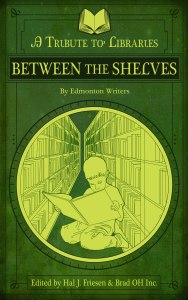
BetweenTheShelvesCoverThis interview was conducted by Hal J. Friesen in anticipation of the anthology’s release:

Trudie Aberdeen is a long-time language educator and social justice advocate. She is currently working on completing her PhD on the topic of heritage language acquisition. In addition, she teaches English to adult newcomers to Canada. Her academic interests include refugee education, multilingual literacy instructional practices, language conservation, action research, and language instruction for heritage language learners. Her research can be found in the following journals: The Manitoba TEAL, Multilingual Discourses, and the 9th Low Educated Second Language and Literacy Acquisition (LESLLA) Symposium. She also serves as the book review editor to the Canadian Journal of Action Research.

  1. The passion for your work is clear in every aspect of your writing. How long has heritage language acquisition been a part of your life? What started it all?

TA: I was raised in a middle-class, English-speaking family in Alberta. My childhood was fairly normal. And when I was a little bit older, similarly to most rebellious teenagers, I took my teenage angst and raged against my parents. While others were sexing, drugging, rock-n-rolling and doing other “naughty things”, I inflicted on my father what I thought might have been one of the most painful childhood revolts I could think of: I went to Campus St. Jean and took university in French! On my personal journey to bilingualism, I learned about the power of language along the way.

Contrary to current popular belief, I’m not really a natural when it comes to language learning. I’m someone who learns with moderate aptitude and great effort. I was always fairly successful in school, so learning that language learning was hard was a shock for me. So despite by best enthusiasm, I wasn’t successful my first year and was put on academic probation. Because I struggled with the language I was in a place very few white, middle class, English-speaking women with average intelligence ever get to be: I wasn’t part of the mainstream. For me, this is when I realized how language (or lack thereof) can limit one’s chances of success. I finished my degree successfully, although it took me more than four years and I had to spend a year in language classes in Quebec, but I eventually triumphed.

I taught in Japan for several years in an international school. I was the English as a second language teacher to elementary school aged children whose parents moved temporarily to Japan for business or diplomatic missions. I saw how quickly many of my students learned English and how quickly many of them forgot their mother tongue. I saw the parents who were “trapped” because if they moved home they could no longer put their children in school because the children couldn’t read or write their “mother tongue”. I also worried a lot for my students who appeared to have learning disabilities. Parents, colleagues and I often asked, “What is this child’s issue? Is it a language learning inability or something bigger?” Often it is difficult to know.

When I started my doctoral studies, I began to take interest in adult literacy learners. In my field of English as a second language teaching and learning, literacy learners are adults who grew up never learning to read their mother tongue, mostly due to limited opportunities because of gender, poverty, or war. Their lack of first language education impacts on their opportunity to learn English. They often struggle with things that most of us take for granted: following instructions for over-the-counter medication, signing their children’s homework log, figuring out a map, and reading street signs. Despite all of their challenges, all of those I have worked with have an undeniable spirit, determined outlook, and an often overlooked sense of intelligence.

My dissertation, however, looks at heritage language learners. These are usually the children of immigrants who have to navigate cultures and languages, not being conventionally “Canadian” and first-language English speakers, but not being of the same language and culture as their parents, either. Most of these children struggle to keep the language of their parents and cannot without the help of a larger language community and school. My work is looking at how schools and communities can support these students.

Heritage language learners and adult literacy learners do not initially seem connected, but they share many commonalities. Both groups often are trying to learn language in an environment that is limited in exposure to language. Both are often trying to learn language without literacy. In many instances, these two groups can be within the same family. Some immigrant parents (especially those with limited literacy) can struggle to learn English and their children can struggle to maintain their first language. In my line of work I have met many people who are unable to have a basic conversation with their parents because they do not know enough of each other’s language to exchange more than limited small talk.

  1. There seems to be a message or end goal with your writing / research. What is it you hope to achieve at the end of your dissertation? 

 TA: I hope to show the world exactly how much expertise exists in the field of heritage language education in Alberta. I wish politicians, educators, and scholars to know about the challenges and limitations that programs face so that they can receive better support in doing what they do best.

  1. Who has inspired you as either a writer or researcher? 

 TA: My four favorite researchers are Dr. Olenka Bilash, Dr. Kenneth Schaeffer, Dr. Nick Ellis, and Dr. Elaine Tarone. All four are gifted scholars and educators. However, what I admire most about them is their compassion and vision for making the world better for others.

  1. Would you be willing to share one or two stories from your experience as a language educator? 

TA: In 2004, I had a beautiful kindergarten student from Sweden called Hedda. She was a dream child: polite, kind, energetic, brilliant, and friendly. She started school in September and by Christmas she was speaking English well. Her reading level was near the top of her class. At the parent-teacher interviews, I gave her parents “the talk.” I warned them about language loss and the importance of first language maintenance. I told them that they had better start planning for her Swedish or else it would be gone. I recommended that they find her a tutor and begin reading lessons as soon as possible.

While Hedda’s mother seemed convinced by my message, her father was less so. He responded firmly, but politely, that Hedda was a little girl. She had just made a huge adjustment, according to her father, by leaving her extended family behind in Sweden and moving to Japan, and furthermore, she needed to worry about enjoying herself, not planning for her future education. I responded that while I respected his point of view, he should at least consider my suggestion. He told me that he would think about it after his family returned from their holiday in Thailand.

Sadly, all four members of Hedda’s family were lost in the 2004 tsunami that killed more than 250,000 people on Boxing Day. I often think of her and her beautiful family. I often think of the advice I gave to her parents, and consider what her father responded to me. For language learning, we need to have long-term planning, and to prepare for what is coming ahead. At the same time, we need to remember that this moment might be all that we have.

  1. Why do you personally think language is important?

 TA: If you ask a brain researcher or a psychologist, they will tell you about all of the cognitive benefits of bilingualism. Of course, I believe all of these things are true such as bilingualism increasing intelligence and delaying the onset of Alzheimer’s disease. Still for me, the most important aspects of language learning are social in nature. Language connects people to opportunities and it connects us to one another.

Check out Trudie Aberdeen’s story “Newcomers to Canada and Edmonton Public Libraries” in ‘Between the Shelves’, which you can purchase now on Amazon.
BetweenTheShelves_poster-YMCA-WEB

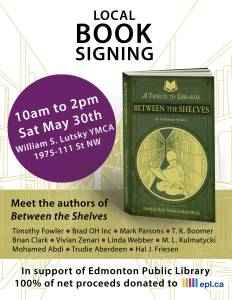
Finally, be sure to visit us for a ‘Between the Shelves’ signing this Saturday, May 30th at William S. Lutsky YMCA (1975-111 St NW) from 10am-2pm!

-Brad OH Inc.
Yours Truly

Under the Green Desk Lamp…

Green Desklamp

I’ve missed you.

I know that may come as a surprise, given my apparent absence. But you’ll have to trust that I’ve held you close in my thoughts, no matter how distant I may have seemed at times.

And it certainly has been a while, I won’t deny it. I’ve been quite busy, although explaining the nature of my work might be a little too heavy at the moment. But you’ve been busy too. Yes, you certainly have. Things have changed around here, even more than I might have imagined.

Not all for the worse mind you. No, I’ve seen some things since my return that have brought a much needed smile to my face—and that’s a rare thing indeed these days, I confess. The decoration I’m a bit split on, but there’s a lot beyond that to appreciate. You’ve had some great ideas, no doubt about it, and there have been moments when you really lived up to your potential.

…It’s just that they’re so damn rare.

Part of it may be my fault, I know—I’ve been derelict in my duties. In truth, I’d been hoping my presence was no longer quite so imperative.

I see now that I was misled. You’ve had a rough go of it lately. It’s hard to say where it all started to go wrong, but it’s far gone now, and it’s time we faced the truth.

I’ll start by apologizing once more for my distance. You deserved some assurance that I still remembered my promise. More importantly, you clearly needed it.

If I’m being entirely honest—and I am, without fail—I actually thought I’d left you with enough to get by. I gave you my word, and I told you everything you needed to know. I tried to make it as simple as I could, but even the clearest instructions grow blurry with the passage of time. And it has been a long time, to say the least.

You must have known I’d be watching though. If not, you should have.

I watched as you forgot who your family was, and turned your back on all the things which really mattered. I saw when you began to use me as a source of justification rather than strength. That’s really what hurt me the most.

What we had was a beautiful thing; at least I thought it was. But you’ve let your passion ferment into a bitter brew, and the intoxication it caused within you has become a blight on everything we once had. We never used to be about the fancy things, but now it’s all you seem to remember about me.

When I first laid eyes on you, I couldn’t help but adore your every fault. All your naïve desires were a wonder to me, and I revelled in your successes and failures alike, as each one made you more and more…you. The way you could be so content in your own head, the way you appreciated everything around you. I lived vicariously through you in some ways, and I adored your passion for creation. I could see myself in that.

But you’re so angry now, so defensive. It seems like whenever my name comes up, you’re ready for a battle. The constant anger is shocking—it’s almost like you wanted to keep me away. Things are different I know, but you can handle it without the blood and teeth and bile. I know you can, because I know you.

Still, I don’t blame you for being bitter. You needed more from me, when I only wanted you to find your own way. You called my name, and I didn’t answer. I tell myself that you needed to learn for yourself, but I know that’s only half true.

I’m not sure what I intended by reaching out again. When I left, I was certain that things could never change between us. Now, I only wish they could once more. You’ve grown unwieldy in my absence, and managed to become something entirely detestable to me. But it works two ways, and I know in truth that the change was at least in part because of my absence.

So what to do now?

It comes down to needs, I suppose. Needs, and wants. I want things to go back to how they were, but I know it’s unlikely. What do you want from me? I can scarcely imagine. Some assurance? Some comfort? I can offer neither. The road is long and hard, and I cannot carry you for all of it.

Maybe the cause is the cure as well. If nothing else, I’d like you to speak of me without the rage, without the need to do battle in the vainglorious hope of proving to others what you doubt in yourself. If that’s too much, then I’d rather you not speak of me at all.

Forget about me.

That’s all I can ask now.

We had a good run together. Great even, at times. But it’s clear we’re beyond each other now. The longer you hold onto the past, the greater damage you do to your present, and I worry that your time is growing short.

So let me go. Just pretend I never existed. Forget my words and burn my letters. Tell yourself you never needed me. Scream from the mountains that you’d be better off without me, that you are beautiful and worthy and glorious just because you are.

…Because you are.

Please, don’t ever forget it. And more import still, please don’t prove me wrong.

Yours Truly…

-Brad OH Inc.

Between the Shelves Book Signing and Interview with Author T.K. Boomer

cropped-cropped-blogbanner13.jpgThe following is an interview with T.K. Boomer, who appears in the Brad OH Inc. and Hal J. Friesen edited Anthology ‘Between the Shelves: A Tribute to Libraries by Edmonton Writers’, which you can now purchase here in either Kindle ($2.99) or Paperback ($12.50) copies. All proceeds are to be donated to the Edmonton Public Library System.

BetweenTheShelvesCoverThis interview was conducted by Hal J. Friesen in anticipation of the anthology’s release:

T.K. Boomer lives in Sherwood Park, Alberta, with his wife. In 2012 he began the awkward and painful transition between being a mainstream fiction writer and becoming a science fiction geek. Remnants of his literary past can been read in his novel, “ A Walk in the Thai Sun” written under the name G.J.C. McKitrick. The future will be revealed in the publication of “Planet Song”, first book in the Fahr Trilogy, probably in late 2015. Other aspects of the transition, like video game obsession and playing “Mr. Dressup” at SF conventions are proving to be more difficult.

1. What made you transition from mainstream into science fiction? 

T.K.: When I originally wrote and tried to place “A Walk in the Thai Sun” I ran into the problem of having written a book that was hard to market. It didn’t fit easily into any of the established genres and was rejected for that reason.   I wasn’t really writing for a mainstream audience but the nature of the book put it in that very broad category.  I’m not a good enough writer to compete with the likes of Margaret Atwood or Barbara Kingsolver so that was the other reason the book was initially rejected.    I resolved, at the time, to not write another book unless it would fit easily within an accepted genre.   When I got the original idea for “Planet Song” it was science fiction.  I did the research and decided that I could write in that genre.   However it’s quite different from writing mainstream fiction and there was a lot to learn.

2. In your story you hint that the Internet has been replaced by something else in the far future. What are your thoughts on what that might be, and what form it might take?

T.K.: My biggest fear is that we won’t move forward but rather retreat. I think the Internet is far too dependant on very complicated and vulnerable infrastructures. One bad solar storm could make a huge mess of it so my guess will be some kind of less vulnerable infrastructure. I think we have more interconnectivity now than we will have in the future. I also think that governments are going to move towards more control and less freedom.

3. Do you read paper or e-books, and which do you prefer? What about Siberius? 

T.K.: I read both but I think that within ten years most reading will be on e-readers. It’s simply a matter of economics and convenience. However if I’m right about the internet it could cause a resurgence in paper books down the road. As for Siberius, he’s a throw back. Notice how he was looking for physical books in the library?

4. Do you think libraries will become sentient in the future, and is that a good or bad thing? 

T.K.: They will but I don’t think sentient in the human sense of the word. The trick will be not to build in a survival instinct into our machines. We should not be trying to create a human-like mind in our machines for that reason. If we do then we’re asking to be out completed by them.

5. Who has inspired you as a writer? 

T.K.: Inspiration is a funny thing. I guess I gravitate to writers who use language in unique ways. It’s part of the reason that I still read a lot of mainstream fiction, because I’m more interested in writing technique than I am in tropes. Margaret Atwood is a favourite as is Anne Tyler and Iain M Banks and William Gibson.

Check out T.K. Boomer’s story “Five Hundred Years” in ‘Between the Shelves’, which you can purchase now on Amazon.

BetweenTheShelves_poster-YMCA-WEBFinally, be sure to visit us for a ‘Between the Shelves’ signing on May 30th at William S. Lutsky YMCA (1975-111 St NW) from 10am-2pm!

-Brad OH Inc.

Between the Shelves Interview with Author Timothy Fowler

cropped-blogbanner1.jpgThe following is an interview with Timothy Fowler, who appears in the Brad OH Inc. and Hal J. Friesen edited Anthology ‘Between the Shelves: A Tribute to Libraries by Edmonton Writers’, which you can now purchase here in either Kindle ($2.99) or Paperback ($12.50) copies. All proceeds are to be donated to the Edmonton Public Library System.

BetweenTheShelvesCoverThis interview was conducted by Hal J. Friesen in anticipation of the anthology’s release:

When not writing for Scribbles and Snaps, Tim works with a Global Fortune 100, leading a team of incredibly talented people to deliver the nearly impossible to their customers doing important work. He travels nearly full time as a result of this engagement, and part time for leisure. He scribbles pictures and snaps stories for his own pleasure and hopefully yours. He lives in St. Albert with his lovely wife, Saskatchewan-born farm girl, Kathy, and Gordon Setter, Rigby. He is Scribbler, Snapper, Navigator, Outdoorsman, Fellow Traveller. He is from Granite Rockies, and Prairie Dust, from Boreal Forest and Wanderlust. Tweet @TimothyDFowler or read his blog here.

  1. In “The Library”, you talk about the hours spent in your Aunt and Uncle’s library. Do you try to model your own home library after theirs, or after another library?

TF: My library mirrors my Aunt and Uncle’s with the soft light, big chair, and favourite books on dark wood floor-to-ceiling shelves.  Thick carpet under sock feet helps make it very quiet like theirs was. Sometimes guest’s children get rocked to sleep there. And the kids books are on the lowest shelf so they can choose which books they want to read, or have read to them.  I have my own childhood books on the lowest shelf.
Like their house, from the library you can smell dinner underway. I started my career in culinary as as apprentice then journeyman chef, now manager. Roughly a quarter of my books are related to food, collected over decades of kitchen work. Many meals are first conjured in the library. My uncle had a collection of food related books on the shelf, and I think of him often in his hotel kitchen.
My library feels like an extravagance, and I suppose it is.
Now I keep a special shelf for writing books, and borrowed books. I now apprentice as writer.

  1. You’ve been writing on your Scribbles and Snaps blog for a year and a bit now. How has that project evolved from when you started, and where would you like to see it go?

TF: For many years I have been quietly writing, but mostly keeping outputs to myself. “Platform,” Michael Hyatt’s book helped me decide to launch my Blog, and write in a public way. I write to entertain, and encourage readers to think about life experience in a new way. I hope the blog posts do this.
My goals for 2015 include submitting 52 pieces for consideration to be published. “The Library” is one that will be published in 2015.
Participating in the Edmonton Writers Group gives me candid feed back, caring coaching, and firm encouragement from fellow writers. Joining the group is one of the best things I did to accelerate my writing apprenticeship

  1. Did you start with writing or photography first? How does photography play a role in your writing?

TF: Since sharpening my fat red pencil and spelling my name with letters in the right order I have been marking up pages with stories. Recently I bought a LAMY fountain pen, and find writing longhand with a real pen and real ink on real paper, a sensuous pleasure. I am saving my money for a Sailor fountain pen with a gold nib.
Now I write by hand in a notebook every day.
After my sixteenth birthday I bought a Pentax 1000 35mm SLR. Before turning twenty I travelled the South Pacific, Australia and New Zealand making hundreds of photographs. I read Freeman Patterson’s great book “Photography and the Art of Seeing” and work hard to see.
We writers spend a lot of time wrestling words, showing over telling, but before any of that happens we need to “see.” So for me making pictures and writing are very much tangled up. I experience them together. I picture what I write, and I hear stories looking through my viewfinder. Metaphors are literary viewfinder for readers.
This is how I landed on ScribblesandSnaps.ca
I explore the question of “Why?” for both writing and photography on my blog.  I find them both rewarding, but recently have been focused precisely on writing.
Why write:
http://scribblesandsnaps.ca/why-i-write/
Why photograph:
http://scribblesandsnaps.ca/biography/why-i-make-pictures-3/

  1. Who has inspired you as a writer?

TF: Mark Twain’s “A Dog’s Tale” and “A Horse’s Tale” had a profound effect on me, teaching me about voice and story point of view. He tells gut-wrenching stories within stories. The story is not the story at all. And it is.

I know Stephen King is cliché-popular but his storytelling ability influences me today. He just jumps off the first word and tells the story. Recently Alberta’s own Fred Stenson’s “Feigned or Imagined” has been great fun and his writing started me on several stories of my own.
The truth is we are influenced by whatever we read, and now more than ever, I read constantly. Precise language and particular personalized description is such a pleasure to read, and a tremendous challenge to write.
Challenge accepted.

  1. What do your children think of your writing aspirations? Are any of them following in your footsteps?

TF: Both my boys are great storytellers, but neither has put pen to paper in a serious way. Both have a keen interest in photography. And both, if I may say, competently maneuver in the kitchen.
My whole family encourages me to write—at least to my face.

Timothy Fowler’s story “The Library” is featured in ‘Between the Shelves’, which you can purchase now on Amazon.

-Brad OH Inc.

‘Actually’

Under the Green Desk Lamp…

Green DesklampToday we have another song/ poem from the intellectual property vaults of Brad OH Inc. For your enjoyment, we present the lost ‘Basic Human Indecency’ song: ‘Actually’.

You walked out

I said it was ok

I signed on the line

Said you wouldn’t go that way

You were gone from my mind

Until the newspaper today

It said you’d returned

To your place from way back

The old needs recurred

Set you on that same track

Lessons never learned

You just wanted what she had

They never called me

But it’s with me all the time

Once trivial choice

Less thought than a dropped dime

You made her your last

And I guess you were both mine

And actually I

Guess I never knew you

Factually I

Thought I saw right through you

Now finally I

Wish I never blew you off…

-Brad OH Inc.

Between the Shelves Interview with Author Mohamed Abdi

cropped-cropped-blogbanner13.jpgThe following is an interview with Author Mohamed Abdi, who appears in the Brad OH Inc. and Hal J. Friesen edited Anthology ‘Between the Shelves: A Tribute to Libraries by Edmonton Writers’, which you can now purchase here in either Kindle ($2.99) or Paperback ($12.50) copies. All proceeds are to be donated to the Edmonton Public Library System.

BetweenTheShelvesCoverThis interview was conducted by Hal J. Friesen in anticipation of the anthology’s release:

Mohamed Abdi is a Somali-Canadian Writer with a Bachelor’s Degree in Communication Studies. He loves to read mystery and historical fiction novels and has written articles for both online and print magazines. Mohamed lives in Edmonton with his wife and children.

  1. Did the EPL play a significant role in your own immersion into Canadian culture?

MA: Absolutely. Edmonton Public Library has played a significant role in my broad understanding of Canadian culture and enabled me to immerse myself into the culture. This comes in the form of reading different books written by diversified authors, and I have realized that much of Canadian culture is built on readership and connection with libraries. In fact, I have been partly acculturated as I like to read and borrow books from the Edmonton public library. And readership culture is created and promoted by individual societies.

  1. When did you make the decision to start writing in English, and why is it so important to you?

MA: My university studies exposed me to writing opportunity, through essays, etc. As a result, I have developed a passion for reading and writing in English. I wrote my first English book in 2004. This was a non-fiction book, which touched on Somalis’ plight and their displacement after the civil war of 1991. I published my second English book in 2012. This was a collection of fictitious, short stories about Somalis’ predicament and their complicated conditions in various places of the world. I think it is so important to me to write in English, for English has become a universal language whose written materials and literature can be comparatively accessed by many people. So by writing in English, I can reach out to a wider audience.

  1. What advice would you give to other Non-Native English speakers trying to make their voices heard in English?

MA: My advice to Non-Native English speakers is to read as many books as possible, and to start putting your ink on paper and write things you have passion for, or concerned about, in other words. And you must know that your writing skill will not come overnight, but it has to start somewhere and grow gradually. So let you start somewhere and develop your writing skills onward.

  1. Who has inspired you as a writer?

MA: Somalia’s civil war has inspired me to become a writer. In fact, the insanity of that sinister civil war has set my mind into motion and compelled me to find responses as to why people wreck each other and take their countries apart. Why blood is spilled? Why children are orphaned? Why women are widowed? Are there alternate means of reconciling and resolving conflicts before resorting to the barrel of the gun?

  1. What is your next writing project? Can you tell us a little about it?

MA: I am now working on a novel (historical fiction) about Somalia, but don’t know how it will turn out or where this journey will take me, but I am determined to unleash my imagination and hone my skills for this project.

BetweenTheShelves_poster-FOR-WEBCheck out Mohamed Abdi’s story “Learning From Your Library” in Between the Shelves’, which you can purchase now on Amazon. And be sure to join us tonight, May 6, from 7:00-9:00PM for the official launch party in the Centennial room of the Stanley Milner Library!

-Brad OH Inc.

Album Review: Insane Clown Posse’s ‘The Marvelous Missing Link: Lost’

The Gentleman Juggalo LogoOn April 28th, 2015 Insane Clown Posse’s Violent J celebrated his 43rd birthday. This is no trivial accomplishment. With a childhood steeped in gang violence and accentuated by poverty, Violent J (aka: Joseph Bruce) may be lucky to have made it even beyond 20.

But something happened along the way which changed Violent J’s life forever. He formed a band. Along with his childhood friend Joey Ustler (aka: Shaggy 2 Dope), J built the Insane Clown Posse from the bones of defunct street gang Inner City Posse.

On October 18th, 1992, ICP released their debut full length album, ‘Carnival of Carnage’. The first in an album series known as the ‘Joker’s Cards’, ‘Carnival’ set ICP onto their lifelong musical odyssey. The Joker’s Cards are a series of thematic albums, each revealing some aspect of the listener’s inner-self—they display moral quandaries and psychic terrors like so many carnivalesque freak-shows.

Since then, ICP’s career has stood as a blazing contradiction to the ‘mainstream’ music industry. With the formation of their record label, ‘Psychopathic Records’, Joe and Joey have created an underground industry for themselves, bringing up countless other acts along the way.

With this sense of purpose, the lives of these two Detroit youth have morphed from nightmares to dreamscapes. Both describe their lives now as being filled with all the happiness and fulfillment they could have ever dreamed of. For more information about the genesis of the Insane Clown Posse, see the Brad OH Inc. article ‘Circular Journey’ (Link).

This all brings us back to April 28th—as this year, Violent J’s birthday also marked the release of the 3rd Joker’s Card of the second deck—‘The Marvelous Missing Link: Lost’.

indexClick image above to buy the album.

‘Lost’ is only one half of ‘The Missing Link’, with the other half—‘Found’—dropping later this year, on July 31st.

Like all Joker’s Cards, there is a very specific theme behind ‘The Missing Link’. As a whole, ‘The Missing Link’ refers to our internal link to belief—our connection to and faith in whatever keeps us on the right track.

Specifically, ‘Lost’ is about the experience of having no belief. Its dark tales tell of loss, death, and torment—the experience of any soul living in such a depraved world without any belief to buffer against the daily anxieties of such a life.

With tracks such as ‘Lost’, ‘Apocalypse’, and ‘Vomit’ painting hellish stories of misplaced anger and suffering, ‘Lost’ is accordingly one of the darkest albums the Clowns have ever released.

Without long-time producer Mike E. Clark at the helm, ICP have instead placed their faith in the talents of Psychopathic collaborators Mike P, Michael ‘Seven’ Summers, Brian Kuma, and one of the label’s up-and-coming stars, James ‘Young Wicked’ Garcia. This results in a daring change to the sound. While every album has certainly represented a significant shift in musical style—ICP have continued to explore their artistic range even after nearly 25 years together—this stands as one of the most radical departures for the group yet.

Marked by the heavy use of DJ scratching and industrial-style bass drops, the backing tracks are fast and heavy—contributing an often frantic pace to an album about the madness of lacking a sense of purpose. The disc plays at times more like a soundscape than an ordered collection of songs, with lyrics often sampled and repeated over and over—the usual raps slipping on many occasions into something closer to a Gregorian chant. In this way, the album is reminiscent of ICP protégé-band Twiztid’s stellar 2009 release- ‘W.I.C.K.E.D.’.

Garcia’s efforts deserve special credit here. Contributing many background vocals and several choruses including on the songs ‘How’ and ‘I See the Devil’, Garcia brings a fresh and welcome sound to the album—acting often as the distant voice of hope amidst the dark rumblings of ICP’s verses.

ICP’s delivery here is significant as well. While never competing amongst the most technically skilled rappers, the Clowns have always turned out crisp lyrics meshing well with their energetic beats. Not here. While frantic at times, the beats seldom flirt with anything close to ‘energy’—opting rather for a more frenetic, plodding, and often vulgar feel.

ICP’s raps follow suit perfectly. When not stuck in repetitive loops, the lyrics often come in disjointed bursts, as if being made up on the spot by a mind too occupied with more pressing concerns. This is especially noticeable in the song ‘Shock’, and fits well with the theme of being unable to control your own deranged impulses, despite how off-putting it can seem at first.

This attention to detail is consistent throughout the record.

While the intro can be somewhat brazen in its repetition, and even disturbingly overt in hammering the point home—it does much to illustrate the earnest message behind this brooding album: Find something to believe in, or risk being lost. Despite this theme however, the album does little to provide any idea of just what one should believe. If internet memes are to be believed, ICP are a couple of evangelical Christians, and thus the easy conclusion would be faith in the Christian God.

But you shouldn’t believe everything you read on the internet, and this is a perfect example. While the ultimate message of how to find your way will inevitably be addressed on ‘The Marvelous Missing Link: Found’, a recent interview in ‘The Detroit News’ did a good job showing the flexibility of Violent J’s views on the matter:

“Faith, for ICP, isn’t about any particular religion; Bruce admits he’s never read the Bible. It’s about finding something to believe in, whether that’s in one’s relationship with their spouse, their children or with art.” (Source).

But this isn’t to say that ‘Lost’ is entirely bereft of guidance. Several songs cover the issues of false beliefs—Money, Sex, Power, and other such temptations which distract people from finding a true sense of purpose. In ‘Vomit’, ICP tell the stories of two people who used sex and money respectively as their guiding principles, and end up lost in the depths of hell as a result.

Notably missing from the album is the familiar sense of humour so ubiquitous to other ICP releases. The lyrics and concepts are consistently bleak, with only brief glimpses of hope in songs such as ‘How’, which laments the confusion of trying to live a decent life amid such lurid distractions.

The album is moreover barren of any deep metaphor—which of course requires belief, as covered in depth in the former Brad OH Inc. articles on ‘The Metaphorical Imperative’ (Part 1 and Part 2). In an indirectly humourous twist, the song ‘Falling Apart’ accordingly eschews metaphor entirely. It tells the story of a man literally falling apart—fingers and limbs snapping off as he tries in vain to keep himself together. The song is punctuated by a surprisingly earnest chorus, in which Violent J channels his inner Rock Star to ask ‘What’s become of me/ I’m falling apart…’.

It pays off wonderfully.

The rest of the album plays out as a series of macabre stories and scenarios depicting the pitfalls of a life devoid of meaning. In stark contrast to most other ICP albums, the protagonist’s endeavours seldom end well, as evidenced in the song ‘Flamethrower’, where the Clown’s characters are ultimately killed. This subtly negative detail is similar to many songs from the group’s 2004 release, ‘Hell’s Pit’.

To me, one of the especially interesting things about this album is that it’s really not the album ICP probably ‘should’ have made at this point. Based on the huge surge of mainstream attention they garnered from songs like 2009’s ‘Miracles’, contrasted against the comparatively underwhelming reception they’ve received in the last few years, it would have made commercial sense to create a much more goofy album; ripe for public lampooning.

Instead, the Clowns opted to make a brazenly sincere album, focused on earnest meaning with a great sense of personal introspection. In theory, it’s the ‘wrong’ album to release just now, and that’s part of what makes it so damn interesting.

‘The Marvelous Missing Link: Lost’ is a daring album and bold new direction for ICP. Its heavy themes and plodding delivery often make for an uncomfortable listen, but that’s just the point. As is their wont, ICP have focused very intently on creating an LP that fits with their own artistic priorities rather than mass-appeal. This shouldn’t be surprising, as the band itself may be seen as the very ‘Link’ which raised Joe and Joey away from the fate of most children born to inner city poverty and set them on their purposeful path to happiness and fulfillment.

‘Lost’ is a dark, moody album. It’s not going to cheer anyone up, and this era in ICP’s career may be remembered as one of the least traditionally pleasant—challenging us with a barrage of negativity before moving on to the inevitably lighter tone of the ‘Found’ album. But ‘Lost’ does provide an important impetus for all of us to consider what really matters in our lives. It’s imperative that we take the time to recognize and cherish these things. Otherwise, our own Missing Link may never be ‘Found’.

The_missing_link_FOUND‘The Marvelous Missing Link: Found’ is out on July 31st, 2015.

A Note to the Reader: This is the first ever album review from Brad OH Inc. We hope you’ve enjoyed this new avenue, and encourage all of our fans to reply in the comments section with their thoughts on the review, or suggestions for other albums to review in the future.

-Brad OH Inc.