Ode to the Tavern

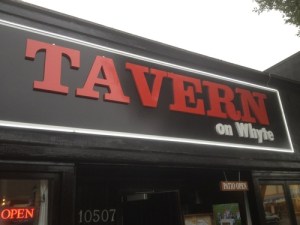
They say that behind every great man is a great woman. Well that’s goddamn sexist, and you should be ashamed for thinking it. But it may be true that behind every middling writer is a great drinking establishment. Therefore, we thought we’d take some time from our busy schedule here at Brad OH Inc. to acquaint you with the little pub that has been the birthplace to so very many of our greatest pieces: ‘The Tavern on Whyte’.

6- Ode to the TavernThe Tavern on Whyte’– Click the Pic to Visit their Site!

Now make no mistake, this isn’t some hair-brained scheme to establish the Tavern as a historical landmark. Not yet at any stretch. In fact, the staff here at Brad OH Inc. want to take this moment to discourage all potential stalkers and photographers from taking advantage of this profession of affection.

Rather, this is a simple declaration of love for an establishment which has acted as the de facto headquarters for Brad OH Inc. since the summer of 2013. The Tavern has seen the creation of the vast majority of articles here at Brad OH Inc., as well as the writing (by hand) of our upcoming novel, ‘Edgar’s Worst Sunday’.

And why not?

It’s comfortable, and quiet enough to think. It provides a fine view of Whyte Avenue without, and is always friendly within. So come by some time and have a drink—or enjoy any of the delicious selections from their unique menu. Chat with the staff and patrons, take in some fresh air on their patio (a true hidden gem of Whyte Ave.), and enjoy yourself.

Yes, the Tavern on Whyte has a lot to offer. But for this writer, it’s the staff that makes it the especially marvelous place it is. Now, it’s not just that they keep the ‘inspiration’ flowing, mind you. They do, no doubt—in fact we have to wait hardly a minute upon entering before we have an icy cold beer in our intensely focused hands. It’s the company as well—the conversations and inspirations. For truly the staff and patrons of the Tavern (past and present) represent many of the essential muses behind the writings of Brad OH Inc., and for that we are eternally thankful*.

*Disclaimer: This admission of appreciation is not to be taken as a legal acknowledgement of debt or the owing of royalties.

-Brad OH Inc.

‘Dog’

Under the Green Desk Lamp…

Green Desklamp

Today we have another song/ poem from the intellectual property vaults of Brad OH Inc. For your enjoyment, we present the lost ‘Basic Human Indecency’ song: ‘Dog’.

I met a man on the curb
Who told me he could see
The end of time the fall of man
And how it would all be

His beard was gray and tangled
His eyes were milky blue
His mouth was dry and twisted
At the things he thought he knew

I grimaced and kept walking
As he called out from behind
That I would have to listen
If he could read my mind

I turned upon my heel
Towards the bent old fool
He waved me to come closer
Mumbling through his beard and drool

He said my mind was simple
Although he could not read
A look into a person’s eyes
Is all that he would need

He spoke of how I judged him
And was so quick to place blame
He talked me up from my old pride
Down to my new found shame

He preached about the ease
Of instincts on the street
But said I’d have a clearer view
If I’d lie beside his feet

I put my hand upon my mouth
Felt the stubble on my face
I felt my strong back lean and tilt
Beneath his lessons weight

He told me that we all are born
From darkness and are blind
And all that we can ever see
Are the paintings of our mind

My eyes were glazing over
And my world began to spin
I guessed it was the old man’s breath
Which smelled of crusts and gin

He said he had to go
I pleaded for more time
I threw myself upon the street
And saw what I denied

People passed and shook their heads
As they looked down on me
I looked to thank the homeless man
For helping me to see

I saw that he was gone
Nothing was as before
I saw a man upon the curb
A man and nothing more…

-Brad OH Inc.

Regarding Religious Freedom

purelyspeculationOver the past several months, Religious Freedom has been one of the most prescient topics in the minds of many. People nationwide are having full-fledged meltdowns at the idea of baking a cake for a couple who view things differently than they do (Link), and a pea-brained Kentucky clerk has managed to convince a bunch of hysterical nitwits that she’s some kind of martyr (Link). At the same time, we observe mass hysteria at the entirely misguided notion that Sharia Law is coming to the West (Link).

Happily, much of this uncertainty is being put to rest even as we speak. With the passing of the Religious Freedom Restoration Act (RFRA) (Link), the Western World has done much to define how we will soon interact with the very populations we claim to fear the most.

The RFRA was passed in part to ‘protect’ Christians from being forced into such heinous and sinful behaviours as baking cakes for loving couples in a public bakery, or issuing a marriage-license at the county registry. See, to be expected to do your job for any member of the public interested in utilizing your services has of late been perceived as religious-persecution. If this is true, then the only thing we can glean of the religious convictions held here is that they demand first-refusal rights for persecution itself.

Yet the ploy has been working. While there can be no argument made that people in any civil society must be free to worship in any way they see fit (assuming no harm to others), we must be careful about the extremes we go to in protecting these rights, and more especially, the ways in which we define them.

Over the next few years or decades, we will inevitably see a great influx of Muslim immigrants—and understandably so (Link). Just as we must for any influx of people, we will need to learn how to coexist with these folks; setting up fair and equitable boundaries which allow for their comfort and ours alike.

Much as we see in ‘China Towns’ and other such cultural hubs, some level of independence must be afforded to any emerging population. Yet many in the west are understandably paranoid about the active assertion of ‘Sharia Law’ on our soil.

Now at the present, I consider this a hysterical over-reaction, but the current machinations of the right wing are actually doing much to strengthen the possibility.

As the religious right defines its adherence to age old biases as a ‘fight for religious freedom’, and asserts new laws protecting this notion, they are laying the groundwork for similar legal enforcements of other religions—one expression of which could conceivably be Sharia law.

Protection to practice religion is a fundamental right in any decent country, but it must be clear that this will not be limited to the most popular religion—nor should it. Everyone must be afforded the right to practice as they choose—so long as it does not affect another. Passing laws that allow Christians to refuse the sale of a product on an open counter to a gay person sets a terrible precedent: one that the courts could (and by rule of precedent doubtless should) use to justify the banning of ‘infidels’ from Muslim operated stores, and other such seemingly inconceivable rulings. If this is not the precedent we want to set for our growing minority populations, then it mustn’t be what we practice for ourselves. Any public storefront should be available to all—just as a non-Asian citizen is not barred from entering a restaurant in Chinatown.

As we go forth defining the ways in which we legislate behaviour and respect, we would do well to bear in mind the broader implications of our attempts. Currently, debate rages over the display of the Confederate Flag (Link), and this is another example of how our rulings on local issues will do much to define our interactions with foreign influences. Ultimately, the Muslim community may have an entirely legitimate claim that depicting the prophet Mohammed constitutes a hate crime under the same sort of laws which prevent Nazi sympathizing and holocaust denial in much of Europe. This is a slippery slope to be sure, but one we must navigate nonetheless.

The question is—where does it end? Common paranoia paints a picture of an America destitute of pork products, while strict public dress codes are enforced by threat of corporal punishment. This certainly may seem absurd to anyone who is not a strict adherent to Islam. Equally absurd to the non-Christian population is the notion of getting up-in-arms over a rainbow on a cake.

If it bothers you, consider simply looking away when you see men kissing (or women kissing…or anything else you may see). Alternatively, consider simply choosing not to order the pork option on a menu if it is against your religion. Such concessions as these are ones we have to make for the simple fact that we live in a society. And that moreover, is the essential point here.

The most effective place for Religion is to help us in coping with society, not in controlling it. As long as we continue to insist otherwise, it is imperative to remember that the way we define our relationship between the law and our currently-dominant religion will ultimately define how we interact with every other religion as well.

So for the sake of us all, let’s keep an open mind here people.

-Brad OH Inc.

The Key To Improving Our Collective Future

Under the Green Desk Lamp…

Green Desklamp

Of all the various topics covered here at Brad OH Inc., perhaps the most ubiquitous theme is our interminable conviction that despite all evidence to the contrary, this world can be better. We’ve covered the notion incessantly, and put forth several potential suggestions for how to achieve this lauded goal. Our ideas have ranged from the online management of resources (Link), to more informed protection of our environment (Link), and even to ‘The Uncomfortable Issue of Population Control’ (Link).

Yes, if there is to be any hope of improving this world of ours, there are unquestionably a tremendous number of considerations to attend to. We’ll need to figure out how to better manage our resources, how to feed our masses, how to improve our governance, how to avoid conflict, and how to escape the iron-grasp of our corporate overlords. And that’s just to get started!

But have no fear. Of course, we here at Brad OH Inc. will continue to work tirelessly in finding solutions to each and every one of these quandaries, but if we’re being entirely honest here, well, the truth is we just may not have the time. It’s quite the list after all, and even Corporate-Persons are subject to the rigid confines of mortality…for now.

Either way, this brings us to our topic today—and what a timely topic it is! If we are sincere in saving the world, then the first step is to agree on the single most important step to improving our collective future. And the key to that, in my mind, is unequivocally a greater investment in education.

While it is—admittedly—a long-term investment, significant support and improvement to our educational system is the most important change available to any country when considering the prospect of its future direction. While it may not arouse the sort of public fervor that a tax-cut or an increase in jobs (not necessarily an ideal goal–Link) would, the eventual payoffs will outshine any other source of investment ten-fold.

While all the other goals listed are certainly relevant sources to invest in if the objective is a sound society, the most essential point here is that in order to face the challenges of the future, we will absolutely need a dynamically informed populace: a generation of children fully capable of rationally considering the key issues of their time and critically evaluating the platforms of competing politicians. Therefore, education will be the most important factor in improving the woes of society.

No matter what other issues you may consider the key burdens on society, we will be unable to address them to the best of our abilities so long as we continue to be easily distracted and divided by petty corporate-politics. Without an informed and critical populace, we are doomed to be washed away again and again in whatever waves of popular trends the mainstream media establishment seeks to drown us in.

To escape this cycle, we need thinkers capable of solving problems rather than merely seeking distractions from them. It’s not a cheap solution to be sure. This notion would require not only significant dollars, but also a major overhaul of the educational curriculum. The leaders of the future will need strong foundations in philosophy, politics, critical thinking, problem solving, interpersonal communications, and so much more which we can hardly imagine. The world increases its pace each and every day…and we need our children to do likewise.

It seems simple, and it should be self-evident that we could truly solve many of the world’s ills if we invested half so much energy into education and science as we do marketing and deception. Yet unfortunately, that’s not the way the tides are turning (Link).

So here’s to the teachers, who continue to weather the storm. Though the rains come strong and the winds blow heavy, they keep their hand on the wheel and eyes on the stars—steering the youth of our world towards a place and time more hopeful than our own. And it is because of this unerring will to improve the generations to come that we here at Brad OH Inc. and many others the world over may maintain our own faith in the future.

So let’s teach the children to think, and pray that they do so better than we have.

-Brad OH Inc.

Fringe Fest Play Review- ‘Rigby Muldoon: Time Traveller for Hire’

cropped-cropped-blogbanner13.jpgLast Saturday I found myself skillfully navigating the crowded and popcorn reeking confines of the Edmonton Fringe Festival—lovely lady on my arm—in a hurried attempt to make it to the box-office in time. My friend Tom, the Stage Manager of the play I’d chosen to see, had advised me that advance tickets wouldn’t be strictly necessary, yet still an uneasy feeling mounted in my gut as I pushed through the mobs on the way to the PCL Studio Theatre.

As is often the case, my intuition had served me well—albeit late—and I arrived just in time to find the box office freshly out of tickets for ‘Rigby Muldoon: Time Traveller for Hire’. Damn my luck! What sort of fringe fest play sells out on its opening weekend?

Well, this one by all evidence. ‘Rigby Muldoon’ sold out its opening night in fact—and every other night since!

Written by Robyn Slack and directed by Olivia Latta, ‘Rigby Muldoon: Time Traveller for Hire’ is a noir-infused sci-fi comedy which tells the fascinating tale of aimless gamer-girl Annie Sinclair (Carina Morton), who is so desperate to undo the decisions of her past that she hires the services of the gritty and unabashedly noir-inspired time traveller: the titular Rigby Muldoon (Joshua Lee Coss).

Rigby And AnnieRigby Muldoon (Joshua Lee Coss) and Annie Sinclair (Carina Morton)

‘Rigby Muldoon’ was first test-read at Nextfest in June of this year, and only written in May. For such a relatively short turn-around time, the performance was impressively polished and professional—a 75 minute romp through time which brought consistent laughs to everyone in attendance.

While writer Robin Slack admits that the themes of the play are laid out on the table pretty early, the deft exploration of the subject matter keeps the audience guessing at several ongoing strands, while distracting like a skilled magician with a litany of jokes ranging from time-travel idiosyncrasies, to complex call back humour and even several plays at retro-inspired nostalgia (not limited to a Coolio reference!).

The tone of the show is unapologetic in its passionate dedication to what’s come before it—it’s innately chrono-conscious after all. The heavy noir imagery and attitudes manage to work incredibly well alongside the throwback video game references and 90’s irreverence which the cast find themselves mired in.

To give some context to the menagerie of mad settings and insightful writing you might find here, one stand-out scene involved a laser-tag shootout which served not only to make some key advances to the storyline, but also to utterly—and hilariously—tackle the concept of ‘trolling’. Take notes kids!

Of course, the humour isn’t limited to 90’s culture and unexpected twists: every facet of the stage design, costuming, and acting serves to solidify the intentionally overblown themes and self-aware quips. It seems at times that each scene might fit as well in a play of a totally different genre—but ‘Rigby’ is one of a kind!

In fact, as I sat watching the show in silent admiration, I realized how unsurprising it was that it had sold out every night it’s been put on. With its non-stop laughs and impressively subtle twists, it is the undeniable progeny of an unrestrained love for all things nerdy, coupled with an innate understanding of the fundamentals of good storytelling.

Group-1Left to Right: Laena Anderson, Robyn Slack, Joshua Lee Coss, Carina Morton

Speaking before the show with Writer Robyn Slack, I was assured that the play’s performance had exceeded his expectations. If so, he may be well-advised to broaden them before considering the next step for ‘Rigby Muldoon’. Its abundance of humour works on all levels while managing to make room for enough essential character building moments to keep the audience affectionately engaged throughout. My showing ended with an extended standing ovation from the sold-out crowd, and I can scarcely imagine the ending is much different no matter what night you attend.

As of the time of this posting, there are only two showings left of ‘Rigby Muldoon: Time Traveller for Hire’. You can catch it at the PCL Studio Theatre at the Edmonton Fringe Festival at the following times:

Saturday August 22nd – 8:45pm

Sunday August 23rd – 6:45pm

Just remember, unless you have the time-altering talents of the titular Rigby, you’d do well to learn from the mistakes of this writer and get your tickets in advance!

For More Info: Rigby Muldoon

-Brad OH Inc.

Album Review: Insane Clown Posse’s ‘The Marvelous Missing Link: Found’

The Gentleman Juggalo LogoOn April 28th of this year, the Insane Clown Posse released their album- ‘The Marvelous Missing Link: Lost’. This album was the first part of the 3rd Joker’s Card of the Second Deck. That’s a lot of jargon to sort through, but we here at Brad OH Inc. have you covered—just read our review of ‘The Marvelous Missing Link: Lost’ (Link) to help you sort it all out.

For now, suffice it to say that ‘The Marvelous Missing Link: Lost’ was one half of the two-part series known as ‘The Marvelous Missing Link’. The titular ‘Missing Link’ refers to our internal link to belief—our connection to and faith in whatever keeps us on the right track.

As such, ‘Lost’ was an exceedingly dark album both sonically and thematically. It described the existential horrors of living with no grounded set of beliefs—no sense of purpose to keep one rooted in positivity or faith. In our review of that album (Link), we discussed how this desperate state was represented in the genesis of the Insane Clown Posse themselves (Link). More to the point, the formation of the band may have been the moment when Violent J and Shaggy 2 Dope’s Missing Link was first ‘Found’.

This brings us to Part 2 of ‘The Marvelous Missing Link’—‘Found’.

The_missing_link_FOUNDClick image above to buy the album.

 ‘Found’ is a very different album from its predecessor, ‘Lost’. While ‘Lost’ focused on the absence of meaning in one’s life, ‘Found’ is the very opposite. With a theme of deliverance and hope, the positive basis of ‘Found’ is heard not only in its lyrics—which tend towards meaning and connection—but also in the sound of the album itself. Where ‘Lost’ was sonically a very dark and sinister record, dominated by industrial-loops and repetitive DJ scratches, ‘Found’ takes a different path entirely.

In fact, fitting to the subject matter, this release may stand as ICP’s most ‘mainstream’ sounding effort to date—with several songs (most notably the lead single, ‘Juggalo Party’) sounding not too dissimilar from the sort of jams you might expect in your typical nightclub. The content isn’t quite the same to be sure—it’s significant that this album sees the return of the Wicked Clown’s sinister sense of humour, which had been conspicuously absent on ‘Lost’—but the gentle rhythms and upbeat tempo provide for a much gentler aural experience.

Once again, this album has been produced without long-time collaborator Mike E. Clark. However, the now familiar team of Mike P, Michael ‘Seven’ Summers, Brian Kuma, and James ‘Young Wicked’ Garcia return to bring a fresh and effective sound to the album. The standout this time is ‘Seven’, whose smooth and flowing beats bring a reflective sense of peace to the album which is truly fitting for the subject matter at hand.

With the positive outlook and comforting tones of this album, the band is successful in bringing their audience a fun and reassuring experience. Song topics range from parties with friends, comfort in belief, and appreciating the time we have; all fitting well with the theme of the album. Others seem slightly less on point however, with songs such as ‘Lost at the Carnival’ or ‘Pineapple Pizza’ having little bearing on the overarching theme of the album, yet contributing in a broad Gestalt effect to deliver the familiar humour and style that the Juggalos demand.

‘Lost’ was certainly a more focussed album, never erring from its morose themes. ‘Found’ bounces around a bit more, providing for a more scenic if slightly distracted jaunt through many of the expected sights for those familiar with the band.

Similar to the track ‘Hell’s Forecast’ on the ‘Shangri-La’ album, the scattering of darker themed songs on this offering remind us how reticent ICP are to put out a wholly positive album. They know that the root of their fan base lies in ‘the Wicked Shit’ that started them off, and they are always more than happy to deliver. While this may ultimately mean that ‘Lost’ will stand as the greater artistic output of the two, ‘Found’ has an undeniable charm, and its positivity is unapologetically contagious—which is surely the point here.

Standout tracks include ‘OK’, ‘Lost at the Carnival’ (providing you have a system with good bass), ‘Juggalo Party’, ‘The World is Yours’, and ‘Time’. Other songs of note include the return to form ‘Shit-Talking’ song, ‘Get Clowned’, and the country-infused comedy track ‘Dreams of Grandeur’, which shows some heavy inspiration from their 2011 Jack White collaboration, ‘Mountain Girl’.

‘Mr. White Suit’ is something of a slow burner, but has been growing on me with repeated listens. The most direct ‘God’ allegory on the album, it’s a catchy track on its own, and an important departure from their standard fare of songs which does much to bring out the intended emotional effect of the album.

Still, while the narrative promise here was to explore the things which keep people connected to a sense of meaning or purpose, this album was less overt in its talk of higher powers than was ‘Lost’, particularly in the respective intros.

One important but subtle effort here is the distinction between the liner notes in each album. While ‘Lost’ was filled with images of violence and strife, in ‘Found’ we find images of friends and lovers, cooperation and progress. Similarly, while the Clowns (thankfully) avoid being too on the nose with their message, they do a good job throughout the album of incorporating themes of belonging and connection, while illustrating how little things such as friends, family, humour, and purpose can lift us out of the doldrums of a life devoid of meaning.

This mix of introspection and irreverence makes for a slightly off-focus, yet impressively poignant package. Too strong a focus on meaning may have left the album feeling heavy-handed. But by combining these topics with songs that are merely for fun, ICP accomplish their intentions with a more roundabout, show-don’t-tell delivery.

In our review of ‘Lost’ (Link), we explained why that album was not the one the Insane Clown Posse likely ‘should’ have released at the moment. ‘Found’ is much closer to that imaginary ideal. With its mix of upbeat bangers, comical irreverence, and anthemic crowd-pleasers, ‘Found’ is an album which—while it may not garner the level of media attention that 2009’s ‘Bang Pow Boom’ did (Link)—is certain to provide plenty of entertainment and meaning to the Juggalos.

And what better testament of success for this album? For just as the band itself acted as the ‘Missing Link’ for two young men in inner-city Detroit, so too have their musical efforts been the ‘Missing Link’ to countless people since—people who often have little else by way of meaning or purpose in their lives. To the Juggalos, the Insane Clown Posse have always been an opportunity to find that sense of purpose, and to that end, ‘The Marvelous Missing Link: Found’ is a terrific success.

-Brad OH Inc.

‘The Election’ Published on GonzoToday

cropped-cropped-blogbanner13.jpgHere at Brad OH Inc., we’re happy to announce that our Single Serving StoryThe Election’ is now available for reading on GonzoToday.

A direct link can be found right here.

Further, the downloadable version of ‘The Election’ over at Smashwords is very fast approaching the 100 Downloads mark. That’s even more reason to celebrate! Click on the image below to access a free, downloadable copy of ‘The Election’ on Smashwords.

theelectioncoverWe want to take this occasion to thank everyone who’s downloaded it for your support—we truly appreciate it, and hope you enjoyed the read. For those of you who haven’t yet read ‘The Election’, now is as good a time as any. So click here, or on the image above, and check it out absolutely free in any e-reader format that suits you! Alternatively, you can view it (along with many other fantastic articles) in-browser over at our friends ‘GonzoToday‘ by clicking right here.

-Brad OH Inc.

Saving the World: 101

purelyspeculationSupply and demand is the driving force behind any effective economy. Since the Industrial Revolution (Link) however, the face of the ‘supply’ end has been changing. As reliance on machines began to increase in the production of goods, the number of workers required has reduced correspondingly. Materials and goods are now produced more efficiently, and at lower costs to the producers.

Of course, like all things technologically driven, this process only tends to speed up exponentially over time. With the dawn of automation in factories, and technologies like 3D-Printing reinvigorating the revolutionary process begun in the 1800’s, the balance between supply and demand may never have seen such a radical shift. In fact, it’s entirely plausible that within a decade or two, we could produce the vast majority of our goods with little to no human investment.

As discussed in our article ‘On the Concept of Society’, the advancements of society are a cumulative process, and their rewards must therefore be shared equally amongst its constituents. Sadly, this is seldom the case.

While the supply end of the market grows ever easier, demand remains moreover the same, and the essential balance between the two becomes very different from what was initially intended. Rather than setting a price based on the amount of a good available contrasted against the demand for that good, we see a more methodical approach: With an unlimited quantity of a given commodity available to be produced at extremely low cost, what is the greatest amount that can be charged for that product without alienating consumers?

Therefore, the maximum amount is charged for all goods and services, while the financial gains resulting from improved means of production tend to filter only into the pockets of the business owners.

The final result is that the vast majority of the citizenry continues to struggle to meet their basic needs. Clearly, this system is no longer an acceptable form of management, but where do we go from here?

Let us consider the original need for economic systems such as the ‘free-market’ and its inherent reliance on ‘supply and demand’. The world—and moreover society—has always been in need of guidance, of a helping hand to direct us in the choices we need to make. In its historical absence, humans have spent the greater part of our existence inventing our own, then fighting over the results.

Usually, the established political system is intended to reign in the ambitions of the market place, but here too we have found ourselves struggling. Voters find themselves muzzled by corporate control of government, false-choice party politics, and the impossibility of getting any legitimate populist issue to the table past the corporate watchdogs.

So the economic systems can no longer function, and the political system won’t. There’s good news however. We may finally be at a point technologically where there is no longer any excuse not to begin work on a real solution to these co-morbid failings. A ‘God Program’, if you will. Its basis is already established in the internet, and certainly the tools are there to build towards an effort at human consensus through the ability to share ideas uncensored worldwide. This would benefit all people: both in the economic forum, and the political one.

Currently, the internet—with examples such as Reddit, Anonymous, Occupy Wall St. etc.—represents the incredible brilliance and diversity of our population. However, this brilliant spread of people have next to no representation in electoral politics. The political view is dominated by the opinions of crusty old business men who care only for their own profit margins.

Tapping into the full potential of the internet represents an incredible shift in our conceptions of democracy and political participation. In a return to something closer to Athenian Democracy (Link),this program would give the power of voice back to the electorate.

By fundamentally altering the existing architecture of the internet to handle these lofty ambitions, we could establish not only international, uninhibited communication on key political topics, but also a database of all fact and knowledge—with Wikipedia likely acting as a fine foundation for that concept.

The program would not only increase the political voice of all people, but fully manage the economic considerations outlined in our discussion of supply and demand. Its considerations would need to include population size and the balances therein, crop yield, required sources of work and how such might be distributed. Essentially, with a computer program evaluating all available supply and existing demand, society would largely be engineered rather than controlled—with science, math, and humanity acting as the fundamental drives, rather than money or power.

To be sure, this isn’t a new idea by any stretch—as far back as the founding of Technoracy Inc. (Link) in 1931, the notion of a society driven by logic and engineered from the ground up to meet the needs of all has been floating around. It just hasn’t gained much traction.

Why is that?

The society we have in mind would be ideal for everyone alive. With a perfect balance of resources, a deep understanding of social needs, and a computer program capable of predicting these needs and social shifts well in advance, we could hone our efficiency, while creating a Golden Age in regards to leisure time and cultural advancement.

Balancing all needs and efforts, and focussing a calculated portion of all proceeds towards scientific research that is not limited by the profit margins of corporate priorities, our overflow of resources could be harnessed to solve any new problem which might spring up—certainly not excluding the ultimate and near-inevitable need to begin mining and colonizing beyond Earth.

There would be room for businesses to thrive and continue to both produce and profit from innovative consumer goods in a truly free-market (un-manipulated by large-scale corporate interests), while government institutions and human resources would focus clearly on the benefit of all mankind.

With an extremely small and efficient active workforce, and the needs of all met by this program, opportunities would be available for anyone to pursue their passions, and these would directly benefit all. The idea of job shortages leading to poverty or starvation would be unheard of. Mothers or Fathers would stay home to take care of their children rather than greeting people at Walmart, and all people would be free to choose a pursuit which serves them the best.

The program would allow for balance and bounty, while increasing our leisure time and guiding us into a new era of economic and cultural prosperity.

So then, what might be standing in the way of such an idyllic solution? I suppose you’d have to ask yourself another question. Specifically—when we consider utilizing the internet as a salvation for society: controlling profits, balancing production, lowering costs, increasing personal freedom and social supports, improving unilateral political participation, and using excess profits for the betterment of all—exactly who could possibly stand to lose?

If you can answer that question, you’ll see the reason that society has not yet begun to take these easily available steps towards a more utopian ideal. But in the end, it’s not their hearts or minds upon which real change depends, but our own.

-Brad OH Inc.

‘Town of Truth’

Under the Green Desk Lamp…

Green Desklamp

Today we have another song/ poem from the intellectual property vaults of Brad OH Inc. For your enjoyment, we present the lost ‘Basic Human Indecency’ song: ‘Town of Truth’.

In the city with no lies

Things are not the same

Love is very rare there

There’s no such thing as blame

There are many ideas

And each one has a name

They name them for a dreamer

A man that’s not quite sane

In the city with no faith

There is no metaphor

They keep their eyes upon the ground

And guard dogs at their door

They know just where they came from

And where they’ll go forever more

Their science killed their magic

And life is such a bore

In the city with no soul

Each man is his own slave

He walks his path all by himself

Up to his lonely grave

Their medicine will cure a man

That he could never save

It can bypass the dreamer’s heart

Of which he only gave

But in the Town of truth

The eyes follow the mind

Dreams blossom to vision

Men smile and are kind

Yes the city may be ugly

But the town-folks they are blind…

-Brad OH Inc.

‘The Election’

Here at Brad OH Inc., we spend a lot of time discussing current political events, and what sort of future they might suggest. We’ve also explored many different writers and styles over the years. Today, we have a treat for you that combines the two!

Inspired by the unique ‘Gonzo’ writings of Dr. Hunter S. Thompson, ‘The Election’ is the story of a cynical journalist covering the heinous events of the fourth annual ‘United Corporate Election’. In this dystopian future inspired by contemporary politics, Corporations control all aspects of government, and elections have been reduced to satirical pantomimes in which citizens use their ‘Citizen Spending Credits’ to vote on their favourite features for the elected effigy.

Journalist Duke O’Brady ventures into this ridiculous spectacle to experience the madness firsthand, but may be in for more than even he anticipated…

This short story is one of our favourites–after all, what sort of self-loathing Corporation wouldn’t dream of such an idyllic future?

We certainly hope you enjoy it as much as all of us here at Brad OH Inc. enjoyed writing it.

theelectioncoverCover Art by- Troy Barker

‘The Election’- Smashwords

-Brad OH Inc.