The Little Book of Bourbon

Under the Green Desk Lamp…

Green Desklamp

The stink of sweat, and the wet hiss of street cars. Saxophones screech from dark alcoves like debutantes that took a wrong turn.

Pedestrians rule the streets, beaten up cars working around them like Indians in a barnyard. New Orleans is a city alive in the truest sense—throbbing with its own potential, adorned in its own inequity like Joseph’s spastic coat.

Here, a man can drink on the streets—paved with cobblestone and flanked by sweaty brick buildings 300 years old.

Citizens crazed—with heat, booze, or lust I cannot tell—approach and talk cordially amongst themselves, and this stranger as well.

As the absinthe flows, the thick, cloying air lightens in tandem with the mood, and the night is alive with a thousand potential stories both new, and as old as the dry bones used by the Voodoo Mama just around the corner, ready to divine fortunes for a false smile and a real fee.

Some men look at a city and decide upon its potential early. They go to bed with the falling sun, counting the hours until they can rise to cut deals and exploit the less proactive denizens of this shared hell they inhabit.

Others rise late and party till dawn, seeing the promise of the city instead scrawled upon the cobblestone alleys and dark crevices of the establishments reborn at dusk; eager to meet and engage with the searing enthusiasm burning in a city alight in its own decadence.

For them there is no hell—and heaven is just a street corner away.

I struggle daily with an overwhelming compulsion to defy the norm, to taste and touch as much of life as time will allow while balancing an ‘acceptable’ life. Others fight for normalcy in a world fraught with turmoil. The most we can take from this is the weight of experience on the psyche, and the importance of mad rushes of varied tastes and flourishes of culture. Old cities like this are a natural extension of the social impulse…a thing lost in more modern complexes.

The Natchez steamboat screeches calliope tunes at me as I pass misshapen statues and covens of filthy pigeons. The $300 I came with has been reduced to a dirty pack of crumpled ones.

My knuckles are bloody—seafood or scuffles, I cannot be certain.

I stop to listen to a soapbox evangelist, the frenzy of vacation scaring off my familiar apathy. But his words are unfamiliar, unexpected. He says that religion is an affront to the spirit. God is an ideal. Original sin—as it is described, is the animal nature in us all, whereas God is the perfect goal we are meant to aspire towards.

True or not—this is not the point; the goal is soul, and perfection is a high watermark to all the savage bastards on this earth.

There is a great sense of ownership in this city. Men speak of renovations like child-rearing, and date each building with the care of tracking genealogy.

The ancient weight of history rests upon the streets like a shroud, cloaking the denizens in its comforting embrace, and a sense of community identity permeates all.

It was around 4:00pm, in a small jazz club off Bourbon, when I realized that I’d never leave this town alive if I couldn’t acquire a strengthened taste for straight liquor and twisted people. But there is something horribly sleazy about drinking fine Bourbon from kitschy party cups. Like hiding cocaine in an animal shaped children’s party balloon.

There can be no doubt that I am yet to find true equilibrium. The battle between the boisterous extrovert and the mumbling, cantankerous recluse wages on daily.

Also, I’m a big fan of absinthe.

It’s a funny line to walk—being tugged between the joys and regrets so inherent to a life well lived.

But if a man can persist, and persevere beyond the quagmires he so ceaselessly chooses to embroil himself in, soon enough the straight road may reveal itself.

And just like that, things were making sense again. The night must get dark before the stars appear again to light the way. And if they need still further darkness… it’s always waiting on Bourbon St. …just a breakdown away!
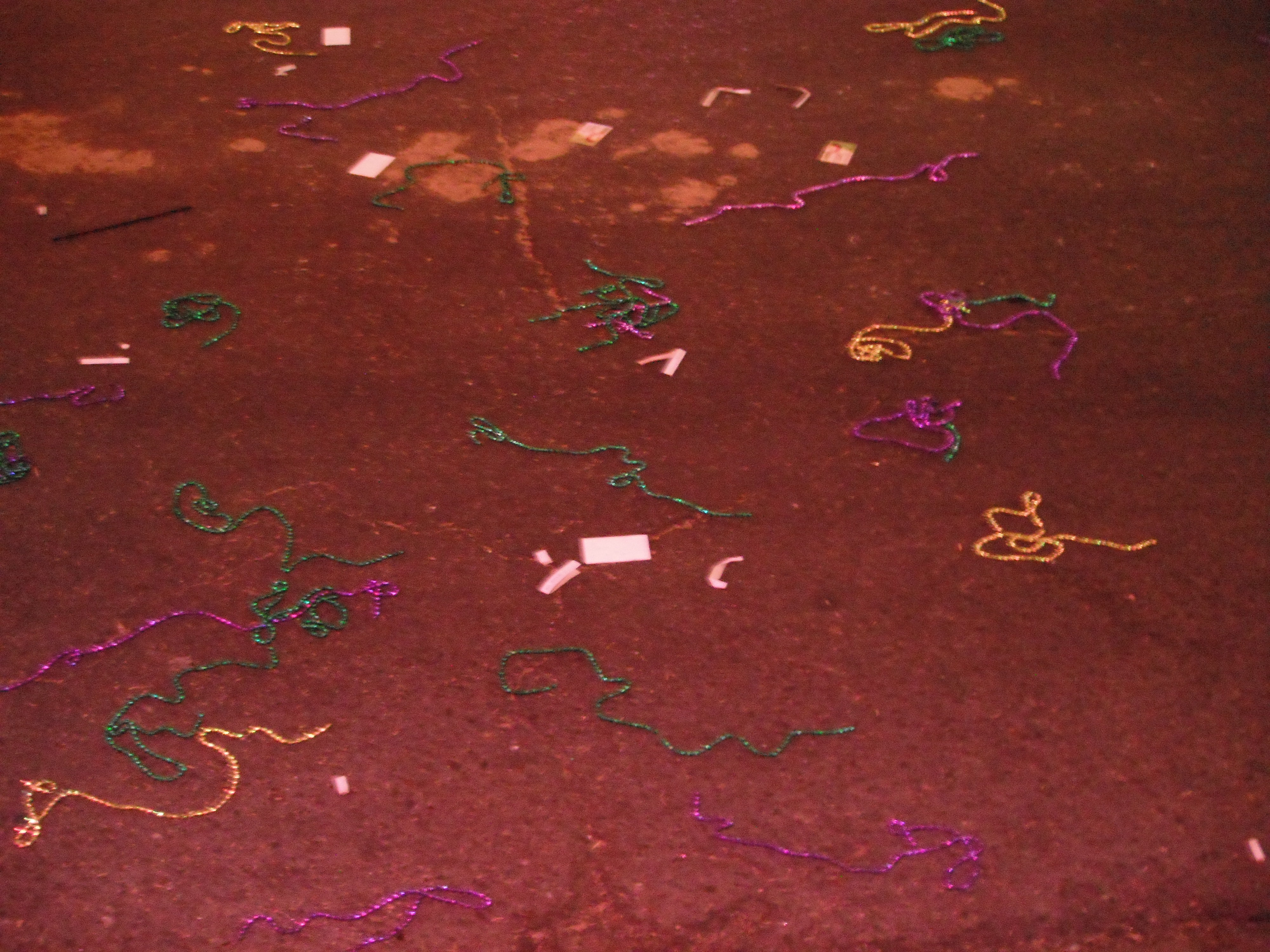
The Little Book of BourbonI’ve learned I lean towards an older crowd than my own age merits, more towards the 50+ blues crowd, willing to truly talk without any of the flirtatious pretension. But this knowledge does little to ease my mind.

A lovely lady lives behind the bar at ‘The Blue Note’ off Bourbon and St. Louis, and feeds me tastes of each drink she makes, providing shots for words as she purrs siren-like about her life and times in NOLA.

She was good, but he was better. She had the kind of angel voice and deadly looks that could with a word command a man into the sickest sort of depravities even he would never have imagined himself capable of. But he had the sort of prodigious talent, and plucked those strings with rhythm and precision sufficient to lift that same man to higher planes of self.

I’ve got to get out of this place. A city of saints and sinners in the truest sense—both more than willing to send a man off his rails and leave him begging for more while reeling with sickness and exhaustion… just as long as you tip.

But not just the tip. They’ll take it all. Your money, your ideals, your direction. Everything that separates a man from these goddamn flea-bitten apes you see on discovery channel as you drink your box wine and eat your cold pizza.

I’ll be dragged down for sure. Deeper than the determined bodies clawing their way up; jealous of those laying in the moldy crypts—spiting sea-levels and buoyancy for the sweeter rumours of voodoo and ancient evils.

No—they’re for another time. I’ll be down in the bayous, a bottle of Jameson clutched in my hand as the gators feast on my bones.

Elsewhere, a woman will stand alone, singing ‘Bohemian Rhapsody’ acapella as a man elsewhere strums out Beethoven on his guitar.

What am I rambling about?

I’ve got to get out of this place before I’m just a stain on its streets.

I’ve heard it said—both recently and before, that all the great things mankind has done have been the result of the powerful—corporations, empires, tyrants—these are the builders, and this I cannot deny.

But the stage is nothing without its actors, and the great stories and moments have always arisen from the fearless few willing to rise up and rage against the rat bastards with everything that makes us human and keeps us animal.

In the face of the depravity and madness I’ve faced, I still cast my lot proudly not with the world builders, but with the rabble and ravers of humanity.

I just need a woman with an eye for photography or an ear for music—either one will do.

I realized rather early on, but feel it all the more pressingly now, that this city must cease to fear the magic of the past and learn to harness that of the present.

A Guest Article by your Friend and Ours,

-Duke O’Brady

The Second Most Important Step to Improving the United States

purelyspeculationHere at Brad OH Inc., we have on several occasions (Link) covered an issue which is indisputably the most important step to improving the United States. That is the complete overturning of Citizens United (Link). This change stands at the foremost of all sorely needed improvements, solely for the reason that this ruling acts as the lynchpin to all the other changes the country—and moreover the world—so dearly needs. So long as laws are decided by the vote of Corporate dollars rather than the will of the citizenry, all other problems shall remain immutably entrenched in the quagmires of Corporate bureaucracy.

As this has been covered in depth elsewhere, however, today we will be focussing on what seems to be the second most important step to repairing the dismal affair that is the United States of America. Specifically, we’re talking about the significant reduction and reallocation of military expenditures. As discussed in our article ‘The Global Scale’ (Link), the current approach to foreign policy taken by the American government—the driving force here being the Military Industrial Complex (Link)—acts in actuality as the source of many of their current greatest woes.

As more and more effort is exerted to bring ‘freedom’ to the rest of the world, so grow the enemies of America—understandably bitter about the ‘foreign aid’ that comes in the form of drone strikes, trade embargoes, and unnumbered civilian casualties. This creates a dangerous cycle, in which the American populace—goaded by the bought-and-paid-for media—feels more terrified by the day, and are comforted only by the knowledge that their dear country is capable at any point of destroying the world in the name of saving it.

“But if you strip military spending, you’ll expose us to terrorists,” cry the feint-hearted American media-stooges. Well, let’s consider the facts for a moment—if that doesn’t seem too tall an order.

Based on presently reported statistics (Source), the United States spends approximately $577 Billion on its military each year. This is significantly more than the TOTAL of the next 10 highest spending countries combined.

I’ll allow a second for that to sink in.

With spending like this, America is rather like the kid who shows up to a water pistol fight armed with a firetruck. It’s Rambo intruding on a friendly game of cops and robbers—PTSD flashbacks and all. Simply put: It’s madness.

Meanwhile, infrastructure is crumbling (Source), the homeless population is ballooning (Source), veterans are left without care (Source), and funding for public education is being gutted (Source).

Looking at the numbers above, let’s consider the relationships here with a quick bit of theorizing. If—and this is a naivety to be sure—the US were to slash their military expenditures in half, they would be left with a yearly military budget of around $288.5 Billion. Now, while only half of what is deemed currently necessary, this would still leave the US with a military budget higher than the combined budgets of the next 3 highest spenders. That doesn’t seem like an especially dangerous situation to be in, especially considering that half of the top ten spenders are allies of America.

Further to this consideration, we’ve seen through manifold examples in the past, and as an ongoing theme of the present (Link), that military escalation is a losing game. Investment in war tends primarily to breed more war—with the only safety-net being found in mutual destruction.

If however, this budget change was made, America would remain far and away the greatest military power the world has ever known, and yet would have a sudden windfall of $288.5 Billion to spend on social services like Veteran Affairs, Welfare Programs, Education, Healthcare, Infrastructure, (real) Foreign Aid, Home Care Services, Senior Care, and so much more.

With such a change, America could begin to be the utopian saviour it so desperately wants to be, rather than the school-yard bully who beats on people until they praise him. By setting an example for the world of the sort of peaceful and genuine neighbour they could be, they would likely reduce their enemies greatly, improve many foreign relationships, and, if funds were allocated appropriately, perhaps solve global terrorism at its root, rather than merely spreading the fire.

The end-goal here should not be hard to see—by addressing this ridiculous budgeting fiasco, the US could be the beacon of hope it has always claimed to be, rather than just another blind threat uttered in the darkness of irrational fear.

-Brad OH Inc.

I Found God in the Drums of ‘Boléro’

Under the Green Desk Lamp…

Green Desklamp

This article is inspired by the classical piece ‘Boléro’ (Link), by Maurice Ravel (1875-1937) (Link). If you aren’t familiar with that piece, it should be considered required listening for the article to follow. You can find it here (Link).

I listened to this piece recently, and found an unexpected intensity within its plodding rhythm. I hadn’t put the song on for any specific reason, yet early in, I understood the depth of the moment I was having.

It should also be noted, perhaps, that I was at the time firmly entrenched in my (11th?) reading of J.R.R. Tolkien’s ‘The Silmarillion’ (Link), a book to which I ascribe particular inspiration. So you should probably read that, too.

Nonetheless, my revelation started with the first beat of that oh-so-familiar snare-drum. Described as an ‘ostinato’, the pulsing rhythm of this opening drum continues throughout the entire song, remaining constant as everything else is thrown into chaos.

It struck me immediately as terribly spiritual, although it took me a while to articulate exactly why that was.

You see, in ‘The Silmarillion’, the one God, Eru Illúvatar, conceives of creation as music—performed by his angels, the Ainur. The Ainur sing his tune, but among them is the spirit Melkor, who sews discord into the song, and causes turmoil. Some of the Ainur join in Melkor’s discord, while Eru adds new themes to the music to counterbalance Melkor’s efforts.

In the end, when all music stops, Illúvatar offers the Ainur an opportunity to see what they have done, and creates the world and all existence to reflect the reality of his divine tune. Unto the Ainur he says, “Mighty are the Ainur, and mightiest among them is Melkor; but that he may know, and all the Ainur, that I am Ilúvatar, those things that ye have sung, I will show them forth, that ye may see what ye have done. And thou, Melkor, shalt see that no theme may be played that hath not its uttermost source in me, nor can any alter the music in my despite. For he that attempteth this shall prove but mine instrument in the devising of things more wonderful, which he himself hath not imagined.” (Pg. 17)

Since childhood, this story always struck me as one of the most apt and inspiring metaphorical representations of the divine will. And so, as I listened to the ever-increasing notes of ‘Boléro’ rising above and competing with the persistent drum-beat in the background, this was the idea that settled in my mind.

The Silmarillion goes on to tell of the events of Middle-Earth being a representation of the Music of the Ainur, and assures us that although great evil does occur, its power is limited, and in the end all things turn to the greater good. This requires a lot of faith, but it’s something I’ve held onto since first reading it as a young elementary school boy—hoping that it would prove true in our world as it does in this fantastical place.

Throughout the duration of ‘Boléro’, the snare drums maintain their eternal beat in perfect rhythm. Meanwhile, horns and woodwinds, strings and symbols are taken up against the drums. They increase endlessly throughout the song, rising to an incredible cacophony and very nearly drowning out the snare drums which are their source.

At times, the listener can barely hear the drums, but when the music changes, or when there is a brief silence in the din, they are ever to be found beneath the turmoil, just as they were before. Patient, persistent, eternal.

Taking this in, I couldn’t help but feel I heard God in those snare drums. The music rising against it was like the duelling theme of Melkor—want and greed and malice and destruction. These are present still in our world, and will often threaten to overwhelm the senses of those unguarded ears who know not how to find the consistency of Grace beneath.

Much like the confusion of the composition at hand, it’s easy to get lost in this world. These days, perhaps more than ever, the myriad distractions and temptations we meet each day are easily sufficient to overwhelm the senses and deafen us to reason and decency. It takes a concerted effort and a determined will for us to focus on what is right and just, when so much around us seems so dark and hopeless.

But of late, I have seen greater evidence of Grace and beauty in this world than I have long held possible. It’s buried no doubt, often times nearly beyond reach. And all the while the daily racket of industry, and want, and loneliness and grief compete for our ear, turning us away from the true rhythm of the world and focussing us only on ourselves.

But to miss the rhythm is to miss the point entirely.

For no matter how dismal the world can be, there is light to be found, and beneath the din there is the rhythm of Grace for any with the will to listen for it. Immutable and constant, it plods along as it always has, unaffected and undeterred by all the competing noise, and when the racket of distraction dies down, its beauty sounds out all the clearer.

I know it isn’t easy. The clamour of discontent can be deafening, and it is often all too easy to fall into this discord and march along with the madness rather than keep to course. But this is folly, for no matter how distant it may seem, for every evil there is goodness still. Where there is hate, there is also love. Where there is terror, there may also be found mercy. For the loneliness of a consumerist society there remains the comfort of the family home. There is friendship, and loyalty, and faith, and hope, and honour…for every conceivable darkness, there is a light which can still set things right.

The drums of decency pound on, and when the din of darkness rises too high for the ears to readily perceive them, all the more must we focus our hearts and minds to that eternal rhythm, and trust that all will unfold according to that divine beat.

-Brad OH Inc.

On Human Nature

Under the Green Desk Lamp…

Green Desklamp

Among the most common battle cries of the reactionary and ill-informed political pundits these days is the infernal chant of- ‘it isn’t natural’. More often than not, it’s used as an attack on anything which fails to fit within the narrow confines of that particular person’s worldview, and is therefore considered unacceptable for anyone else to exhibit. It’s an ignorant and xenophobic reaction at its very best—but that’s likely giving it too much credit.

To speak of ‘normal’ when it comes to humans is an interesting notion. What can possibly be described as a ‘natural’ way for humans to act? Or the better question perhaps—what could possibly be unnatural?

Humans are unique, it must be said. We’re the only species known to use complex language—which does much to inform our ability to reflect on and consider our material world. More important still, we are the only living things we know of which are fully and fundamentally aware of our own mortality, a phenomenon argued by psychologist Ernest Becker to contribute to our psyche the drive of ‘mortality salience’, which binds our behaviours under the drive of what he refers to as ‘Terror Management Theory’ (Link).

These facets, combined with our incredible cerebral capacity, allow us to invent tools, define and solve problems, and create meaning in ways no other animal even comes close to achieving. Yet the fact remains that at the heart of this argument, our animal nature must be acknowledged. Most everything we do would seem foreign if exhibited in any other animal. Monkeys wearing hats? Unnatural! But…it may be natural to a person. At any rate, no one is going to make a political stance out of calling hats—or most any other clothing for that matter—unnatural.

If we’re being practical about the idea, the easiest approach to take would be to look back at our evolutionary roots, and conclude that anything beyond running around naked, scavenging whatever the greater hunters of the world leave behind, would be unnatural. But these ‘unnatural’ abilities we have are precisely what have gotten us here. Without clothing, tools, the harnessing of fire, and other such ‘unnatural’ acts, we would likely have been left far behind. The fire of reason that burns within us and allows us to defy our animal nature is the very key to our surpassing it.

So where might the line be drawn? Is clothing unnatural? If not, then why should we call kinky bondage clothing unnatural? Why is monogamy ‘natural’ (likely not the standard of early humans, and almost, to my knowledge, never in apes), but homosexuality unnatural?

Usually, the terms are meant more aptly to describe what is natural or accepted to the speaker in a pragmatic sense, rather than any true and intellectual consideration of what might be natural to human-beings as a whole. What one culture embraces as undeniable truth, another sees as lunacy. But in a worldview where exposed breasts are an unforgivable sin, yet veiled faces are a heinous affront, there is little room for rational discourse.

Ultimately, we may need to accept that the terms are nothing more than reactionary vitriol, unfitting of any discussion outside of ridiculous GOP debates. After all, with so much behavioural variance in an animal so far removed from true ‘nature’, there is truly no line to be drawn. Either everything we do is unnatural, and we are an aberration in the face of the natural world, or else nothing is. In the case of the latter, nothing at all could be considered unnatural. Just as it is the nature of the ape to draw ants from the hill with a blade of grass, so it would be within the bounds of our nature to clothe ourselves, and set fires, and split atoms, and alter DNA.

The human brain, at any rate, is a natural thing. So too then must be the products of that brain. So rather than waging our personal wars to define human nature, let us rather celebrate its quirky, unassailable depth. After all, we are the exceptions to a very broad rule, and our ability to seemingly defy nature is the very thing which has carried us out of the dark savannahs. It has led us from cowering at the sight of lightening to harnessing it, and taken us from the stony caves of our ancestors to the lauded cathedrals of our true worth.

So let us worry less about what is natural, and work rather to celebrate the diverse and divine nature that is common to us all.

-Brad OH Inc.

Regarding Religious Freedom

purelyspeculationOver the past several months, Religious Freedom has been one of the most prescient topics in the minds of many. People nationwide are having full-fledged meltdowns at the idea of baking a cake for a couple who view things differently than they do (Link), and a pea-brained Kentucky clerk has managed to convince a bunch of hysterical nitwits that she’s some kind of martyr (Link). At the same time, we observe mass hysteria at the entirely misguided notion that Sharia Law is coming to the West (Link).

Happily, much of this uncertainty is being put to rest even as we speak. With the passing of the Religious Freedom Restoration Act (RFRA) (Link), the Western World has done much to define how we will soon interact with the very populations we claim to fear the most.

The RFRA was passed in part to ‘protect’ Christians from being forced into such heinous and sinful behaviours as baking cakes for loving couples in a public bakery, or issuing a marriage-license at the county registry. See, to be expected to do your job for any member of the public interested in utilizing your services has of late been perceived as religious-persecution. If this is true, then the only thing we can glean of the religious convictions held here is that they demand first-refusal rights for persecution itself.

Yet the ploy has been working. While there can be no argument made that people in any civil society must be free to worship in any way they see fit (assuming no harm to others), we must be careful about the extremes we go to in protecting these rights, and more especially, the ways in which we define them.

Over the next few years or decades, we will inevitably see a great influx of Muslim immigrants—and understandably so (Link). Just as we must for any influx of people, we will need to learn how to coexist with these folks; setting up fair and equitable boundaries which allow for their comfort and ours alike.

Much as we see in ‘China Towns’ and other such cultural hubs, some level of independence must be afforded to any emerging population. Yet many in the west are understandably paranoid about the active assertion of ‘Sharia Law’ on our soil.

Now at the present, I consider this a hysterical over-reaction, but the current machinations of the right wing are actually doing much to strengthen the possibility.

As the religious right defines its adherence to age old biases as a ‘fight for religious freedom’, and asserts new laws protecting this notion, they are laying the groundwork for similar legal enforcements of other religions—one expression of which could conceivably be Sharia law.

Protection to practice religion is a fundamental right in any decent country, but it must be clear that this will not be limited to the most popular religion—nor should it. Everyone must be afforded the right to practice as they choose—so long as it does not affect another. Passing laws that allow Christians to refuse the sale of a product on an open counter to a gay person sets a terrible precedent: one that the courts could (and by rule of precedent doubtless should) use to justify the banning of ‘infidels’ from Muslim operated stores, and other such seemingly inconceivable rulings. If this is not the precedent we want to set for our growing minority populations, then it mustn’t be what we practice for ourselves. Any public storefront should be available to all—just as a non-Asian citizen is not barred from entering a restaurant in Chinatown.

As we go forth defining the ways in which we legislate behaviour and respect, we would do well to bear in mind the broader implications of our attempts. Currently, debate rages over the display of the Confederate Flag (Link), and this is another example of how our rulings on local issues will do much to define our interactions with foreign influences. Ultimately, the Muslim community may have an entirely legitimate claim that depicting the prophet Mohammed constitutes a hate crime under the same sort of laws which prevent Nazi sympathizing and holocaust denial in much of Europe. This is a slippery slope to be sure, but one we must navigate nonetheless.

The question is—where does it end? Common paranoia paints a picture of an America destitute of pork products, while strict public dress codes are enforced by threat of corporal punishment. This certainly may seem absurd to anyone who is not a strict adherent to Islam. Equally absurd to the non-Christian population is the notion of getting up-in-arms over a rainbow on a cake.

If it bothers you, consider simply looking away when you see men kissing (or women kissing…or anything else you may see). Alternatively, consider simply choosing not to order the pork option on a menu if it is against your religion. Such concessions as these are ones we have to make for the simple fact that we live in a society. And that moreover, is the essential point here.

The most effective place for Religion is to help us in coping with society, not in controlling it. As long as we continue to insist otherwise, it is imperative to remember that the way we define our relationship between the law and our currently-dominant religion will ultimately define how we interact with every other religion as well.

So for the sake of us all, let’s keep an open mind here people.

-Brad OH Inc.

Brad OH Inc. Partnership with ‘Trolling with Logic’

cropped-cropped-blogbanner13.jpgToday, we here at Brad OH Inc. are happy to announce that we’ve been invited to share our posts with a brand new source. The good folks over at ‘Trolling with Logic’ have asked that we join their efforts in exploring some of the hard hitting and more divisive topics of the times. Needless to say, we were happy to accept the challenge.

So henceforth, select postings from Brad OH Inc. will also be accessible over at our very own ‘Trolling with Logic’ blogroll, accessible here!

This is an exciting opportunity for everyone here at Brad OH Inc., and we want to take this moment to thank our friends over at ‘Trolling with Logic’ for the chance to reach this exciting new audience. Also, for all of you dedicated Brad OH Inc. fans who haven’t yet, be certain to head on over to ‘Trolling with Logic’ and check out the bounty of unique content they have to offer!

Your Dear Friends and Ever-Expanding Imperial Overlords,

-Brad OH Inc.

‘The Election’

Here at Brad OH Inc., we spend a lot of time discussing current political events, and what sort of future they might suggest. We’ve also explored many different writers and styles over the years. Today, we have a treat for you that combines the two!

Inspired by the unique ‘Gonzo’ writings of Dr. Hunter S. Thompson, ‘The Election’ is the story of a cynical journalist covering the heinous events of the fourth annual ‘United Corporate Election’. In this dystopian future inspired by contemporary politics, Corporations control all aspects of government, and elections have been reduced to satirical pantomimes in which citizens use their ‘Citizen Spending Credits’ to vote on their favourite features for the elected effigy.

Journalist Duke O’Brady ventures into this ridiculous spectacle to experience the madness firsthand, but may be in for more than even he anticipated…

This short story is one of our favourites–after all, what sort of self-loathing Corporation wouldn’t dream of such an idyllic future?

We certainly hope you enjoy it as much as all of us here at Brad OH Inc. enjoyed writing it.

theelectioncoverCover Art by- Troy Barker

‘The Election’- Smashwords

-Brad OH Inc.

Embrace the Security State

cropped-blogbanner1.jpgHere at Brad OH Inc., we are acutely aware of the ongoing concerns over government infringements on personal security (Link). At an ever increasing rate, governments are worming their ways into our homes, businesses, and private lives—all in the almighty name of security.

While these government intrusions into public life are most often done under the broad banner of national security, this isn’t the case for all instances of data theft. Next time you’re browsing through your favourite social media sources, take some time to observe the side-bar of advertisements tailor-made for you based on websites you’ve recently visited or items you’ve considered buying. This is all possible through the ability of the current website to read your browsing history and sell it to advertisers.

And why not? No one reading this right now has the ability to protect themselves from international killers any more than they have the clairvoyance to choose what to buy for themselves. No matter whether we’re discussing terrorism, cyber-security, or consumer habits, it’s foolhardy to deny that without corporations, we are as helpless and exposed as fish in a barrel—or the ocean at the very least.

It’s inevitable that we rely on corporations for these fundamental needs, just as we rely on them for everything else: the building of infrastructure, the shaping of our society, and the social stratification of our population. So let’s take a moment to calm down, cause I’ve seen a lot of griping going on about the notion of the government and corporations perusing through our personal data in order to serve us better.

At Brad OH Inc., we suggest you give up this tired charade. Safety, privacy, and advertisements are better left to those who know how to run things. Worrying is for the birds, and in our humble opinions, the only action left to your sorry lot is to relax and accept the inevitable. After all, be it civil liberty or private data, the only real way to protect what you own is to own nothing at all!

Maybe this notion seems hostile to you? Maybe you’re the sort that easily set off by trifling abdications of liberty? I’m sorry to tell you, but you’re entirely wrong her. Consider this: if you don’t like what you’re reading right now, maybe it’s your own fault. After all, if we here at Brad OH Inc. had the level of access to your personal lives and information that the government and other corporations do, we could happily go out of our way to ignore reality and write up just about anything you wanted to hear.

…Just like they do.

-Brad OH Inc.

The Metaphorical Imperative Revisited

Under the Green Desk Lamp…

Green DesklampIn our last article, ‘Without Words’ we reflected on the idea of what the world would be like without the vocabulary to define it. The concept was an interesting one to write about and consider; ultimately, it got us thinking back on another article we wrote, ‘The Metaphorical Imperative’.

The Metaphorical Imperative, for those who don’t recall, was a notion we explored about the source of and meaning behind creativity. In a nutshell, the idea is that as human beings evolved and our cerebral capacity expanded, the ability to question our world or ask ‘why’ would have appeared around the same time as the ability to use abstract conjecture to answer the question. These activities are certainly tied to language, although they need not be defined by it. Still, for the purposes of this article, we will take articulated thought as the base point for our considerations.

The fundamental assertion behind the concept of ‘The Metaphorical Imperative’ is that if humans owe any reverence or thanks for their current state, we owe it to the incredible work of evolutionary architecture that is our own minds—not to any god, devil, or undefined miscreant in between.

The need for existential reassurance, the fear of death, and the question of what we are and why we are here; these are all the direct products of a brain grown sufficiently complex to wrestle with such abstractions, and this alone is more miraculous and better cause for celebration than any story I’ve read in a holy book.

But that leads us to the next point. If our ability to ask questions is a miracle, what can be aid of our ability to create the answers for them?

Metaphor is the abstract use of one object to find or create meaning in another. If abstract thought is the impetus for asking ‘why’, then the tool for answering it is metaphor. My contention is that these abilities would have evolved in relatively close proximity to one another, representing a true ‘awakening’ of humanity.

If we are to discuss metaphor and meaning, we might as well start with one of the most famous—and central to our current topic. In the Garden of Eden, it’s said that Eve (that reckless upstart) ate from the tree of knowledge of good and evil, and thus doomed mankind forever.

Thanks a lot, Eve.

I find an interesting parallel in this. This fruit, the ‘knowledge of good and evil’ which caused mankind’s fall from innocence, is symbolically comparable to the notion of the Metaphorical Imperative, in which we gain both the ability to question our nature, and the skill to fashion suitable answers.

But it’s really the answers that interest me here; the nourishing apples to the terrible hunger of ennui. Via our ability to create meaning, the human race has tapped into our most fundamental and defining abilities: creation, art, and belief.

The power of this ability might be observed most directly in expressions such as organized religion, whose depth of belief has inspired acts of miraculous empathy and terrible cruelty. But the power of metaphor isn’t limited to religion alone. Any story—TV shows, books movies, video games—has the power through metaphor to provide just as much as religion to anyone with the ability to relate to it on a personal or psychological level.

Stories are the foundation of all culture; ideas, philosophy, art and religion, the fundamental basis of humanity can be defined as the ability to dream things up in a way they are not.

There are no exceptions. Whether it’s sports, gods, science-fiction, or science alone, everyone places their trust in some grand idea, anchoring their hopes and aspirations to some intangible notion that rings true to them.

Luke Skywalker, Aragorn, The New Orleans Saints, Zen Buddhism, Zeus and Allah and Jesus, all the angels in heaven and demons in hell have sprung from this one key human drive. All art is the product of the metaphorical imperative, and stands as testament to everything which makes us human.

But here an important consideration arises in our series of metaphors. If, as suggested earlier, this key drive which makes us human (for both good and ill) was represented as the great deception of the devil in the garden, then perhaps all artists are in fact worshipping the devil.

Perhaps the development of consciousness and desire in humans was an accident—a random fluke forever changing the course of our species. No doubt we would have existed in perfect harmony with our environment if we’d never developed the capacity to believe we are separate or better.

Maybe it’s a good thing, and maybe not. But although this cerebral capacity has led to great pain and suffering throughout history, I refuse to believe it is not also the thing which will see us to what we need to become. Creation and metaphor, for all our missteps, define us as the beautiful, shining bastards we are, and will someday show us just how incredible we can truly be.

All we need to find is the right story.

-Brad OH Inc.

Without Words

Under the Green Desk Lamp…

Green Desklamp

Among the many blessings inherent to being a writer, paramount among them is the gift of always having the right word for a given occasion. Any writer—and even well-read non-writers—knows the thrill of pulling out some million-dollar word that so perfectly encapsulates your predicament it seems made just for the occasion. But recently, I found myself wondering just what sort of blessing this is, and whether with every proud smile and impressed friend that comes with knowing how to effectively articulate some miniscule event, some greater thrill may be lost.

What would the world be like without words?

Not many know—and those that do would certainly have a difficult time expressing it. It’s a primal sort of idea, hearkening back to cold days huddled around small fires on the plains of the savannah; gazing with inexpressible unease into the encroaching dark.

Sitting at that fire, you might feel the cold creeping into your bones, and with no words for why, toss another handful of sticks onto the glowing coals of your salvation. The flames would lick up; tiny firefly sparks sailing up into the boundless night sky to get lost among the countless, brilliant stars that watch you each night from above as the wolves watch from below.

The heat would swell, pushing back the creeping chill of night in its eternal yet ultimately futile battle. You might smile, and your head would swim with the wonder of it all. You would understand the connections and worship the results, but you’d have no words for the meaning behind it. A smile would have to suffice.

The next day would find you rested and warm, the sun back again, reliable as ever, chasing away the nameless demons of night and promising again that the familiar cycle would continue. And you would be glad.

There would be no words for the joy that day brings, nor the trepidation you might feel when the thunder clouds roll in, covering up the sun and threatening with their deep voices to tear the sky asunder.

With all the terrible fury of an unimagined god they would come, beating down with rain and hail from above, and shattering the mountaintops with flashes of authority beyond description.

Imagine then the relief when they passed, and again the world returned to normal—like it always did. Imagine the thrill of security and the reassuring surge of faith in your pounding heart: imagine it all without words.

So too would every waking moment be defined by such wonder. In the world we live in now—there are words for everything, even if at times many seem to fall so pitifully short.

Without words, how confounding would be ideas like hate, and love, and grief. Without a means of expressing them, how could we ever let go of that which hurt or hallowed us. All would be reduced to the guttural screams of terror or triumph; communication shackled to the hair-tearing passions of inarticulate isolation.

With no weather systems or science or writing, the world would be an unpredictable place of magic and mania—and every turn would bring some uplifting new idea which would lie stillborn on lips incapable of giving them birth.

It’s a marvellous but inaccessible idea. I think about it a lot, and slide every time down an unspeakable precipice of wonder and nostalgia, as if touching by proxy upon the culturally inherited passions we all share in our ancient past. It fills me with an incredible sense of awe, but each time I’m moved to encapsulate the extent of such feelings, I find sadly that I am without words.

-Brad OH Inc.