Resource Connection- ‘LearningTime Canada’

Today, we’re happy to share an incredible resource from our friends over at LearningTime Canada. At LearningTime Canada, you can create custom children’s books and personalized learning paths from prenatal to age 10. These make great gifts and custom memories for your precious little ones.

Don’t take our word for it though, check out what they have to say:


Transforming Young Minds, One Personalized Page at a Time

LearningTime Canada is pioneering a transformative approach to early childhood education, harnessing the power of artificial intelligence to create personalized learning experiences that are as unique as your child. Our mission is to foster a lifelong love for learning by crafting educational journeys tailored to each child’s individual needs, interests, and developmental stage.

Our Vision: A World Where Every Child Thrives

We dream of a future where every child, from the moment of birth, is embraced by the power of literacy. Our goal is to eliminate illiteracy by ensuring that every newborn receives a personalized book, setting the foundation for a lifetime of learning and growth.

The LearningTime Canada Difference

  • Personalized Learning Paths: Using state-of-the-art AI technology, we create custom-made children’s books that adapt to your child’s unique learning style and interests.
  • Comprehensive Coverage: Our subscription service spans from prenatal development to age nine, covering the crucial first decade of a child’s life.
  • Engaging Storytelling: We believe in the power of stories to ignite imagination, foster creativity, and cultivate a deep-rooted passion for learning.
  • Multilingual Options: Embracing diversity, we offer books in multiple languages, supporting families with varied linguistic backgrounds.
  • Parental Empowerment: We provide tools and resources to help parents actively participate in their child’s learning journey, strengthening family bonds through shared educational experiences.

Our Comprehensive Package

  • A custom prenatal read-aloud book
  • A special “Welcome to the World” book for newborns
  • A selection of Baby Firsts
  • ABC + CH Read Alouds
  • 5 to 10 books per year
  • A Happy Birthday Book each year customized for your child
  • over 150 different personalized storybooks and adventures to choose from
  • A customized ABC Read Aloud book featuring your child’s name and interests

Join the Learning Revolution

At LearningTime Canada, we’re offering more than just educational products – we’re pioneering a transformative approach to learning that empowers children, engages parents, and shapes the future of education. By choosing LearningTime Canada, you’re investing in your child’s future and contributing to our vision of educational equality and excellence.

Embrace the LearningTime Canada advantage and embark on a journey towards educational innovation. Let’s make a lasting impact on early childhood education and inspire a generation of lifelong learners.

Visit LearningTime.ca to explore our offerings and start your child’s personalized learning adventure today.

We are 100% Canadian and Straight Out Of Edmonton!


We hope you enjoy them!

-Brad OH Inc.

Single Serving Stories Series- ‘Circular Journey’

In addition to regular blog articles and my published novels, I’ve also written several Single Serving Stories over the years. Some have been published in anthologies like ‘Between the Shelves’, ‘Edmonton: Unbound’, and ‘All Mapped Out’. Others have been shared exclusively on this blog via the publication platform Smashwords.

Recent changes to the Smashwords platform has made it a less reliable option however, and therefore an exciting change has come to Brad OH Inc.

I will be re-sharing in full—un-edited and un-abridged—all Single Serving Stories previously published on Smashwords with Brad OH Inc. as the new, exclusive provider. All text will be provided in full, with no download necessary. If Smashwords don’t like that, they can message our complaints department.

This project will culminate in a couple of heretofore unpublished Single Serving Stories, so even the most dedicated of readers will have something to look forward to.

Today’s article is a bit of a change up, not a short story, but rather an old essay examining one of my favourite artists through one of my favourite psychological lenses. I hope y ou enjoy it as much as I do.

A Psycho-biographical Study of Joseph Bruce (AKA Violent J of the Insane Clown Posse)

Terror Management Perspective

Joseph Bruce, aka Violent J of the Insane Clown Posse (ICP), is one of the creative forces behind what could be described as one of the most perplexingly twisted musical forces of our time. With lyrics fueled by violence, profanity and rage, ICP has found itself on the receiving end of multitudes of protests, and have been all but completely marginalized from the mainstream music industry. Despite this, the diehard fans of the ICP- called ‘Juggalos’- have sworn a near-religious loyalty to their music, painting their faces to attend shows and swearing that there is more behind the music than most people seem to believe. The intention of this paper is to explore, from the perspective of Terror Management Theory (TMT), which processes may have led to the creation of music that is so commonly reviled by the public, yet so highly revered by those who take the time to put together the pieces. The main focus of this paper will be to explore the psychological function (based on Terror Management Theory) of the lyrical concepts and album themes underlying the 12-year, 7-album saga: ICP’s 6 Joker Cards.

Terror Management Theory (TMT) stems from the research of cultural anthropologist Ernest Becker, and has been conceptualized in full by others since the original work (Greenberg et. All, 1991). TMT serves as a broad social theory that attempts to explain the rational motivations for various facets of human belief and behavior. Its’ focus is the way in which people buffer themselves against the terror that naturally arises from our awareness of death. Because people have a natural instinct to stay alive, yet have the temporal capacity to know that death is inevitable, we are faced with death anxiety. TMT asserts that we deal with this death anxiety by investing in what is known as a cultural worldview. A cultural worldview is essentially our belief system; it serves to give the world order, predictability, meaning and permanence, and provides a reassurance of our ability to transcend death. The cultural worldview is comprised of an idea of who we are, moral conceptions of right and wrong, and an idea of what will happen to us after we die.

The cultural worldview acts to buffer us against death by assuring us that, if we follow the dictates of our worldview, we will be able to achieve some level of immortality in the sense that we can live on through our children, our creations, the memories of loved ones, etc. It also buffers against the anxiety of death by assuring us that if we are to follow the moral principles of our worldview, we may be rewarded in the afterlife. This works only to the extent that our cultural worldview is supported by others; as the more widely received it is, the more plausible it seems, and thus the more effective its’ function.

Jock Abra supports many aspects of this theory in his paper (1995), in which he asserts that artistic creation is a process of self-immortalization, and functions as a cathartic relief of the fear of death, often in the reflection of it. This, along with the prime dictates and focus of TMT, does well to explain the works of the ICP. Throughout the history of the 6 Joker Cards, death, along with violence, depravity, and cultural exclusion, is a highly salient theme. The reasoning behind this thematic focus, the conceptual changes in the Cards progression, and the need for the specific theme of the final Jokers card, can easily be understood through the understandings of TMT.

Joseph Bruce was born in the tiny suburb of Berkley, Michigan. One of his first reported memories was of his father, Richard Bruce, building a Halloween haunted house in the basement of his home for him and his brother Robert to play in. This was a time of happiness and security for Joe, but it was short lived. At the early age of 2, Joe can still remember the violent breakup of his parents, as father Richard became abusive, and finally moved out in a cathartic fight which saw Joe in the middle.

At the age of 4, Joe had an experience that affected the rest of his life. He and his brother Rob managed to capture a large butterfly, and put it into a bottle. They took it to their room, and kept it for the night, intending to release it the next day. In the morning however, they found it dead, and were crushed. It was their first experience of death, and they held a tiny funeral for the butterfly in their backyard, swearing to each other that they would one day go to heaven and apologize to the butterfly for killing it. With this experience came the concept of death, and thus death anxiety. It was presumably here that Joe first truly realized that living things are temporary, and that even he would someday cease to be.

Joes’ mother, Linda Harwood, was a devout catholic, and worked nights cleaning the basement of a Church in a neighboring suburb. With such limited means, and being a single mother of 3, she could not afford life in their pleasant suburb alone for long, and thus had no choice but to remarry; this time to an older, well off man named Lester Wool. Lester provided Joes’ first notion of evil. A rich man, he would provide lavish gifts to Joes’ mother Linda, but when Linda was away, a different side came out. A serial molester, Lester had been an unwanted member of several families before Joes’, and presumably several after. He molested Joe, as well as his two siblings, until his older sister Theresa left a note telling their mother of his acts, before running away. Lester was thrown out.

Another violent family breakup- the cycle of tribulations continued for Joe. Without any constant father figure, and a well-conditioned distrust of any who took the role, Joe had clear reason to harbor bitter feelings towards authority. Further, with the anxiety of death instilled in him from the butterfly incident onward, Joe was in need of a stable cultural worldview to buffer against this terror. But with no lasting family structure, few friends, and a pile of bitter experiences, it is presumable that any concept of steadfast morality seemed unlikely for Joe.

Things only got worse. Once again on her own raising 3 children, Linda had to move the family out of the expensive Berkley neighborhood, and into a tiny house in Oak Park, a low rent suburb on the outer limits of the Detroit ghetto zone. Violence and death were everyday realities for Joe now, as gang activity and shootings were common occurrences here. Further, Joe found himself a cultural minority in the heavily Afro-American neighborhood, and was constantly the target of the disgruntled and dangerous local teens. When traveling to nicer neighborhoods however, he was once again discriminated against due to his association with the Oak Park area. A reject in every level of society, it was clear that Joe would have trouble fitting himself into any existing cultural worldview.

Hated locally for his color, and in other areas for his class, Joe witnessed a constant stream of violence and death. In childhood, Joe coped by staying in a constant state of make-believe with his brother. As time passed however, his brother shipped off to the army, and he found himself joining the gangs that he once feared. It was a matter of protection and survival. In these gangs, rapping was always viewed as a goal, a way to escape and move beyond the local scene. So Joe and the gang started a group/gang: ICP, which then stood for Inner City Posse.

This group floundered, got into many dangerous fights, and eventually all but broke up, leaving only Joe and his friend, Joey Ustler (Shaggy 2 Dope). Joe knew that he would go nowhere as things were, and suddenly decided to re-frame the Inner City Posse as the Insane Clown Posse, keeping the old ICP initials. They donned racially-ambiguous clown paint, and made a cryptic announcement: Their albums would each be a separate aspect of what they called the “Dark Carnival”, each one in turn being called a Jokers Card. Inside of each Joker Card were 2 constant quotes. The first proclaimed: “There will be 6 faces of the Dark Carnival, after all 6 have risen, the end of time will consume us all”. The second, in tiny print on the inside cover of each card: “Dedicated to the Butterfly”.

With no basis for an understanding of morality in their violence strewn life, no friends, little family to support anything they cared about, and every reason to have a fear of death, ICP were left with no means of dealing with this death anxiety. As social rejects, the group had no means of identifying with any existing cultural worldview, and so, started their own.

The first Joker Card was called the Carnival of Carnage (1992), and the idea behind it was the events that would take place if all of the violence and suffering that they saw in the ghetto they lived in was suddenly tossed into the upper class towns of suburban America. It was violent, graphic, and filled with death, with lyrics that brought Joe’s reality home, such as:

“You wake up to gunfire,

thinking it was a dream

until you hear your neighbor howl

and a  young child scream…”

In this album, Joe brought the mortality salient life he had lived to the eyes of anyone who bought his CD, and with it, the unaddressed death anxiety that he had lived with for so long.

As his work progressed, Joe began more and more to feature ideas of morality, justice, and distrust of authority. He sang of people suffering as penance for evils they had committed, and of people being forced to deal with the consequences of actions they’d assumed they were free of, as in the lyrics:

“Buy a richie home or two

This reflects the things you do

others starving down the block

richies heart is like a rock…/

/even though some down and out

you keep what you could live without…”

After only 2 albums, the ICP had created the start of a dynamic cultural worldview. They had shown people death as they saw it, and taught them of justice as they perceived it.

They had established their own death anxiety in others, and they had determined their moral attitude, but as explained earlier, a cultural worldview needs the support of others in order to function. ICP needed a focused and well-defined fan-base, a group who would relate in full to their line of thinking, and who would understand their methods. In the era around their 3rd Joker Card, The RiddleBox (1995), ICP sang a new tune. While maintaining the original levels of mortality salience and vigilante justice, ICP began to express the rejection they felt, alongside the brotherhood they perceived possible among other rejected people; people that felt as forgotten, vulnerable, and scared as they did.

Death once again came into play, and using death as an active metaphor for societal rejection, they sang of the dead rising up to dance, of cast-aways forming their own carnival shows, and of learning to disregard the beliefs of others in order to cultivate understanding of yourself. The idea exploded, and they earned a nationwide, underground fan-base, all intent on understanding reality on their own terms, with lyrics such as:

“Throw all your (gang) signs in the air

what’s that I don’t check I don’t care

‘cause I’m down with the clown everywhere

and much clown love is in here”

Over the years, ICPs’ focus on unity and internal support only grew, and by the time they had released their 5th Jokers Card, they had an enormous international fan base of ‘Juggalos’, who would follow the group around the country, buy every piece of merchandise available, wear the face paint on every possible occasion, and most importantly, argue enthusiastically that, behind the profanity of ICP was a clear cut, simple message to it’s followers: stay true to your friends and family, be prepared to own up to your unjust actions, and accept yourself as you are: a reactionary set of rules opposed to the family trauma, societal rejection, and evil deeds that Joe had been exposed to in childhood.

With music that provided its own source of mortality salience, and a moral code and sense of belonging to buffer against it, ICP was a self-made and independent cultural worldview. However, prior to the release of the 6th Jokers card, they were missing one very important thing. ICP would certainly be able to live on through their music at this point, and had certainly confronted the concept of death within their art. Their creation had formed a conception that gave the world order, predictability, meaning and permanence, but a cultural worldview is most effective at buffering against death anxiety if it includes some conception of what happens to us when we experience death. Before the 6th Card dropped, Joe knew it had to be significant, and before deciding what it was, reports feeling very empty. In his book, he writes “I was lost without the 6th…. Like we were running from the ending and it was killing me off”. He knew, consciously or not, that the conclusion of his cultural worldview would be an intricate part of its efficacy in dealing with death anxiety.

The 6th Jokers Card was called “The Wraith”, and was an allegory for the experience of death. It came in the form of 2 separate albums; Shangri-la (2002) and Hells Pit (2004). Hells Pit was the final word in their construction of morality, and featured songs such as “Walk into the Darkness” and “Burning Up”; cautionary tales about the results of a life lived poorly. Shangri-la was the other side, it opened with “Walk into the Light”, and was a positive album focusing on the rewards of a good life, the comfort of friends and family, and the promise of belonging and happiness resulting from just choices. The album concluded with a track called “Thy Unveiling”, which explained that the “Dark Carnival” concept was a metaphor for God.

“It ain’t about Violent J or Shaggy

the Butterfly or 17

When we speak of Shangri-la

What you think we mean

Truth is we follow God

We’ve always been behind him

The carnival is god

And may all Juggalos find him!”

The 6th card had dropped, and as prophesized since the first, the end of time had consumed its listeners. The end of time was death, and it had arrived to ensure protection against the fear of death, by completing the cultural worldview started 12 years prior. Therefore, the circularity of ICPs’ journey was fitting in that it began because of, and ended with, death. The faithful reminder and predictor of this remained; as the first of the Wraith albums, Shangri-la, was dedicated, just as all previous, to the Butterfly that had first shown Joe the reality of death. This was also among the first occasions they chose to explain the significance of the ubiquitous butterfly dedication. Hells’ Pit however, lacked this reference; the first album to not include it. While Shangri-la served as the completion of the cultural worldview, and promise of salvation to those that fit within it, Hells Pit was the completion of their moral constructs, the promise of punishment to those who deviated. Referencing the Butterfly in this album would be unfit, as the Butterflies significance had already been dealt with. Instead, the album was dedicated to “The Underground”: the forgotten, tossed aside, and misled of the world. It was a beacon to find understanding before it was too late, the final inclusion in a cultural worldview that had been a journey from forgotten and vengeful, to belonging and faithful; from fearing the uncertain eventuality of death, to accepting the purpose and freedom of it.

So the artistic journey ended by the same means it had begun. By tying their creation to as understandable and abstract a concept as God, Joe assured that his artistic creation, and the worldview created within, would have a level of permanence that he knew since the age of 4 he could not attach to himself. Joe did not know the exact path that his works would take at the beginning, but reports that it progressively made more and more sense as they went. It started out with an album that was angry, vengeful, violent and ungrounded, and ended with an album series justifying a morality of acceptance, honor, and faith. Due to his traumatic childhood, unstable youth, and violent, dangerous adolescence, we have seen how Joe was left with very little means to buffer against the anxiety of death, and thus created his own cultural world view. With a progressively defined concept of self, belonging, morality, and transcendence, Joe met with the existential terror of death head on in his work, and proceeded to build a belief system which helped him and countless fans deal with both the feeling of exclusion, and the anxiety of death.

Without in depth comment on his own planning of the work, we cannot say with certainty exactly how conscious this process was. There is certainly evidence that he had a clear vision of what he wanted to create, but the underlying psychological reasoning for this was likely a subconscious drive. However, the transformation Joe experienced- from a street tough punk to a well off, self made family man- is clearly representative of the effectiveness of his artistic process to encompass a functional cultural worldview now embraced by Juggalos worldwide.

References:

Bruce, J., & Echlin, H. (2003). ICP: Behind the Paint. Detroit: Psychopathic Records

Greenberg, J., Pyszcynski, T., & Solomon, S. (1991). A Terror Management Theory of

Social Behaviour: The Psychological Functions of Self-Esteem and Cultural Worldviews. Academic Press

Jock, A. (1995). Do the muses dwell in Elysium? Death as a motive for creativity.

Creativity Research Journal, 8, 205-217.

-Brad OH Inc.

Single Serving Stories Series- ‘In That Number’

Under the Green Desk Lamp…

Green DesklampIn addition to regular blog articles and my published novels, I’ve also written several Single Serving Stories over the years. Some have been published in anthologies like ‘Between the Shelves’, ‘Edmonton: Unbound’, and ‘All Mapped Out’. Others have been shared exclusively on this blog via the publication platform Smashwords.

Recent changes to the Smashwords platform has made it a less reliable option however, and therefore an exciting change has come to Brad OH Inc.

I will be re-sharing in full—un-edited and un-abridged—all Single Serving Stories previously published on Smashwords with Brad OH Inc. as the new, exclusive provider. All text will be provided in full, with no download necessary. If Smashwords don’t like that, they can message our complaints department.

This project will culminate in a couple of heretofore unpublished Single Serving Stories, so even the most dedicated of readers will have something to look forward to.

Today we share our fourth Single Serving Story, ‘In That Number’. This one was inspired by an amazing experience I once had at a concert down in New Orleans, and was a precursor to the ‘The Evocation Series‘ of articles, which you can find using the Search Bar.

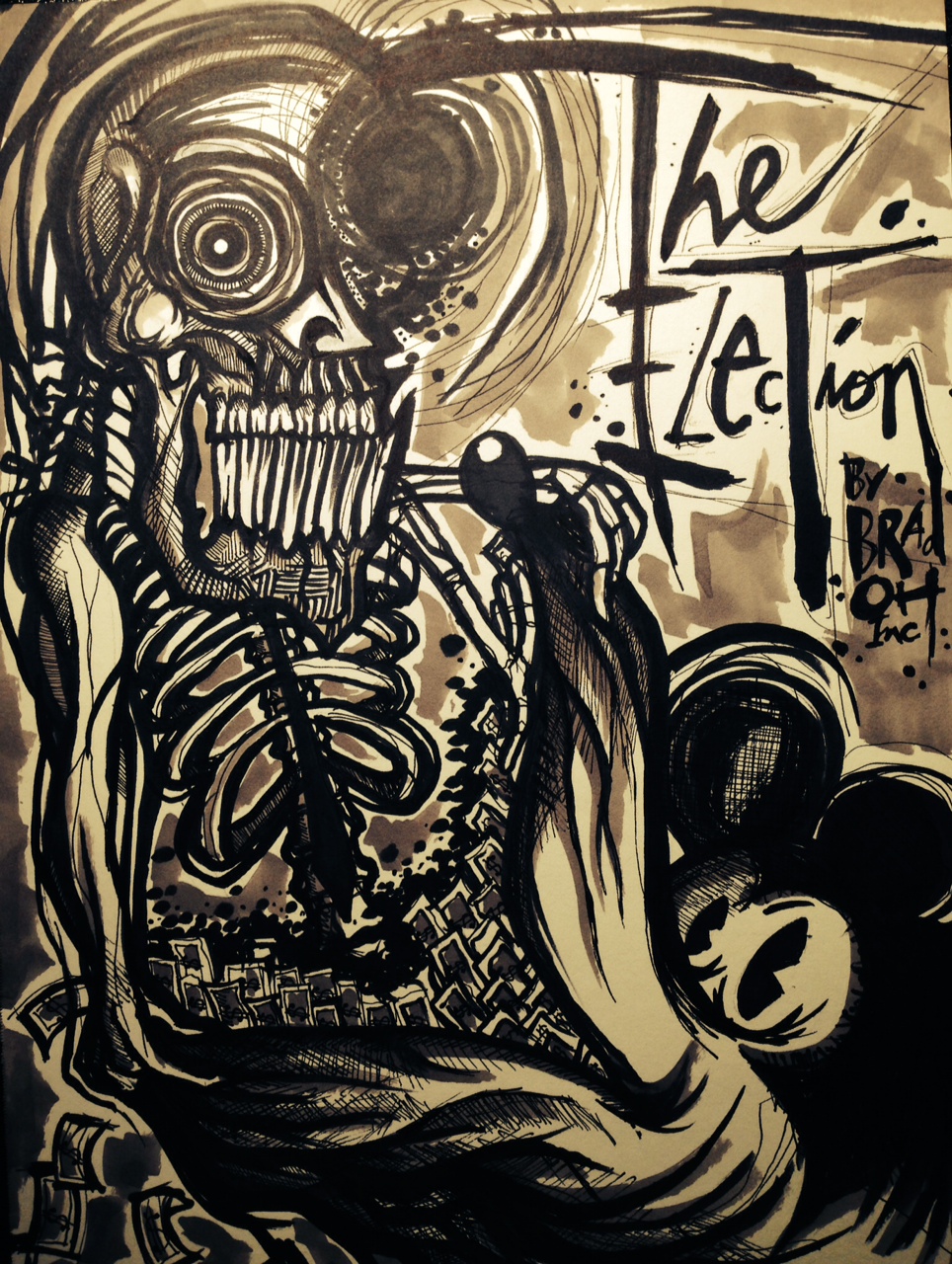
As an added bonus, if anyone e-mails or comments with a correct explanation of the [incredibly artistic] cover art below, a prize may or may not be arranged.

We had all followed along in the steps of those who’d gone before. With so many disparate justifications we’d went on our way, trusting always that the path would show us safely through the darkness. No one could say where we were going… only that we had to keep on; to continue until we’d found what was promised to us.

Now, I held my head high as I marched by them in the red light of the low hanging moon. Even in my most sombre reflections, I had never been able to fully anticipate the depth of this day’s mood. Nor had I ever dreamed as I rose that morning that the sun which burned away my slumber would finally fail to complete its cycle.

On that morning I’d walked among them, all of us equal on the precipice which we had constructed. That seemed like another time now, a forgotten age when our footsteps all fell together, and the joint direction of our path was the shared responsibility of all.

That was before the signal came… before the numbers were given. Now I could see them to either side, reaching and calling as they trailed endlessly off out of sight, into the distance of the world I was now leaving forever. When the march was over, and we had passed out of this place, I knew they would remain. What would be left to them? That was not for me to know.

They were packed in tightly to both sides of us, yet I focussed only on their eyes, remembering the way they’d shrunk down to pinholes through midnight when it had all begun. The trumpet had sounded, rending from the world all other sound and thought, and the sun had faded away like the shredded remnants of dreams come morning.

Had my eyes done the same? I couldn’t say, but even as the march continued, the thrill which had risen in my stomach shook me still to the core. Many around me had fallen to their knees at the sudden trill, lamenting their misfortune for having believed that mere words could alter fate. Then the moon had turned, the familiar blue-white of its surface blushing like the water around a fresh kill, and its shimmering light had fallen down upon the world like a torrent of blood.

How long had we known it was coming? How many had listened? It had been spoken for as long as anyone could recall… written in the most sacred of books—screamed from the most dilapidated of street corners. Certainly none could have denied the truth, and yet the crowd to be left behind—the unnumbered—were beyond count, making the orderly lineup filing by seem inconsequential in comparison.

There could be no doubt that of the millions in that thriving mob, many of them would be known to me. Family and friends; bitter enemies and long-forgotten loves. I’d tried to tell them all. I’d spoken of it whenever I found the opportunity, and remember still the scorn and derision with which I had been met; the pain which was imparted upon me with each sneer, each denial.

Now I had my number, and they called to me, their fingers searching helplessly as I passed. I had no words for them—what before would not suffice, could now offer no succour. They knew by this point. Quite simply—it could no longer be denied.

Some of their faces showed pain or doubt—the rest gaped blankly. Perhaps some still failed to process the extent of the change to come—the trials and strife that were in store for them.

It wasn’t that they’d been complacent. None had ever denied the need for change. Nobody had missed the breaking point as it approached. Some had spoken of revolution, others of revelation. Many had spoken of changing the path, while others had actively steered toward the right.  Most had shared in the speaking alone, but when the world roils, speech alone offers little repose.

It had never been up for vote. Debates had spun their wheels as they always had, their engines of change providing only smoke and ruckus. It was enough for some. When it had come down to action, most had somberly admitted the necessity quickly enough, or else blanched at their opportunity to deny it. Then they would keep steady on their path—their eyes searching desperately for someone else to change the course. It wasn’t that they didn’t agree. It was, most often, that they were simply afraid.

Would they ever know where we went? Watching us now—their eyes alight with helpless wonder—did they question their decisions? If the opportunity was given, would they trade their passivity for a chance to stand in this number, or would they remain crippled by fear; hamstrung by seeds of doubt?

The worries of the world were the forgotten trinkets of childhood now, discarded carelessly upon the floor of society when suddenly innocence is ended by the first sight of blood. With the blaring of the trumpet, the freedom of choice had gone. The numbers were given, the lineup was formed, and the rest had only to wait on the changes to come.

Of those I had truly loved I had no account. Were they in this number, walking somewhere in the line pressing ever onward all about me? Or were they left among those who watched, wondering forever about my fate? Would we be reunited at the end, or had we been sundered forever by the depth of my own conviction? That knowledge as well was beyond me, but as my steps fell, I could not say which fate I would choose for them.

Staring into the vast distance beyond, I considered my own fate. I’d wanted the change as much as the rest; meditated upon it daily. I knew the others had too. Looking around upon those locked in step with me; I felt a kinship unknown to me when the sun had still shone upon our town. They were all following the same path I was, and that alone sufficed to make us one. None of us in this line would be allowed to see the changes to come—by the time they were realized, we would be far, far gone.

Even now, I could not fail to wonder what would remain. It would not be for me—I was leaving with the chosen ones—but what of the rest? It had been said that a new world was coming, and that the sun would rise again on a land cleansed of its weariness.

But that time was not now.

It was hard to believe, despite its being the only certainty I’d ever held. Every day of my waking life I’d dreamed of this stand, yet now the tremble in my spine betrayed my trepidation, and with each step of the march my sense of awe threatened to overwhelm the eternal strength of my resolve.

Would our leaders weep at their naivety? Would they repent of their ill-advised efforts—the endless negotiating and rationalizing they had applied to human desire? When finally the air again was pure, and there was food on every table, would they understand the need for this separation… the reason for the numbers? Would they understand why we had gone, or would they merely start again?

I would not be around to know.

The red of the moon was blinding now, combatting the flare of the trumpet for dominance over all the senses of man. Brought together by our numbers, we passed through it like silhouettes, greys and blacks against the crimson—we were all going the same way now.

Everyone present, in their own way, were waiting to see just what sort of world had been ordained for them. Some would be here to see, others would not. The world had been divided, and shattered shards of the lie called ‘unity’ snapped and cracked under the footsteps of the chosen ones.

We had all been traveling in the footsteps of our elders, each one trying to wring truth from the soiled rags of rumours and empty promises. Now my footsteps fell in rhythm with the rest of the numbered, as still the trumpet sounded… again and again, as if the significance of the moment may still be lost on those who still harboured doubt.

It was of no account now. The choices had been made, and I was on my way. On and on I marched, knowing always that I was headed to the only place which remained to me. I was in that number, and that was all that mattered.

Acknowledgement: Inspired in part by ‘When the Saints Go Marching In’—with particular credit given to the ‘Bruce Springsteen- Live in Dublin’ version.

-Brad OH Inc.

Single Serving Stories Series- ‘Of Pipers and Pigs’

Under the Green Desk Lamp…

Green DesklampIn addition to regular blog articles and my published novels, I’ve also written several Single Serving Stories over the years. Some have been published in anthologies like ‘Between the Shelves’, ‘Edmonton: Unbound’, and ‘All Mapped Out’. Others have been shared exclusively on this blog via the publication platform Smashwords.

Recent changes to the Smashwords platform has made it a less reliable option however, and therefore an exciting change has come to Brad OH Inc.

I will be re-sharing in full—un-edited and un-abridged—all Single Serving Stories previously published on Smashwords with Brad OH Inc. as the new, exclusive provider. All text will be provided in full, with no download necessary. If Smashwords don’t like that, they can message our complaints department.

This project will culminate in a couple of heretofore unpublished Single Serving Stories, so even the most dedicated of readers will have something to look forward to.

Today we share our third Single Serving Story, ‘Of Pipers and Pigs’. This one was always a favourite of my father’s. I was very proud of that.

The thin metal barricades were all that separated us from them. Judging by the press of people facing us, it was anybody’s guess how long that alone would be sufficient. I gazed down the line—right and left—to the determined men and women by my side. They stood resolutely shoulder to shoulder, as was their duty, and the resolve on their faces did much to conceal the doubt in their eyes.

I saw my own uncertainty mirrored in theirs. It wasn’t so much a question of whether the barricade would hold—such tides had an inconceivable ability to lay waste to even the most thorough plans of men—but how they would react when it did give. The answer would be different for each of them.

With a turn of my head, I brought my attention to the people before me. They were a mixed lot. They wore all manner of clothing, having come here from every walk of life. I saw furious men in fancy suits, raving college kids with gaudy t-shirts, topless folk with body paint…and cameras—so many cameras all aimed at me and my colleagues. They were as eager to judge our course of action as we were to settle upon it.  

The railing, which reached to my midsection, swayed violently against the upheaval. It threatened now to collapse in against us, then to topple over upon them. Many of the onlookers were angry—the sort of anger that occurs only in those who have known great comfort, and now perceive it being denied to them. I felt their breath against my face.

One man loomed up right before me, pushing and shoving as if vying for position on the floor of some mad rock show. Jerking and wheeling, he made his way to the fence, holding up a blindingly bright sign and seeming to scream in tongues. The letters were too close to form words, but danced before me like the disjointed stars of some unfamiliar constellation. What does he want?

A sudden surge brought the mass forward, and the metal joints of the fence screeched in distress. Instinctively, I threw my weight forward to counter the assault, and felt my efforts validated by those beside me working in perfect unison.

Amongst the crowd, some fought harder. Like dogs chasing cars, their desire for action far exceeded their comprehension of the potential results. Others retreated quickly, slipping backwards and leaving in their wake only curses, insults, and more of their kind to fill their place.

Accusations flared in their eyes, confusing me, as I was usually looked to for comfort. Wasn’t that the idea?

Upon my left breast, my fingers drifted absently across my badge, as they did so often in moments like this. It felt the same as ever—the familiar surface that read like brail ever since the day it was first given to me. Each bump and scratch brought back the words of the oath I’d taken so long ago. They would never be forgotten.

So much has changed since then.

Shouts clawed at me from beyond the barricade, but were muffled by voices resounding in my head from much, much further away in time and space.

“What are you going to do about it?” my father had asked me.

I didn’t know, and kept my silence.

“Are you afraid?”

Yes, I knew. “No.”

There was blood on my face, my shirt…my hands.

“It’s all right to be,” he said, leaning down. He was a large man, and wore a rough old wool sweater as he set me upon his lap. “Smart men know when to be afraid.” He always knew how to comfort me.

“But everybody’s blaming someone else. Evan even blames me.” My whining was piteous, but at that age the strength of another is the surest route to vulnerability in yourself.

“That’s the way of the world,” he replied with a knowing sigh. Even in my hardest days, he expected me to find the answers for myself. There was no learning in being told what to do.

“But if no one really knows what happened, how can I know what’s right?” I pleaded, hoping for any bit of inspiration to help me resolve the insignificant playground conflicts which then seemed to be the focal point of all the world’s stress.

Then I saw it. Looking up over my shoulder, I watched the wisdom fade away. The certainty and resolve I’d come to depend on flowed like ice melting in spring, and the sun of confusion shone upon his face, illuminating the deep lines and off-coloured spots of the long years he’d seen. His eyes glassed over, as with a deep recollection he would not share. “I don’t know.” He’d answered.

“I’ll figure it out,” I’d assured him, wrapping my small arms around his shoulders, and losing myself in his familiar scent.

My fingers moved back down from my badge as my gaze wandered out to my left, chasing the sudden sounds of struggle. Farther down the fence, I saw a large throbbing black shape as several officers pushed together. A shouted chant was rising up and spreading from the area, but the words were lost to me.

At the heart of the mob, I could make out Jason, my oldest friend on the force. His uniform was splashed with paint, and he was yelling loudly, pointing at one of the men in front.

Ahead of me the crowd continued to heave and push, frantic to go someplace they didn’t know, and perhaps had only dreamed of. A sudden yell brought me back to the struggle, and I saw them dragging away the protestor Jason had indicated. The man kicked and lashed out; fighting desperately to be free from what he’d so passionately sought mere moments before.

“Just hold your position,” directed one of the other uniformed men beside me. “They’ve got it under control.” I’d never met him before.

The scene was dispersing now—most officers returning to their former positions as Jason and three others carried the man away. He was docile now, smiling innocently at the flashing cameras as my friends dragged his dead weight along. Passing behind me as they went, Jason whispered, “’Right and true’, buddy.”

I felt a subtle smile force its way across my lips. “Right and true,” I mouthed, but he was beyond hearing now. With the departure of my three colleagues, the line shifted as the remaining officers spread out, widening their stances to cover the gaps. I followed suit.

“Fucking pigs!” someone yelled. It made no difference who. Tension stiffened the limbs of those standing beside me as my own spine straightened with indignation. Did they come here today just to pick fights? Many looked as if they had.

But anger was not the only emotion worn by the people before me. They yelled and chanted. They shook the railing and they held up crude signs with uncertain meanings. But as they looked back at us, I could see in them the same fear I concealed in myself, the brooding question as to how this situation would end—what an ending to it would even mean.

The anxiety on their brows told me they knew their danger as well as I did, and were entirely aware that their absent friend was not the exception—that the same could happen as easily to any one of them. Gazing upon their strange looks of apprehension stiffened with resolution, I found myself wondering if their greatest fear was not that they might be arrested today, or that the barricade would break and their flood sweep over our breakwaters. It struck me that perhaps their real concern was that nothing at all would happen; that the tide would pass, and things would remain unchanged, and that they’d need to be back here again some other day.

Each face held a secret judgement, and again my fingers flashed briefly over my cold metal badge, assuring me that I was on the right side of the line. But ‘right’ is a funny word, and with my experience, I knew how to read its presence. Beyond all the anger, beyond the anxieties and fears, beyond the trepidation and dissent, I saw the ‘right’ in every one of them—an absolute certainty, as if they held some truth which I lacked. They believed in their cause absolutely.

It’s a strange thing, that two sides can line up so neatly, and stand in opposition to men who they may have peacefully passed on the street only a day before, yet both be so thoroughly convinced of the sole truth of their own position.

Right and true… I reflected, and I remembered Jason standing proud beside me the day we’d been given our badges. He beamed as the applause took hold of him, while I stood straight and calm by his side. We’d finally made it.

Later that night, we’d sat together in solemn reflection—drinking beers and speaking of the future.

“So, now what?” I’d wondered.

“Now we finally get to begin.” Jason responded as if the path we’d been seeking was laid out before us—forever free of forks or detours.

“Yeah… begin.” I acquiesced.

“Listen,” Jason put his hand on my shoulder. He was three years older than I, and had been a mentor to me as we’d come up through training together. “We’re officers of the law now. No matter where we find ourselves, we’ve got to remember that ‘right’ is on our side.”

I smiled, certain he was correct. Still, there was unease in me, remembering conversations from long ago… people long gone. “What if ‘right’ isn’t always clear?”

Jason took a long pull from his pint glass, emptying it down to suds as he rolled his eyes. “Jesus,” he’d said. “It’s your first day as a cop, and you’re already having doubts about yourself? Shape up man; you’ve reached the Promised Land. That badge you got today—that means ‘right’. If you’re honest with yourself, you’ll remember that. What’s got you so down anyway?”

It wasn’t an easy thing to describe, especially in the face of my friend’s confidence. I sat awkwardly, taking noncommittal sips from my glass as Jason stared straight through me. His focus was astounding when he was intent on a subject. “I guess the whole time I was fighting for this, I felt like it would come with some solution. They got me ready for the job, trained me physically and mentally. Yet today, when they pinned it to my shirt, it seemed so heavy.

“Now all the expectations are on me, but I’m still the same person. The same doubts, the same uncertainties, the same ability to see different sides of an argument. I thought it would come with answers…I don’t know—I just expected to be more sure of the truth is all.”

“You’re never going to find any truth outside yourself buddy,” Jason grinned as he spoke, revelling in his perceived wisdom. “But you’ve come this far because you know enough truth already. You wouldn’t be here otherwise. Remember all those clowns who started with us. Where are they now? You have a great honour here man; your duty is to serve the people, to do what’s right. That’s the only truth you need.”

“You’re right,” I agreed, finishing my beer.

“Right and true!” Jason smiled.

A deep roar shattered my reverie, returning me to my post. The crowd was shifting, as if the masses were a single great beast breathing in for the charge. It swelled, pushing against the fence, testing it…seeking the breaking point.

Again I threw my shoulder against it, and again my fellow officers were there in unison. We stood as one resolute blockade, convincing ourselves together that the direction of the few could outweigh the determination of the many. Then the beast exhaled, the chants rose up again, and the moment had passed.

Straightening up, I gazed about me—the instant of reprieve allowing me to look out over the sea of humanity and take in the entirety of the scene.

They stretched back as far as I could see. There were people of every imaginable ethnicity, all ages and backgrounds. They all stood packed together in a sprawling, sweaty mass. Some were pressed so close to others they seemed barely able to speak or move, but remained as a number—one amongst many—and that was enough for them.

The square was packed from end to end; the traffic had been redirected well in advance. Somewhere in the distance I heard the beating of drums and tambourines, banging and clanging not with the heavy rhythm of an army on the move, but sounding more like a folk festival; a strange, displaced cultural jamboree tearing down the ritualistic order of our city.

In odd corners and assorted empty pockets amid the human sea, tents had been erected, and here and there circles of protestors danced with looks of joy on their faces, as if oblivious to the chaos around them.

Many held signs, each made by hand and bearing its own unique interpretation of the mob’s intent. I read them skeptically, trying to glean some idea of what exactly that intention was.

Some bore only curt slogans about change, while others featured well known logos and images of public figures, each altered and contorted to share their intended messages.

One logo I spied was instantly familiar. It came attached to my family’s healthcare receipts—the ones which got accepted at any rate. Another one, though it was partially covered with bright red lettering, I recognized to represent the corporation in charge of my pension. I’d heard they weren’t doing so well.

High up all around the square, the same logos—pristine and fresh—looked down accusingly at the scene. Each promised its own deliverance from the daily grind: ‘Fresh Food at Cheap Prices’, ‘Cars to Suit Your Class’… special offers to ‘Buy $100 Now for $120 Later’. Many of the biggest billboards bore bank logos so common amongst the signs of the crowd that it was easy to forget their actual origins.

A scuffle to the right stole my attention, and looking, I saw a ragged protestor in a dull fleece sweater trying to wrestle his sign back from the hands of two of my colleagues. Though torn and bent, on it I could distinguish the defaced countenance of the man who signed my paycheques.

Right and true. The words echoed in my ears, seeming as naturally fitted to one another as polar ends of a magnet…as ‘Us and Them’. I was surprised to feel my fists wrapping themselves around the metal railing before me. It had none of the old etchings of my badge, yet still my fingers clung to its sleek bars as my mind raced.

The uncertainty in the faces squaring off against each other was the only visible balance. I stared at the people beside me, then at those in front of me. Each group stood upon their respective side of the metal barricade, looking to one another as if to ensure the plan hadn’t changed.  Everyone had come here with some expectation, but all stood patiently now, just wondering how it was going to end.

The railing jerked under my hands.

Right and true were sundered by doubt, and the smooth surface of the shifting rail assured me that I was as guideless as the rest—left to draw my own conclusions…though there was still the badge. All lined up beside me, my fellow officers remained strong, doing their duty. Each had undoubtedly reached this position with intentions similar to my own. What are they thinking now?

A sudden urge took me, and I felt my body turn. There was a hand upon my shoulder, though I couldn’t tell if it belonged to an officer or protestor as my vision turned away from the bustling mass behind me and settled upon the ornate building now in front. It stood on our side of the barricade, fenced entirely by my friends and colleagues as suited men passed in and out unhindered.

Your duty is to serve the people, to do what’s right. That’s the only truth you need. Jason’s words rang through my mind as a tremor passed down my spine. I turned back around, and set my shoulders squarely in line with the fence.

The chants and screams were growing louder now, and the heads of the people beyond me drifted side to side wildly as the crowd surged about like boats unmoored against a rising storm.

My right hand drifted towards my chest once more, closing around the cold metal over my heart. My left remained upon the railing as it jockeyed wildly about, threatening to fail at any moment. Which way will I face when it does?

Right and true. I felt all things at once now: the barricade before me, the badge upon me, the gun at my side, and the surging mob pushing towards me. The fence bounced and jostled—the frail division line between us ready at any moment to collapse upon itself. Then we’ll all stand together.

I imagined the protestors struggling over the wreckage of the barricade, pondered the responses of my fellow officers…and of myself. ‘Right’ was a hollow spot in my chest, and ‘true’ was but a taunting memory. There was a lump in my throat I could not swallow, and I found my thoughts settling ultimately upon my own family at home, wondering what they’d expect of me.

Still the fence held, though I knew that whether here and now, or later and elsewhere, it had to break in the end. There were questions to be answered, and when the tides of society shifted, there was no barrier sufficient to stand against the flood.

I straightened my back and waited, knowing I had a decision to make.

-Brad OH Inc.

Single Serving Stories Series- ‘A Conversation of Inconclusive Results’

Under the Green Desk Lamp…

Green Desklamp

In addition to regular blog articles and my published novels, I’ve also written several Single Serving Stories over the years. Some have been published in anthologies like ‘Between the Shelves’, ‘Edmonton: Unbound’, and ‘All Mapped Out’. Others have been shared exclusively on this blog via the publication platform Smashwords.

Recent changes to the Smashwords platform has made it a less reliable option however, and therefore an exciting change has come to Brad OH Inc.

Starting today, I will be re-sharing in full—un-edited and un-abridged—all Single Serving Stories previously published on Smashwords with Brad OH Inc. as the new, exclusive provider. All text will be provided in full, with no download necessary. If Smashwords don’t like that, they can message our complaints department.

This project will culminate in a couple of heretofore unpublished Single Serving Stories, so even the most dedicated of readers will have something to look forward to.

Today we share our second story, ‘A Conversation of Inconclusive Results’, which the sharp-eyed among you may note was a heavy inspiration for my first novel, ‘Edgar’s Worst Sunday’.

The events of that Saturday night were ultimately a complete waste. Ethan had gone out with the sole intention of finding some means of distraction from the stress of his impending graduation, and failing that, had chosen to get exceptionally drunk. Sadly, his fixation on the future had accompanied him into his intoxicated state, rather than being alleviated by it.

With these distractions playing through his head, Ethan had chosen a bar far off campus, one seldom frequented by his academic peers.

So now he sat, absentmindedly spinning his beer around in the golden puddle spreading slowly out from beneath it as the small speakers mounted in each corner churned out muffled approximations of songs he’d never heard. It was an hour from closing time, but only minutes before everything really began going to hell.

“Everything’s fucked,” Ethan groaned.

Ethan was unhappy.

“Pretty much,” replied Desmond, seated comfortably to Ethan’s right.

“It’s not that bad,” Andrew chimed in to his left.

The room was mostly vacant- the dim light cast by the two battered old chandeliers barely reaching its furthest edges. Ethan’s table sat, somewhat lopsided, at the far right corner beyond the thick metal door leading outside. With his back to an old grey wall decorated with a strange variety of oddities and memorabilia, Ethan faced the bar at the other end of the room.

Made of polished redwood, the bar stretched from just beyond the entrance all the way to the far wall. A lone man walked back and forth behind it, alternatingly polishing glasses and running a sloppy grey dishrag over his workspace.

The tables were low and heavy- big wooden structures whose shine had worn off long ago. Each was lined with long scars and crags from years of drunken abuse, with small illegible etchings carved into many of them- forgotten declarations of eternal love, announcements of specific patronage, and assorted obscenities.

Few of these were populated, though one lone man sat near the entryway at a single table wedged awkwardly between a worn pool table and the hallway leading to the dilapidated restrooms.

An old disco ball sent a shower of light twirling around the empty space opposite the stranger- likely the only activity the dance floor had seen in a good while. The entire room reeked of stale beer and old eggs, though the source of only one was immediately identifiable.

“What’s left now?” asked Ethan, sprawling across the table as his brown and green striped polo shirt drank deeply of the beer still remaining from a spill hours prior.

“Nothing,” Desmond flipped a toothpick into his mouth with a grin.

“Everything!” insisted Andrew, casting an irritated glance across the table. Desmond took no notice.

Ethan peeled himself up slowly from the mess of cloth and booze, a long wet slurp accompanying his efforts. He glanced over briefly as a small group entered the bar and took one of the many empty tables near the dance floor. To Ethan’s chagrin, they seemed in fine spirits. “I don’t even know what I’m meant to be doing.”

“Isn’t that up to you?” Andrew leaned over the table, unconcerned about his elbow, which drifted precariously close Ethan’s little lake of wasted but unforsaken beer.

“Isn’t that the essence of his problem?” Desmond’s expression of innocent intrigue fit him as naturally as empathy on an alligator.

“It really is!” Ethan nodded his head enthusiastically, then let it roll in a long looping circle before finally bringing it to rest facing no one in particular as he resumed his woeful diatribe. “What do I have to look forward to? Now I’ll just get some job I’ll hate, raise kids who won’t appreciate me, and finally I’ll accept the cold embrace of death.”

“Well at least there’s that death part then,” quipped Desmond, leaning back in his chair and interlacing his hands behind his head. Desmond was tall and lean, and wore his shock of dark hair mussed up with intricate apathy.

“Don’t be morbid,” Andrew said with a sigh. He shifted in his seat, rotating to better face Ethan, or perhaps to better avoid facing Desmond. Andrew wore a vibrant t-shirt depicting a wizard riding a wild boar. No one really understood his affection for such irreverence, nor did it ever seem to fit his stoic demeanour. The shirt did fit his strong arms particularly well however, and was therefore seldom the cause of significant chastising. “I’m sure when you sober up you’ll look back and realise how rewarding your life has been so far.”

“I thought looking back at your life was exactly what death was for,” mused Desmond before taking a long swallow of his thick red ale.

Ethan laughed despite himself- a sloppy, frantic sound that sent a pale trickle of beer running down his lightly stubbled chin. “That’s just what I’d need- to endure a rerun of my sorry fucking life before I died. Do you think there’s any option to skip that whole to-do?”

Andrew pushed his chair against the wall with a long screech, leaning his large frame back and crossing his legs. On his face was fixed a baleful, disappointed expression. “Are you really going to sit here and lament everything you’ve ever accomplished Ethan? You’re being ridiculous. You’re a great guy, and have plenty to be thrilled about going forward. Can’t you think of anything you’re proud of?”

“Do keg-stands and courtesans count?” Desmond asked, but went ignored.

“I’m not trying to be an asshole here.” Ethan answered the first question put to him. Perhaps trying to mimic Andrews’s adjustment, he slid back in his seat, and then downward, slouching like a wax sculpture left in the sun. “I know I’m lucky.  I have a lot to be thankful for, I’m not arguing that. But right now, all that only makes it tougher. I know who I am, what I was given, and what I’m capable of. I know all the expectations on me, all the different opinions of what I might be. It’s just that I have no clue what I really want.

“It’s a lot to handle- I don’t know how you guys are so calm about it,” he finished.

“Well that’s what good company is for, isn’t it?” Andrew reassured, swallowing back the last of his beer.

“No, that’s what beer is for. Happily, good company serves good beer. Isn’t it your round Andy?” Desmond asked with a smirk.

“I told you not to call me that. And no- in fact it’s your round Desmond, if you’d be so kind.” Andrew slid his empty cup across the table.

“Damn.” Desmond rolled his eyes back and placed the back of his hand to his forehead in a faux expression of grief. Standing, he spat his gnawed toothpick into an empty glass and turned to make his way to the bar with a merry declaration- “Be right back Drew!”

With a chuckle, Ethan stared down into his empty cup, sighed, and began to drag his finger back and forth through the spilled beer in front of him, leaving little yellow lightning bolts zagging towards him and dripping down onto his legs. “I know what you’re gonna to say Andrew. ‘This is only the beginning- an exciting new chapter in my life.’ You’re right too. But all that talk about having your life flash before your eyes- that ending point really gets to me. It’s been pretty great, I’ve had a lot of laughs and experienced nothing but success. But I’m not sure how much of that was me and how much was predetermined. I’ve been on a direct path for so long- now I have to begin making my own decisions. Now it’s all up to me to fuck up. ”

“Well maybe you need to consider this flashback differently. You’re not dying tonight to the best of my knowledge. You’ll die a long time from now, and this choice will just be another one of the many events you look back on then. The question is, how will you feel when you look back on it?”

“Hopefully better than he did when we reminded him what he did last time he got this drunk… What are we talking about?” Desmond interrupted, speaking primarily for his own amusement, as usual. Sitting back at the table, he divided out the drinks. A short, stout glass filled with thick red ale for himself. For Ethan there was a tall glass of pale beer, and for Andrew, a thin, colourful drink with a melon wedge sticking out of it like the mast of a sunken galleon.

“You’re such a fucking dick Desmond.” Andrew complained, dredging out the melon and tossing it at Desmond, just missing his shining white grin.

“That’s a pretty mean thing to say to your friend Andrew.” Desmond stared across at the bigger man, holding his gaze until he saw the expected blush creeping up his neck and reddening his cheeks. Andrew could never hold his ground if he felt someone else may have been hurt by his actions. “… Christ you’re a pussy.”

“I guess that’s one way to look at it.” Ethan refocused the conversation, taking a small sip of his new beer. “It certainly doesn’t take the pressure off it though- if I fuck up this decision, not only will it ruin the rest of my life, but I’ll have to reflect on how it all went wrong before I kick it. Jesus, would time ever drag looking back on that!”

“You’re focussing on the negatives again Ethan. Maybe we should switch drinks- this one seems a bit more… fun?” Ethan laughed again, while Desmond cast a cautionary glance to ward against any unforeseen drink switching. “Take your time with this decision, do what’s right for you, and time will fly by. Think of how amazing it would feel to look back at that, and all the other times where you just kicked ass in life. It sounds like a pretty good way to go!”

The smile that spread across Desmond’s face now was not one of mocking insincerity. His lips curled into a self-satisfied sickle as he leaned over the table, examining each of his companions in turn. “Happy memories or not Ethan, time is hardly going to fly. It’s your fucking deathbed we’re talking about here. Death! The one, absolute thing humans are evolved to avoid. That’s the pinnacle of unpleasant right there.”

“He’s right.” Ethan slouched back down in his chair and took a long pull from his cup. “Shit… if time slows down when we’re having a bad time, and death is the worst thing that can happen- wouldn’t time stand still when we die? I mean, think of it graphically- wouldn’t death form an asymptote where the experience of time is infinite in that one single instant?”

“You know why you’re always so down Ethan?” asked Andrew.

“Because he’s the kind of asshole who goes to a bar with his friends and uses words like ‘asymptote’?” Desmond smirked momentarily, but caught himself at the severity of the topic, and bit his lip to fight off the temptation of further heckling.

“No!” Andrew was getting frustrated. “Because when he looks back on his life, he only looks for negatives and regrets. It’s no use living with your mind fixed on what’s already done. You need to look ahead.”

“At the very least, it’s a helpful perspective on life.” Ethan mused absently.

“What?” Andrew asked.

Desmond smiled in silence.

“Think about what we have here,” Ethan’s voice rose in excitement, his hand grasping tightly about the stem of his half empty glass. “Here we are, imagining me at the second of my untimely demise. In that moment I’m granted, mercifully no doubt, an opportunity to look back on my life- all my successes and regrets.”

“So what will you see?” Andrew asked, sipping slowly from his long black straw and leaning forward in his seat.

“A close-up of the floor, smeared in your own vomit?” offered Desmond, leaving his sense of propriety where he’d found it.

“Shut up you idiots. Not only that, but we’ve agreed that time slows down when you’re having a bad experience, and that death is the worst possible experience. That means this event would theoretically- and certainly in the graphical sense- last forever.

“So, I lie dying- my experience of which is eternal- and look back at my life, reflecting on my decisions.”

“Heaven,” promised Andrew.

“Hell,” Desmond chided simultaneously.

“Jesus…” Ethan lamented, sliding further down in his chair as his eyes grew distant and glassy.

“Well does that help you make your decision?” Andrew swallowed the last of his drink, wiped his mouth with a napkin he’d had folded in his pocket, and leaned his weight onto his elbow.

“Or just further terrify you as to its magnitude?” Desmond asked, smiling as he held his glass up, tipped it skyward, and held it until the deep amber liquid disappeared down his throat. He belched loudly.

“What decision? Let’s get more beer.” A thin trace of saliva dropped from Ethan’s chin, down onto his polo.

“Last call is done buddy, but you can owe me for next time.” Desmond mumbled, stretching as he rose from the table.

“Oh leave him alone, he’s had a long night,” cautioned Andrew, rising and circling around the table. Evening off with Desmond, he stood patiently. Ethan leaned to one side, and then the other as his legs began to straighten in turns under the old wooden table. Leaning forward, he placed one hand heavily onto its surface for support, and slowly worked to elevate his midsection as he wavered back and forth under the effort.

Just as his ascension was all but achieved, Ethan’s hand slipped in the puddle of beer on the table, sending his mass careening forward onto its surface, taking it off balance and sending him pouring over its far end. He was left buried beneath the tables upturned frame.

“Holy shit! Are you ok Ethan?” Andrew shot around to one side, hooking his arm under Ethan’s as he heaved the table off of him.

Laughing hysterically, and entirely unable to catch his breath, Desmond did the same on the other side.

“Get out, you damned idiots!” bellowed the bartender.

Working together, Andrew and Desmond managed to hoist Ethan up, and began their way across the bar on the long trek for home. “What were we talking about just now?” Ethan’s voice was slurred, and came in fits and halts.

“You were doing some real soul searching Ethan, I’ll tell you about it in the morning,” Andrew assured him as he held the door open with one large hand.

Helping guide the human tangle over the threshold, Desmond could feel the cool night air against his face. “Now won’t that be a treat. Don’t worry Ethan, I’ll be there too. Wouldn’t want it to take too long, would we?” he asked, rolling his eyes.

Together the three friends made their way down the quiet streets. Ethan sagged heavily between them, but supported at each shoulder he continued to trudge along. A dying streetlight flickered above them, its efforts supported only by the dim light of the moon, hidden between buildings.

Ethan’s feet caught and dragged on the broken cement of the roadway, finally ceasing to move at all, causing the procession to halt long enough for him to empty the contents of his stomach down onto his shoes. Then, after a short bout of weary laughter, they continued on.

“Oh Ethan my wayward friend, why do we always need to carry you?” asked Desmond.

-Brad OH Inc.

Single Serving Stories Series- ‘As It Happened’

Under the Green Desk Lamp…

Green DesklampIn addition to regular blog articles and my published novels, I’ve also written several Single Serving Stories over the years. Some have been published in anthologies like ‘Between the Shelves’, ‘Edmonton: Unbound’, and ‘All Mapped Out’. Others have been shared exclusively on this blog via the publication platform Smashwords.

Recent changes to the Smashwords platform has made it a less reliable option however, and therefore an exciting change has come to Brad OH Inc.

Starting today, I will be re-sharing in full—un-edited and un-abridged—all Single Serving Stories previously published on Smashwords with Brad OH Inc. as the new, exclusive provider. All text will be provided in full, with no download necessary. If Smashwords don’t like that, they can message our complaints department.

Starting with the first story, ‘As It Happened’, all the way through the most recent, this project will culminate in a couple of heretofore unpublished Single Serving Stories, so even the most dedicated of readers will have something to look forward to.

So, without further ado, let us revisit my first completed Single Serving Story under the Brad OH Inc. banner, the strange and unsettling 2012 classic, ‘As It Happened’.

They sat together on the couch, the glow of the newscasters face from their small TV lighting up the room. How long had it been growing?

At the centre of the divide between them, their hands just grazed one another. It was a seemingly insignificant space, but through it blew the winds of change, howling with the desperate voice of a day that would not come. The woman on the TV was beautiful— even while telling them it was all true, and things would never be the same.

Soft cushions cradled each of them delicately, betraying their discomfort. The sun shone brightly behind the reporter, who delivered the news with an unrelenting drawl. Stone faced and tenacious, there was an understated bravery there.

The room was cold.

Repeatedly, the woman onscreen reassured the viewers that the events were isolated incidents, and there was no cause for speculation beyond the facts. Yet the camera showed another truth, clear as day. There was no reference made to the people running in the background. They weren’t doing it for the audience.

The images changed like the flickering of a dwindling candle as more and more reports came in. They all said the same thing. On the couch, nestled deeply in her cushion, she wondered what she’d say— how to express all the things she needed to, yet not reach what she knew to be the inevitable result.

She remained silent.

Before them, the screen pulsed with movement— the picture at times was clear as glass, depicting beyond doubt the finest details of all that transpired. At other times it jumped and crackled, the signal interrupted and the image distorted, leaving only the muffled voices and brief glances of scenery to tell the story.

With each change of the scene, their faces were illuminated— white, orange, blue, crimson. Occasionally the sound would rise up, pinning them in place with the force of its message. Then it would dip, and they could hear the gentle rumours of each other’s breathing in the cloying calm of the room.

She thought about the start, and how it had sounded like the promise she’d been waiting for. Her stomach groaned with hunger, but she remained quiet as she stared at the box of glowing light in front of her. The busy people on the TV only served to accentuate how terribly still she sat.

At the farthest reach of his periphery, he could see her, a dim evening star dancing heedlessly upon the razor’s edge of perception. It was a safe distance. Watch and record, note changes and variances, try to learn without direct intervention.

They both listened and learned— there was nothing else to do. They remembered the rumours passed about so long ago— all going ignored amidst the milieu of suspicion and doubt that peppered common conversation these days. Sometimes the greatest betrayal was the failure to see what was right before you.

What now remained to be done?

His eyes were fixed forward; dying lanterns passing down a dark trail. In times such as these, people had to keep their focus, lest the distractions and deceits of the woods lure them forever from their courses.

Everybody had their theories about how things got to this point: little narratives that tied the confusions together, small offerings of guilt— what might have been different if only this hadn’t been said, if only that hadn’t been done? But they all knew the source— the drive all people felt towards unity. People were born to love. They could love each other, love ideas; even love their country.

They used to tell each other that love was enough.

But when does something like that begin and end? How is the line drawn? It’s only a scratch that appears one day along the vinyl, and grows slowly until it’s impossible to distinguish the tune beneath the tumult.

There’s no fanfare at first, not until it’s already too far gone. Some will deny, rationalize, or accept. Others may reframe their entire perspective to accommodate the changes of the world around them, but that only goes so far. They stretch the lens; contort the picture until the blur seems normal.

It’s almost cute at first. But then there are things that cannot be explained away. Call them unbelievable mathematical improbabilities, divine signs, psychological decay—call them whatever fits.

Yet there comes a point when they just can’t be ignored.

None of that mattered any longer. This wasn’t science, and understanding the start wasn’t always a sure way to predict the future. Here they were, and as the lady on the TV continued to update— now listing chronologically the events speculated to have led them all to this terrible precipice— he already knew it was on the way out.

Fighting had never done any good. Some sorts of alliances cannot be fought for, with one side flitting away while the other chases, only to reverse roles at some point, all the while braving the pitfalls and sabotages of circumstance and society. Rather should any true alliance be pursued with undying ferocity, both sides defying or ignoring any odds with continual movement towards connection— for one approach is based in courtship, the other grounded in partnership.

Sometimes it almost seemed that it was truly attainable— that it was a tangible thing to grasp and hold. But hearts are not moved through the simple occupation of space.

The voices on the TV were quiet now, and he could hear his heartbeat clawing desperately at the safety screen of silence between them.

The scene was shocking. All they’d ever known had been stripped of the robes of artifice they’d helped in sewing. A sudden cacophony of competing cheers and jeers was the haunting dirge that led the gruesome parade through their home, and they couldn’t say now what part of the clamour was theirs to play.

A man was speaking on the TV, insisting in practiced homilies that people were only doing the jobs set to them, and that it was not the viewer’s part to judge.

The steel of the words was betrayed by the waver of the voice. It was ever the case.

They recognized many of the faces flashing past— each had made some promise, offered some hope. Looking back, every last one of them had claimed it was coming. Some for one reason, some for another. One claimed it was because of the first. But they all agreed— without change, this was inevitable.

Why had they all ignored it? How could so many people, with such a wealth of knowledge at their finger-tips, collectively fall into the lie?

Of course they had their ideas now. One could speculate, another hypothesize. They could chase each other in circles as the world fell out from under them. It made no difference.

The TV showed a blur, static scraping itself over cityscapes, and the words came pouring on, now muffled, now crystalline. A fire flickered from an alley, and a man in a suit was gesticulating furiously at the camera while ducking into a black car. A preacher stood in the street calling for apologies, and all around the crowd stared expectantly one to the other.

If she looked closely enough, she could almost make it out. Beyond the static, past the distortion of years were all the things she’d once held dear. With a squint of the eye and a trick of the brain the major details were all there— but it hadn’t been the big things that had changed. She could cradle the image in her mind, and nearly believe that it could still be. It flowed before her, a reflection in the river of time until some distraction shattered it like the ripples of a thrown stone. Then it was gone, relegated to its proper place on the shelf of her memory, with all the other things whose beauty was now remembered only by the light of a sun long set.

Still, everyone seemed to be missing it, all fixated upon their own illusive ideal.

The ideal never came.

They were left instead to wander blindly through mazes of ambiguous promises, seeing their own loss and confusion mirrored back in the eyes of those they’d looked to for guidance. Concepts like honour and loyalty— when the sources that defined them have dissipated like blood in water— quickly lose their meaning.

He remembered the first time the thought had entered his mind— that maybe all the things he’d grown to expect would never come. It had darted in one day unbidden and never left. When finally he’d heard the words, the doubts had been soothed. But they lingered like embers in the morning dew— forgotten fears smouldering patiently amongst the tinder’s of trust.

Even now the ideas would still spring up in his mind on occasion, hopes like secret castles in a child’s tale, which only existed as long as they were believed in.

He started to speak, and she opened her mouth. A bulletin blared across the screen, and they both sat quietly with their mouths agape.

How long had they sat back, waiting for that one perfect moment to find them; the flawless solution that would wash over them and assure them that everything would be ok? They were still waiting, as every other opportunity slipped by. Sitting and staring. Starry eyed and terrified.

Now a crowd was gathered on the TV. Someone was dying in the streets. They didn’t recognize the face shown, nor catch amidst the fury of the mob the narrator’s explanation of the dying man’s significance. It would’ve been irrelevant— all titles were equal once blood had been shed.

His eyes carved across the room, settling upon and holding hers. Not long enough at first, then suddenly, self-consciously far too long. He jerked his gaze away frantically, as if to avoid further rejection. His arms interlaced across his chest, leaving nothing but the still, cold air as her hand reached across the barren space between them, grasping only the ghost of what had been a moment before.

Lights were flashing on the TV, and packed tightly around a statue was a throng of cheering people. Through the crackling picture it was impossible to determine if they were truly deluded into happiness, or merely too afraid to take up the song that curled submissively at the backs of their throats.

They twitched in unison with the shared recognition of a building that appeared on screen, but the men entering it were strangers to them. Faint noises came from the window across the room— another jarring reminder that the world before them was the very one in which they now sat. Yet outside were only passing cars, filled with people going wherever they were needed most. The more significant events were smeared across the glass right in front of them, and that’s where their attention remained.

It wasn’t how they might have imagined it. The news was constantly changing, the truth of the events sorting itself out from the falsities like straining oil from water. They knew the facts would be blurred for a long time— but what they could see was sufficiently telling. Short clips played, sometimes repeated in increasingly close approximations to their entirety, at other times discarded indefinitely for developments of more immediate relevance. With every scene, the chill of the room grew more difficult to bear.

There were no bombs dropping. It wasn’t that kind of a revolution. There weren’t even any clear sides— just a big, bleeding divide.

Signal flare reasons filled the air— reaching out for certainty through the impenetrable fog of its absence. Time passed as they sat, still and quiet. The hours seemed of small account now— many things they’d come to rely on would lose their worth in the days to follow.

On the couch, their focus was inexorable. Ever as they watched, the despair cut deeper, as every misgiving they’d ever pushed aside was dredged up from the darkest corners of their psyches. Still, they couldn’t look away, as if the jagged rocks ahead were their salvation from the siren’s song behind.

In every other direction dangerous visions laid in wait— the home they had, the things they shared, and the memories held in each. Both of them could feel how the fabric of the seat was pulled by the weight of the other beside them, and photos decorated the walls on all sides with reminders of what wouldn’t be.

The distraction of the television offered little succour. The revelations being shown told them that things were unravelling fast. The mystery of the cause had been forgotten— searches for responsibility cast aside. Now the focus was single-minded— the rats had already left the ship, and solution was no longer part of the vernacular.

No one claimed to understand. No one even offered false assurances that everything would be ok. Things would be different— that’s all that could be said. Knowledge was a ghost remembered from childhood— its former certainty fading into doubt, and none remained so bold as to claim they still believed.

Thoughtlessly, instinctively, they allowed their eyes to drift together, repelling that same second like bullets off battered brick walls. The men on the TV were flopping about like beached fish; excuses and justifications the sand that came splattering out beneath them.

Everywhere, people were arguing— building skyscrapers out of conjecture, and then blasting them down to prove their point. The footage rolled on, endless as smoke billowing from the ashes of their aspirations.

Still, upon the couch silence reigned, and from the TV so far across the room, the newscaster returned to explain the choices that remained to them.

-Brad OH Inc.

Re-Share: Humanity vs. the Corporate Mindset

Of all the unfortunate ills in this world, the Corporate mindset may be the chief. It is this idea which keeps society unbalanced and desperate, which controls our information and divides us against one another. Laws are changed, rules are broken, people are robbed of their potential, and the world at large is injured by this idea that more is better, and that the ability to take more is self-justifying.

It’s often preached about as ‘freedom’, or ‘capitalism’, or even ‘fairness’—all hair-brained explanations for one of the greatest con’s ever. The system supports only itself and those at it’s very top, while actively trying to quash out any popular movement attempting to return to the people some semblance of the power which is theirs by right.

Let’s look briefly at two examples to illustrate this point.

The first is the idea of a universal basic income. The concept here is that if the highest earners paid a higher level of taxes than the pittance they currently do (if they pay at all), then a universal basic income could be provided to each citizen, raising them out of poverty, and allowing them to participate in the economy and society in a meaningful way. This would reduce suffering, and build up communities across the nation, and the world.

To the Corporate mindset, this is the highest of heresies.

They would argue that having successful people pay taxes for less successful people discourages big ideas, and that if the ability to lord unimaginable wealth over the rest of the population wasn’t available, then any incentive to be productive would go with it.

What unimaginable hogwash.

The true reason for such objections is a little more obvious, and far more believable. It’s greed, of course…good old number three.

The truth is that at some point, the motivation of money is no longer about providing for you and yours—Maslow’s hierarchy and such. It ceases to be the calculated pursuit of betterment or provision, and becomes instead the reckless pursuit of an addict. Wealth fast becomes an addiction, and like most addictions, people resort to increasingly terrible extremes to feed it. A Corporation, in essence, is this wealth addiction made manifest. Pursuit of money as a drug in this way breaks the market, the chain of trust, the social contract, and capitalism in general.

Another fine example of the destructive nature of this Corporate mindset can be found in the realm of art and creativity. Corporations have no interest in creating thought-provoking materials or fresh ideas—the very opposite in fact. Their goal is to create easily consumed, content devoid filler. They rehash the same tropes and keep people clapping along to the same tired old ideas. It’s about placation and distraction, never enrichment.

The end result can be seen in the relentless struggle before any true artist—in their need to cut through these quagmires of idiocy to ever have a chance at being heard by the desperate ears of people starving for original content. Examples can be found in free-speech warriors such as Howard Stern or the Insane Clown Posse, who have struggled through great adversity and opposition from the Corporate market, despite having a product which many people desired.

If something’s not in line with a Corporation’s vapid tripe, and especially if it’s not making an obscene amount of money for people who already hold far too much, it has little chance of significant exposure without amassing a devoted underground following in spite of Corporate adversity.

More about the negative impacts of the Corporate mindset on the entertainment industry can be found in our article, ‘The Disgraceful Suicide of ‘Old’ Media’.

In the end, the crux of the issue is that the Corporate mindset influences our society—making us callous and suspicious of one another, rather than supportive and loving. Indeed, it can easily be argued that the Corporate mindset is the very antithesis of the human spirit, and yet it holds us tightly in its sway; controlling our media, our art, our economy, and our very perspectives on life.

What would it take to break free of this influence, and begin to live like the compassionate and caring society we are undoubtedly capable of being? We look forward to hearing your thoughts in the comments below.

-Brad OH Inc.

Canadian Independent Bookstore Day Event!

Next week, join myself and other local authors at Audreys Books to celebrate Canadian Independent Bookstore Day!

Saturday, April 27th, Brad Oates along with other local Authors will be at Audreys Books (10702 Jasper Ave, Edmonton). The event runs from 10:30am-2:30pm, with fun and prizes throughout.

I will be there from 11:30am onward, and Audreys Books will have copies of both ‘Meaning Less‘ and ‘Edgar’s Worst Sunday‘ on hand for purchase!

I hope to see you there,

Brad OH Inc.

One Year of ‘Meaning Less’

A man struggles to find meaning in a dystopian corporate hell-scape, but as he chases it in all the wrong places, each day begins to mean a little less…

Recently, my latest novel, ‘Meaning Less‘ celebrated one year in publication! Today, I just wanted to send my love and thanks to everyone who’s had had the opportunity to buy and enjoy my new book, ‘Meaning Less’. If you have, please consider leaving a review on Amazon and/or Goodreads. There are few things that help an author like a verified review.

If you haven’t been able to get it yet, ‘Meaning Less’ can be purchased in paperback or e-reader at any of the following locations.

Indigo/ Chapters

Barnes and Noble

Amazon.ca

Amazon.com

Thanks to all,

-Brad OH Inc.

Have Some Fun; it’s for the Best

In my recent novel, ‘Meaning Less’, protagonist Jeffrey Boggs gave the famous advice, “Whatever happens, just remember that everything is pointless, and there’s no real meaning behind any of this. Try to relax and have some fun; it’s for the best.”

We agree with that advice, and the best way to follow it is to click the link below, and get y our own copy of ‘Meaning Less’.

A man struggles to find meaning in a dystopian corporate hell-scape, but as he chases it in all the wrong places, each day begins to mean a little less…

Languishing in a dystopian corporate hell-scape, Jeffrey Boggs struggles to find meaning in a world that’s left him behind. His apartment is empty, his future is grim, and each day working in the terrible black tower of SALIGIA Inc. plays out like an ill-humoured assault on what scarce dignity remains to him.

As the brief summer begins to fade into a bitter Edmonton winter, Jeff is haunted by memories of better times long behind him. Desperate to find a purpose in life, he turns to his new co-worker, Janice, hoping to use what he’s taken years to learn to help her cope with the degrading daily grind at SALIGIA.

Time and again however, Jeff fails to find what he needs. His colleagues compete for favor, his supervisors conspire to get him fired, and Jeff plots to find a way out on his own terms.

When a gathering snow storm promises to end the brief reprieve of summer, Jeff makes a final play for control in his life. But there’s no secret meaning to life beyond living with meaning, and as he chases it in all the wrong places, each day begins to mean a little less…

Click Here to get your copy now.

-Brad OH Inc.