Interview with ‘Edmonton: Unbound’ Author A. Merlyn

The Edmonton Writers’ Group’s new anthology, ‘Edmonton: Unbound’, contains fourteen stories by twelve local authors, unified only by the common theme of their current hometown, Edmonton, AB.

Ranging from simple domestic interactions, to futuristic sci-fi adventures, to deep psychological introspections, these stories take a look at Edmonton from viewpoints as different as the writers themselves. This anthology is a love letter to our hometown, and demonstrates our incredibly varied approaches to literature, and to life.

As a gesture of our gratitude, all proceeds from the sales of this book will be donated to the Edmonton Public Library, which has been gracious enough to host our humble group at the Capilano branch for over a decade and a half.

Click the Image to buy ‘Edmonton: Unbound’

To celebrate this release, we have an interview with one of the ‘Edmonton: Unbound’ authors, A. Merlyn.

1. Your story features Edmonton’s ‘Talus Dome’. Why did you decide to write about the Talus Dome?

Merlyn: It is one of the most well known and indeed most controversial pieces of public art in Edmonton. It also had some very unique properties that I felt a story was just waiting to exploit, namely a large number of reflective surfaces as well as a hefty reputation.

2. Why do you think your protagonist Ant has lost his way in life?

Merlyn: Ant is a young man, and I think a lot of young people (older ones too) have a difficult time figuring out the path they should take in life. I don’t think he is so much lost as changing and temporarily waylaid. Following through on a dream is difficult, and we all get discouraged. I have three mostly adult children and all of them have gone through and continue to go through periods of change, and time when they don’t know what their future will hold or how to get there.

3. How different is the story in its current form from its first draft?

Merlyn: This is one story that stayed very close to the same from the first draft to finish. It was always about choices and changes. The biggest change was that in my original idea the dome has something to do with Fairies. In fact Ant’s last name is Teg, short for Tylwyth Teg, the Welsh name for Fairies.

4. Your story uses fantasy elements in a story that is mostly realist. Why do you like to use fantasy elements in your fiction?

Merlyn: I tend to believe that the world is not quite as realistic and concrete as we seem to think it is. I find that there are a lot of things in life that are just a little bit on the fantastic side. I don’t believe that things like what happens in this story really happens, but it might, might it not?

5. What is your favourite piece of public art in Edmonton? Why?

Merlyn: Probably my favourite piece of public art in city is the Talus Dome. I like the look of it and It always seems to me to be a very personal piece of art, one that is neither easily defined nor easily, forgotten.

Merlyn’s story, “Myriad”, is featured in ‘Edmonton: Unbound’, which you can purchase now on Amazon.

The authors of ‘Edmonton: Unbound’ will be selling copies and doing signings in person at the Enterprise Square Branch of the EPL on January 7th, starting at 1:00pm. Come on down to meet the authors, and get your copy!

Merry Christmas and Happy Holidays,

-Brad OH Inc.

The Bushido of Bogney, Part II

Under the Green Desk Lamp…

Bushido: (武士道) literally meaning “the way of the warrior”, is a Japanese word for the way of the samurai life, loosely analogous to the concept of chivalry in Europe. (Source)

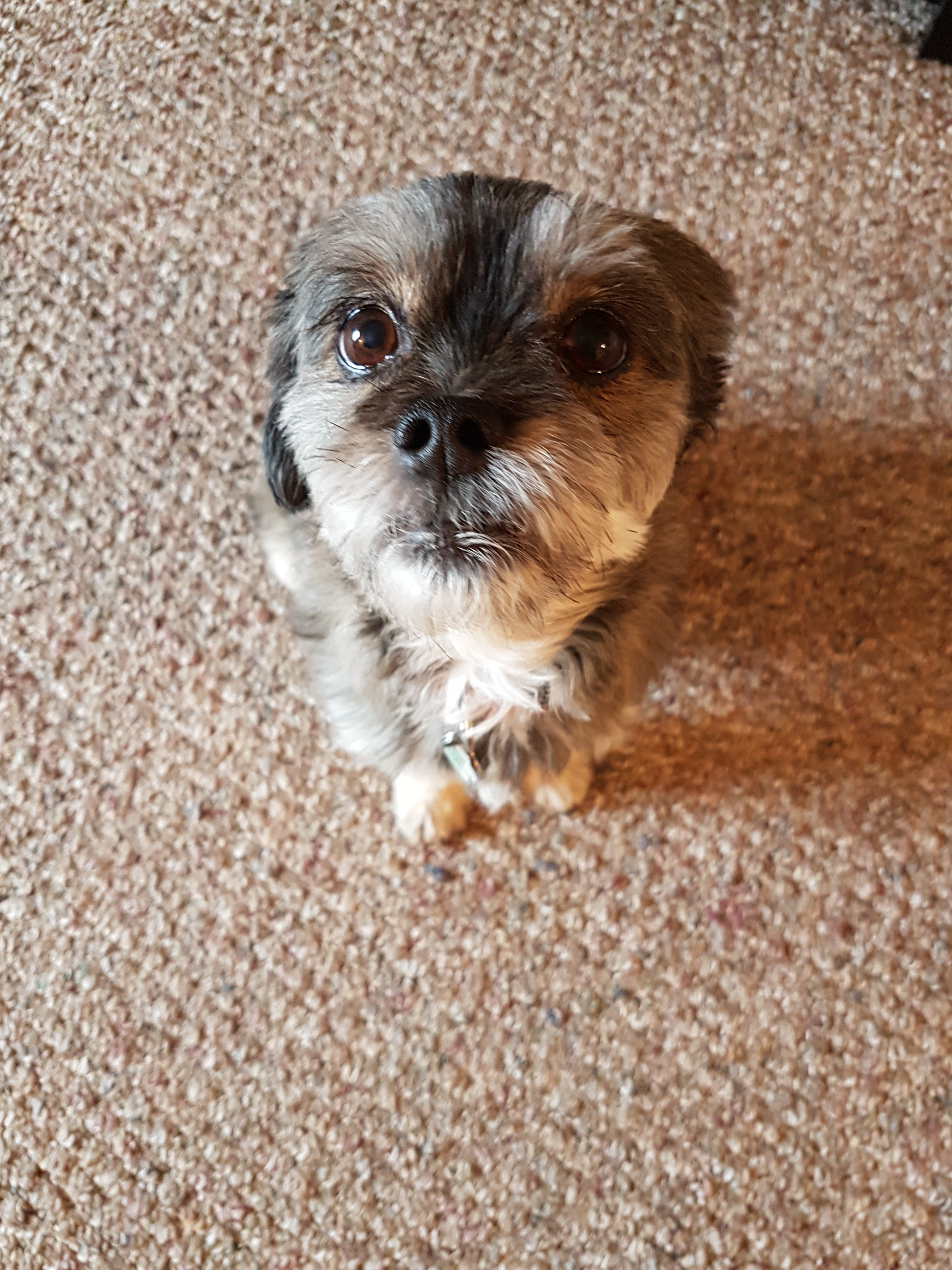
 Bogney: A tiny dog, wise for his years.

Today, we once again combine the old and the new for a fresh new perspective on life through the eyes of our classy canine friend. This is the daily living of a small dog. This is the extrapolated wisdom of the ages…This is the Bushido of Bogney.

-Click Here for the Original Article-

Lesson #1:

At the start of each morning, Bogney is given his portion of food for the day. When I am out of the house, he will rarely touch it. When I return, he eats it ravenously. This is a clever concept lost on even most people. When earthly pleasures are limited, we must be prudent and careful. When the source of these pleasures is close and there is bounty for all, we must remember to occasionally indulge ourselves.

Lesson #2:

Bogney is a creature of habit, and learns quickly what are the expectations on him, and the proper etiquette for any situation. When at home, he knows his walk times, when to go to the bathroom, and the expected rewards of each. When he is at another residence, this is thrown off. At times such as this, Bogney will divide up his washroom breaks, hoping to be rewarded for each tiny movement. It is a clever trick, but rarely successful.

Nevertheless, he will continue with the ruse whenever the possibility arises. To pursue with creative vigour any potentiality we desire is the mark of an ambitious soul.

Lesson #3:

In the company of his master, Bogney is a model of restraint and composure—entirely content with life, and his place within it. However, on the occasion of company arriving at his home, he becomes cloying—clinging to his master’s leg in a desperate bid for constant attention. We most value the things we have when we can see that they are also valued by others.

At this point in our lessons, I’m afraid Bogney became quite distracted in an effort to catch a piece of dust from the air, and is well beyond any further insights. Perhaps there is some gem of wisdom to draw from this as well, but this writer, for now, will remain content in watching the show.

Fear not though, as soon as the air is cleansed of foreign particles, there is no doubt Bogney will be back with further enlightening anecdotes for us all.

-Brad OH Inc.

The Evocation Series- ‘Space Oddity’

Under the Green Desk Lamp…

The following post is part of ‘The Evocation Series’. Click Here for more information about the project, and to learn how to get involved yourself!

David Bowie- ‘Space Oddity’

Song Link

The mind can be a sanctuary at times, especially when the world outside seems a dark and unwelcoming void. But like many sanctuaries, its isolation can also be suffocation, and its secrets are strange and surprising even to its own inhabitant.

It’s a terrifying balance to strike—between the darkness without and the cold serenity within. We all feel like that sometimes, and though it is an experience shared by most everyone, this makes it no less horrifying.

Check ignition,
and may God’s love be with you.

 It’s no easy task—to turn away from the chaos of the world without and face instead the calamity within. To surrender to our own uncertainty has been described as both a depressing submission and an inspiring act of faith or self-realization. Of course, neither perspective makes the deed any easier.

But to tread this line with grace is a most worthy endeavour. Despite the tribulations of the waking world, it is a thing we all must brave. But to do so with vigour and agency, we must also master our inner selves. It’s a fine line to be sure, but the potential payoff is well worth the venture.

 I’m floating in a most peculiar way,
And the stars look very different today.

 It’s a rare and wonderful thing when it’s pulled off just right. To equally know ourselves and our reality is a path tread most often by the shamans and philosophers of the world. For the rest of us, we can hope, at the least, to understand some small part of it before we go.

Darkness is as unavoidable as light, its counterpart—and it is just such a truth which might illuminate the greater realities of the world…the connections which exist within, but which can be understood only in moments of rapture, or surrender.

 Planet Earth is blue,
And there’s nothing I can do.

We all die alone, and to face this is the truest challenge and most necessary condition of being alive. Feeling hopeless, but finding contentment in that? Sometimes, there is nothing more liberating than to acknowledge our own powerlessness.

-Brad OH Inc.

Introducing ‘The Evocation Series’

Under the Green Desk Lamp…

Green DesklampToday on Brad OH Inc., we’re happy to announce the start of a brand new project—‘The Evocation Series’.

‘The Evocation Series’ is a fresh endeavour for us, and will be posted within the ‘Under the Green Desk Lamp’ (Link) category. This series focusses on our congruent love of music and metaphor. For each of these posts, we’ll be sharing a much-loved song of ours, providing a link to it for your listening pleasure, and then creating a brief literary piece inspired by the lyrics of said song.

This will be a keen opportunity for us to explore some of the themes and moods presented by many of our favourite pieces of music, but we don’t want it to be an entirely selfish endeavor! We want your involvement as well!

To that end, you’ll find a ‘Contact’ link here, and at the bottom of today’s post. That’s is where you, the reader, come in! Reach out and let us know if you have a song you’d like us to cover in the ‘Evocation Series’—whether it’s a song by your favourite artist, a song that’s previously inspired something in you, or even a song you’ve made yourself!

So drop us a message, and let us know what you’d like to see us cover in this exciting new project. Finally, stay tuned for our first official entry in ‘The Evocation Series’, coming next week!

‘Contact us Here with your Requests.’

-Brad OH Inc.

The Greatest Hits of Brad OH Inc.

cropped-cropped-blogbanner13.jpgHere at Brad OH Inc., we’ve been sharing regular content since late 2012, and over the years we’ve covered countless invaluable topics in great depth. In fact, there are now four distinct categories (Link) on offer for our readers—each with a unique voice and subject matter.

Today, we want to take the opportunity to review and revisit some of the very best articles we’ve put out over the years. Below, you’ll find our own personal Top 10 List, conveniently broken down by category. You can click the banner of each to go directly to that category, or you can click the title of each article to navigate there and read it in full.

 Under the Green Desk Lamp:

Green Desklamp

Bourbons by the Fire: A brief, stream of consciousness piece about vision and purpose. In this article, we explore the state of the world, and our individual power to change it.

Bullying in the Supermarket: This piece is an exploration of the culture of bullying, exploring the mixed messages of a world which tells children to be kind, while holding no such expectations for its adults, business leaders, or media.

Profits and Prophets: Over the past decade, many of the greatest disasters, losses, and threats we’ve faced have centered around two specific homonyms: Profits, and Prophets. We explore this notion here.

The Metaphorical Imperative- Part 1, and The Metaphorical Imperative- Part 2: The ‘Metaphorical Imperative’ is one of the most fundamental ideas behind Brad OH Inc., and will soon prove to be among the defining themes in one of our biggest upcoming projects. These two articles take an in-depth look at this essential philosophy.

 Purely Speculation:

purelyspeculation

On The Concept of Society: In this article, we establish and explore a basic understanding of society based on human history and contemporary needs. If we are to endeavour to consider changes to society, it is imperative that we first define our terms and understand exactly what we mean by the word.

Saving the World 101: How can we harbour hope for the future when the current situation often seems so dire? In this post, we discuss exactly what hope we may find for the future, and exactly what it would take to get us there.

The Global Scale: In ‘The Global Scale’, we pull our perspective back a bit to educate the reader about how interconnected the world truly is. If the decisions of one nation inevitably effect the rest, then we must take this global perspective into account any time we seek to make changes. Here, we reveal exactly what’s going on behind the scenes on the Global Scale, and exactly what sort of opposition the forces of progress are up against.

Requisite Things:

cropped-cropped-blogbanner13.jpg

 A Call for Corporate Suffrage: ‘Corporate Suffrage’—what two words could be more heinous and detestable to any sober mind? Unless of course that mind happens to be focussed on the profits of its own Corporation—in that case, Corporate Suffrage seems pretty damn agreeable.

The New Corporate Religion of Brad OH Inc.: Here, we use our trademark Corporate perspective to push the notion of ‘Freedom of Religion’ as currently defined to its most vile extreme—specifically, Corporate Religion.

Gentleman Juggalo:

The Gentleman Juggalo Logo

The Juggalo Gang Designation Essay: Juggalos—the fanatical fans of the Insane Clown Posse—have been labelled an organized, hybrid gang by the FBI. In this article, we take those tools to task—elucidating not only what a miscarriage of justice this action is—but also establishing it as an unforgivable misdirection from federal accountability.

Collectively, these articles cover a fine spread of what we’ve put on offer over the years here at Brad OH Inc., and while it is certainly important to celebrate the past, it must not be taken to mean we don’t look to the future. Therefore, we invite all of you to let us know in the Comments below what your favourite articles have been, which categories you prefer, or if you have any specific topics you’d like to see us cover. After all, here at Brad OH Inc., we live to please!*

*This statement does not necessarily reflect the thoughts or opinions of anyone at Brad OH Inc., and is not to be taken as legally, morally, or even tangentially binding.

-Brad OH Inc.

‘Never Uncovers the Ultimate Truth of All Things’

Recently, the myriad authors of the ‘Edmonton Writer’s Group’ (Link) published our second anthology, ‘Between the Shelves’ (Link) . This book was sold in support of the Edmonton Public Library System (Link), and to that end has gone on to raise over $700 in donations!

We here at Brad OH Inc. want to thank everyone for their support. Today, we add our contribution, ‘Neve Uncovers the Ultimate Truth of All Things’ (Link), to our list of ‘Single Serving Stories’ (Link), meaning you can download it now for free over at Smashwords (Link).

Neve Uncovers the Ultimate Truth of All Things- Cover‘Never Uncovers the Ultimate Truth of All Things’- Smashwords

We certainly hope you enjoy this new format for ‘Neve Uncovers the Ultimate Truth of All Things’! But don’t forget, if you haven’t already bought your copy of ‘Between the Shelves’ (Link), you can do so now right here (Link)!

BetweenTheShelvesCover‘Between the Shelves’- Amazon

Remember, there are 10 other stories by local Edmonton authors in the anthology, so click here (Link) to grab your copy now. After all, every dollar earned goes towards the worthy cause of supporting the Edmonton Public Library System (Link)!

-Brad OH Inc.

‘My Brother Cain’

Under the Green Desk Lamp…

Green Desklamp

Today we have another song/ poem from the intellectual property vaults of Brad OH Inc. For your enjoyment, we present the lost ‘Basic Human Indecency’ song: ‘My Brother Cain’.

The disillusioned knight

You find the world has changed

But if anything’s unnatural

You know everything is

But about that boat

I just know it sailed

I can’t tell you when

Still caught up in that tale

And I could never consider

How I’d turn that table

What I would have changed

If I’d known I was able

He had a magic wand

That slowly seared his voice

And it just kept showing up

Like any other choice

So now some smile back

You know it’s not the rule

But I never rolled my eyes

That was me looking up to you

My Brother Cain

Remember me?

You’re shadows and history

But do you remember me?

Still I could never consider

How I’d turn that table

What I would have changed

If I’d known I was Abel…

-Brad OH Inc.

‘Between the Shelves’ at ‘Words in the Park’ and Interview with Author/ Editor Hal J. Friesen

cropped-cropped-blogbanner13.jpgToday, we’re happy to formally announce that the sales of ‘Between the Shelves: A Tribute to Libraries by Edmonton Writers’ have led to the donation of over $700.00 to the Edmonton Public Library System We at Brad OH Inc. think that’s awesome—and we couldn’t have done it without all of you!

Many of the Authors (and both Editors) will also be set up at ‘Words in the Park’ this Saturday, September 26th from 10:00am-4:00pm in the Sherwood Park Community Centre. We’ll be selling and autographing copies of ‘Between the Shelves’!

In celebration of these accomplishments, we have an interview with Editor and Author Hal J. Friesen, who appears in ‘Between the Shelves’, which you can now purchase here in either Kindle ($2.99) or Paperback ($12.50) copies. All proceeds are to be donated to the Edmonton Public Library System.
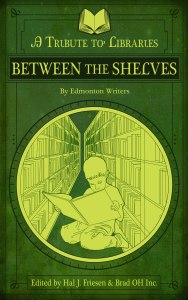
BetweenTheShelvesCoverThis interview was conducted by a variety of Authors featured in ‘Between the Shelves’ in anticipation of the anthology’s release:

  1. Brian Clark: What is the biggest thing you have learned from this self-publishing experience?

HF: I learned how achievable it is to put out a product of professional quality using readily-available tools. There were some frustrating moments getting the book formatted properly and tweaking cover blurbs, but on the whole it felt great to see a self-published book that could easily have come from a professional publishing house.

I also need to mention how pleasantly surprised I was at the scope and variety of stories submitted to the anthology. I thought I had a pretty good idea what I was going to get from the EWG group members, but they surprised me in a very good way.

  1. Vivian Zenari: What is your educational background, and how has that influenced your writing?

HF: I got my Bachelor’s Degree in Science from UNBC with a Joint Major in Chemistry and Physics, and a Minor in Mathematics. Basically for my undergraduate degree I was trying to refuse specialization, which in hindsight might not have been a good approach in terms of employability. I had knowledge in many fields but was missing snippets from each to prevent me from being completely proficient. My Master’s Degree in Science, focusing on Plasmas and Photonics, helped me tune my abilities and knowledge toward more practical applications – as ridiculous as that might sound after working on laser fusion experiments.

The breadth of theoretical and experimental science experience I’ve gleaned through the years helps me to appreciate how certain science fiction ideas might be implemented, the realities both pleasant and unpleasant of logistics that really help make a fantastical proposition seem real. When I wrote in high school I was thinking of sci-fi notions in a more detached and academic way. After academia, ironically, I think about them more in terms of what’s happening on the ground, what’s happening to the little guy who has to pull the levers, which helps make science fiction more meaningful to readers.

  1. Brad OH Inc.: Hal, your story is about a man (Albert Einstein), gaining great knowledge from libraries, but also experiencing stunning existential terror. Do you consider libraries to be places of hidden danger, or is learning in general a threat to our sense of being?

HF: I used to read these time machine choose-your-own-adventure books, and they were like puzzles where you got stuck in time loops until you figured out the correct sequence of events to escape a grisly fate. There was one particular instance where I was trying to avoid being guillotined, but kept getting sent back over and over again, being chased, being caught, having the blade fall – to the extent that I fell asleep and had nightmares about it. Libraries taught me to be utterly terrified of the Spanish Inquisition.

I think in our age of ubiquitous fear-mongering, it’s important to recognize libraries and their potential role in contributing to the general fright that fits so well in a terror-state. In this story I wanted to show that even a brilliant Einstein can’t escape the spine-tingling horror of a nameless source of danger. His existential cataclysm in a place of learning draws close parallels to the dread during the discovery of a newly-christened terrorist cell, or the announcement of the construction of yet another totally-necessary prison. I felt that the role of books and libraries in general has been undervalued in terms of their capacity to inspire totally irrational fear, and wanted to emphasize how deeply they can touch our being versus other forms of media.

  1. Brad OH Inc.: Why did you choose Einstein as your character? Do you have some arcane knowledge of his life the rest of us aren’t privy to? Is there any biographical truth to this tale?

HF: I have a copy of Einstein’s original manuscript on Special Relativity, and if you go to the trouble of reading it you find very strange references in the margins, almost as if he was placating some unseen observer. With extensive and advanced calligraphic decoding I was able to parse some of the scribbles he had tried to hide after the fact, after whatever it was had stopped peering over him threateningly. It was clear he had communion with a library spirit, or as he named it, Wilfred, though exactly which library was unclear – I used artistic liberty in that aspect.

It’s amazing how much you can discover when you read the source material rather than just taking secondary sources at face value.

  1. Brad OH Inc.: Your passion for libraries is clear in this story. Share with us some of your most formative memories of being in the library. Is there any encounter in particular that stands out as a moment where knowledge was so startlingly thrust upon you?

HF:  Guillotines were startlingly thrust upon my unsuspecting neck in that traumatizing time machine book…

When I was a child, there were summer reading challenges where you got to move your pawn along footsteps lining the library walls, taking a step for every book you read. The path took a circuitous route around the two-story Prince George Public Library, and I would take out piles of books in order to get to the end. And I did.

My prize? PTSD from an impossible and horrific Spanish Inquisition time machine loop. And a ribbon.

The library used to have person-shaped chairs in bright colors, and I would sit near the large windows and browse through Goosebumps books, Tintin comics, and fantasy books. I would sway back and forth in the S-shaped chairs, knocking them flat onto the back, or upright again with a satisfying thunk. The trips to the library were a fairly regular occasion – my mother would tiptoe off to the romance section, and my brothers and I would spin the carousels housing adventure and horror novels.

Getting my first library card was actually one of my happiest childhood experiences, because I felt like I had graduated from this semi-weekly family ritual and had become an adult. It was a lot better than any actual graduation, that’s for sure.

  1. Brad OH Inc.: Your writing has historically been focused on some pretty heavy scientific concepts. What do you consider to be one of the most interesting unanswered questions in modern science? Do you have any possible ‘dream scenario’ solution to this quandary that strikes you as the most appealing?

HF: Not to avoid the question, but I guess the more interesting questions are ones we haven’t thought of yet. The untapped potential and dark corners of our understanding are very exciting places, which is why I enjoy good hard science fiction so much. One recent discovery was that the brain might have a lymphatic system, which opens the door to all sorts of medical progress and better development of humanity.

The unanswered question of life beyond Earth is a continually fascinating one for me, and my dream scenario is that I live long enough to see contact happen. That would be a great privilege.

The unification of gravity and the other fundamental forces is another issue that fascinates me. I remember the exact place where I first read Maxwell’s derivation of electromagnetism and the intimate relationship between them. I literally got up and wanted to run around (but couldn’t in my cramped dorm-room) because I was so excited by the beauty of something so connected and intertwined. Connectedness, for lack of a better term, is something I explore a lot in my writing, and it interests me equally in the natural world.

Similarly, the unification of quantum mechanics and general relativity – the small with the very large – is also quite an interesting unanswered question. I’ve read a proposal that suggests the answer might be in our interpretation of time itself, which sent my head spinning in beautiful pirouettes.

I think some of the deeper philosophical-physics questions might go unanswered for a long time, but can make you experience some of the same existential schism Einstein does in the story. Questions like: what exactly is charge? What exactly is mass? We have equations that describe what they do but that’s different from knowing what something is. There’s a joke that if you want to drive a physicist crazy, ask him what charge is. Try it sometime.

  1. Brad OH Inc.: As a follow-up to the former question, of the myriad scientific discoveries throughout history, which would you most like to have been a part of, and why?

HF: I’ve developed an unlikely fondness for light and optics, so I think I would have loved to have been a part of Maxwell’s discoveries unifying electricity and magnetism. Any of the so-called Maxwell’s equations. Ampere, Gauss – to have been around any of those guys would have been gnarly and radical, and I’m sure my language wouldn’t drive them crazy. Gauss was a genius.

I would say quantum mechanics, but the results aren’t as easy to put your hands on or see with the eye. The laser would have been pretty amazing to discover. I got the chance to hear Charles Townes, one of the co-inventors of the laser, speak, and it was surreal to see him use a laser pointer to point at a slide of his original laser conception. He made lasers originally for astronomical purposes, and at the time of his talk (age over 90) he was still doing that. There’s a raw enthusiasm and electricity some scientists exude and I think to have been around any of those remarkable individuals would have been illuminating and inspiring outside of the discoveries themselves.

WitP twitter header

Remember to catch the authors of ‘Between the Shelves’ at ‘Words in the Park’ this Saturday, September 26th from 10:00am-4:00pm in the Sherwood Park Community Centre!

Finally, be sure to visit Hal J. Friesen at his blog right here, and check out his story “Reading After Hours” in ‘Between the Shelves’. You can purchase it now on Amazon.

-Brad OH Inc.
‘A Song for Alec’

Under the Green Desk Lamp…

Green DesklampToday we have another song/ poem from the intellectual property vaults of Brad OH Inc. For your enjoyment, we present the lost ‘Basic Human Indecency’ song: ‘A Song for Alec’.

Old Alec McPhee
Was a man of the sea
He’d traveled all over the globe
But now his boots sat
In a house on a road
Where old Alec shouldered his load

He moved into the house
To care for his family
Who offered him no word of thanks
He worked for the army
To pay for his children
But poor men don’t rise through the ranks

Every day he worked hard
Every night he lay cold
His dreams and his future denied
Old Alec sat
In a chair at a table
And looked out his window and cried

Old Alec walked down
To the water one night
Kept walking as it reached his chest
He carried with him
The clothes on his back
Some memories and left all the rest

Walked into the water
Up past his neck
Through the water he pushed out so fast
Away from the land
Out into the water
Alec walked away from his past

A man that is living
Must live in the present
A man that has run carries shame
But a man that’s found dead
Will live on in memory
And not scar the worth of his name

Alec turned around
With the water at his nose
And knew he had made a mistake
Remembered his duty
To care for his children
And knew there was no choice to make

The sounds of his life
Were silence or screaming
His friends from the past never called
His kids barely knew him
His wife didn’t love him
Alec’s house was no home at all

His family was cruel
As if sent by the Gods
To punish him for all his sin
But they needed a man
To survive in this world
And damned if it wouldn’t be him

Old Alec walked dripping
Into his kitchen
And up to his wife for a hug
She shrugged him away
And tossed him a towel
And told him to stay on the rug

In his chair by the table
He looked out the window
As dreams of the past filled his head
He stared at the ocean
And knew he’d been foolish
For he was already long dead

A man he will live
For the Gods that he chases
And see them wherever he’ll roam
And he’ll chase the shadows
Make gifts into shackles
And a prison out of a home

Alec can you find
Alec does it seem
Alec won’t you learn
That you’re chasing dead dreams

Alec are you lost
Alec are you blind
Alec don’t you know
You’ve lost more than you’ll find…

-Brad OH Inc.

Between the Shelves Book Signing and Interview with Author Trudie Aberdeen

cropped-blogbanner1.jpg

The following is an interview with Trudie Aberdeen, who appears in the Brad OH Inc. and Hal J. Friesen edited Anthology ‘Between the Shelves: A Tribute to Libraries by Edmonton Writers’, which you can now purchase here in either Kindle ($2.99) or Paperback ($12.50) copies. All proceeds are to be donated to the Edmonton Public Library System.

BetweenTheShelvesCoverThis interview was conducted by Hal J. Friesen in anticipation of the anthology’s release:

Trudie Aberdeen is a long-time language educator and social justice advocate. She is currently working on completing her PhD on the topic of heritage language acquisition. In addition, she teaches English to adult newcomers to Canada. Her academic interests include refugee education, multilingual literacy instructional practices, language conservation, action research, and language instruction for heritage language learners. Her research can be found in the following journals: The Manitoba TEAL, Multilingual Discourses, and the 9th Low Educated Second Language and Literacy Acquisition (LESLLA) Symposium. She also serves as the book review editor to the Canadian Journal of Action Research.

  1. The passion for your work is clear in every aspect of your writing. How long has heritage language acquisition been a part of your life? What started it all?

TA: I was raised in a middle-class, English-speaking family in Alberta. My childhood was fairly normal. And when I was a little bit older, similarly to most rebellious teenagers, I took my teenage angst and raged against my parents. While others were sexing, drugging, rock-n-rolling and doing other “naughty things”, I inflicted on my father what I thought might have been one of the most painful childhood revolts I could think of: I went to Campus St. Jean and took university in French! On my personal journey to bilingualism, I learned about the power of language along the way.

Contrary to current popular belief, I’m not really a natural when it comes to language learning. I’m someone who learns with moderate aptitude and great effort. I was always fairly successful in school, so learning that language learning was hard was a shock for me. So despite by best enthusiasm, I wasn’t successful my first year and was put on academic probation. Because I struggled with the language I was in a place very few white, middle class, English-speaking women with average intelligence ever get to be: I wasn’t part of the mainstream. For me, this is when I realized how language (or lack thereof) can limit one’s chances of success. I finished my degree successfully, although it took me more than four years and I had to spend a year in language classes in Quebec, but I eventually triumphed.

I taught in Japan for several years in an international school. I was the English as a second language teacher to elementary school aged children whose parents moved temporarily to Japan for business or diplomatic missions. I saw how quickly many of my students learned English and how quickly many of them forgot their mother tongue. I saw the parents who were “trapped” because if they moved home they could no longer put their children in school because the children couldn’t read or write their “mother tongue”. I also worried a lot for my students who appeared to have learning disabilities. Parents, colleagues and I often asked, “What is this child’s issue? Is it a language learning inability or something bigger?” Often it is difficult to know.

When I started my doctoral studies, I began to take interest in adult literacy learners. In my field of English as a second language teaching and learning, literacy learners are adults who grew up never learning to read their mother tongue, mostly due to limited opportunities because of gender, poverty, or war. Their lack of first language education impacts on their opportunity to learn English. They often struggle with things that most of us take for granted: following instructions for over-the-counter medication, signing their children’s homework log, figuring out a map, and reading street signs. Despite all of their challenges, all of those I have worked with have an undeniable spirit, determined outlook, and an often overlooked sense of intelligence.

My dissertation, however, looks at heritage language learners. These are usually the children of immigrants who have to navigate cultures and languages, not being conventionally “Canadian” and first-language English speakers, but not being of the same language and culture as their parents, either. Most of these children struggle to keep the language of their parents and cannot without the help of a larger language community and school. My work is looking at how schools and communities can support these students.

Heritage language learners and adult literacy learners do not initially seem connected, but they share many commonalities. Both groups often are trying to learn language in an environment that is limited in exposure to language. Both are often trying to learn language without literacy. In many instances, these two groups can be within the same family. Some immigrant parents (especially those with limited literacy) can struggle to learn English and their children can struggle to maintain their first language. In my line of work I have met many people who are unable to have a basic conversation with their parents because they do not know enough of each other’s language to exchange more than limited small talk.

  1. There seems to be a message or end goal with your writing / research. What is it you hope to achieve at the end of your dissertation? 

 TA: I hope to show the world exactly how much expertise exists in the field of heritage language education in Alberta. I wish politicians, educators, and scholars to know about the challenges and limitations that programs face so that they can receive better support in doing what they do best.

  1. Who has inspired you as either a writer or researcher? 

 TA: My four favorite researchers are Dr. Olenka Bilash, Dr. Kenneth Schaeffer, Dr. Nick Ellis, and Dr. Elaine Tarone. All four are gifted scholars and educators. However, what I admire most about them is their compassion and vision for making the world better for others.

  1. Would you be willing to share one or two stories from your experience as a language educator? 

TA: In 2004, I had a beautiful kindergarten student from Sweden called Hedda. She was a dream child: polite, kind, energetic, brilliant, and friendly. She started school in September and by Christmas she was speaking English well. Her reading level was near the top of her class. At the parent-teacher interviews, I gave her parents “the talk.” I warned them about language loss and the importance of first language maintenance. I told them that they had better start planning for her Swedish or else it would be gone. I recommended that they find her a tutor and begin reading lessons as soon as possible.

While Hedda’s mother seemed convinced by my message, her father was less so. He responded firmly, but politely, that Hedda was a little girl. She had just made a huge adjustment, according to her father, by leaving her extended family behind in Sweden and moving to Japan, and furthermore, she needed to worry about enjoying herself, not planning for her future education. I responded that while I respected his point of view, he should at least consider my suggestion. He told me that he would think about it after his family returned from their holiday in Thailand.

Sadly, all four members of Hedda’s family were lost in the 2004 tsunami that killed more than 250,000 people on Boxing Day. I often think of her and her beautiful family. I often think of the advice I gave to her parents, and consider what her father responded to me. For language learning, we need to have long-term planning, and to prepare for what is coming ahead. At the same time, we need to remember that this moment might be all that we have.

  1. Why do you personally think language is important?

 TA: If you ask a brain researcher or a psychologist, they will tell you about all of the cognitive benefits of bilingualism. Of course, I believe all of these things are true such as bilingualism increasing intelligence and delaying the onset of Alzheimer’s disease. Still for me, the most important aspects of language learning are social in nature. Language connects people to opportunities and it connects us to one another.

Check out Trudie Aberdeen’s story “Newcomers to Canada and Edmonton Public Libraries” in ‘Between the Shelves’, which you can purchase now on Amazon.

BetweenTheShelves_poster-YMCA-WEB

Finally, be sure to visit us for a ‘Between the Shelves’ signing this Saturday, May 30th at William S. Lutsky YMCA (1975-111 St NW) from 10am-2pm!

-Brad OH Inc.