
Under the Green Desk Lamp…
 In addition to regular blog articles and my published novels, I’ve also written several Single Serving Stories over the years. Some have been published in anthologies like ‘Between the Shelves’, ‘Edmonton: Unbound’, and ‘All Mapped Out’. Others have been shared exclusively on this blog via the publication platform Smashwords.
Recent changes to the Smashwords platform has made it a less reliable option however, and therefore an exciting change has come to Brad OH Inc.
I will be re-sharing in full—un-edited and un-abridged—all Single Serving Stories previously published on Smashwords with Brad OH Inc. as the new, exclusive provider. All text will be provided in full, with no download necessary. If Smashwords don’t like that, they can message our complaints department.
This project will culminate in a couple of heretofore unpublished Single Serving Stories, so even the most dedicated of readers will have something to look forward to.
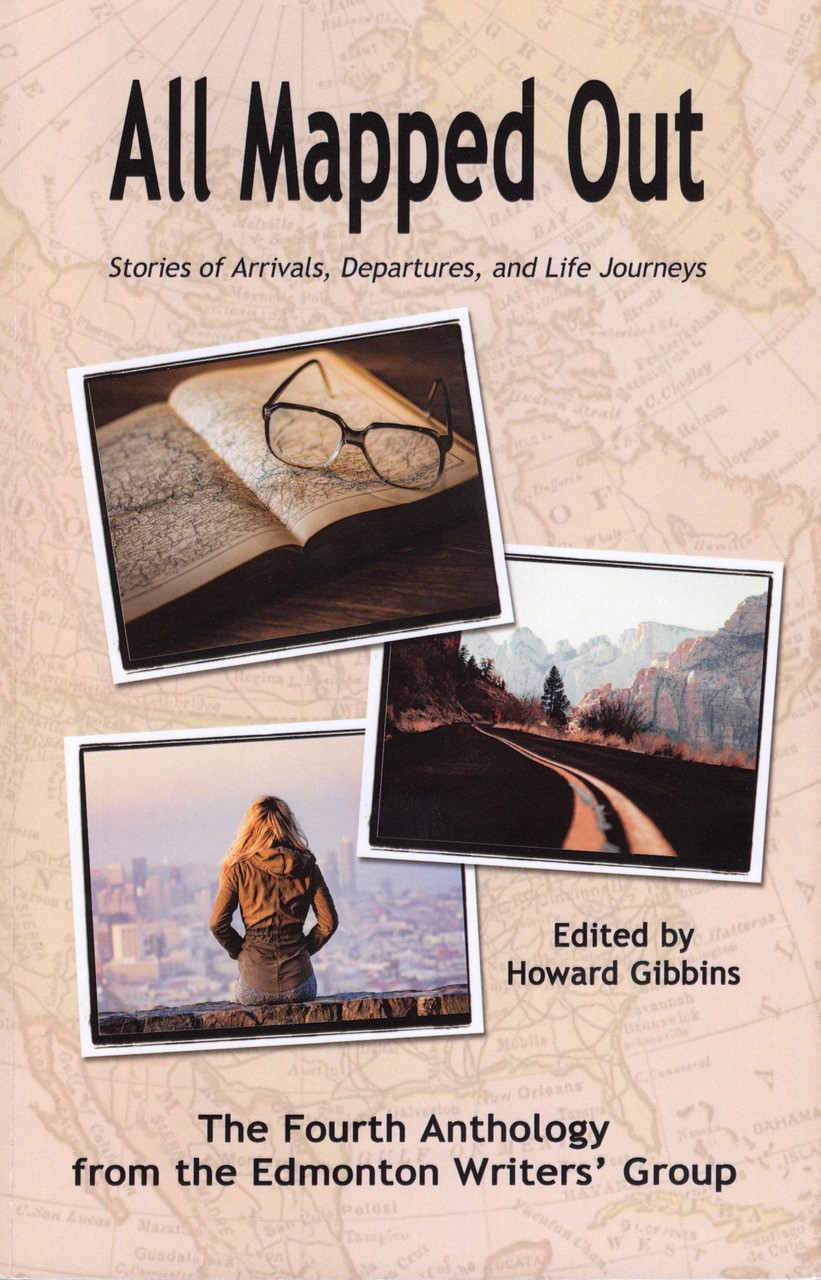
Today we share our twelfth and final Single Serving Story to be released previously, ‘The Great River’. This story was written for the ‘All Mapped Out’, which was published with the Edmonton Writers’ Group. These stories were unified by a theme of navigation, mapping, or finding your way, and is likely the closest I will come to writing fantasy.
 The village of Erro’s people was tiny, at least that’s what he was told. He had never seen a bigger village though, so to him, it was the world.
It was old as well, older at least than anyone could tell. The villagers had no way of knowing when the village was founded, or who had done the founding. They knew only that it was their home, and had been for as long as they were a people. It was to them the very reason for being, and everything that they were.
Maintaining their meager way of life was no easy task, and providing for the infirm took no shortage of sacrifice from the more fit members of the village.
This had always been an accepted truth, but as Erro approached his 13th summer, what had always been accepted finally began to be understood. Sometimes, there is a terrible difference between knowing something, and understanding it. As Erro’s father took him into his room one day to speak away from the others, that was the first great lesson that he learned.
“The time has come Erro. We’ve discussed this before. You’re no longer a child, but not yet an adult. You are of the age now that you must be tested.”
Erro bowed his head solemnly. “I know,” he said.
In order to maintain the balance of their tribe, one in five children were selected at birth to face the trial of the Great River. That was the way of his village in the new days.
Of the old days, little was remembered, save that the people had failed in their duties. Because of this failure, they lost the role of stewards of their world, and became instead slaves to its whims.
The meaning of both the old legends and the new traditions was hardly understood by any but the village Elders, but they were subtle, and shared only in vague riddles and half-meanings. Central to maintaining their lifestyle, however, was the trial of the Great River. Erro had been among those selected for it—a white flower hung above his door when he saw his third summer.
All his life, it had loomed over him as both a great honour, and a terrifying mystery. He was treated with prestige among his peers, but each day he would inevitably end up staring off alone at the distant forest, and the strange broken towers beyond their lands, and wonder if he would be able to find the Great River when the time came.
“Only by crossing the Great River can you become the leader that our people need, Erro.” His father’s voice was gentle. To Erro though, it seemed needlessly cold. It was a bitter truth he was telling. “You must go tomorrow morning with the supplies I have set aside for you. Find the Great River, cross it, then return to us to claim your rightful place.”
It was nothing new. Every summer, a few would be sent off to find the Great River. He had seen older friends go, and knew younger ones who had shouldered the same fears he had since finding the white flower. Only once did he recall someone returning after having crossed the Great River, but Elder Tashi never told of her journey. She was strong and stoic, and gave fair judgements and sage advice to the village. Of the Great River or where it lay though, she had not spoken a word since her return one rainy night, so many summers after she had departed. Bent and world-weary she had come back to them, and most met her then for the first time. In spite of that, they accepted her immediately—anyone who had crossed the Great River and returned to their people deserved that honour at least.
“How will I find it?” asked Erro.
His father reached under the battered bed he used to share with Erro’s mother, and pulled out a canvas rucksack. “You will take this with you,” he said. “There is a map in here given to us by the Elders on the day you were chosen. The rest, your mother and I saved up and stored away until this day. It’s all we could afford. May it serve you well.
“You will sleep here tonight. You must go tomorrow before the sun rises. May the winds favor your return to us my son.”
His father handed him the bag, then left the room. Erro sat for the first time alone in the room of his father, feeling the weight of the rucksack in his hands. Reaching inside, he pulled out a small bag of smoked meat, dried fruits, nuts, and other sundries. There was also a leather skin for water. Next, he found a small wooden shield. It made his stomach churn to imagine what he may need to fend off with such a crude barrier.
He knew what would be next. It was never spoken about, but in that moment, it seemed to Erro the only thing he could find. The small sword in the bag was heavier than he could have imagined, although it was little more than a dagger, and not very sharp. It had only a battered leather sheath, with a small loop where it could hang from the rope-belt that fastened his tunic.
Erro held it up, feeling strange and out of place. Already, he missed the days of playing in the fields with the other boys; running through the trees and climbing through the old grey tower just outside the town. He knew tomorrow his friends would return to their games. Not him though. That was behind him now.
He slipped the sword back into the bag. Blowing out a candle, he laid down in his father’s bed. It felt too large for his small frame. It was hard, and a cold wind came in through the open window, biting at him and making it difficult to fall asleep. His own bed was small and soft, and there were no windows in his room to let in the frigid air.
Erro felt as if he would never fall asleep.
That was not the last time he would be wrong.
***
Erro didn’t feel rested, but he knew he had slept. The moon was low in the sky, but the sun had not yet risen when a distant bell sounded in the village—a solemn goodbye to an old friend. He had heard the bell before, and pushed his head into his pillow, or pulled the blankets over his head, knowing it was forbidden to go outside to see off the chosen one. Even those who had been friends had to let go silently in the cool dawn. Back then, he’d wondered why. Now, he understood. He didn’t want his friends to see him as he slipped out of his home—his cheeks wet and his hands shaking as he passed between the stout houses, past the big barn, and out into the fields beyond.
Now that it was his time, Erro knew it was something he had to do alone.
That first day, he travelled far before resting. He wanted to be well out of sight of his village before he risked turning back, for he feared that if he saw again the gentle smoke rising from the small huts, or the familiar ruins, or the grassy fields of his youth, his heart would leave him and he would run back—a child forever. Not until he was well into the forest that marked the boundaries of his people’s land did he dare to stop. There, on a rock beside a small stream, he sat for a while, and ate a few nuts from his bag. He drank deeply from the cool waters of the stream, and filled his leather skin, which he hung upon his belt.
Then, he took out the sword, and looped the small leather sheath onto the other side of his belt. Throwing the strap of the shield over his shoulder, it crashed into his back with a hard thud. Stashed in the bag with all his other supplies, he hadn’t realised how heavy it was on its own.
“I suppose I should ready myself, now that I am on my path,” he spoke to himself. It seemed only appropriate, with no one else around.
Finishing his paltry meal, he returned the rest of the items to the bag, drew the string tight, wrapped it twice around his arm, and stepped back onto the path, through the stream, and off between the trees.
“If only that had been the Great River, and I could return home now with my duty complete,” he said. Just then, a terrible realization dawned upon him, and he stopped once more. How would he know the Great River when he found it? Tearing his rucksack open, he pulled out the map. On the old parchment paper was drawn a small cluster of huts which had to represent his village. Seeing them made his chest tighten, and he drew his eyes away quickly. The border-forest was beyond it, then there was a vast stretch of land with only vague scribbles and uncertain symbols. Some showed what may have been broken towers, others might have been mountains. In some places were what looked like people, but whether those were an indication of his own journey, or a warning of what he might meet on the trail, Erro could not be sure.
Starting from the top of the far corner was a long winding line that slowly bent back towards the far edge until it finally disappeared again about a third of the way down the map. This was clearly marked, ‘The Great River’.
Even if the forest was drawn to scale, it seemed like a terribly far journey. “No wonder it took Elder Tashi so long,” he mumbled to himself, and was ashamed to hear the trembling sound of his own voice.
Still, the path was clear for a while. He would continue on until he left the forest, then take the eastward road, bending north as the course allowed. What came after that, he would discover in time.
Erro slung his rucksack over his shoulder, and leaned into the road. It would be a wearisome journey, and he knew in his heart that his next rest was a long way off.
***
How many days had passed? Erro had lost count. The sun wheeled carelessly across the sky as he walked, and the moon passed through its cycles as it always had. But that had been in familiar lands and safe places. Now, those were but sad longings to Erro. He was hungry, but knew he had to ration his food—unsure how much he would be able to find along the way.
His map did little to soothe his doubts. The space between his village and the Great River was so nondescript, he knew not how long it would take. So, he hurried his steps, half-hoping at any moment to see it stretched out before him. Still, he had been taught since childhood to prepare for the worst, and so he tightened his belt and trudged onward.
His stomach began to hurt, and his head was light as he hastened over round green hills, and through deep dusty gorges. Despite the mounting exhaustion seizing his body and the wracking hunger-pains, he kept his eyes sharp for berries, roots, or any other edibles that might fill out his dwindling supply. They were few and far between, and his spirit sank with every step. He determined to cross only a few more hills before settling down to rest for a while. The day was still young, but he knew he could not go much further without a break, and wondered how he would muster the effort to rise when the next day finally came.
Upon the crest of the final hill, he gazed out over a broad flat valley. Far in the distance, he could see the blue lines of what he guessed must be mountains. He had never seen such things before, though he’d been told about them in his youth, and they drew his eyes immediately to them and held them a long while. They were far off, but their size could not be denied. They gave him both a thrill and a tremor of doubt—there were no definite mountains anywhere on his map, only jagged lines that could easily have been anything else.
Tracing the valley floor down from the far blue mountains, he saw patches of trees—some might have held precious fruits—occasional stony outcroppings, and tall grasses blowing in a gentle wind.
Then he saw it. A thin line of silver bending its way between the grasses on the valley floor. Erro knew immediately that it could only be a river.
Down the hill his hurried steps took him, and no longer did thoughts of rest enter his mind. Only to reach the water, fill his canteen, and finally cross the river. Was it the Great River, he wondered? He had no way of knowing. It was before the mountains, and that was a good sign. But it didn’t look very big, no wider than perhaps the height of four men, and there was nothing about it that struck him as particularly great from this distance.
Still, it was the first real river he’d seen on his journey—the first bit of water besides small streams and the occasional stagnant pond. His spirit soared at the sight of it.
At any rate, Erro reasoned, crossing it was inevitable, and he could assess its greatness by how he felt once the crossing had been done.
At a near-jog, he hurried along a beaten grass pathway towards the river. He passed between stands of tall trees, noting they were pine, and held no fruit for him. Again, his stomach rumbled as he moved along, and his limbs began to ache for need of a good meal, but on he rushed, eager to reach the river.
Dodging around a stony outcropping and down a short incline, the river finally lay just before him. It was no wider than he had imagined, and at no point did he lose sight of its bottom—so shallow and crystal clear was its surface. But it moved faster than he’d guessed, with occasional branches or leaves showing the speed of its passing.
His lips were dry and cracked, but he smiled, bending over and filling his water-skin from the cold rushes of the river. He drank deeply, directly from the source, and his back ached as he straightened up and steadied his feet for the treacherous crossing. The way would be slippery, and he would need to take his time lest he lose his footing and hit his head on the rocky bottom of the river’s bed. But he had no doubt that when he reached the far bank, the answer would be clear to him. Soon, he would know if his journey was at its end.
“Hail! You there!” The sudden sound of a voice startled away his thoughts. Following the sound to his right, he saw lying beneath a tall pine tree the bent shape of an old and bearded man.
Fingering the hilt of his sword under a flap of his tunic, Erro swallowed a sudden lump in his throat and stepped towards the stranger. He realized only then that this was the first person he’d seen since leaving his village. The first real stranger he’d ever met.
“What is it?” he called in answer, and moved cautiously forward.
The old stranger sat up slowly, using the trunk of the tree as a crutch to pull himself doggedly to his feet. “The current is too fast for me to cross. It would take the feet out from under me and drown me even in its shallow flow. Wouldn’t you help an old man across?”
Erro’s stomach groaned with hunger, and glancing sidelong to the river, he was desperate to put it behind him and see what lay beyond it both physically, and for his own quest. He hoped that stepping on the far shore would quiet his hunger and bring a great swell of peace and knowledge to him—the sort of calm certainty displayed ever by his seniors that seemed the elusive promise of adulthood.
For just a moment, he was tempted to turn his back and cross the river alone, ready to bask unburdened in the glow of his personal triumph. The thought did not last though, and Erro knew somewhere inside that there would be no triumph if he failed to help this desperate stranger. Still, he was nervous, and as he put an arm around the old man and led him towards the river, he watched the man’s hands closely, and felt beneath his thick robes many strange tools, and wondered at their purpose.
The stones of the riverbed were slick, and the force of the rushing water reached Erro’s shins, pushing against him and testing his balance. The old man slid side to side on the stones, leaning his weight against Erro to steady himself as they crossed. It was not the heroic and noble passing Erro had imagined, but as the bed began to rise towards the bank, he felt quite certain this was not the Great River he was seeking.
“Thank you,” the old stranger’s voice came in tired huffs, and he slumped again down to the ground. “I’d have never made it back across if you hadn’t come along. My home is just over the rise there, but I’d crossed in a cart which had to go suddenly south, and I was left to return on my own. I have little to offer,” he said, reaching slowly into his robe, “but I have this old hunting bow. My arms have not the strength to draw it any longer. Please, take it for your troubles.”
Erro took the bow, along with a quiver of arrows. The bow was small but sturdy. “Thank you, I was happy to help you.” It was at least half a lie, but Erro knew he could never have crossed and left the stranger wanting. If that had cost him his moment of triumph—if he’d needed to cross the river alone to feel the sense of accomplishment he’d so hoped for, then he knew it would not have been worth it.
One could not find their own way by ignoring those around them. That was the second great lesson Erro learned.
This bow would help him far more than anything else the stranger could have offered. He could hunt now, and with any luck he would be full and re-energized before nightfall. “Thank you,” he said, “can I help you get the rest of the way home?”
“No, no,” puffed the stranger, still lying in the grass with a broad smile on his face. “It’s not so far now, I just need a moment’s rest, but I can make it on my own now that the river is behind me. Thank you again.”
Erro nodded, and left the man. He continued on his way, over hills and into a small spot of trees, where he soon got himself a rabbit with his new bow. He decided to rest there, start a fire and eat—a small celebration of his day’s success, if he could call it that.
Drawing out his map as he tended the small fire, he used the blood of the rabbit to draw the thin river onto the map, and mark the other things he’d seen along the way. If ever he made it back to his village an Elder, he thought it would be helpful to have a more accurate version to pass along to the future generations. His drawings were rough, and stood in stark contrast to the fine black lines on the map that had been given to him, but they would do for now.
The rabbit was a treat after nothing but nuts and roots for so long, and he slept that night more content than he had since the start of his journey. He wondered how long it had been, but had no true way of knowing. The stars circled the sky above him, and in the middle of the night, he awoke, rested but suddenly alert.
What if that really had been the Great River, he wondered, and now he was simply walking away from his home and all the people who needed him? But what had he gained? What had changed within him to make him an asset to the village? Nothing that he could be certain of. And after all, the few Elders who had returned from crossing the Great River had done so after a much greater time away. At any rate, he felt in his bones that when he truly crossed the Great River, there would be no doubt.
Being an Elder was a special privilege. It was worthy of respect, and it came with the duty and honour of serving the people of the village. He would find his way, he was determined, but he knew there was a long journey ahead of him yet.
Erro drifted back to sleep, and the glowing embers of his little fire warmed him all through the night.
***
The sun was high when Erro woke again. He found himself in good spirits, and travelled far that day, and for many days after.
Seasons passed, and his skill with the small bow grew. His hair grew too, and though he had no means of measuring it besides the slow rising of his baggy tunic, he was certain he had grown as well.
At all times now, his rucksack was filled with berries, and roots, and smoked meat from the wild game he found on his path.
Sooner than he expected, Erro struggled breathlessly over the mountains he’d spotted from the hill far behind him. They were almost as terrible as those he’d been told about as a child. The winds were cold, and several times rocks rolled out from beneath his feet, nearly sending him tumbling over a deadly precipice.
The crossing was a terrifying ordeal, but he made it over unscathed. As he ventured down towards safer paths, he wondered if the mountains were the jagged black lines he saw on his map.
With no scale, no key, and no information, the map had proved of little use so far. How strange it was that the learnings of one could be so meaningless to another. People try to pass on wisdom, he thought, but more often than not we must walk our own paths before we understand the meaning they impart. This was the third great lesson Erro learned.
As he mounted the last hill upon the mountains’ edge, he saw tall black columns rearing up into the cloudless sky. For a long while he stared, and knew not what he was seeing. Only slowly did he approach, and the strange shapes took the form of ancient buildings. They were enormous beyond anything he could imagine, and many were broken and crumbled. The ground around them was hard as stone, rough and cracked—with grass and vines growing out from the broken black surface.
The wind hissed menacingly between the towers, and Erro felt terribly alone as he made his way, step by dreadful step, through the ruins of this lost world.
He drew out his sword, and held it in front of him as he moved. How awful it would be, he thought, to finally need to use it. What terrors might be hiding among the mysterious structures, and what tales might they have to tell of the old days from before the memory of his village?
The sword was heavier even than he remembered it being the day his father gave it to him, and his arm soon trembled with the burden.
The buildings seemed to stretch on forever. How could so many people have lived in one spot, he wondered? Even more so, he wondered what could have brought such an amazing city to ruin.
The people of old had failed—lost their way and been eaten by the world they had let down. That was the legend he’d been told. Never had it felt so real as it did wandering among the broken towers and sharp shards, with the hollow cry of the lonely wind chasing lost memories through the timeless canyons between the ruins.
If these people failed, how could his small tribe ever manage to survive, he wondered? Hopefully, he would make it back one day to share all he’d learned and help them along the way. But if any of the other Elders had seen things like this before, they never spoke about them to Erro.
Only well after he’d left the ruins behind him did he tuck the small sword back into its sheath. His heart was still racing long after that.
He moved with little thought, wanting only to put distance between himself and that horrifying place of mystery, despair, and death. Over small hills and down long sloping plains he wandered, until suddenly he felt cool water on his feet. With a start, he gazed up to find a broad river before him. He’d never seen such a big river in his life, and a surge of excitement took him. Could this be the Great River?
Its current was slow, but the opposite shore was far away, and Erro knew he would have to swim if he was to cross. He paused a moment, thinking over his options. To swim, he would need to part with many of his supplies—his sword at the very least—or risk being pulled beneath the calm surface of the river and drowned by its weight.
His wooden shield he could take across, but his bag of supplies would be difficult. He would probably have to empty much of it. He could take his bow, though swimming would be difficult with it looped around his shoulder and down his back.
What to do? Erro hated the thought of parting with so much of his gear, and the sword of his father least of all. But if he didn’t cross the river, he would never complete his quest. Even if this didn’t prove to be the Great River, it certainly laid between him and his journey’s end.
The river flowed straight and sure from his right as far as he could see. To the left, it carried on for some way before turning gently near the far slope of the hill he’d just come down. There, near the river’s bend, he could see a small structure, though he knew not what it was.
Slowly, he made his way over, moving carefully lest danger befall him. He drew his sword again as the structure—long and wooden—came into focus.
He stepped up to it with as bold a countenance as he could manage. “Hello?” he called.
For a moment, there was silence, then, from a small patch of trees just beyond the wooden platform, there came a voice. “What do you want?”
A woman stepped out from behind a tree. She held a longbow of her own, drawn and pointed at Erro. She was tall and fair—more so than anyone Erro had ever seen. She approached slowly, and the tip of her arrow never strayed from its mark.
“I am only looking for a way across the river,” he answered, holding out his sword as if to swat her arrow from its course. Sloping his shoulder, he worked his shield around to his side as he spoke.
“Be still,” she commanded. Erro obeyed. “My family keeps this crossing, and for a small fare I can take you across in my boat. But you must first lay down your arms, and your pack. We do not risk aggression.”
Erro was no hero. He had never been in more than a childhood tussle, and knew nothing of real combat. Sadly, he set his sword upon the ground. He unslung his shield, and his rucksack, and laid them down beside the sword. “What is your fare?” he asked.
“Only a bit of food to take back to my aged parents,” said the woman.
Erro knew he would not be able to bring much of his food across the river if he swam—and what he could would most likely be spoiled by the water. It seemed fair enough. “I can pay that; may I take up my bag?”
“No!” she barked, pulling the string of her bow tight. “You will leave all of your gear here while I take you across the river. If you attempt any harm on me, my sisters will make off with your gear before you can return for it, and fire upon you if they can. Once I leave you on the far shore, I will return for your gear, take my fare, and toss the rest to you from a safe distance. It is the only way I can ensure my safety and earn my due.”
For a long while, Erro thought about this, but could come up with no other alternative. He nodded, and stepped away from his supplies.
Her bow still drawn taut, the woman nodded towards her boat, moored securely to the wooden dock. “Sit in the front,” she said.
Erro did as he was told, and she set the bow down on the dock even as she drew a long knife.
With the practiced movement of one hand, she untied the boat, perched upright on the backend, and picked up a long stick from within. With this, she pushed the boat out from the wooden dock, and guided it slowly across the river. At all times, she held out the gleaming knife—a solemn reminder of who was in control. Erro looked back only once—his attention glued to the far shore.
Could this really be the Great River? Carried across by a strange and threatening woman? It certainly didn’t strike him as the coming of age moment he’d been hoping for.
In no time, the boat brushed up against the far shore, and came to a halt. “Get out,” ordered the stranger.
Only then did Erro begin to question his wisdom. “How can I know you’ll return with my supplies?” he asked.
The woman stepped forward with her knife held at eye level. “You cannot be sure about anything in this world.”
Begrudgingly, Erro stepped out and waited near the river’s bank.
He watched the boat travel over to the far shore—and the woman looked no bigger than a small dog as she got out again, tied her boat, and approached his supplies. He watched her rummage through his rucksack—taking out no small store of the meat, nuts, and fruits he had painstakingly gathered. He saw her draw his sword, then sheath it. She examined his bow, and his shield, then placed them all in the sack and threw it into her boat.
Again, she made her way across the river. Not far from the shore, she jammed her pole deep into the river’s bed, stopping the boat and stepping forward. “Good luck on your travels, and thank you for the food,” she said. Then, she threw the rucksack to Erro, and moved her boat back into the river, pushing it toward her small dock—no doubt to wait for the next needy traveller.
Erro took up his rucksack, and carried it over the hill out of her sight before setting it down to assess his losses. She’d taken all of his smoked meat, and much of his other food. He was left with only a few nuts, a small cloth full of berries and some stale roots. Still, he had his sword, his shield, his bow, and his useless map. He could replace what was spent, and he had managed to put another river behind him. This, he was sure, was not the Great River, but he had to be closer now, and he was grateful for that at least.
Sometimes, you had to give in and trust others if you meant to move forward in life. That was the fourth great lesson Erro learned.
He settled in once more to rest, pulling out his map and chewing on some berries. With the juice of one, he added this second river to the map. He gave detail to the soft slopes of what he assumed were the mountains on the map, and built upon what must have symbolized the ancient ruins. He made some crude markings, and noted his best guess for how many days walk lay between each of the landmarks. One day, he hoped, another young wanderer would inherit this map, and they would find their journey easier for his efforts.
For now, though, Erro was content to lay upon the open grass, and eager to take what sleep he could under the slow-setting sun.
***
Erro replenished his supplies with little effort—hunting wild game as he travelled, and gathering herbs and berries from small patches of brush, or beside shallow ponds. The lessons of his youth in hunting and gathering and the smoking of meat proved useful, although trial and experience were perhaps the better teachers.
Ahead of him, another set of mountains came slowly into view. These did not roll with gentle curves and long slopes like the ones he’d crossed already—they were jagged, like the ends of spears sticking up into the sky. Erro thought they must be made of the shattered bones of the earth itself. They were much more like the ones he’d been told about in his childhood, and he didn’t know if this for was good or ill.
All too soon, he found himself panting as he pushed up towards their terrible slopes, wondering now if these were the jagged lines on his map, rather than the ones he’d climbed before. It seemed like so long ago now. At the time, he’d struggled with what were no more than hills in comparison, and worried with each step that some patch of rock would crumble under his feet and send him rolling to his death.
Now, Erro moved with confidence, and even as he pulled himself hand-over-hand up the cold faces of rock, no fear was in his heart.
The mountains took a long time to cross, but never did their trial weigh on Erro, or cast doubt into his mind. It felt like he had been on this quest most of his life now, searching for the elusive Great River that would bring him wisdom, maturity, and the readiness to serve his people as the best and final version of himself.
When the mountains were but jagged blue-black spectres far behind him, he wondered if the boy who had set out—small and scared from his tiny village long ago—would recognize who he had become. The perilous trek over those peaks had not daunted him, and even the most difficult passes were handled with grace.
Erro now walked with a certainty he could not have dreamed of in the times before. He thought about his friends back in his village. Had they grown the same as he had, or did they play still in the flower-scented fields of their youth?
Capable, brave, strong, and discerning, a proud smile crossed Erro’s stubbled face as he hurried over a wide flat plain of tall grasses and sparse trees. He walked until it turned into a desert, dry and choking, with bursts of wind that threw hot, grating sand into his face.
Making a scarf out of an animal skin he carried, he wondered what challenge or test the Great River could possibly give that would finally make him ready to return to his village, and what skills or wisdom would he return with?
Back in the village, he had only known four Elders, and only been alive for the return of Elder Tashi. Each of the Elders were indispensable for the survival of his people, sharing crucial knowledge about what plants could be eaten, or locating distant game trails for the hunters to pursue. Some could read the weather far in advance just by the movements of the animals, or even by raising a finger to the winds. Others could solve with just a few words the most terrible arguments, maintaining peace in the small village. This last one, Erro thought, may be the most important. With so many of the young sent away to find the Great River, the village remained small, and it was essential for neighbours to know and care about one another, or else it would fail completely.
One person could not do it all, and there had to be trust for the farmer to give his crops to the millers, and for the hunters to take supplies with the promise of bringing back meat. Everyone relied on everyone else, and a single broken relationship could bring down the whole village.
But what of the big cities? Erro thought about the endless stretch of ruins he had passed through, and others not unlike it he’d discerned in the distance on his travels. Had these crumbled due to internal strife, or some outside force? What did the failing of the people’s duty to the Earth have to do with it? What did that even mean? Even the Elders may not have known, he suspected, although this was something he wished greatly to understand.
Everyone had their role, and as small ferns and cacti began to turn up amid the treacherous dunes, Erro wondered if he could return to his village with the key to explaining the past, and use it to help his people.
That would be a good gift, he thought, and certainly a unique one so far as he could see. He missed his village and the people who lived there, and thought about all the other children he’d known who disappeared on the night they were called, just like him. Had they passed this way? Were they dead, he wondered? Or had they simply given up their mission, finding some better life elsewhere?
What a dreadful thing it was, that so many failed to bring anything back to the village. Some of them Erro had known well, and his heart grew heavy to think of the wasted life, and the lost potential of each.
He walked in silence as the desert turned to grass, and then into rolling hills. For many days these thoughts were with him, and his head was a wasteland of lost souls and empty ruins, and the sweet memory of his little village so far away.
For a long while, the only sound was the wind, and he passed over rocky outcrops, and down steep slopes of dirt and grass, until the sound of the wind began to drown under another sound. A roar like some great animal tore up the serenity of the hills. With each step it grew louder, until it drove out all other thoughts from Erro’s mind and rattled his very bones.
Passing over a final shoulder of hard rock, he saw it just below him—a rushing river as wild as it was loud. It raged through a deep bed of jutting stones and sharp bends. The shores on either side were steep and rocky, and their dark glimmer revealed how slippery they must be from the raging of the white waters.
Whether due to the hard stone of the banks, the width of the bed, or the violence of the waters, Erro could find no bridge for as far as he was willing to wander in either direction. It may have been that no one tried to cross this river often enough to make a bridge worthwhile. Or, he thought, it could be that a bridge would make the crossing too easy.
Was this finally it? The Great River that he’d searched for all this time?
If it was or it wasn’t seemed of little consequences just then however, as Erro could imagine no possible way to get across with the supplies he had. Even if he sacrificed everything he owned and tried to swim, he would be dashed senseless upon the rocks and drowned in the unforgiving rapids. If he had an endless supply of rope and a bow strong enough to launch it across, he might hope against hope to construct some rude bridge, but that would be a rare chance, and at any rate, he didn’t have what he would need for the attempt.
Still, Erro had come far, and was unwilling to turn aside from his journey when the end seemed so near at hand. So, making his way carefully down the rocky slopes and close enough to the river to feel its foamy spray upon his face, he considered his options.
They were very limited, and for a long while, Erro stood in the mist, trying to come up with a plan. Then, he saw far off to his right, a small figure picking its way towards him over the rocks.
A boy—he could not have seen more than 12 summers—walked right up to Erro. His hair was dirty, but blonde, and his ruddy face was lined from too much time outside. He wore beaten leather pants and a plain cloth poncho, but his eyes were bright and keen, and his devious smile told Erro that he was wise beyond his age.
“Looking for a way across I’ll bet,” the boy said cheerfully.
“I am,” said Erro, and suspected that he knew now why there was no obvious bridge in sight.
“It’s no easy crossing,” said the boy, “but I know a way not too far from here.”
“And you’re looking for someone to sell it to?” Erro asked, surprised by how different he felt from the naïve boy who’d left his village. This boy, on the other hand, seemed to have none of that quality to him.
“No need to be bitter about it, it’s the way of the world, isn’t it? I help you, and you help me—it’s only fair. I have no need of gold if that’s what you’re thinking. I’m happy to take supplies, although for a secret like this it would be no small sum. People come from all directions needing to cross, and I know the only way. For you though—I’d do it for that bow. That would be a help to me beyond compare, and I’d be grateful for the trade.”
Erro knew it would. Before he’d been given the bow by the old man, he was nearly dead—starving and hopeless out in the barren wastes far from home. Now, he was a skilled hunter and survivalist. The world had sorely tested him, and found him strong and hale. He could craft another bow, or make snares from woven grass, or a hunting spear from fallen branches. Whatever the world threw at him, Erro knew he would get by, and it seemed only fitting to pass the bow along to another young one in need.
He nodded, and handed it over. The boy smiled broadly, tested its strength, then slung it eagerly over his small shoulder, and indicated that Erro follow him. “Just over this way.”
“What are you doing out here?” asked Erro. “Is there something you’re searching for?” He wondered if the boy was on the same quest as he was. But if he already found a way across, why wasn’t he heading home?
“Just earning my keep, as anyone must. My village isn’t too far away, although I won’t tell you where for any price. There’s not a lot around here though, and there are always many mouths to feed. I’m old enough to help, so it’s my job to act as a guide here on the river. I cover a large stretch, collect goods and food, and bring them back to my village whenever I have enough to make the trip worthwhile.
“With this bow though, I can hunt for myself while I’m out here. I can stay out longer, then bring back more and better. I’ll be a hero for this,” he gushed.
They made their way slowly along the bank, and Erro continued to interrogate the boy, placating his own burning curiosity. “It is noble of you to provide for your village, but why must you stay out in the wild so long?”
“Like I said, the village is some ways off, and I need to keep my eye out for travellers like yourself. You’d be hopeless without me. Besides that, if I went back to the village too often, I’d just end up eating all their food while I’m there. It’s better to have capable hands like me far from home and providing for themselves, let them as need it eat from the stockpiles.”
The system did make sense, and Erro wondered why his own village hadn’t thought of something similar. Then he thought of all the children who went to seek the Great River and never returned, and the roar of the water beside him nearly drowned out the sudden ringing in his ears.
A thousand questions sprang to mind, but he knew the boy was not the one to answer them. At any rate, he was crawling along the edge of the river now—his pants soaking up water and his head low to the ground. “Here we are!” he called, suddenly jerking up a thin rope from just below the water’s rough surface.
Pulling a second rope from his bag, the boy tied one end around his waist, and passed the other to Erro. “Tie this around you,” he said.
“Why do we need this?” asked Erro.
“It’s no easy crossing. You’ll need to follow me very closely, and if either of us fall, a lifeline is important.”
The idea was not appealing, but the thought of turning back now was impossible, so Erro tied the rope around his waist and waited for instruction.
Grabbing up the rope from the water, the boy began to wade forward. “Watch where I step. Sometimes we’ll use rocks, other times there are ropes stretched along the surface of the water. Go slow, watch closely, and never look back,” he said.
This was a boy who knew what he was doing. At such a young age, he was more fearless even than Erro had become. It was a struggle to steel his nerves and follow his young guide.
From one wet rock to the next they went. At times they would have to make leaps of faith, not seeing the surface of the boulder below the surface until they landed. Other times, they would shimmy across ropes stretched tight between two distant rocks. The boy called instructions back to Erro, encouraging him as they went.
Soaked and freezing they pushed on, bit by bit, and slowly the opposite bank drew closer, gradually becoming a tangible thing that they could truly reach if they persevered only a while longer.
As Erro finished crossing a long stretch of rope—one under his feet as he held the cold and soaking support line tightly in his hands, he joined the boy on a rough peak of rock, not far off from the shore. “This last bit is tricky, there are four more rocks, and each one will be a leap. They aren’t big, so you’ll need to be careful with your footing.” With that, the boy jumped off. He landed precariously a good distance away, and pointed downward. “Right here, you’ll feel a knot in the rope just before it,” he called back over the thunderous roar of the river. “There’s no room for two, so I’ll have to jump over to the next one as you jump here. Are you ready?”
Erro nodded, although he was not convinced. The boy nodded back, and they both jumped. The rock was small and sharp under Erro’s foot, and twisted his ankle as he landed. He wheeled back, losing his balance and teetering on the edge of disaster. In a panic, he grabbed at the rope around his waist and pulled it for support. It was just enough to steady his footing, but as he caught his balance, he saw the devastating cost. The boy teetered backward, his arms circling frantically before he crashed into the river, going under and rushing away.
The rope on his waist went taut, Erro’s feet shifted, and then he fell forward after his guide.
For a long while it seemed he was beneath the crashing waters, spinning and rolling and half-drowning as their white-crested waves ran over him. Then his head was above, but he could not see the boy. Stealing a desperate breath as he broke through the water, Erro pulled himself along the rope between them until he reached him. The boy was struggling to stay above the water, the bow around his shoulder hampering his movement. His bag was clearly heavier than Erro’s, and kept dragging him under.
The quest seemed of little concern. The boy—struggling to support his own village—was all Erro could think of. With a deft movement, he unslung the wooden shield from his back, and jammed it snug under the boy’s arm. “Hold this!” he screamed, hoping the boy would hear him over the crash of the water—hurling them forward and dashing them carelessly against the rocks.
The boy seemed to understand, and gripped the shield tight, keeping afloat only so long as the rope between them remained loose. When they drifted far enough apart to pull it tight though, the boy would be flipped below the shield, and his head would disappear beneath the foam.
Erro knew what he had to do. Not all journeys went the way you thought they would, and not all tools served as expected. Quickly, he drew out his small sword. It was light in his hand, and shone brighter than the waves as he brought it down and slashed the rope between them.
He saw the boy bob immediately to the surface even as he went under, spinning ever more recklessly without his tether. Erro didn’t see the rock coming, and felt it’s impact only for a moment before the water turned red, and his vision went black.
***
Time had no meaning. The sun held no warmth. It only seared his eyes, and Erro’s head throbbed. So, for a long while, he lay still and shaking with his eyes closed on the shore.
When finally he rose, the boy was nowhere in sight. Erro hoped he was alright. His head was bleeding badly, but he had no sword to cut a bandage, so he did his best to tear a piece off his worn tunic and wrap it around the wound.
A brief look about told him that he had washed up on the further shore. The river was behind him, but what lay ahead he did not know. Whether it was the Great River or not seemed of little import. Bleeding, lost, and bereft of his sword, shield, and bow, Erro felt, finally, that he had everything he needed.
Checking himself for further injury, he was pleased to find his rucksack—wet and half-empty—was still slung across his back. There was a bit of food left, a sopping blanket, and the old parchment map—water laden, but still holding together.
He stared at it for a long while, and the once vague stretches of mystery between his old village and his present state played through his mind. He knew he could draw a better map than what he had inherited, if given the chance. He wondered though, what good it would do.
He thought again about the boy—sent away from his village to fend for himself—to leave the food and supplies to those who needed it more. To bring back, but never to take.
That was how the boy’s village managed to continue in these trying times, and it was perhaps a lack of this dutiful spirit that had created the ruins Erro had passed through so long ago.
Once more, he thought about the Great River—the test so many of the youth of his village were sent on. To find a mysterious river, with a vague map, and to cross it before returning.
Had there ever truly been a Great River?
Erro knew it didn’t matter. But he also knew he could not go back to the village. Not without some new resource or discovery. He couldn’t be a burden to his struggling people, or consume so much of the limited resources they had without finding some better way to provide.
With a deep breath, he dropped the map into the river, and watched as it was carried away by the roaring waves. He understood now what it truly meant to be ready—to do what you had to, no matter how hard it was. He knew he would miss the comfort of his family and his friends, and the familiar wood-burning smell of his village forever, but he knew also that staying on his current course was the best gift he could give to them.
He’d managed through many obstacles, but there were no easy endings in life. The journey to adulthood had no final destination, and there could never be a map to finding yourself. This was the last great lesson Erro learned. Now, he could only continue on, doing his best despite the inevitable hardships of the long road ahead.
-Brad OH Inc.




 Brad OH Inc.