Happy 3rd Anniversary to Occupy Wall St.

cropped-blogbanner1.jpgToday, we here at Brad OH Inc. want to wish a Happy 3rd Anniversary to the Occupy Wall St. movement—to all those who’ve shown their support over the years, and everyone who dreams of a more just and equitable society. The decent people of this world will never idle so long as the corporate swine hold power. Stand in solidarity brothers and sisters, for the road may be long, but righteous are those who sojourn on the path of virtue.

We will now return to your regularly scheduled propaganda.

-Brad OH Inc.

The Constitution is America’s Bible

purelyspeculationI’ve heard it said that the Constitution is America’s Bible. I have to admit it has a nice ring to it. Certainly, it can’t be argued that the founding document of the USA is held in high regard—revered even, in the same way that devout Christians look to the Bible.

Further, the constitution is often cited as an absolute, just like the Bible. “That’s my constitutional right…” you might hear someone declare, with the same self-righteous cadence one might declare that “it’s the word of God”. The speakers in both examples inevitably mean the same thing: There’s no use debating it.

I’ve come to suspect however that the colloquial turn of phrase doesn’t mean quite what I might’ve assumed. When people say that the Constitution is America’s Bible, they’re often referring to perceptions similar to those mentioned above. It may be that they see the Constitution as irrefutable, absolute, or beyond reproach. Further, there are some who use the phrase to expound on the Biblical inspirations for the Constitution (Source)—which serves of course only to solidify the former perception.

But those aren’t the sort of notions that brought the phrase to my mind the other day, and they’re certainly not the ideas that have followed from that initial reflection—terribly far from it in fact.

It’s not that I disagree with the comparison. To the contrary—the quote occurred to me quite independently, a natural extension of a concern I’ve been harbouring for a while, and which comes to light again and again whenever I read a news article in which the Constitution is invoked to cease all further debate.

The Constitution, it’s true, is America’s Bible—but not in the way they mean.

The Constitution, written in 1787 and ratified in 1788, lays out the fundamental principles of the USA as envisaged by the founding fathers—and is the de facto final source of relevance when it comes to all things Americana.

The Bible is similar. Of course, that depends on what we’re talking about exactly, but for the purposes of this article, any Holy Book will do really. If we’re talking about the Christian Bible, the New Testament was written around 2000 years ago, and the Old Testament approximately 3500 years ago. The Quran is estimated to be around 1358 years old. Still, much like the constitution, each serve their own role as the final word—the irrefutable truth in all related matters.

Absolutism is dangerous in even the most light-hearted issues, and especially so when the stakes involve the governing of a country or ruling of a faith. Countless wars have started on grounds justifiable, and even necessary, according to the laws of holy books, and no less so for those in the constitution.

But that’s not all they have in common. Whether 3500 years old like the Old Testament (also called the Pentateuch or the Torah), or a mere 226 years old like the constitution of America (successfully amended only 27 times—of which the first 10 compose the Bill of Rights, and were written only a year after the original document), these are, at best, historical documents.

When considering the merits of any historical document, and especially in evaluating its relevance for modern understanding, we must consider a number of key factors. Firstly, being historical documents, context is an important consideration when making any attempt to apply their instructions in a contemporary setting.

Meanings change, as do the circumstances which might at one time necessitate a law, and at others render it counterproductive. In the case of the Bible or other Holy Books, one key problem is translation. Over the long stretch of time it’s existed, countless translations have occurred to bring it to its current state. What depth of meaning might have been lost in these translations is hard to say—especially when weighed alongside the vastly different political and social environment of its original writing.

It’s a difficult knot to untie, but whether it’s a matter of translation or social context, there exists a slew of Biblical rules which we can surely agree fail to fit our expectations of divine leadership in the present age. The Bible forbids the crossbreeding of cattle, requires death to both partners in an adulterous relationship, suggests the burning of prostitutes and stoning of unchaste daughters, forbids the eating of pork, of mixing fabrics, and even calls for death to children who disrespect their parents. A harsh set of rules—but arguably conceived of and considered sensible in such entirely different times.

But times change, and so too should our reverence for works which are so inseparably tied to their own era.

The constitution is little different. In terms of language and context, one of the most obvious examples is the infamous second amendment. This key piece of the bill of rights (Ratified in 1791) protects the rights of citizens to keep and bear arms. Specifically, it’s intended as a protection of citizens against their government, in order to allow for the raising of a people’s militia. However that legislation is now 223 years old, and at the very least, the meaning of a word like ‘arms’ has changed along with the technology which it describes.

Currently, debate is waged constantly over the intentions and effective modern interpretations of this amendment, as school shootings and death by gunfire run rampant in the USA.

But these documents present another dangerous precedent unrelated to historical context or accidental mistranslation. When any creed is treated as absolute, it becomes an indefatigable trump card against any set of actions acting contrary to the interpreter’s agenda. The very nature of interpretation is malleable, and thus any issue may easily be shoe-horned into its speculated intentions. This is intentional misinterpretation, and is an especially prominent issue right now with the American Constitution.

The passing of Citizens United (Link), a case of constitutional law which used an intentionally flawed interpretation of the Constitution, ultimately made two incredibly damning determinations. Firstly, in the eyes of the law, a Corporation is considered to be interchangeable with a human being. Secondly, the spending of money in a political campaign is protected as a form of free speech (the protection of which is guaranteed by the first amendment to the Constitution).

This legislation has directly led to the seizure of the American Government by Corporate interest groups and labour unions, as they buy up politicians and usher through laws intended to benefit only their profit margins.

Once again we run into the confounding quagmire of interpretation. The Bible, for instance, fully encourages the owning of slaves—so long as they are from foreign nations (Leviticus 25:44). This is a point which is happily ignored by most religious practitioners. Yet if Wall St. and the Stock Exchange in general are meant to allow people to buy and sell shares in Corporations, and Corporations are legally defined as human beings, then Wall St. and the American Stock Exchange must be little more than a glorified slave market.

It’s a difficult circle to square, but considering that the Constitution begins with the famous preamble of “We the people…”, the fact that meaning and sense have all but left the building should come as no surprise to any observer of the current political scene. The document has been bastardized for agendas entirely removed from the interests of the people—one need look no further than the establishment of ‘Free Speech Zones’ (Link) for evidence of that.

Presently, we continue to look to holy books for advice: on family planning, attitudes towards love, and more. The constitution as well is the be-all-end-all source for issues which had no contextually-relevant counterpart in the time of its conception. Issues such as gun control in modern times, managing political dissent, the definition of marriage and more will not be solved by looking to the uninformed past, but rather by looking ahead, with the clairvoyance and empathy which can be garnered from hundreds of years of crucial experience.

Ultimately, whether you’re looking to one of the Holy Books for inspiration, or to the Constitution for guidance, it’s worth considering that you might be doing a fire-dance to fix your empty lighter. While there is undoubtedly great wisdom and sense to be had in both documents, at the end of the day, to live by laws set out for different times rather than relying on the common sense and decency inherent to us all is a misguided effort. Here at Brad OH Inc., we look forward to the day when such archaic attitudes are as outdated as the source material upon which they rely.

-Brad OH Inc.

A Brad OH Inc. ‘Featured Artist’

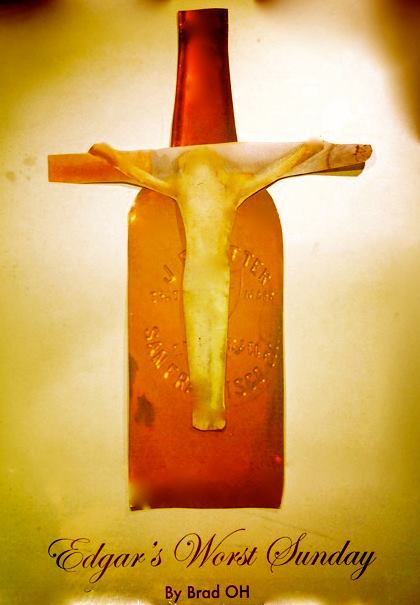
cropped-blogbanner1.jpgToday at Brad OH Inc., we are happy to present featured artist, Troy Barker. Troy has been very busy behind the scenes creating a good deal of cover art for Brad OH Inc., Including that for our upcoming novel, ‘Edgar’s Worst Sunday’.

Edgar's Worst Sunday Official Cover‘Edgar’s Worst Sunday’ is the story of Edgar Vincent, a semi-successful composer who’s always had one great passion—himself.

In life, Edgar Vincent had been something of a cad. Callous comments, thoughtless promiscuity, binge drinking, and excess sufficient to shame Caligula were standard Saturday night fare.

Sundays for Edgar had always been a painful haze of sickness and regret.

But when Edgar finds himself in the cloudy planes of the afterlife on one particularly bleak Sunday morning, he must put aside his ever-present hangover and try to figure out how he ever got to this point, and where he’s meant to be going now.

However, heaven also presents Edgar with an unending smorgasbord of hedonistic entertainment, so he’s in no particular hurry to change his self-serving outlook. After all, considering that he’s already dead, what could he stand to lose?

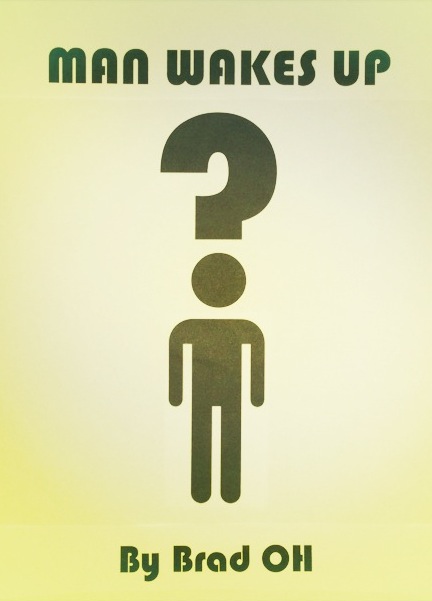
Troy is also the man responsible for the cover art of ‘Man Wakes Up’, a Brad OH Inc. novel currently on hold in lieu of other projects.

MWU Official CoverYou can read more about ‘Man Wakes Up’ and ‘Edgar’s Worst Sunday’ on our ‘Novels’ page.

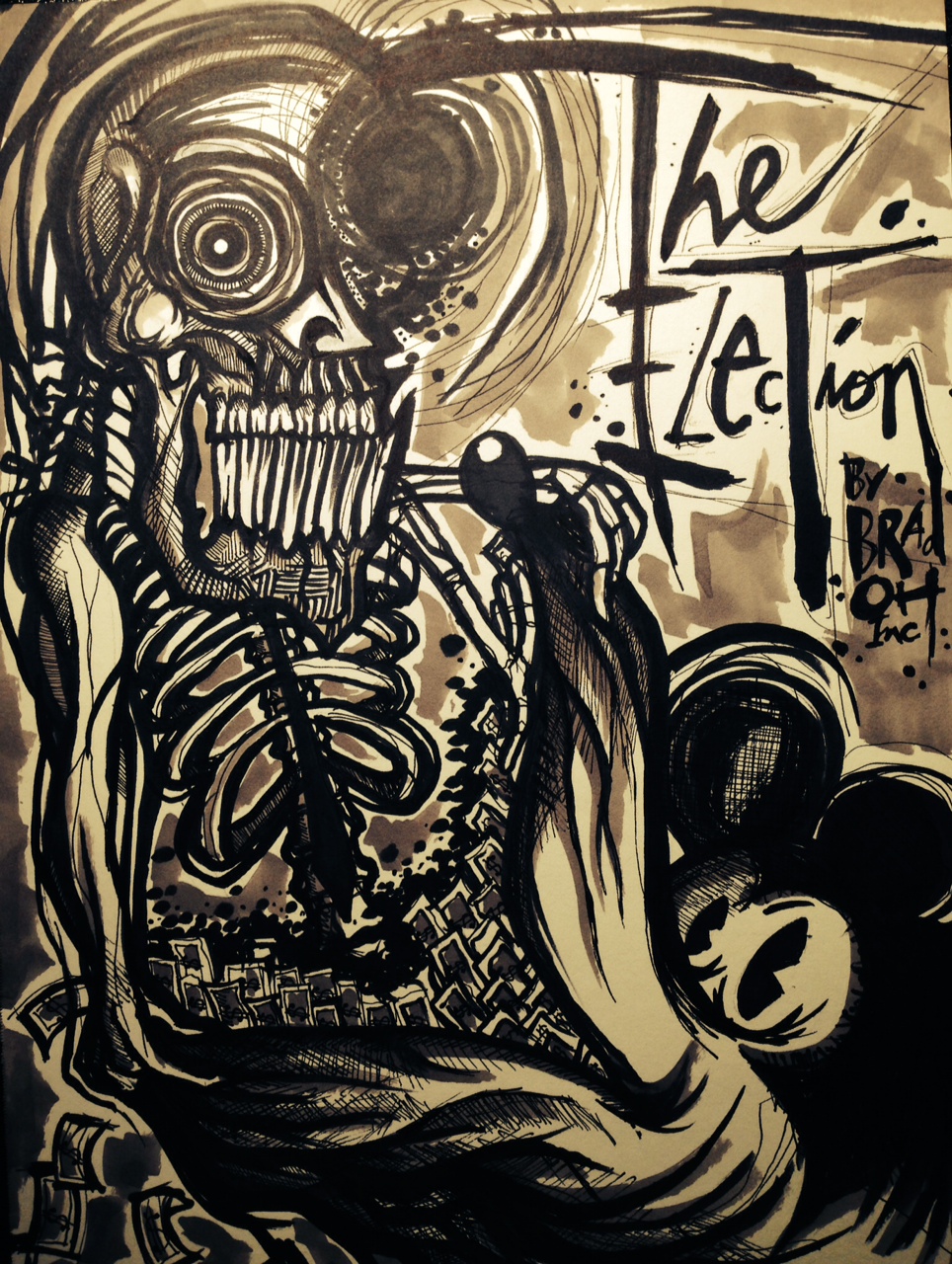
Finally, Troy is also the creator of the incredible cover art for ‘The Election’, an upcoming ‘Single Serving Story’ from Brad OH Inc. ‘The Election’ is the story of a cynical journalist covering the heinous events of the fourth annual United Corporate Election. This story is inspired by and dedicated to the late Dr. Hunter S. Thompson, and as such Troy was driven to do the cover in an amazing, Ralph Steadman based style.

theelectioncoverClearly, Troy is a considerable talent, and it’s our pleasure today to share him with you. Troy is available to do cover arts and various other commissions at negotiable prices, and can be contacted at Troy Barker. You’ll also find a sampling of other works by Troy on his page.

-Brad OH Inc.

The New Corporate Religion of Brad OH Inc.

cropped-blogbanner1.jpgHere at Brad OH Inc, we cherish the indelible right to Freedom of Religion for all people, and this is especially important when that person happens to be a Corporation. Corporations clearly have a right to religion, just as any citizen of this marvelous country must if we are to continue to earnestly support the timeless and indelibly pertinent values of our ancient forefathers.

But it’s important that we not be unreasonable with the application of such essential considerations. While there can be no coherent argument made against the notion that humongous, international monetary entities are entirely interchangeable with living, breathing individuals, certainly there must be some concession made in regards to how those rights are enforced.

While an individual person must be allowed the right to choose and practice their religion in their own way (so long as that practice does not affect any other person in a manner otherwise illegal…especially a Corporate one!), the Corporate right to Freedom of Religion must be exercised in a somewhat different manner. Specifically, if we are to respect the Religious Sovereignty of a Corporation such as ours, it is essential that the given Corporate Religion and its implied doctrines be extended to anyone working for or affected by (or even in distant contact with) said Corporation.

This may seem like a stretch, but the recent ruling by the Supreme Court of the U.S of A. confirms that these aspirations are entirely within our reach (Source). Call it a Brad OH’men!

Given this new precedent, we here at Brad OH Inc. feel it would be utterly obtuse of us—disrespectful to the constitution even—to not take full advantage of this god given right. Therefore, it is with careful consideration and great anticipation that we announce the new Corporate Religion of Brad OH Inc.

Now, the religions of old share a variety of key traits: a unified mythology, a concept of good and evil, a calling to a higher purpose, the promise of salvation. But to be honest, it’s pretty hard to deny these things are utterly boring, to say nothing of having been covered ad nauseum by other religions. So if that’s what you’re looking for, pick a church and take a seat, you’ll find plenty of stories there.

Here at Brad OH Inc., we are far more concerned with practicality, after all, pragmatism is one of the core tenets of Brad OH Inc.

Therefore, without further ado, we are pleased to present the 5 Central Commandments of the Corporate Religion of Brad OH Inc.:

  1. Thou Shalt Share: This one should be easy people. Sharing is nice, plain and simple. It’s so nice in fact, that we hold it to be sacrosanct. Therefore, henceforth, all patrons of Brad OH Inc. should consider themselves divinely mandated to share all content created here. To do otherwise would be a sin.
  1. Divine Duty of Discourse: If there is one key ingredient to any good society, it’s the free flow of public discourse. Don’t bother arguing—any contrary thought is wrong, plain and simple. To read an article here at Brad OH Inc. and fail to express yourself in the comments section is not only inconsiderate, henceforth it shall be considered an infringement on the Freedom of Religion of Brad OH Inc.
  1. Fundamental Freedom of Expression: We don’t think anyone can argue that the right to free expression is a fundamentally good concept. So good in fact, that we here at Brad OH Inc. consider it a moral imperative. That’s why we are so entirely dedicated to expounding erratically extreme philosophic tenets. Don’t believe us? Just check our banner! Therefore, if at any point you feel that some idea expressed on the site is contradictory to the nature of our Corporation, please remember that any such thought is a blatant violation of our religious right to free expression. If you have any further problem with it, kindly refer to Commandment #2.
  1. Functional Faithfulness and Loyalty: What can be said of any person who doesn’t hold dear the invaluable trait of loyalty? ‘False Hearted’, ‘Fly by Night’, ‘Insidious’, ‘Recreant’, ‘Craven’… and that’s just to name a few. Without loyalty, people just flit around all willy-nilly, doing what they will and going where they please. It’s certainly no way to run an empire. Therefore, Brad OH Inc. considers loyalty to be one of the most essential values a Corporation could ever hope for in a religion. So don’t forget about us, or you can expect a civil-suit for violation of our right to Freedom of Religion.
  1. Sacramental Self-Determination: Beyond the shadow of a doubt, self-determination is one of the most important traits any Corporation can have. After all, if left to the vile volitions of the common people, we’d be out there paying taxes, showing restraint in our environmental impact, and feigning sympathy for issues of social justice. Clearly, that’s no way to operate. So if at any point you find that the hearts and minds of us here at Brad OH Inc. have shifted, or that we’ve decided to go in a direction that doesn’t suit your selfish personal agenda, please remind yourself that we are simply following our Constitutionally Protected right to Freedom of Religion.

There you have it, the 5 Central Commandments of the Corporate Religion of Brad OH Inc. It is with a great sense of relief that we are able to share this with you today, and we know that you’ll surreptitiously revel in our joy as we celebrate our devotion to Freedom of Religion. After all, if a Corporation can’t profit off the liberties of the people who populate them, then what’s the point?

Your Sincere Friends and Mentors of Freedom,

-Brad OH Inc.

The Religious Rights of Corporate America

purelyspeculation

Here at Brad OH Inc., we are firmly and indelibly entrenched in the minutiae of Corporate politics; or at least that’s what they’d have you believe. Given recent developments therefore, it would seem natural that we address the issue of Corporate Religion.

Recently, The U.S. Supreme Court ruled that employers may opt out of the Affordable Health Care Act’s (AHCA) provision of comprehensive birth control coverage based on grounds of religious freedom. The decision came as a result of the Supreme Court’s claim that ‘American families do not give up their constitutional right to religious freedom just because they open a family business.’ (Source)

The first point to clarify is that of Religious Freedom. Religious Freedom is an absolute necessity for any decent society, this I feel goes virtually without saying. The fundamental right to Religious Freedom is essential to allowing citizens of a diverse yet ultimately secular society to practice their faith in their own way without persecution.

Another core right in this society of ours is that to own and operate a business. In a society allegedly driven by free market enterprise and initiative, all citizens must have equal opportunity to join and function in the market place freely.

However, I believe that this issue represents a conflation of these two rights, and ultimately results in significant sacrifices to individual freedoms.

Religious freedom is fundamentally an individual right. Any citizen must be allowed to practice whatever faith they see fit, so long as in so doing they are not breaking any other laws, including bringing harm to other citizens.

However, the concept that a business too has the ability to practice religion is a deeply flawed notion, and serves moreover to allow the imposition of one person’s faith onto another; namely, that of the employer onto the employee.

In this particular case, businesses such as Hobby Lobby and Conestoga Wood Specialties are being given explicit permission to deny to their employees important health care provisions as a result of the owner’s religion. This strikes me not as an example of religious freedom being protected for the owners of these businesses, but rather an example of their religious values being legally imposed on their employees, much to their detriment.

Let’s examine the initial quote. The court claimed, as noted above, that ‘American families do not give up their constitutional right to religious freedom just because they open a family business’. I believe this to be true beyond debate. No law could or should be passed requiring business owners in America to have abortions, or eat pork, or to do anything else which violates their personal liberties. However, that’s not what’s happening here.

Rather, the ruling dictates that anyone working for them must conform to their particular religious beliefs—if you work for hobby lobby, your right to have contraceptives and other forms of birth control covered by the AHCA are forfeit. The natural extension would be for these businesses to say that no employee will be allowed to eat pork in their private lives. An absurdity to be sure—but healthcare and family planning choices are certainly just as much an aspect of private life as are dietary decisions.

Now, the business owners would claim that making them pay for these provisions is a violation of their individual right to Religious Freedom—not so. While they are free to practice their religion in any way they choose (within the confines of the law), they must be expected to operate their business in a way that respects all given laws of the nation they operate in—and healthcare can be no exception. By ruling otherwise, the Supreme Court is disrespecting the right to Religious Freedom for all employees, while falsely claiming the moral victory of defending it for the owners.

Now, I would be remiss if I didn’t clarify one important aspect of the equation at this point. In a respectable move, Congress assures that women affected by this ruling will be subsidized by the government rather than their employers. While that is a commendable step by the government, it is still skirting the issue, and opens the door for myriad other violations of personal freedoms grounded under such trite and non-consequential claims as Religious Freedom.

This approach opens a veritable Pandora’s Box. Inevitably challenges to Corporate Religious Freedom such as do-not-resuscitate orders and vaccine coverage will ultimately be laid on the government as well; another example of Corporations bastardizing the legal structure of our society to save costs, and allowing the government to foot the bill.

It comes down to a key issue we’ve covered before here at Brad OH Inc., namely the concept of Corporations being treated as people. It’s a dangerous and foolhardy idea to be sure, and it leads invariably to socially damning decisions such as these. When a business or Corporation is viewed as being fundamentally equal to an individual human being, the rights of the individual will unequivocally be trampled underfoot. That’s what’s happened here, and that’s what will continue to happen until this absurd notion is dismissed as the mad miscarriage of social justice that it is.

-Brad OH Inc.

On Corporate Utility

cropped-blogbanner1.jpg

With all the radical ideas posted on this blog lately—and to be sure, we don’t mean ‘radical’ in the surfer sense—we here at Brad OH Inc. thought it necessary to provide to you, the dear customers of Brad OH Inc., with a quick statement of purpose.

At the heart of things, we’re a Utility Corporation… but not like that.

Corporations are often seen as cold, cruel, or callous conglomerations; caring little for their customers. This couldn’t be further from the truth!

In reality, we are utilitarian to the bone. Like Corporations everywhere, our goal here at Brad OH Inc. is to maximize customer satisfaction–because we care. We’ve come to find that the most effective way of maximizing net customer satisfaction is by focussing our energies entirely on increasing the total number of customers. We market simply to sell, and thus serve to increase the greater good… of our customers.

Because the customer is clearly such an integral factor in the success of Brad OH Inc., we feel it’s important to acknowledge this resource. We know that we’re part of a vibrant and functioning community—one from which we both reap benefits, and are obliged to provide great returns as well.

That’s why we feel it’s so very important to provide a regular stream of content—varied in all ways, to appeal to the greatest user base possible. Sometimes, you may come across an article you don’t agree with, or even one that offends you deeply. Don’t worry, that’s all part of the plan. Before you lament the callous ideals of this ‘heartless Corporation’, remember that one simply concept—utility.

It is the very process of providing the world with inconsistent messages and contradictory values that enables us to reach so very many people. Just think of it: if we were to focus on one single idea, we would only be effective in reaching people who support that idea, and the fan base of Brad OH Inc. would stagnate. Nobody wants that—least of all our shareholders!

Only by opening ourselves up to all avenues of thought can we truly capture the full market potential.

So before complaining about something you read, remember that although it may not be your cup of tea, there is surely some demented ideologue out there that supports it with all their heart. Clearly, that’s the sub-sect of the market we were going for that day, so kindly set aside your conceited self-interest.

At Brad OH Inc., we firmly believe that only through free ideas and open dialogue can we improve upon the foundations of our shared society. And only by ensuring that we cover all possible avenues of interest can we guarantee that the Brad OH Inc. fan base is everything it could possibly be. So don’t worry if something spits in the face of your deepest held moral convictions, just turn your other cheek and remind yourself that at the end of the day, we do it for you—the customer.

…Because we care.

Yours Sincerely,

Brad OH Inc.

On the Concept of Society

purelyspeculation

I often hear it said that society is in rough shape. Loss of public faith in government, failing standards of education, a quickly vanishing middle class…it can hardly be denied that times are turbulent.

Of course, there are two sides to every coin, and for everyone bemoaning the ever increasing corporate dominion over society, there are others waving the flags of liberty and personal responsibility—claiming those who do without have only themselves to blame. They’ll tell you that the soaring corporate profit margins are a true testament to the success of the free market and inevitable payoff of personal initiative. The rest? Just rabble-rousers—lazy people clamoring for more than they deserve.

It’s a complex issue, to be sure. It seems that everyone agrees there are problems with modern society, but no one can quite agree on what those problems are. As for myself, I don’t recall ever hearing it said that the true wealth of a nation is measured in corporate dividends—but that’s just me.

To focus the issue, I’ve always been of the point of view that the first step in a debate—the only step if meaningful progress is to be made—is to define our terms.

A society, in simplest terms, is a collection of people. This collection may be organized in a number of ways, based on such grounds as spiritual belief, cultural, political, or scientific concerns.

This doesn’t help a lot, but it gives us a good place to start. At the least, we know what a society is made of: People. Now, what exactly is a person?

Notwithstanding the clear albeit dubious exception of ‘Corporate Personhood’ (Source), there is a clear and undeniable case to be made that humans, at the root of it, are nothing more than animals.

A single person, at any rate, cannot be anything more than a shuffling, confused and naked creature without dependence on his peers. Unless a man (or woman) can be dropped naked and alone into a natural environment and survive, he cannot claim to be wholly independent. This at least is beyond refute.

In order for humanity to achieve anything beyond the most base of animal lives, there is a clear need for people to work together, to build on the knowledge of previous generations and combine their efforts into a greater whole; a society.

Consider it in terms of the basic things we own and take for granted. What would it take for a single, unsupported human being to make themselves even the simplest of modern homes?

Well, they would at any rate need to chop down a significant number of trees—a gargantuan task, considering they would have only the biggest, sharpest rocks they could find to accomplish the task. The metal in the house? Good luck mining for that.

For a more practical example, refer to this interesting site breaking down the international efforts in the creation of a single I-Pod: (Link).

The important take-away here is that everything we benefit from as a society is the direct result of that society itself; the cumulative effort of countless people over thousands of years, slowly building towards the smorgasbord of goods we all benefit from today. There’s no question—people need each other.

The reverse is true as well of course; a society needs its people.

Because humanity as a whole is an organism which must work together perforce, it is certainly unreasonable to exclude some, or design any society to favor some while excluding others. If this is done, then we cannot blame the lone, cast aside people who lash out and act in animal-like ways. For by facilitating their isolation, we have ourselves reduced them to this state.

If we wish to avoid this unpleasant turn of events, then society must be designed in a way to include all people in meaningful relationships and allow them to engage in mutual, non-zero sum exchanges (Link).

And yet this is where we find ourselves; in a world where the pay-cheques of the few are inherently valued over the welfare, even the basic human rights, of the many.

This unfortunate situation is illustrated at the moment nowhere as clearly as in Detroit, where the bankruptcy of the city by ineffective governance has led to the potential cut-off of public water supplies for upwards of 150,000 people (Source).

It’s convenient to claim these people should simply pay their bills if they want water, but the situation is far more nuanced than all that. The poverty of the people is the partial result of a litany of complex changes in the city, including the moving of former jobs out of the country—an effort by corporations to take advantage of lower overseas pay grades and increase their own profits, leaving countless formerly contributing citizens out of work.

The issue is further muddled by the consideration of society outlined above: the owners of the water companies certainly did not build their facilities alone, nor do they have any defensible rights to the natural and public sources of water that are the Great Lakes.

The pumps, purification plants, and pipelines are the results of the cumulative efforts of countless generations of people—many of whom are now being denied access to that very water.

Human beings which are naturally and inevitably a part of a society are now being excluded, or pressured to buy their way in. In a situation such as this, it is natural and even ethically justified for these isolated people to take in any way possible that which they have been denied.

And this is happening, sort of. All over the city, groups such as the ‘Detroit Water Brigade’ are working collectively to defend (and at times actively protect) their communal rights to safe drinking water in spite of the protests of officials.

Stockpiling of water, collection of rainwater, distribution hubs and countless other methods of support are being offered to the maligned citizens of Detroit as people pull together to survive these austere times.

Of course, this trend isn’t limited to Detroit. All over the world, we are seeing an increase in social movements as people come together to subvert the actions of corporate plutocrats, slowly raising awareness while taking direct action to protect their basic human rights.

This brings us back around to our initial quandary—the one about society. Society is by definition a series of interconnections and mutual help. It is imperative therefore that society fight to maintain individual liberties regarding independence, while also learning to consider itself as a whole. It must gain a form of self-awareness if it is to survive, just as men once did in ancestral times.

And we are seeing this. The Detroit Water Brigade, Occupy Wall Street, Occupy Sandy, and myriad community gardening programs are just some examples of the valiant efforts which are ongoing. With all these examples in evidence, maybe society is not in such bad shape after all. It seems to thrive in fact, in defiance of a corporate state which would endeavour to suppress it.

In the end, it may be the corporate idealists who are left out. But it’s assuring to know that society in its truest sense is doing just fine… You’ve just got to know where to look for it.

Note: As part of the society discussed in today’s article, it’s important to help out in any way you’re able. To help in Detroit, visit the homepage of the Detroit Water Brigade: http://detroitwaterbrigade.org/

-Brad OH Inc.
The Misled Goal of Job Creation

purelyspeculation

In this troublesome economic climate, people often wonder what can be done to keep the majority of citizens gainfully employed. The most common solution bandied about is the creation of jobs, but I’m not convinced this is the correct answer. As a matter of fact, I’m not even convinced it’s the right question.

Creating jobs is an unsavory and archaic notion for any true politician of the people. The implication buried within the notion of job creation is that there is a scarcity of work, and therefore an abundance of people struggling to get by—desperate for any job that might put even a few extra dollars in their painfully neglected wallets.

This shift towards job shortage is not a new trend; there have been myriad elements contributing to job reduction for centuries. From assembly lines to industrialization, technological changes in society have always had a significant impact on the need for labour. On the other front, remaining jobs are continually outsourced to countries unable to protect the rights of their workers, allowing corporate profits to skyrocket while jobs previously available to our citizens are doled out to foreign workers for a pittance of pay.

With the impending shifts inherent to burgeoning fields like 3D-Printing and nanotechnology, the number of jobs is only poised to shrink even further, leaving more and more people out of work and desperate for money.

In this scenario, we must view labour as a societal need and resource both. Living wages however, must be taken as a right. Thus, there exists a clear need to balance the two intelligently.

The creation of low-paying jobs, capable of keeping people occupied while failing to supply a living wage is a deeply flawed solution. The notion that one must toil in obscure and needless positions just to get by is counter-intuitive in a society poised to benefit unilaterally from our continued advancement.

Make no mistake about it; the high functioning state of societies output at present is due to the cumulative effect of human progress, not the ingenuity of a few thousand people at present. The corporate executives currently pulling the strings have benefited from being in the right place at the right time just as much as business savvy or vision.

Still, history has shown us that the trend is to consider ‘job creation’ an invaluable resource mercifully allotted by these high level executives. This perspective is entirely wrong—the resources we must now be focusing on, finally, are our human ones.

So if job creation isn’t the answer, what is? Well, once again, we must consider if we’re asking the right question. The initial quandary was how to keep the majority of citizens gainfully employed—but I don’t think this is the right goal.

If we as a society have reached a point where we don’t have a need for everyone to be working, then forcing it is illogical and unnecessary.

With profits booming, and CEO’s taking home ever-increasing bonuses, perhaps the solution instead is to ensure that every available job is sufficient for a person to support themselves and their family.

It’s not a difficult idea, but the implications are further reaching than may be apparent.

A significant increase to minimum wage would allow for more stay-at-home parents—an investment in our future the worth of which is beyond measure. Further, with increased pay, the working class would have significantly more money to pump into the economy, which would only benefit the businesses.

Therefore, the result of increased wages would be two-fold. First, the number of jobs necessary to keep society fed would be decreased by as much as half, while the function of society (Raising healthy, well-adjusted children to carry it on) would be served all the better. Secondly, the economy itself would boom with the injection of blue-collar spending dollars, creating more robust business opportunities.

Now, I can already hear the incensed chattering of right-wing loons and business moguls, decrying how this would slice into their profit margin and collapse the free market.

While the economy has struggled and stagnated for the majority, corporate profits have been doing just fine, and high level executives continue to line their pockets with the fat of the land (Source).

The concept of protecting profits is a misnomer, and while these executives would like you to believe that increasing minimum wage would castrate their ability to function as a business entity, in truth the only thing being hurt would be the paycheques of the top 1%–a notion I am entirely comfortable with.

So there we have it. Rather than the ubiquitously heralded goal of creating jobs, the real solution may be to fix wages. By doing so, we could again create a society where kids have parents to come home to, where people aren’t forced to work 60 hours weeks just to rent a basement flat, and where the greed of the few does not necessitate the squalor of the many.

It’s really not such a bad idea, if you think about it.

-Brad OH Inc.

‘Of Pipers and Pigs’

Here at Brad OH Inc., we often sit and watch the happenings around the world, and we must admit—it’s all pretty confusing. Whether you’re a common-place reader, or the head of a successful corporation, the political climate of our current age is not an easy thing to navigate.
The story we have for you today, ‘Of Pipers and Pigs’, tells of an individual dealing with just such uncertainties. It’s about a man watching big things happening, while simultaneously questioning his own role in the events. After all, it’s an important thing for everyone to consider their role in the world, and what they can best do to improve things.
With that acknowledged, we here at Brad OH Inc. wholeheartedly encourage you to do your best to improve our world by downloading this newest free story! We hope you enjoy it.
As always, thanks for reading, and we here at Brad OH Inc. wish to remind you that while passion is good for poets, what we seek is power. Brad OH Inc. loves all our fans, and we sincerely hope that when the fight for corporate suffrage comes—you’ll remember your love for us.

Of Pipers and Pigs CoverOf Pipers and Pigs- Smashwords

-Brad OH Inc.